Charging an Electric Car at Home in the UK: The Complete Guide
Everything you need to know about home EV charging, from wallboxes to tariffs, installation to solar
Quick answers
- Home charging is the reason most electric car owners say they would never go back to petrol. You plug in when you get home, you wake up to a full battery, and you never queue at a forecourt again.
- How does home EV charging work: Your electric car has an on-board charger that converts alternating current (AC) from the mains into the direct current (DC) that the battery stores.
- What does home EV charging cost: At the standard Ofgem variable rate of 24.67p per kWh (Q2 2026), a full charge of a typical 60kWh battery costs around £14.80.
- How long does home charging take: Charging time depends on two things: your charger's output and your car's on-board AC charging limit.
- Do you actually need a home charger: If you drive 30 or more miles a week, a wallbox makes economic and practical sense.
- What equipment do you need: The standard home EV charger in the UK is a 7kW single-phase unit.
Home charging is the reason most electric car owners say they would never go back to petrol. You plug in when you get home, you wake up to a full battery, and you never queue at a forecourt again. Done right, it costs a fraction of public charging and far less than filling a tank. This guide covers everything: how it works, what equipment you need, what it costs, and how to get the most from it.
How does home EV charging work?
Your electric car has an on-board charger that converts alternating current (AC) from the mains into the direct current (DC) that the battery stores. When you plug in at home, you are supplying AC power via a cable, and the car manages the rest.
The two ways to charge at home are:
- Standard three-pin plug (Mode 2): Uses a domestic 13A socket at around 2.3kW. Every EV comes with a granny cable for emergencies. It is slow and places sustained load on household wiring.
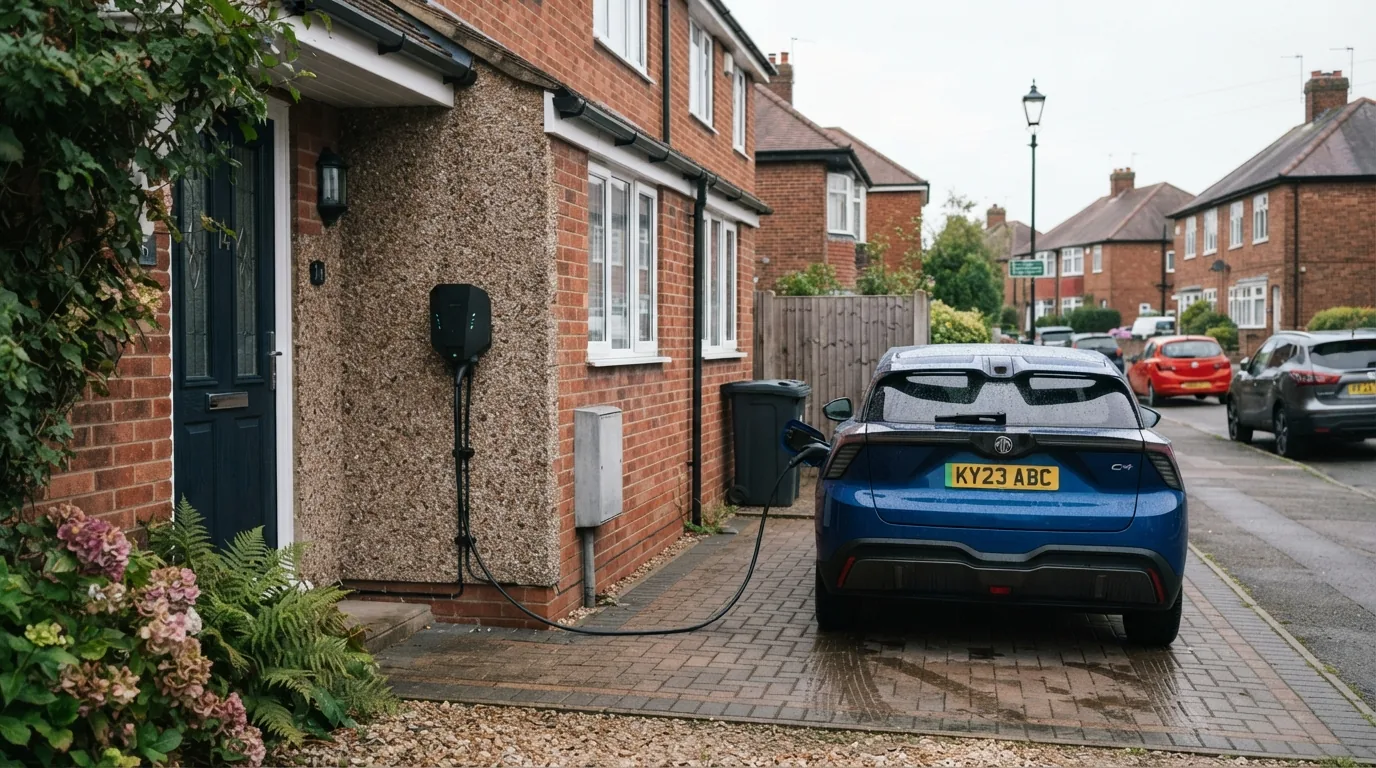
- Dedicated wallbox (Mode 3): A purpose-built 7kW or 7.4kW unit wired directly to your consumer unit. It is 8-10 times faster than a three-pin plug, safer, and qualifies for government support.
For daily home charging, a 7kW wallbox is the practical choice for almost every UK household.
What does home EV charging cost?
At the standard Ofgem variable rate of 24.67p per kWh (Q2 2026), a full charge of a typical 60kWh battery costs around £14.80. Switch to a dedicated EV tariff and that figure drops dramatically.
The best EV tariffs in 2026 offer overnight off-peak rates of 7.9p to 9.5p per kWh, reducing the same full charge to roughly £5 to £6. That equates to approximately 2-2.5p per mile, compared with 12-15p per mile in a petrol car.
A driver covering 9,000 miles a year on an off-peak EV tariff will typically spend £250-£350 annually on home electricity, versus £1,300-£1,500 on petrol. Over 12 months, a switch to Intelligent Octopus Go alone is worth around £770 in energy savings compared with the standard variable rate.
Full cost breakdown and calculator: How much does it cost to charge an EV at home?
How long does home charging take?
Charging time depends on two things: your charger’s output and your car’s on-board AC charging limit.
| Battery size | 2.3kW (3-pin) | 7kW wallbox | 11kW wallbox |
|---|---|---|---|
| 40kWh (e.g. Nissan Leaf) | 17 hrs | 6 hrs | 4 hrs |
| 60kWh (e.g. VW ID.3) | 26 hrs | 9 hrs | 6 hrs |
| 75kWh (e.g. Tesla Model 3) | 33 hrs | 11 hrs | 7 hrs |
| 100kWh (e.g. Mercedes EQS) | 43 hrs | 14 hrs | 10 hrs |
In practice, you rarely charge from empty to full. Most drivers top up 20-30% each evening, which takes 2-3 hours on a 7kW wallbox. The overnight window on an EV tariff runs for five to six hours, which is more than enough for any daily commute.
Detailed charge time guide: How long does it take to charge an electric car at home?
Do you actually need a home charger?
Technically, no. Your car came with a granny cable that plugs into any 13A socket. In practice, a dedicated wallbox pays for itself in convenience and, in most cases, cost.
If you drive 30 or more miles a week, a wallbox makes economic and practical sense. A 3-pin plug at 2.3kW takes over 24 hours to charge a typical 60kWh battery from empty, and sustained high-draw use on household sockets carries a fire risk over time. Major manufacturers including Tesla, Volkswagen, and Nissan recommend against regular 3-pin charging.
Full explainer: Do you need a home charger for your electric car?
What equipment do you need?
The wallbox
The standard home EV charger in the UK is a 7kW single-phase unit. Almost all UK homes have a single-phase supply, which caps AC charging at 7kW. Three-phase supplies (needed for 22kW charging) are found in commercial premises and some larger detached homes, but the cost of upgrading a domestic supply runs to thousands of pounds, and most EVs cap their on-board AC charger at 7kW or 11kW anyway.
The main decision is tethered (cable fixed to the unit) versus untethered (socket only, you supply the cable).
| Feature | Tethered | Untethered |
|---|---|---|
| Convenience | Grab and plug | Fetch cable each time |
| Cable theft | Lower risk | Cable can be removed |
| Future-proofing | Locked to one connector | Swap cable if car changes |
| Typical price premium | £100-£200 more | Cheaper upfront |
| Best for | One car, daily routine | Multiple cars or flexibility |
Tethered vs untethered: which should you choose?
Smart chargers
From June 2022, all new home EV chargers sold in the UK must be smart chargers, capable of scheduling and off-peak charging. A smart charger connects to your home Wi-Fi and, via an app, schedules charging to run during off-peak hours. The better ones integrate directly with Octopus Energy, OVO, and EDF to pull live tariff data and charge at the cheapest moment automatically.
Smart charging explained: How it cuts your bills
What does installation involve?
A standard 7kW wallbox installation takes two to four hours and must be carried out by a certified electrician registered with a competent person scheme such as NICEIC, NAPIT, or ELECSA. This is Part P notifiable electrical work, and DIY installation is not legally recognised.
The installer runs a dedicated 32A circuit from your consumer unit to the charger position, protected by an RCBO. If your consumer unit is old or already full, you may need an upgrade. Your Distribution Network Operator (DNO) must also be notified.
Total installed cost in 2026 typically runs from £800 to £1,200, including hardware and labour.
Government support
The OZEV EV Chargepoint Grant covers up to £500 (75% of the cost) for eligible renters, flat owners, and landlords. The grant for homeowners with a private driveway closed in April 2022. The OZEV grant increased to £500 from 1 April 2026 and runs until March 2027.
Do you need planning permission to install a home charger?
Do you need planning permission?
In most cases, no. Home EV chargers fall under permitted development rights, provided the unit does not exceed 0.2 cubic metres (wall-mounted) or 2.3 metres in height (freestanding), and is not on a wall facing a classified road. Listed buildings and conservation areas may have additional restrictions. Your installer should advise.
What if you do not have a driveway?
Options exist, though they are more complicated. Cross-pavement cable channels (gullies embedded in the footway) are being rolled out by councils across England, Wales, and Scotland: by the end of 2026, around 42% of councils plan to offer this. The OZEV grant also covers approved cross-pavement solutions, up to £500.
Flat owners and renters with dedicated off-street parking can apply for the OZEV grant with their landlord’s written consent. Shared residential car parks can access a separate EV Infrastructure Grant.
Full guide: Can you install an EV charger without a driveway?
Can you charge from solar panels?
Yes, and for solar panel owners it is one of the most cost-effective setups possible. A solar-aware charger uses a CT clamp to read your real-time generation and household consumption, then diverts surplus solar energy into your car rather than exporting it at the lower Smart Export Guarantee rate.
The Zappi from myenergi is the UK market leader for this. Ohme, Hypervolt, and Indra also offer solar integration modes. A 4kWp solar array generates approximately 3,400kWh per year, enough to power 12,000-17,000 miles of driving.
How does solar EV charging work? | Best EV chargers for solar panel owners
When is the best time to charge?
On a smart EV tariff, the answer is handled for you. On Intelligent Octopus Go, charging is automatically scheduled for the cheapest overnight window (11:30pm to 5:30am at 8p/kWh). On other tariffs with a fixed overnight rate, you set a schedule in the app.
Overnight charging also tends to be lower-carbon: the UK grid carries a higher proportion of wind and nuclear power after midnight when industrial demand falls.
Best time to charge your EV at home
Pillar overview: everything in this charging guide
| Topic | Page |
|---|---|
| How much does it cost to charge at home? | Cost guide |
| How long does charging take? | Charge time explainer |
| Do you need a home charger? | Home charger explainer |
| Can you use a 3-pin plug? | 3-pin plug guide |
| Tethered vs untethered chargers | Tethered vs untethered |
| What size charger do you need? | 7kW vs 22kW guide |
| No driveway? Your options | No driveway guide |
| How smart charging cuts bills | Smart charging explainer |
| Best time to charge | Charging time guide |
| Planning permission rules | Permission guide |
| Solar panel EV charging | Solar charging guide |
| Can your wiring handle a charger? | Home wiring guide |
| Best home EV chargers | Best chargers |
| Best chargers for Octopus tariffs | Octopus-compatible chargers |
| Cheapest chargers under £600 | Budget charger guide |
| Best chargers for solar owners | Solar charger guide |
| Best untethered chargers | Untethered charger guide |
| Best EV charging tariffs | Tariff comparison |
| Best chargers with an app | App charger guide |
| EV charging for flats | Flats guide |
| Weatherproof outdoor chargers | Outdoor charger guide |
| How to choose an installer | Installer guide |
| Ohme vs Hypervolt | Head to head |
| Pod Point vs Wallbox | Head to head |
| Octopus Go vs Intelligent Go | Tariff head to head |
| EO Mini Pro vs Easee One | Head to head |
Where to start
If you have a driveway and your car is on order or already arrived, get three quotes from OZEV-approved installers and ask each one to confirm which charger model they plan to fit and why. Ask whether you need a consumer unit upgrade. At the same time, check whether your energy supplier has an EV tariff or whether switching to Octopus Intelligent Go would save you money. The tariff switch alone is typically worth more over three years than any difference between charger models.
The best home EV chargers guide ranks the leading models with UK prices, specs, and our honest verdict on each.
How we test and where our numbers come from
Range figures are official WLTP combined values taken from manufacturer UK specification pages, with real-world estimates drawn from independent comparative testing. Prices are UK list prices at the time of the latest update. Tax, grant and charging-scheme figures come from GOV.UK and HMRC publications. We re-check every guide when pricing, specification or policy changes. Last checked 11 August 2026.
Frequently asked questions
How does home EV charging work?
Your electric car has an on-board charger that converts alternating current (AC) from the mains into the direct current (DC) that the battery stores. When you plug in at home, you are supplying AC power via a cable, and the car manages the rest.
What does home EV charging cost?
At the standard Ofgem variable rate of 24.67p per kWh (Q2 2026), a full charge of a typical 60kWh battery costs around £14.80. Switch to a dedicated EV tariff and that figure drops dramatically.
How long does home charging take?
Charging time depends on two things: your charger's output and your car's on-board AC charging limit.
Do you actually need a home charger?
Technically, no. Your car came with a granny cable that plugs into any 13A socket.
What equipment do you need?
The standard home EV charger in the UK is a 7kW single-phase unit. Almost all UK homes have a single-phase supply, which caps AC charging at 7kW.

EV Compared
The EV Compared editorial team tracks the UK electric vehicle market full time: new model launches, list prices, WLTP and real-world range, public charging tariffs and the tax rules that decide what an EV actually costs to run. Every guide is checked against manufacturer specifications and official GOV.UK figures, and updated whenever the numbers move.
Related reading
View all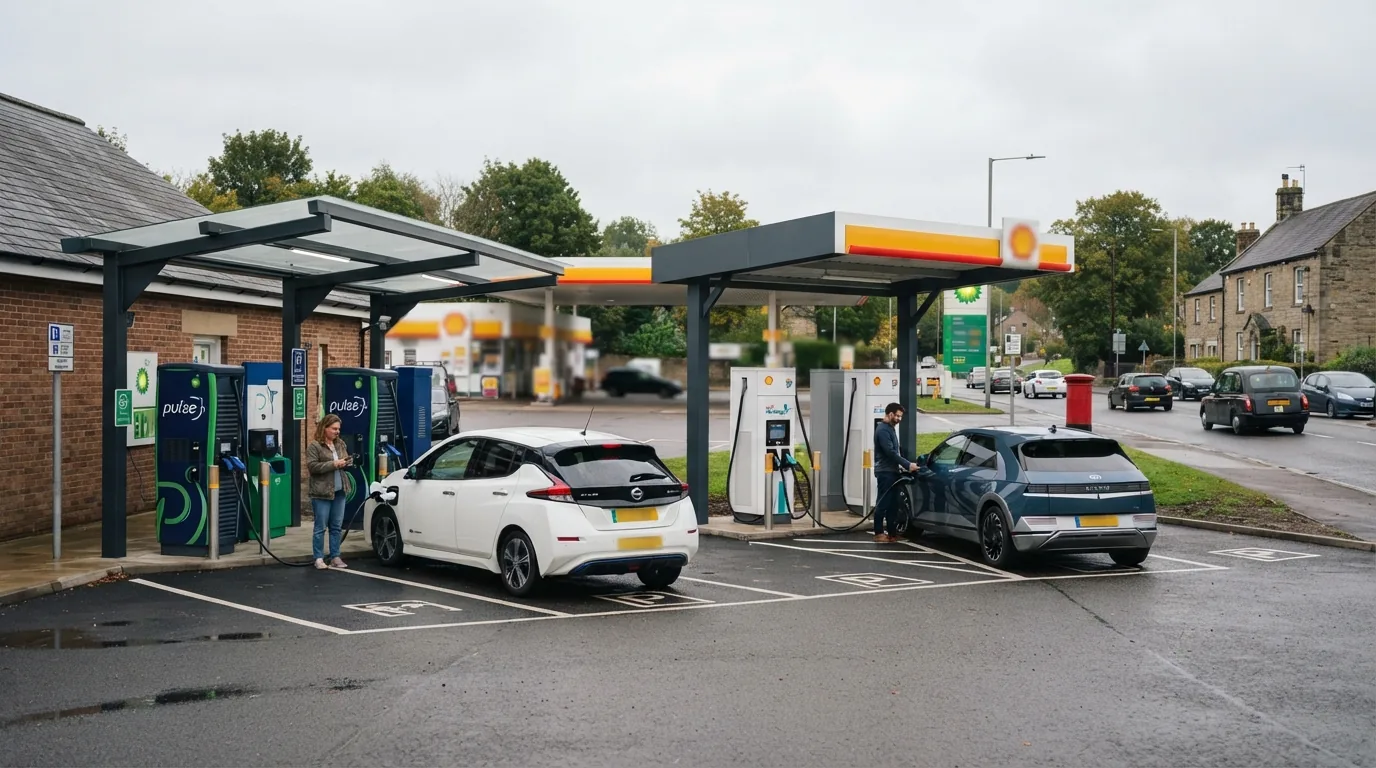
BP Pulse vs Shell Recharge: Which UK Network Wins?
Two of the UK's biggest charging networks compared on price, reliability and which type of driver each suits
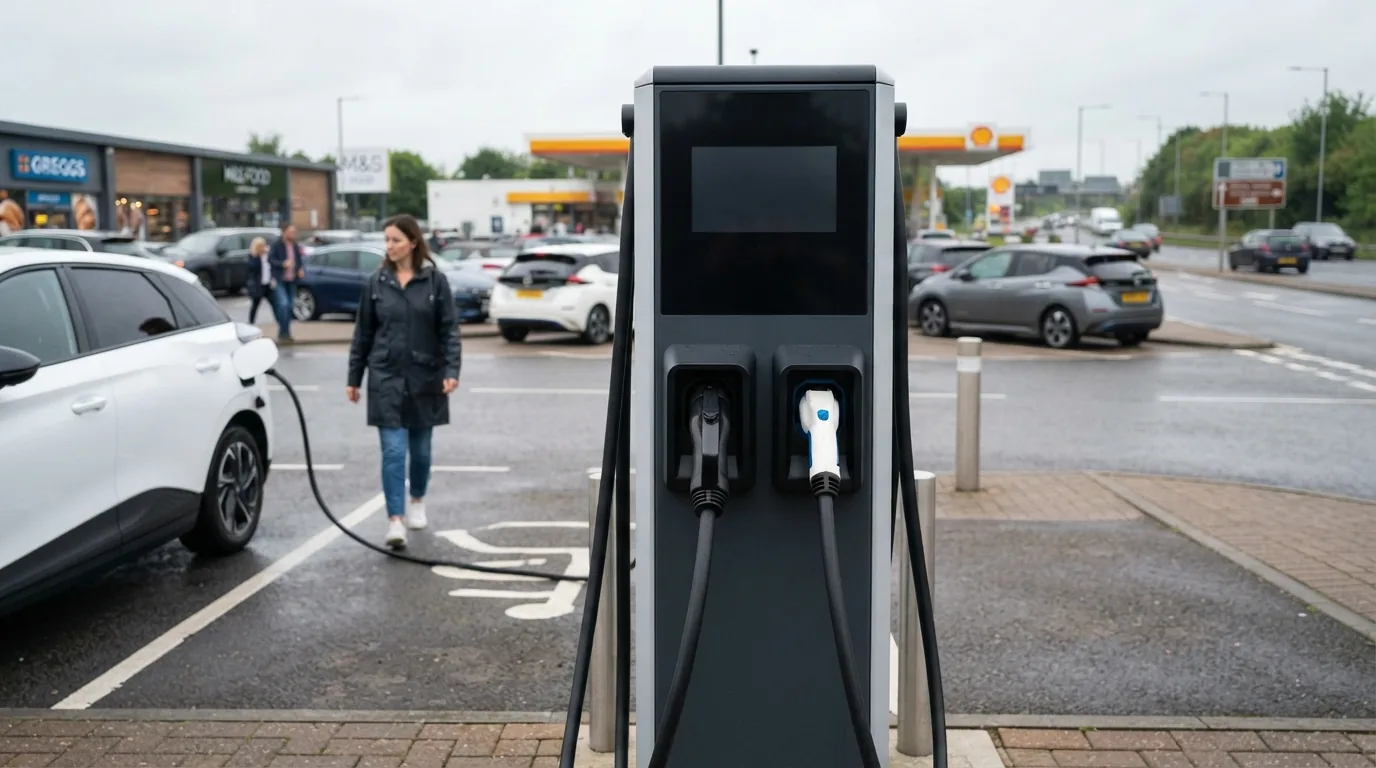
Can You Charge Any EV at Any Public Charger in the UK?
Why almost any new EV works at almost any UK public charger, and the two exceptions you need to know
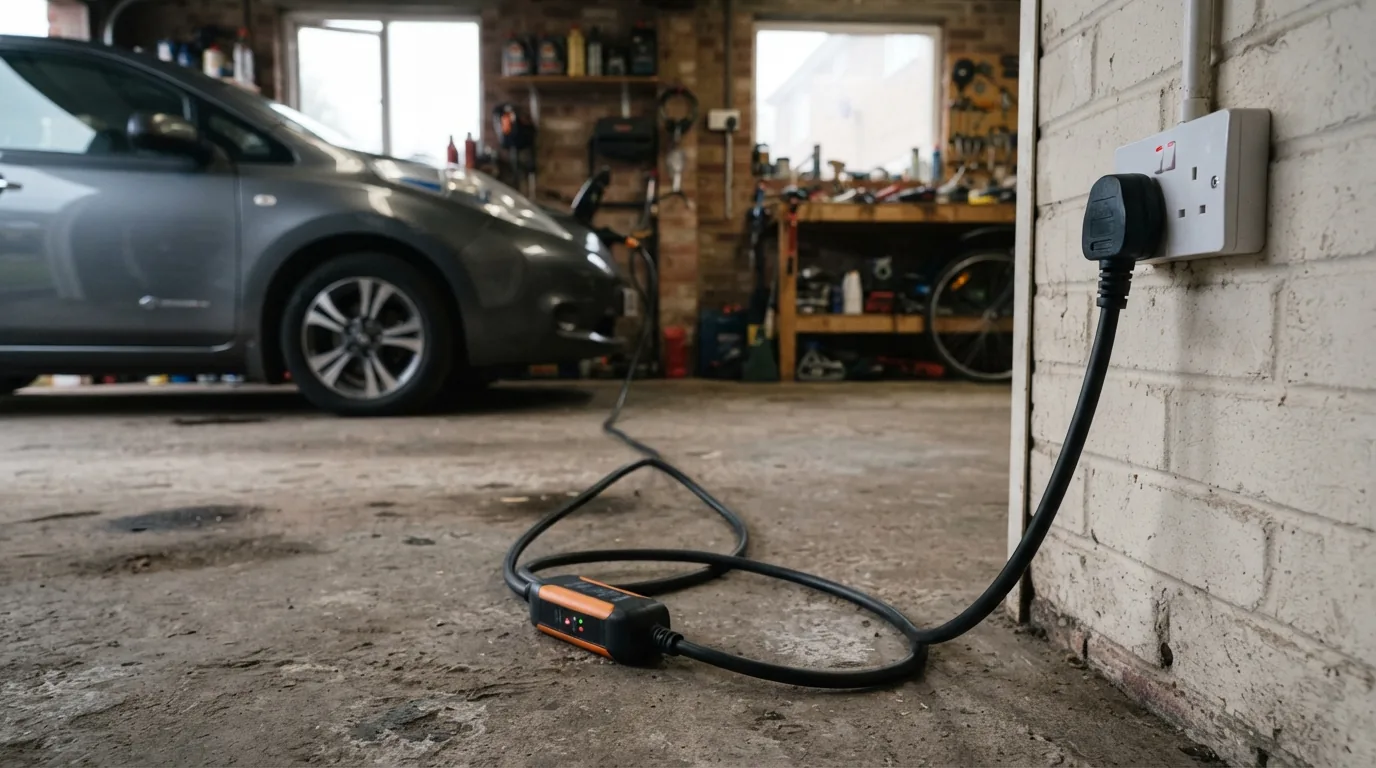
Can You Charge an EV From a Three-Pin Plug in the UK?
Yes, most cars ship with the cable, but speed and safety limits mean it works best for occasional or emergency use