Can You Charge an EV From a Three-Pin Plug in the UK?
Yes, most cars ship with the cable, but speed and safety limits mean it works best for occasional or emergency use
Quick answers
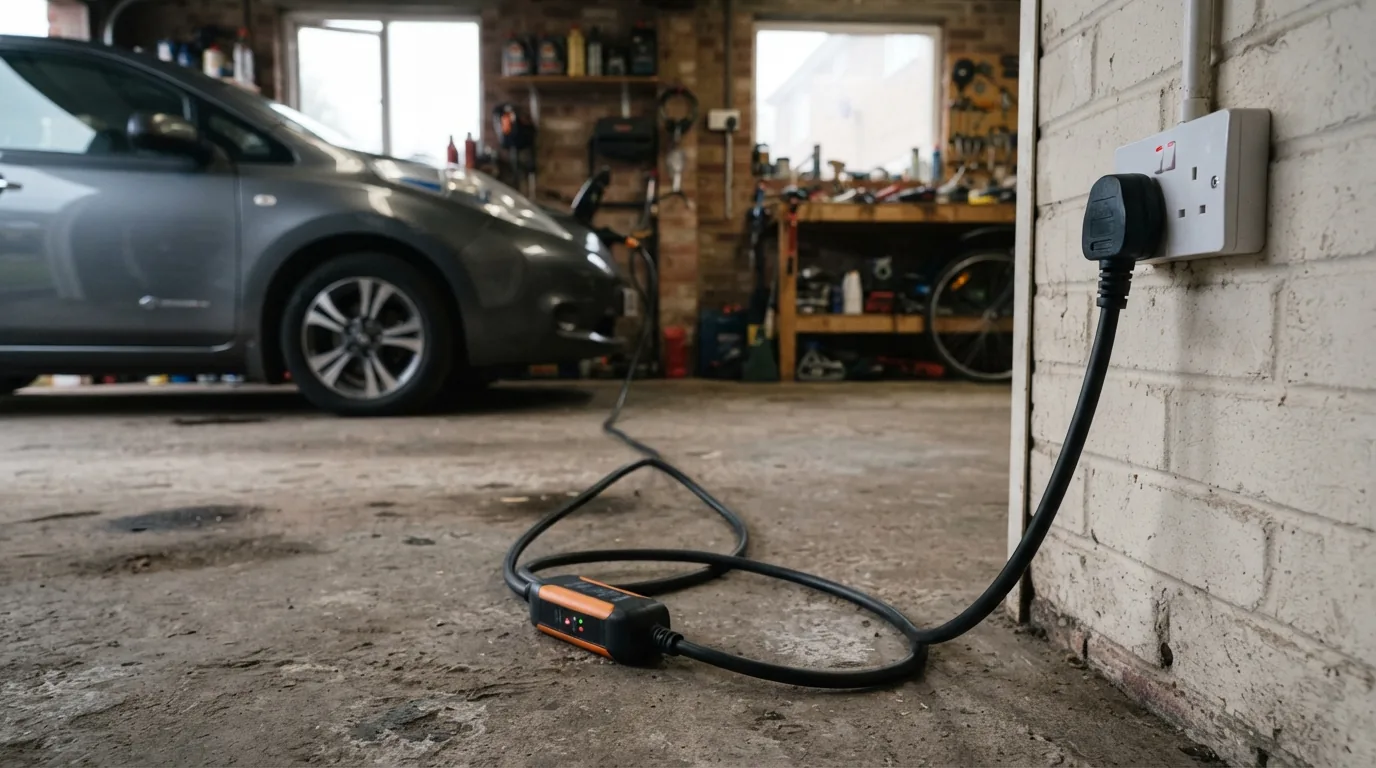
- Yes, you can charge an EV from a standard UK three-pin plug using a Mode 2 granny cable, and most cars include one as standard.
- Expect around 2.3kW and roughly 6-8 miles of range per hour; a 60kWh battery can take well over 24 hours from empty.
- It is safe for occasional or emergency use with a sound modern socket, but not designed for daily hours-long charging.
- Never use extension leads or adaptors; plug straight into the wall and check the socket for warmth during charging.
- A 7kW wallbox charges about three times faster and unlocks EV off-peak rates near 8p/kWh versus the standard rate of around 24.67p/kWh on the Ofgem price cap.
- The OZEV grant covers 75% of a wallbox install up to £500 per socket for renters, flat owners and on-street solutions, with the scheme running to 31 March 2027.
Yes, you can charge an EV from a standard UK three-pin plug. Most cars include a Mode 2 granny cable as standard, with a three-pin plug at one end and a Type 2 connector at the car end. It charges at around 2.3kW and adds roughly 6-8 miles of range per hour. That is fine for the odd overnight top-up, but a 7kW wallbox charges roughly three times faster and unlocks far cheaper off-peak electricity rates.
Most EV owners start out using the granny cable while waiting for a wallbox to be installed, which is perfectly reasonable. The problems begin when three-pin charging becomes the daily routine rather than the occasional backup.
Can you actually charge an EV from a normal three-pin plug?
The short answer is yes, with the right cable, and most cars already include one. A Mode 2 granny cable is a dedicated EV charging lead with an In-Cable Control Box (ICCB) that performs safety checks before allowing current to flow. It is not the same as plugging a lead straight into the car battery.
Manufacturers including Tesla, Volkswagen, Renault and Nissan supply a granny cable as standard with most models. A UK three-pin socket can supply up to 13A at 230V, but granny cables typically limit the draw to around 10A, which works out at about 2.3kW. Many cables let you step down further to 6A or 8A if you want to ease heat stress on an older or suspect socket.
If your car did not come with one, expect to pay roughly £120-£200 for a reputable replacement. The cable connects to your car’s standard Type 2 charge port, so there is no unusual hardware needed on the car side.
Secondary names you may see: granny charger, trickle charger, Mode 2 EVSE. They all refer to the same thing.
How long does it take to charge an EV on a three-pin plug?
Slow is the honest word. At 2.3kW, you are adding roughly 6-8 miles of range per hour, which means filling a typical battery from empty takes the better part of a day rather than overnight.
A 60kWh battery from empty takes well over 24 hours on a three-pin plug. Larger batteries, common in newer SUVs, can take more than two days. Compare that with a 7kW wallbox, which handles the same 60kWh charge in around 8-9 hours and is over three times faster overall.
The table below puts the numbers side by side using current 2026 figures.
| Measure | Three-pin plug (2.3kW) | 7kW home wallbox |
|---|---|---|
| Power output | ~2.3kW | 7kW |
| Range added per hour | ~6-8 miles | ~25-30 miles |
| Time to add 60kWh (approx) | ~26 hours | ~8.5 hours |
| Cost at price cap (24.67p/kWh) | ~£14.80 | ~£14.80 |
| Cost at EV off-peak (~8p/kWh) | usually unavailable* | ~£4.80 |
*Off-peak EV tariffs such as Intelligent Octopus Go generally require a compatible smart charger or a compatible car to schedule automatically. A basic three-pin setup typically stays on the standard rate. Both cost figures are approximate, based on 60kWh at the relevant unit rate.
The figures make the three-pin plug look fine on raw energy cost, and that is accurate: electricity costs the same per kWh regardless of how you put it in. The gap opens when you look at tariff access, which is covered in the section below.
How much does three-pin charging cost?
The electricity itself costs the same per kWh whether you use a granny cable or a wallbox. On the Ofgem price cap for April to June 2026, the average unit rate is 24.67p/kWh, so a full 60kWh charge costs approximately £14.80 either way.
The real cost difference is the tariff you can access. On Intelligent Octopus Go the off-peak rate runs at around 8p/kWh between 11:30pm and 5:30am (regional variation applies; some areas are below the 8p headline). At that rate the same 60kWh charge costs roughly £4.80, saving about £10 per charge compared with the standard rate. Over a year of regular home charging those savings add up to several hundred pounds.
The catch is that you generally need a smart wallbox to schedule charging automatically into the off-peak window. A three-pin plug keeps you locked on the standard rate. That is the real argument for upgrading to a dedicated unit: not raw speed alone, but the combined effect of faster charging and much cheaper electricity.
Is it safe to charge an EV from a three-pin plug?
For occasional or emergency use, with a modern sound socket and a good-quality cable plugged straight into the wall, yes. For daily hours-long charging on an older socket or a ring main circuit, the risks are real.
Domestic sockets are not built for continuous high-power draw. Sustained use can overheat the socket and wiring and, in the worst cases, cause fire. A standard socket running at 2.3kW for 20-plus hours is operating close to its maximum rated capacity for the entire duration, which is far outside normal domestic use.
The IET Wiring Regulations (Section 722) require dedicated circuits, RCD protection and PEN-fault protection for fixed EV chargepoints. A standard household socket lacks all three. Experts advise limiting continuous draw to around 10A on longer sessions and note that homes built before 2008 may lack RCD protection on older circuits.
Key safety rules:
- Plug directly into the wall socket, never into an extension lead or multi-socket adaptor
- If an outdoor socket is unavoidable, use only a fully unwound, outdoor-rated heavy-duty lead and never chain leads together
- Inspect the cable for signs of wear before each session
- Check the socket and plug for heat during charging; if either feels unusually warm, stop and investigate before continuing
- Use the cable supplied by your vehicle manufacturer or one from a reputable UK supplier, not cheap third-party adaptors from unverified sources
The conditions under which three-pin charging is genuinely fine: a modern socket in good condition, a short or infrequent session, a quality cable, and a plug straight into the wall.
Should you use a three-pin plug or get a home charger?
Three-pin charging is a reasonable choice in a handful of situations: an occasional overnight top-up, a low-mileage driver or PHEV owner who rarely needs a full charge, an emergency when public charging is not available, or the short window between taking delivery of a new EV and having a wallbox installed.
For regular daily charging of a full-battery EV, the three-pin route is not designed for the job. The three practical reasons to upgrade are: it is three times faster, it unlocks cheaper off-peak tariffs, and it removes the sustained load on domestic wiring.
The cost barrier to upgrading has also fallen. The OZEV EV chargepoint grant covers 75% of the installation cost up to £500 per socket for renters, flat owners, on-street cross-pavement solutions and landlords. The cap was raised from £350 to £500 from 1 April 2026, and the scheme runs until 31 March 2027. That brings the upfront cost of a typical wallbox installation down significantly.
If you charge at home more than once or twice a week, a 7kW unit pays for itself quickly through tariff savings alone. Our guide to the best home EV chargers compares the leading units on price, smart tariff support and installation, so you can see exactly what fits your situation.
If you charge regularly at home, a dedicated wallbox is cheaper to run, far faster, and backed by the OZEV grant. See the best home EV chargers to find the right unit for your property and car. For a broader look at all your home charging options, our charging at home guide covers everything from cable types to smart tariffs.
Useful Resources
GOV.UK - Electric vehicle chargepoint grants https://www.gov.uk/guidance/electric-vehicle-chargepoint-grants
Ofgem - Energy price cap Apr-Jun 2026 https://www.ofgem.gov.uk/news/changes-energy-price-cap-between-1-april-and-30-june-2026
Octopus Energy - Intelligent Octopus Go https://octopus.energy/smart/intelligent-octopus-go/
How we test and where our numbers come from
Range figures are official WLTP combined values taken from manufacturer UK specification pages, with real-world estimates drawn from independent comparative testing. Prices are UK list prices at the time of the latest update. Tax, grant and charging-scheme figures come from GOV.UK and HMRC publications. We re-check every guide when pricing, specification or policy changes. Last checked 11 August 2026.
Frequently asked questions
Is it safe to charge an electric car with a 3-pin plug?
Yes, for occasional or emergency use with a modern, sound socket and the cable plugged directly into the wall. It is not designed for daily hours-long charging, which can overheat the socket and wiring. Check the plug and socket for warmth during a session and stop if either feels hot.
How long does it take to charge an EV on a 3-pin plug?
At around 2.3kW you add roughly 6-8 miles of range per hour. A typical 60kWh battery can take well over 24 hours to fill from empty on a three-pin plug, compared with around 8-9 hours on a 7kW wallbox. It suits short overnight top-ups rather than regular full charges.
Do you need a special cable to charge an EV from a 3-pin plug?
Yes, you need a Mode 2 granny cable with a three-pin plug at one end and a Type 2 connector for the car. Most manufacturers include one; if yours did not, expect to pay roughly £120-£200 for a reputable replacement. Never improvise with a standard domestic extension lead.
Can you use an extension lead to charge an electric car?
No. You should plug the granny cable straight into the wall socket. Standard domestic extension leads and multi-socket adaptors can overheat under sustained EV load.
Is it cheaper to charge an EV at home with a wallbox than on a 3-pin plug?
The electricity costs the same per kWh either way. The saving comes from the tariff you can access. A wallbox lets you use EV off-peak rates near 8p/kWh (such as Intelligent Octopus Go), while a three-pin plug typically keeps you on the standard rate of around 24.67p/kWh on the Ofgem price cap.
Sources and further reading
- gov.ukGOV.UKPrimary source referenced in this article.

EV Compared
The EV Compared editorial team tracks the UK electric vehicle market full time: new model launches, list prices, WLTP and real-world range, public charging tariffs and the tax rules that decide what an EV actually costs to run. Every guide is checked against manufacturer specifications and official GOV.UK figures, and updated whenever the numbers move.
Related reading
View all
BP Pulse vs Shell Recharge: Which UK Network Wins?
Two of the UK's biggest charging networks compared on price, reliability and which type of driver each suits
Can You Charge Any EV at Any Public Charger in the UK?
Why almost any new EV works at almost any UK public charger, and the two exceptions you need to know
What Is Charge Point Etiquette in the UK?
The unwritten rules and legal realities of public EV charging, from ICEing to idle fees