Apple CarPlay vs Built In EV Software: Which Is Better?
Apple CarPlay is familiar and loved, but built-in EV software controls your battery, charging and range. We explain when each wins and which cars get the balance right.
Quick answers
- When you buy a petrol car and enable CarPlay, you get your iPhone's maps, music and messages on the dashboard. You lose very little by switching to it.
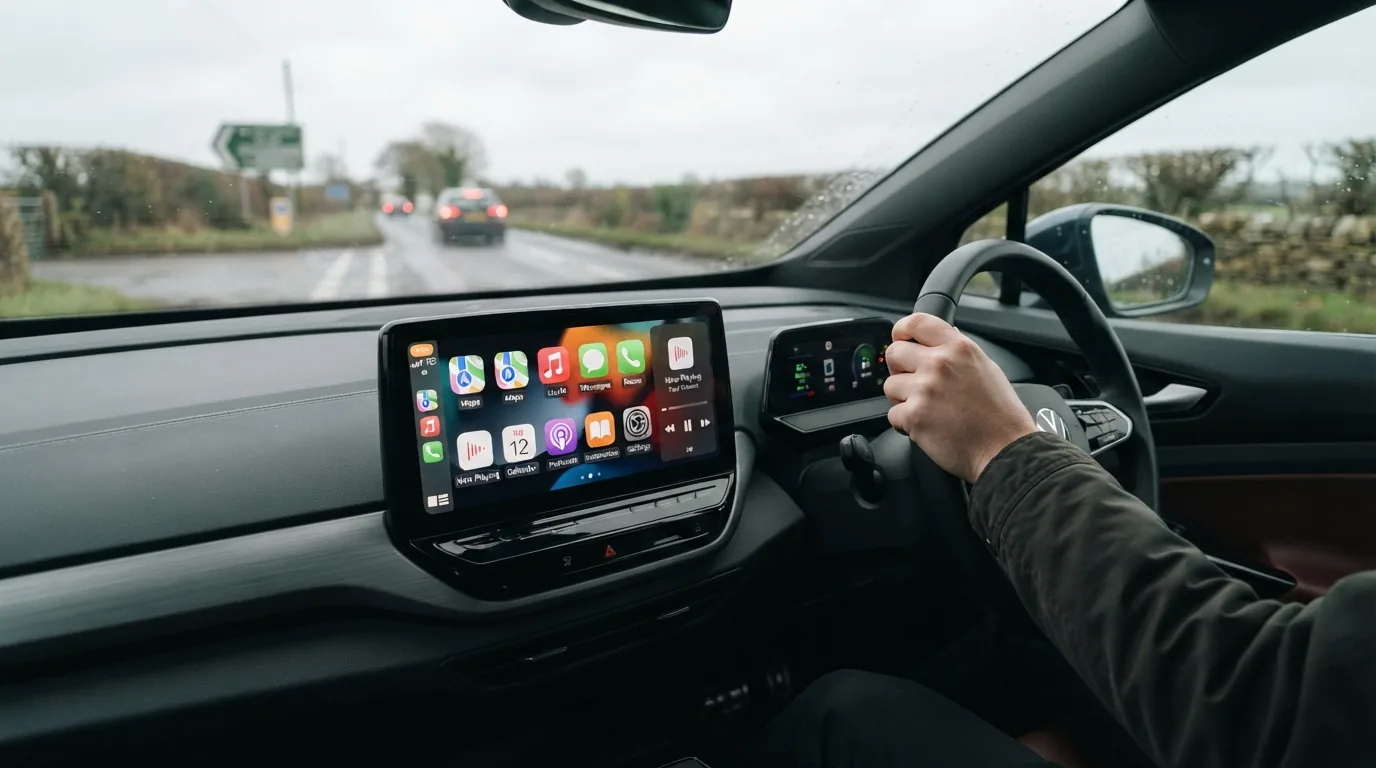
- What CarPlay can and cannot do in an EV: Apple CarPlay mirrors a subset of your iPhone's interface onto the car's screen.
- Apple Maps has improved significantly for EV drivers in recent years.
- The built-in system's advantages: Every EV manufacturer builds a proprietary infotainment system that has access to the car's full data layer.
- The problem with some built-in systems: When built-in software is poor, CarPlay is a significant improvement to daily life even if it lacks EV-specific features.
- Which cars get the balance right: The best outcome is a car with both excellent native EV software and full CarPlay/Android Auto support.
When you buy a petrol car and enable CarPlay, you get your iPhone’s maps, music and messages on the dashboard. You lose very little by switching to it. When you buy an electric car, the relationship with the built-in software is more complex. The car’s native system controls battery management, charge planning, preconditioning and energy displays that Apple CarPlay cannot replicate.
The direct answer: Apple CarPlay is better for everyday smartphone integration, familiar navigation and audio. Built-in EV software is better for battery management, charge planning and the specific capabilities that only the car’s own systems can deliver. The best electric cars in 2026 give you both without compromise.
What CarPlay can and cannot do in an EV
Apple CarPlay mirrors a subset of your iPhone’s interface onto the car’s screen. It is optimised for:
- Navigation (Apple Maps, Google Maps, Waze)
- Phone calls and messaging
- Music and podcast playback
- A growing library of CarPlay-compatible third-party apps
What CarPlay cannot do is access the car’s own data. It does not know your battery level (unless the car shares it via a specific API, which is rare and limited). It cannot precondition the battery. It cannot show you accurate range on a gradient-aware map. It cannot start or monitor a charging session on a public network.
In a petrol car, this limitation is irrelevant. In an electric car, these are genuinely important functions.
Apple Maps EV routing: better than you might think
Apple Maps has improved significantly for EV drivers in recent years. On supported vehicles, Apple Maps EV routing plans trips with charging stops, factors in battery level and charger availability, and can even trigger battery preconditioning before a charging stop on compatible cars (the 2026 Mustang Mach-E supports this via Apple Maps integration).
However, this works only when the car’s manufacturer has built the integration with Apple’s APIs. The compatibility varies significantly by vehicle, model year and even trim level. Not all CarPlay-supporting cars expose EV data to Apple Maps.
If you have a car where Apple Maps does not access your EV data, you lose the main advantage that EV-specific navigation provides. You get a generic route with no charging stop suggestions relevant to your battery level.
The built-in system’s advantages
Every EV manufacturer builds a proprietary infotainment system that has access to the car’s full data layer. This enables:
Battery preconditioning: The navigation system can tell the thermal management system to warm the battery before a rapid charging stop. This maximises charging speed from the moment you arrive.
Accurate range estimation: The car’s native system knows your current consumption rate, ambient temperature, gradient data and battery health. It can give a more accurate range estimate than any external application.
Charging network integration: Some systems integrate directly with specific charging networks, allowing you to start, monitor and pay for sessions from the dashboard.
Energy consumption displays: The breakdown of how energy is being used (climate control, drivetrain, accessories) is only available through the car’s own systems.
The problem with some built-in systems
Built-in EV software is not universally good. The worst examples have:
- Slow, unresponsive touchscreens
- Maps that load slowly and have poor search
- Voice assistants that misunderstand requests frequently
- No over-the-air updates, leaving outdated software baked into the car indefinitely
When built-in software is poor, CarPlay is a significant improvement to daily life even if it lacks EV-specific features. The question for each car is whether its native system is good enough to justify spending time in it.
Which cars get the balance right?
The best outcome is a car with both excellent native EV software and full CarPlay/Android Auto support. These are the models that manage it well in 2026:
Hyundai Ioniq 6 / Kia EV6: The ccNC system is good, includes solid EV-specific functions, and supports wireless CarPlay and Android Auto. You get both, without meaningful compromise.
BMW i5 / iX: iDrive 9 is a high-quality native system with good EV routing, and wireless CarPlay is supported. The integration is the smoothest of any German premium brand.
Renault 5 E-Tech: The Google-native OpenR Link system is arguably the best of all approaches: Google Maps and Google services are built natively (not mirrored), so you get familiarity with full EV data integration. Wireless CarPlay is also supported.
Volkswagen ID.3 / ID.4 / ID.7: Volkswagen’s MIB3 system is competent and CarPlay is supported, though not wirelessly on all models. The native EV routing has improved significantly since the early ID-series software issues.
Cars that complicate the picture
Tesla: Does not support Apple CarPlay or Android Auto. Tesla’s built-in software is the most capable EV-specific system available, which softens the blow significantly for most users. However, if iPhone integration is a requirement, this is a genuine dealbreaker. Roughly a third of new car buyers cite CarPlay absence as a potential deal-breaker, and Tesla loses sales because of it.
General Motors EVs (Polestar exception): Some newer GM electric vehicles have dropped CarPlay support in favour of their proprietary Google-built system. The backlash among iPhone users has been vocal. Polestar (technically Geely, not GM) takes the opposite approach and provides both Google-native integration and CarPlay.
The practical recommendation
For most UK buyers, the answer is simple: choose a car with both good native EV software and CarPlay support. In 2026, there are enough models in this category (Hyundai, Kia, BMW, Renault, Volkswagen) that you do not need to compromise.
If you are considering a Tesla and are not strongly attached to CarPlay, the built-in software is genuinely excellent and the gap matters less in practice than it sounds. If CarPlay is essential to you, there are strong alternatives that do not require giving it up.
The one scenario where built-in software genuinely should take priority over CarPlay quality is long-distance driving. If you regularly do 200-plus mile UK trips, the preconditioning and charging integration of a good native EV system saves real time at chargers. For daily commuting and shorter trips, CarPlay familiarity is probably the more important factor.
CarPlay Ultra: the future to watch
Apple announced CarPlay Ultra in 2025, which promises much deeper integration with vehicle systems including speedometer, energy management and EV-specific displays. If CarPlay Ultra delivers as announced, it would significantly close the gap between CarPlay and native EV systems. The first cars supporting CarPlay Ultra were expected in 2026, but UK availability is still limited. Watch this space.
What to read next
For the full ranking of electric cars by software quality, visit our best electric cars for in-car technology page. For our guide to all EV apps and digital tools, see the EV Tech & Apps guide and the best EV charging apps page.
How we test and where our numbers come from
Range figures are official WLTP combined values taken from manufacturer UK specification pages, with real-world estimates drawn from independent comparative testing. Prices are UK list prices at the time of the latest update. Tax, grant and charging-scheme figures come from GOV.UK and HMRC publications. We re-check every guide when pricing, specification or policy changes. Last checked 11 August 2026.

EV Compared
The EV Compared editorial team tracks the UK electric vehicle market full time: new model launches, list prices, WLTP and real-world range, public charging tariffs and the tax rules that decide what an EV actually costs to run. Every guide is checked against manufacturer specifications and official GOV.UK figures, and updated whenever the numbers move.
Related reading
View all
Best Apps to Find EV Chargers in the UK
With over 120,000 public charge points in the UK, the right app makes the difference between a smooth charging stop and a wasted detour. Here are the options ranked
What Is Bidirectional Charging and Can It Power Your Home?
Bidirectional charging lets your electric car act as a home battery or feed the national grid. Here is how it works, what it costs and which UK cars support it in 2026
Best Electric Cars for In Car Technology in 2026
Software is now a key differentiator between electric cars. We rank the UK's best EVs for infotainment, over-the-air updates, driver assistance and connected services.