Best Electric Cars for In Car Technology in 2026
Software is now a key differentiator between electric cars. We rank the UK's best EVs for infotainment, over-the-air updates, driver assistance and connected services.
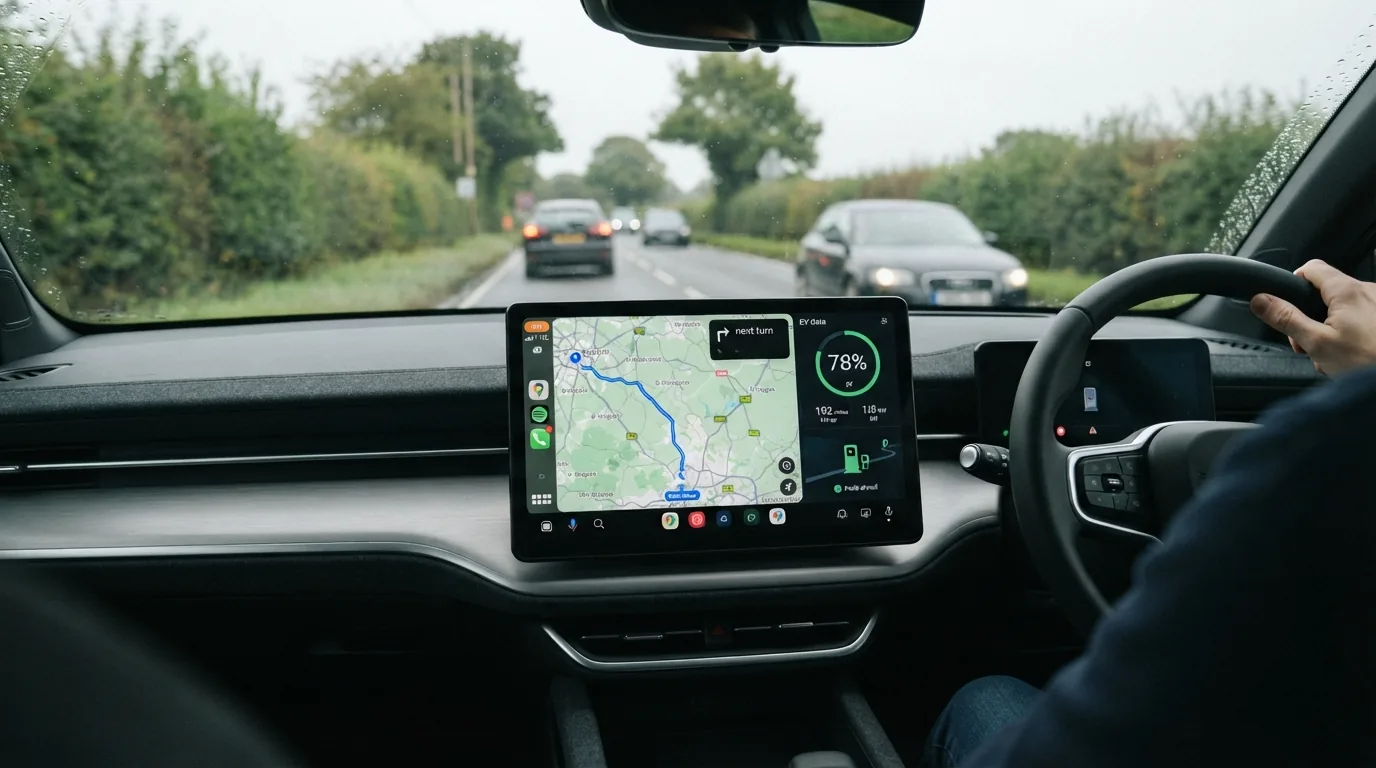
Quick answers
- The software layer in an electric car does something a petrol car's infotainment system never had to: it controls charging, manages battery preconditioning, plans your route around charge stops and tells you whether you will make it home.
- Tesla remains the benchmark for EV-specific software integration.
- The most exciting software development in the mainstream EV market in 2026 is the OpenR Link system in the Renault 5 and Renault 4.
- Polestar's approach is to build the car around software rather than adding software to a car.
- BMW's iDrive 9 system, as found in the iX and i5 (and forthcoming models), is the strongest conventional premium infotainment system in any EV.
- The one to watch: Hyundai and Kia: The ccNC (Connected Car Navigation Cockpit) system shared across Hyundai and Kia EVs is highly rated for ergonomics and screen quality.
The software layer in an electric car does something a petrol car’s infotainment system never had to: it controls charging, manages battery preconditioning, plans your route around charge stops and tells you whether you will make it home. The quality of that software is now a genuine purchase consideration, not a nice-to-have.
The direct answer: Tesla leads on software integration and over-the-air updates, but several strong challengers have emerged in 2026, particularly Renault (with Google-native OpenR Link), Polestar and BMW. The right pick depends on whether you prioritise deep vehicle integration or smartphone familiarity.
What makes EV tech genuinely good?
Before ranking specific cars, it is worth being clear about what separates good from bad EV technology in 2026:
- Over-the-air (OTA) updates: does the car improve itself after purchase?
- EV-specific navigation: does the system plan around charge stops, battery level and charger speed?
- Battery preconditioning: does the car prepare the battery before arriving at a rapid charger?
- Charging integration: can you start, stop and pay for public charging from the car or app?
- Smartphone integration: CarPlay, Android Auto or equivalent quality native experience?
- Voice control and AI: practical and accurate, or marketing gimmick?
The top EVs for technology in 2026
| Rank | Model | Infotainment system | OTA updates | CarPlay/Android Auto | EV route planning | UK price from |
|---|---|---|---|---|---|---|
| 1 | Tesla Model 3 / Model Y | Tesla (proprietary) | Frequent, feature-rich | Not natively (wireless in testing) | Excellent (Supercharger-integrated) | ~£34,990 |
| 2 | Renault 5 E-Tech / Renault 4 | OpenR Link (Google native) | Regular | Yes (wireless) | Good (Google Maps native) | ~£22,995 |
| 3 | Polestar 4 | Android Automotive (Google) | Regular | Yes | Good | ~£56,900 |
| 4 | BMW iX / i5 | BMW iDrive 9 | Regular | Yes (wireless) | Very good | ~£77,900 / ~£70,895 |
| 5 | Hyundai Ioniq 6 | ccNC infotainment | Regular | Yes (wireless) | Good | ~£44,350 |
| 6 | Kia EV6 / EV9 | ccNC infotainment | Regular | Yes (wireless) | Good | ~£42,995 / ~£65,995 |
| 7 | Volkswagen ID.7 | MIB3 infotainment | Regular | Yes | Good | ~£57,995 |
| 8 | Mercedes EQS | MBUX Hyperscreen | Regular | Yes | Very good | ~£104,750 |
Tesla Model 3 and Model Y: still the software benchmark
Tesla remains the benchmark for EV-specific software integration. The 15.4-inch touchscreen controls almost everything (a point of frustration for some buyers), and the OTA update cadence is genuinely more frequent and more feature-rich than any rival. Updates arrive several times per year and can add meaningful new capabilities, not just bug fixes.
The navigation system is tightly integrated with the Supercharger network. When you enter a destination beyond your range, the car automatically routes through Superchargers, preconditions the battery before arrival (maximising charging speed) and adjusts estimates based on real-time traffic and temperature.
The limitation: Tesla does not natively support Apple CarPlay or Android Auto. If you are deeply embedded in the Apple or Google ecosystem, this is a genuine drawback. Some owners use the browser workaround with third-party CarPlay apps, but it is not a first-class experience.
Renault 5 E-Tech and Renault 4: Google-native standout
The most exciting software development in the mainstream EV market in 2026 is the OpenR Link system in the Renault 5 and Renault 4. This is the first mass-market system built with Google services as native (not mirrored) components. Google Maps, Google Assistant, Google Play and the car’s own EV functions all live in the same environment.
Because Google Maps is native, EV routing is genuinely integrated. You do not need to switch to a separate app for charging stop planning; it is built into the same navigation system that knows your car’s battery level and consumption.
“Reno,” Renault’s AI avatar powered by Google’s framework, acts as a digital co-pilot for voice commands. Early real-world reports suggest it is significantly more accurate than older voice systems. The Renault 5 starts from around £22,995, making this level of software sophistication unusually accessible.
Polestar 4: software-defined from the ground up
Polestar’s approach is to build the car around software rather than adding software to a car. The Polestar 4 uses the Google-built Android Automotive OS with a clean interface, frequent OTA updates and deep integration between the vehicle’s systems and third-party services.
The Polestar app ecosystem allows third-party developers to build native applications for the car, which is unusual among mainstream manufacturers. Camping apps, energy monitoring tools and charging optimisers are available through the system in a way that does not require phone mirroring.
BMW iDrive 9: the conventional premium benchmark
BMW’s iDrive 9 system, as found in the iX and i5 (and forthcoming models), is the strongest conventional premium infotainment system in any EV. The screen quality is excellent, the user interface is logical, wireless CarPlay is supported, and the EV-specific routing is genuinely good (though not as seamless as Tesla’s Supercharger integration). The natural language voice assistant is more practical than most rival systems.
BMW also supports regular OTA updates, though the cadence is less frequent than Tesla and the updates tend to be more conservative (fixing issues rather than adding major features).
The one to watch: Hyundai and Kia
The ccNC (Connected Car Navigation Cockpit) system shared across Hyundai and Kia EVs is highly rated for ergonomics and screen quality. Wireless CarPlay and Android Auto are standard on most trim levels. Where the Korean brands trail Tesla and Renault is on deep EV integration: the routing system is capable but not as seamlessly connected to real-time charging network data.
The Ioniq 6 and EV6 both score highly in owner satisfaction for their technology. The hardware quality (displays, voice systems, over-the-air capability) is strong. The software polish has improved significantly from the 2022 to 2023 vintage.
What to avoid: slow OTA update cycles
The biggest red flag in EV technology in 2026 is a manufacturer that does not commit to over-the-air updates, or delivers them infrequently. Buying an EV with no OTA capability means the software you buy today is the software you will have in five years. The worst performers in this category tend to be smaller-volume manufacturers and some budget brands where the software development team is not resourced to maintain long-term update cycles.
Before buying, check the manufacturer’s OTA update history: how many updates were delivered in the past 12 months, and what did they include?
UK-specific consideration: EV charging network integration
A feature that matters specifically to UK drivers is whether the car’s navigation integrates with real-time charger availability data. Tesla does this for the Supercharger network. A growing number of cars now integrate with Zap-Map or similar third-party data to show live charger status, but the quality varies significantly.
The best implementations show you not just where chargers are, but whether they are currently in use, what speed they deliver for your specific car, and how many spaces are available. This is genuinely useful for UK motorway driving where charger availability can vary significantly by time of day.
Our overall pick
For technology as a primary purchase driver:
- Best overall: Tesla Model 3 (software depth, OTA, navigation)
- Best value for technology: Renault 5 E-Tech (Google-native, £22,995)
- Best conventional premium: BMW i5 (iDrive 9, wireless CarPlay, polished)
If Apple CarPlay is a dealbreaker, eliminate Tesla from your list immediately. If you want the most seamlessly EV-integrated software experience and are prepared to adapt to the Tesla UI, nothing else matches it at any price point in 2026.
What to read next
For our guide to EV apps, navigation tools and charging software, visit our EV Tech & Apps guide. For the best EV charging apps to use alongside your car’s built-in system, see our best EV charging apps page.
How we test and where our numbers come from
Range figures are official WLTP combined values taken from manufacturer UK specification pages, with real-world estimates drawn from independent comparative testing. Prices are UK list prices at the time of the latest update. Tax, grant and charging-scheme figures come from GOV.UK and HMRC publications. We re-check every guide when pricing, specification or policy changes. Last checked 11 August 2026.

EV Compared
The EV Compared editorial team tracks the UK electric vehicle market full time: new model launches, list prices, WLTP and real-world range, public charging tariffs and the tax rules that decide what an EV actually costs to run. Every guide is checked against manufacturer specifications and official GOV.UK figures, and updated whenever the numbers move.
Related reading
View all
Apple CarPlay vs Built In EV Software: Which Is Better?
Apple CarPlay is familiar and loved, but built-in EV software controls your battery, charging and range. We explain when each wins and which cars get the balance right.

Best Apps to Find EV Chargers in the UK
With over 120,000 public charge points in the UK, the right app makes the difference between a smooth charging stop and a wasted detour. Here are the options ranked
What Is Bidirectional Charging and Can It Power Your Home?
Bidirectional charging lets your electric car act as a home battery or feed the national grid. Here is how it works, what it costs and which UK cars support it in 2026