What Does the 2030 Petrol and Diesel Ban Actually Mean?
Separating the facts from the myths: what changes in 2030, what does not, and what it means for your next car
Quick answers
- From 1 January 2030, it will be illegal for manufacturers to sell new cars powered solely by petrol or diesel in the UK. This is what the "2030 ban" means: a ban on new sales, not on driving, owning, taxing, insuring or selling second-hand petrol and diesel cars.
- This is the most pervasive misunderstanding about the 2030 ban.
- What about hybrids: Full hybrids and plug-in hybrids (PHEVs) get a transitional window.
- How does the ZEV Mandate phase things in: Manufacturers that fail their target face a fine of £12,000 per non-compliant car registered above their allowance.
- Micro-volume manufacturers (those registering very few vehicles per year in the UK) are exempt from the ZEV Mandate and the 2030 ban.
From 1 January 2030, it will be illegal for manufacturers to sell new cars powered solely by petrol or diesel in the UK. This is what the “2030 ban” means: a ban on new sales, not on driving, owning, taxing, insuring or selling second-hand petrol and diesel cars. You can carry on driving your existing petrol car past 2030, past 2035, and beyond, for as long as it passes an MOT and you tax it. What changes is what you can buy new from dealerships.
The myth: you will have to get rid of your petrol car
This is the most pervasive misunderstanding about the 2030 ban. The policy covers only new registrations by manufacturers. There is no plan to ban the use of existing petrol and diesel cars, no compulsory buy-back scheme, and no timeline for restricting used petrol car sales. Petrol and diesel fuel will remain available at forecourts for many years after 2030. The used ICE car market will simply coexist with a new car market that has gone fully zero-emission.
What the ban actually covers
| What changes in 2030 | What does not change |
|---|---|
| New car sales: no new pure petrol or diesel models | Driving your existing petrol or diesel car |
| New van sales phase: new diesel van ban moves to 2035 | Buying or selling a used petrol or diesel car |
| Manufacturers cannot register new ICE-only cars | Petrol and diesel fuel availability at forecourts |
| ZEV target hits 80% for new car registrations | MOT, insurance and taxation of ICE cars |
What about hybrids?
Full hybrids and plug-in hybrids (PHEVs) get a transitional window. Between 2030 and 2035, these vehicles can continue to be sold new, provided they meet specific criteria around electric-only range and emissions performance. The exact criteria are still being finalised in regulation, but the principle is that a car must be able to cover a meaningful distance in zero-emission mode. A self-charging hybrid that can run on electric power for only a few miles at slow speeds may not meet the threshold; a PHEV with 40 or more miles of electric range almost certainly will.
From 2035, the transition ends. Every new car registered in the UK must be fully zero-emission at the tailpipe.
How does the ZEV Mandate phase things in?
Rather than a sudden cliff edge, the government uses the Zero Emission Vehicle Mandate to step up the proportion of zero-emission vehicles in the new car market each year:
| Year | Mandatory ZEV share of new car sales |
|---|---|
| 2026 | 33% |
| 2027 | 38% |
| 2028 | 52% |
| 2029 | 66% |
| 2030 | 80% |
| 2035 | 100% |
Manufacturers that fail their target face a fine of £12,000 per non-compliant car registered above their allowance. This financial pressure is why manufacturers have been offering very large discounts on EVs since 2024: they need sales volume to hit mandated percentages, and the fine for missing is more expensive than a deep discount.
In 2025, the UK EV market share was about 23%, below the 28% mandate target for that year. The 2026 target of 33% is therefore even more demanding relative to where the market naturally sits, which means manufacturer discounting and financial incentives on EVs are likely to remain intense through 2026.
Does the ban affect used cars?
No. There is no restriction on buying, selling, owning or driving a used petrol or diesel car. The second-hand ICE market will continue indefinitely. What will happen gradually is that new ICE vehicles stop being added to the pool from 2030, meaning the average age of petrol and diesel cars on the road will increase over time and eventually, decades from now, the pool will shrink as older vehicles are scrapped. But this is a natural market evolution, not a policy restriction.
What happens to petrol car values?
This is genuinely uncertain terrain. The most common view among analysts is that petrol car values will hold up in the medium term (2026 to 2030) because of ongoing demand from buyers who either cannot afford EVs or who do not have home charging access. Beyond 2030, as no new petrol cars enter the market, well-maintained petrol cars in useful condition may actually hold value reasonably well because they will represent an increasingly scarce type of vehicle. The counterargument is that Clean Air Zone charges, higher running costs and shifting buyer preferences erode second-hand petrol values. Both dynamics will probably operate in different segments.
What does this mean for fleet and business buyers?
Fleet operators face a compressed timeline. Typical fleet replacement cycles of three to four years mean that fleets need to start committing to EVs now to meet duty-of-care requirements and emissions reporting obligations. Companies reporting under frameworks such as the Carbon Disclosure Project (CDP) or scope 3 emissions rules face external pressure to decarbonise their vehicle fleets ahead of the 2030 ban. Salary sacrifice schemes for EVs are the most cost-effective mechanism for many businesses; the Benefit in Kind rate of 4% in 2026/27 makes EVs dramatically cheaper as company cars than equivalent petrol models.
Will petrol be available after 2030?
Yes. Petrol and diesel fuel will not disappear from UK forecourts in 2030. With tens of millions of petrol and diesel vehicles still on the road, there is a viable commercial market for fuel for at least a decade after the new car ban, probably longer. The question of when individual forecourts become economically unviable is a business model question for petrol retailers, not a policy decision. Forecourt closures driven by falling volumes will be gradual and concentrated in areas with the highest EV adoption; rural areas and parts of the country with lower EV penetration will likely retain petrol availability for much longer.
What about performance cars and niche vehicles?
Micro-volume manufacturers (those registering very few vehicles per year in the UK) are exempt from the ZEV Mandate and the 2030 ban. This preserves the ability of very small specialist carmakers to continue producing petrol-powered performance and heritage vehicles beyond 2030, though the definition of micro-volume and the exact exemption criteria are set in regulation.
For mainstream performance brands such as Porsche, BMW M, Mercedes-AMG and Ferrari, the ban applies. These brands are all developing electric or hybrid performance models for their post-2030 ranges, with varying degrees of enthusiasm.
What should you do if you are thinking about buying soon?
If you are thinking about an EV: Buy in 2026 or 2027. Manufacturer ZEV Mandate pressure is near its peak, meaning deals and discounts on zero-emission cars are unusually strong. The Electric Car Grant offers up to £3,750 off eligible models; salary sacrifice can save 35 to 60% of monthly lease costs for employees. Both levers are available now and will not necessarily persist at the same strength in 2028/29 as the market naturally shifts.
If you are keeping your petrol car: There is no urgency to change. Your car remains legal and operational, fuel will be available, and the used market is not going away. The main reason to consider switching sooner is the expanding network of Clean Air Zones in UK cities, which may affect your journey costs if you regularly drive into places like Birmingham, Bristol or London.
If you are buying a new petrol car in 2026: It is a legitimate choice but worth thinking about resale timing. A petrol car bought in 2026 will be four years old in 2030 when new ICE sales end. Resale values beyond that point are harder to predict than they have been historically.
What to read next
For a factual breakdown of when and where Clean Air Zones currently charge non-compliant vehicles, see our guide to which UK cities have Clean Air Zones.
For help identifying the best-value EVs available right now, including grant-eligible models, see our guide to best value EVs that qualify for UK grants.
For the full policy picture, return to the grants, policy and legislation hub.
How we test and where our numbers come from
Range figures are official WLTP combined values taken from manufacturer UK specification pages, with real-world estimates drawn from independent comparative testing. Prices are UK list prices at the time of the latest update. Tax, grant and charging-scheme figures come from GOV.UK and HMRC publications. We re-check every guide when pricing, specification or policy changes. Last checked 11 August 2026.
Frequently asked questions
What about hybrids?
Full hybrids and plug-in hybrids (PHEVs) get a transitional window. Between 2030 and 2035, these vehicles can continue to be sold new, provided they meet specific criteria around electric-only range and emissions performance.
How does the ZEV Mandate phase things in?
Manufacturers that fail their target face a fine of £12,000 per non-compliant car registered above their allowance. This financial pressure is why manufacturers have been offering very large discounts on EVs since 2024: they need sales volume to hit mandated percentages, and the fine for missing is more expensive than a deep discount.
Does the ban affect used cars?
No. There is no restriction on buying, selling, owning or driving a used petrol or diesel car.
What happens to petrol car values?
This is genuinely uncertain terrain. The most common view among analysts is that petrol car values will hold up in the medium term (2026 to 2030) because of ongoing demand from buyers who either cannot afford EVs or who do not have home charging access.
What does this mean for fleet and business buyers?
Fleet operators face a compressed timeline. Typical fleet replacement cycles of three to four years mean that fleets need to start committing to EVs now to meet duty-of-care requirements and emissions reporting obligations.
Sources and further reading
- gov.ukGOV.UK DfTPrimary source referenced in this article.

EV Compared
The EV Compared editorial team tracks the UK electric vehicle market full time: new model launches, list prices, WLTP and real-world range, public charging tariffs and the tax rules that decide what an EV actually costs to run. Every guide is checked against manufacturer specifications and official GOV.UK figures, and updated whenever the numbers move.
Related reading
View all
Best Affordable EVs Under the Electric Car Grant
The electric cars that combine a government grant with the lowest purchase prices in the UK market right now

What Is the Benefit in Kind Rate for Electric Cars?
The electric car BiK rate is 4% for 2026/27, rising to 9% by 2029/30 on a confirmed schedule. Here is what that means for your tax bill, with worked examples and a full multi-year projection.
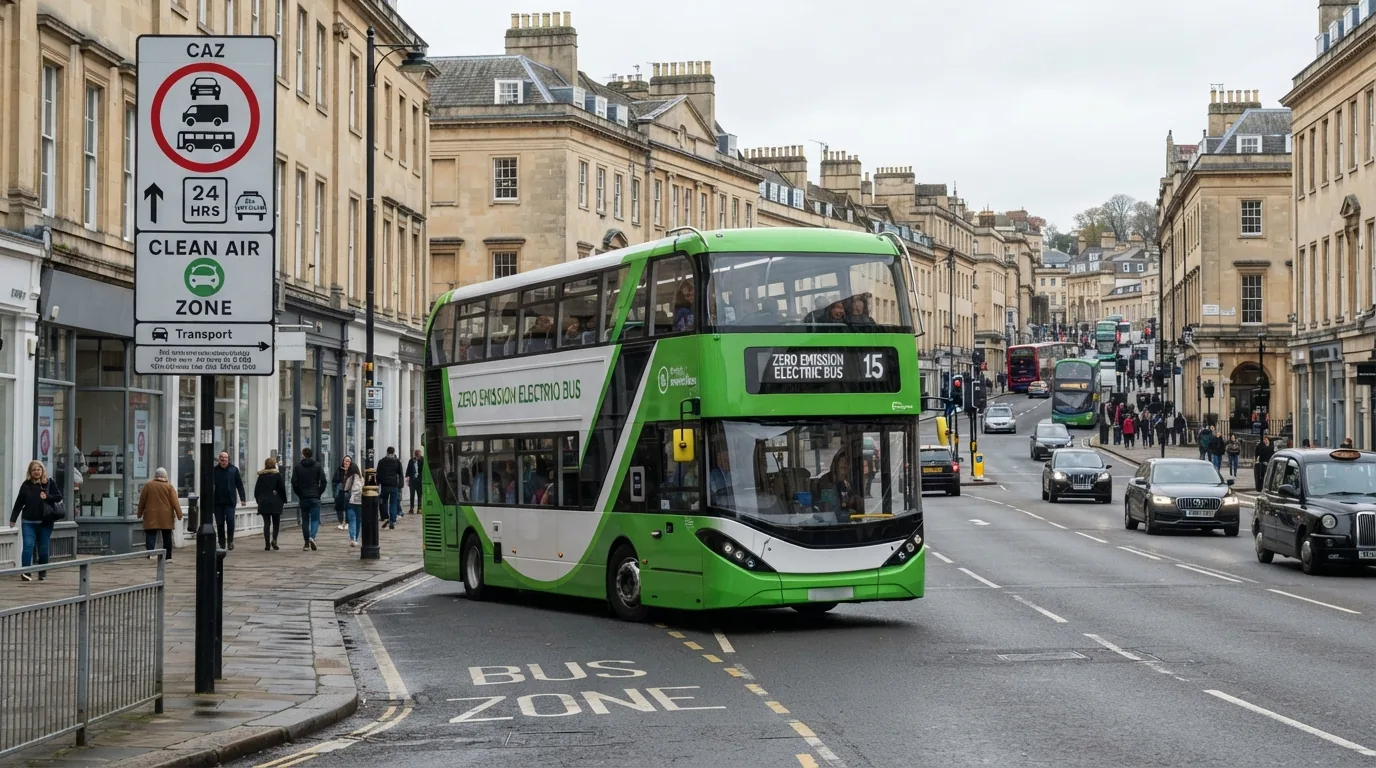
Which UK Cities Have Clean Air Zones in 2026?
The definitive 2026 map of UK Clean Air Zones, what they charge, which vehicles pay and how EVs are treated