Which UK Cities Have Clean Air Zones in 2026?
The definitive 2026 map of UK Clean Air Zones, what they charge, which vehicles pay and how EVs are treated
Quick answers
- As of mid-2026 there are 12 active Clean Air Zones (CAZs) across England, plus four Low Emission Zones (LEZs) in Scottish cities. Not all of them charge private cars; some focus on taxis, vans, buses and HGVs.
- What is a Clean Air Zone: A Clean Air Zone is a geographically defined area in which vehicles must meet minimum emission standards or pay a daily charge to enter.
- Which cities have active Clean Air Zones: Note: "Non-compliant" means failing to meet the relevant emissions standard.
- Birmingham's CAZ is Class D, meaning it charges non-compliant private cars.
- Bristol: the second city-level car charge: Bristol is also Class D, with a £9 per day charge for non-compliant cars.
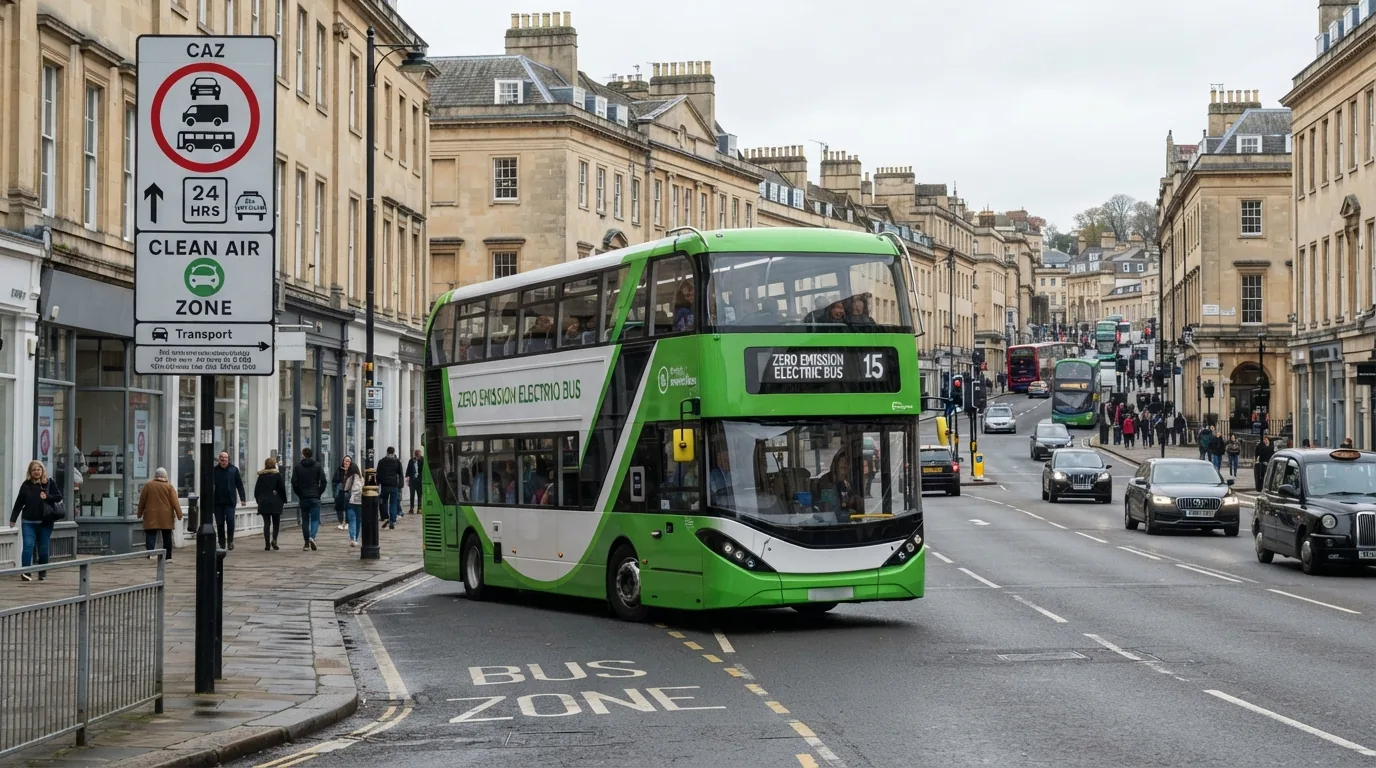
- Bath: Class C, private cars not charged: Bath introduced one of the UK's earliest CAZs in March 2021, but it is Class C, meaning private cars are not charged.
As of mid-2026 there are 12 active Clean Air Zones (CAZs) across England, plus four Low Emission Zones (LEZs) in Scottish cities. Not all of them charge private cars; some focus on taxis, vans, buses and HGVs. Electric vehicles are universally exempt from CAZ and LEZ daily charges. Here is the complete picture by city, class and cost.
What is a Clean Air Zone?
A Clean Air Zone is a geographically defined area in which vehicles must meet minimum emission standards or pay a daily charge to enter. The scheme was established under the Environment Act and administered locally, with central government setting the four class levels. The goal is to reduce nitrogen dioxide (NO2) concentrations in areas where air quality legally exceeds permitted limits.
Clean Air Zones are not the same as London’s ULEZ. ULEZ is a separate London-specific scheme with its own rules and charge structure. The rest of this article covers CAZs outside London; for ULEZ see our dedicated guide.
The four classes of Clean Air Zone
| Class | Vehicles charged |
|---|---|
| A | Buses, coaches and taxis only |
| B | Class A vehicles plus private hire vehicles (PHVs) and heavy goods vehicles |
| C | Class B vehicles plus vans, minibuses and non-compliant cars |
| D | Class C vehicles plus private cars |
Only Class C and D zones charge private cars. Most of the UK’s CAZs are Class C or B, meaning private cars are typically not charged in the majority of cities.
Which cities have active Clean Air Zones?
| City | Class | Private cars charged? | Daily charge (non-compliant car) | Operating hours |
|---|---|---|---|---|
| Birmingham | D | Yes | £8 | 24/7, all year |
| Bristol | D | Yes | £9 | 24/7, all year |
| Bath | C | No | Not charged | 24/7, all year |
| Bradford | C | No | Not charged | 24/7, all year |
| Sheffield | B | No | Taxis and vans pay £10 | 24/7, all year |
| Portsmouth | B | No | Taxis and vans only | 24/7, all year |
| Newcastle/Gateshead | B | No | HGVs and taxis only | 24/7, all year |
| Dundee (LEZ) | Scotland | Yes | Varies | 24/7, all year |
| Edinburgh (LEZ) | Scotland | Yes | Varies | 24/7, all year |
| Glasgow (LEZ) | Scotland | Yes | Varies | 24/7, all year |
| Aberdeen (LEZ) | Scotland | Yes | Varies | 24/7, all year |
Note: “Non-compliant” means failing to meet the relevant emissions standard. For petrol cars, the standard is generally Euro 4 (registered from 2006 approximately). For diesel, it is Euro 6 (registered from 2015 approximately). Most modern petrol cars from 2006 onward comply; many diesel cars registered before 2015 do not.
Birmingham: the most financially significant CAZ
Birmingham’s CAZ is Class D, meaning it charges non-compliant private cars. At £8 per day for cars, a driver entering the zone five days a week for 48 working weeks would pay £1,920 per year. The zone covers all roads within the A4540 Middleway Ring Road (but not the Middleway itself) and operates 24 hours a day, all year round. Electric cars, fuel cell vehicles and the most modern hybrid models meeting the emission standard are exempt.
Bristol: the second city-level car charge
Bristol is also Class D, with a £9 per day charge for non-compliant cars. Bristol’s zone covers a large section of the city centre. At £9 per day, the annual cost for a regular commuter entering five days a week is £2,160. Bristol is notable for being stricter on hybrid vehicles than some other zones: certain self-charging hybrids that do not meet Euro 6 (diesel) standards can still be charged.
Bath: Class C, private cars not charged
Bath introduced one of the UK’s earliest CAZs in March 2021, but it is Class C, meaning private cars are not charged. Only buses, coaches, taxis and vans are affected. Private cars passing through Bath’s zone pay nothing regardless of their emissions. This is commonly misunderstood by Bath residents and visitors.
Bradford: Class C, private cars not charged
Bradford’s CAZ is also Class C, focused on taxis, vans and heavy vehicles. Private petrol and diesel cars are not directly charged. However, the zone does require taxis and private hire vehicles to meet emission standards, which has driven significant fleet renewal among Bradford’s cab operators.
Scottish Low Emission Zones
Scotland’s four LEZs in Aberdeen, Dundee, Edinburgh and Glasgow follow Scottish Government legislation rather than the English CAZ framework. All four operate year-round. Private cars that do not meet the emission standards are charged from August 2024 onwards; before that date there was a grace period for car drivers. Penalty notices rather than daily charges apply in some Scottish zones: enforcement is by fine rather than a pre-paid daily rate. Electric vehicles are exempt from all four Scottish LEZs.
London: ULEZ, not a CAZ
London’s Ultra Low Emission Zone (ULEZ) operates under different London-specific legislation and is not classified as a CAZ under the standard English framework. It covers all 32 London boroughs plus the City of London and charges £12.50 per day for non-compliant vehicles. Electric cars are completely exempt from ULEZ charges. For full details, see our guide on how ULEZ affects electric car owners in London.
Note: the London Congestion Charge, which covers only the central zone, is separate from ULEZ. EVs lost their Congestion Charge exemption in January 2026 and now pay £13.50 per day (Auto Pay rate).
Are electric cars always exempt?
In every active CAZ and LEZ in the UK, fully electric vehicles (battery electric vehicles, BEVs) and fuel cell hydrogen vehicles are exempt from daily charges. This is not discretionary; it is built into the scheme rules. Plug-in hybrids are exempt in some zones when operating in electric mode, but enforcement varies and PHEVs are not universally exempt in all zones.
Which non-compliant vehicles pay the most?
HGVs and buses face the steepest charges where applicable. In Bristol, a non-compliant HGV faces a £100 per day charge. In Sheffield, taxis and vans face £10 per day. The economic impact on operators who have not upgraded to compliant or zero-emission vehicles is significant, which is why the commercial vehicle sector has moved faster than private car drivers to electrify fleets operating in CAZ cities.
Are more Clean Air Zones coming?
Yes. Several other English cities have been directed by central government to address NO2 exceedances and may introduce CAZs in the coming years. The pressure from the government’s legal obligations on air quality, following court orders arising from ClientEarth litigation, means local authorities in non-compliant areas have continuing obligations. Manchester is among the cities that has faced pressure to implement a scheme, though local politics have delayed it significantly.
What does this mean for EV buyers?
If you regularly drive into Birmingham or Bristol, switching from a non-compliant diesel to an electric car eliminates daily charges of £8 to £9. At five days a week, the saving is £1,900 to £2,160 per year. That is before factoring in lower fuel costs, reduced maintenance and the various purchase grants available for EVs.
If you drive mainly into Bath, Bradford, Sheffield or Newcastle, your private car is not directly charged under current CAZ rules; the financial pressure point is different and your calculation should focus on fuel costs and any applicable employer or purchase incentives rather than daily charge avoidance.
For a ranked list of the best EVs for avoiding Clean Air Zone charges, see our guide to best EVs for avoiding Clean Air Zone charges in the UK.
For the full grants and policy picture, return to the grants, policy and legislation hub.
How we test and where our numbers come from
Range figures are official WLTP combined values taken from manufacturer UK specification pages, with real-world estimates drawn from independent comparative testing. Prices are UK list prices at the time of the latest update. Tax, grant and charging-scheme figures come from GOV.UK and HMRC publications. We re-check every guide when pricing, specification or policy changes. Last checked 11 August 2026.
Frequently asked questions
What is a Clean Air Zone?
A Clean Air Zone is a geographically defined area in which vehicles must meet minimum emission standards or pay a daily charge to enter. The scheme was established under the Environment Act and administered locally, with central government setting the four class levels.
Which cities have active Clean Air Zones?
Note: "Non-compliant" means failing to meet the relevant emissions standard. For petrol cars, the standard is generally Euro 4 (registered from 2006 approximately).
Are electric cars always exempt?
In every active CAZ and LEZ in the UK, fully electric vehicles (battery electric vehicles, BEVs) and fuel cell hydrogen vehicles are exempt from daily charges. This is not discretionary; it is built into the scheme rules.
Which non-compliant vehicles pay the most?
HGVs and buses face the steepest charges where applicable. In Bristol, a non-compliant HGV faces a £100 per day charge.
Are more Clean Air Zones coming?
Yes. Several other English cities have been directed by central government to address NO2 exceedances and may introduce CAZs in the coming years.
Sources and further reading
- gov.ukGOV.UK DfTPrimary source referenced in this article.

EV Compared
The EV Compared editorial team tracks the UK electric vehicle market full time: new model launches, list prices, WLTP and real-world range, public charging tariffs and the tax rules that decide what an EV actually costs to run. Every guide is checked against manufacturer specifications and official GOV.UK figures, and updated whenever the numbers move.
Related reading
View all
What Does the 2030 Petrol and Diesel Ban Actually Mean?
Separating the facts from the myths: what changes in 2030, what does not, and what it means for your next car
Best Affordable EVs Under the Electric Car Grant
The electric cars that combine a government grant with the lowest purchase prices in the UK market right now

What Is the Benefit in Kind Rate for Electric Cars?
The electric car BiK rate is 4% for 2026/27, rising to 9% by 2029/30 on a confirmed schedule. Here is what that means for your tax bill, with worked examples and a full multi-year projection.