How Does ULEZ Affect Electric Car Owners in London?
EVs are permanently exempt from the £12.50 ULEZ charge, but the Congestion Charge is a different story since January 2026
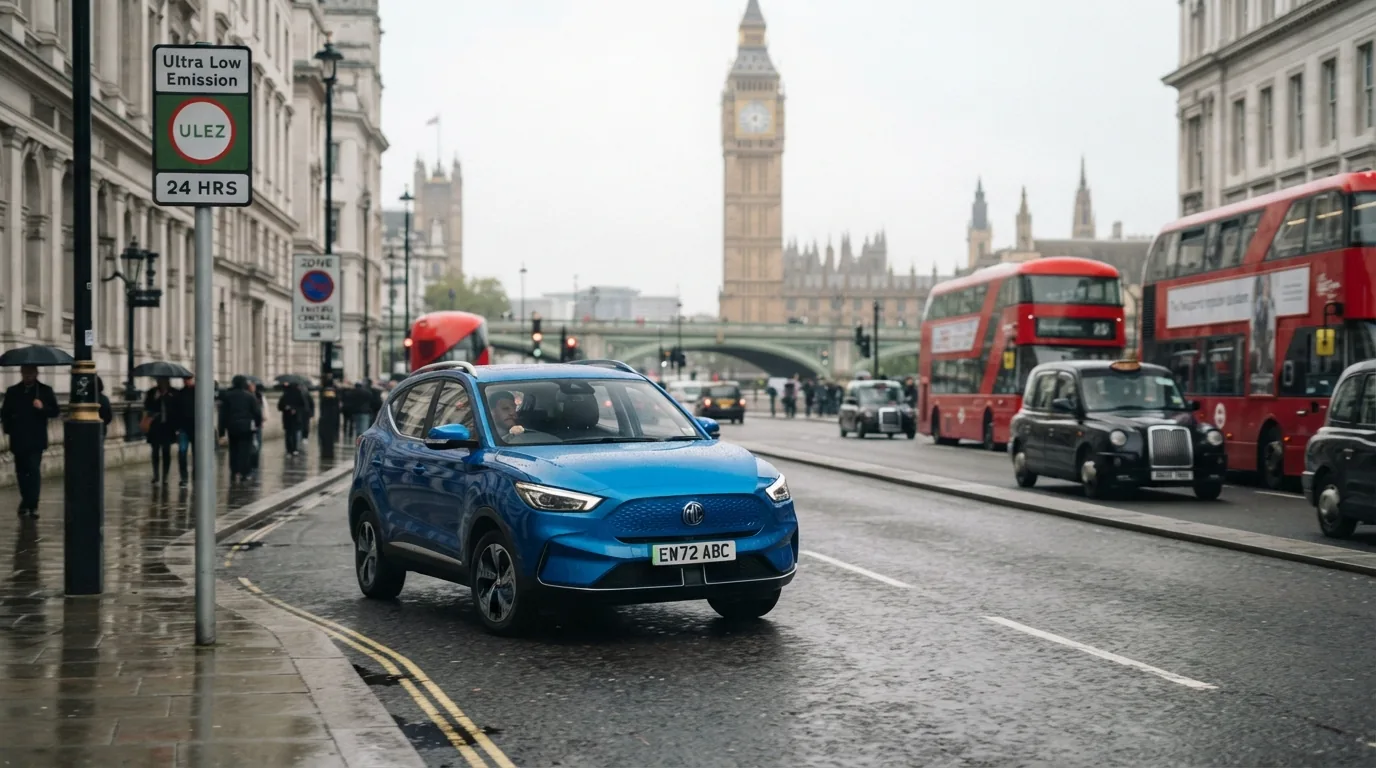
Quick answers
- Electric cars are completely and permanently exempt from London's Ultra Low Emission Zone (ULEZ) charge. There is no daily fee, no taper, no end date and no registration requirement for ULEZ exemption.
- What is ULEZ and where does it apply: The Ultra Low Emission Zone was introduced in April 2019 and expanded to cover all of Greater London in August 2023.
- This is a significant change that caught many EV drivers off guard.
- A driver in a non-compliant diesel car who enters the ULEZ zone on five days a week would pay £12.50 x 5 x 48 weeks = £3,000 per year in ULEZ charges alone.
- For London-specific driving patterns, range matters less than in rural or motorway contexts; most London journeys are well within the range of any modern EV.
Electric cars are completely and permanently exempt from London’s Ultra Low Emission Zone (ULEZ) charge. There is no daily fee, no taper, no end date and no registration requirement for ULEZ exemption. An EV drives anywhere within all 32 London boroughs and the City of London, 24 hours a day, every day of the year, without any ULEZ charge. The ULEZ charge currently stands at £12.50 per day for non-compliant vehicles.
However, as of 2 January 2026, electric cars no longer receive a Congestion Charge exemption in central London. These are two entirely separate schemes, and confusing them is the most common mistake EV drivers make when planning journeys into London.
What is ULEZ and where does it apply?
The Ultra Low Emission Zone was introduced in April 2019 and expanded to cover all of Greater London in August 2023. It operates 24 hours a day, 365 days a year, with no time windows and no weekend exemptions. The zone covers all roads within the Greater London boundary including residential streets.
Vehicles that do not meet the emission standards pay £12.50 per day for private cars and motorcycles, and £100 per day for larger vehicles. The emission standards are Euro 4 for petrol cars (broadly, petrol cars registered from 2006 onward) and Euro 6 for diesel cars (broadly, diesel cars registered from September 2015 onward).
Electric vehicles have no tailpipe emissions and are automatically compliant; the charge is simply not applied.
Is the ULEZ exemption for EVs permanent?
Yes, in current policy. Transport for London has confirmed that the EV exemption is ongoing with no scheduled end date. Unlike the London Congestion Charge’s now-ended EV exemption, the ULEZ exemption for battery electric vehicles has not been subject to a review or taper process. TfL’s position is that EVs represent the cleanest category of vehicle and the exemption is consistent with the scheme’s air quality purpose.
What changed with the Congestion Charge in January 2026?
This is where many EV owners have been caught out. The Congestion Charge is a separate scheme operated by TfL that applies only to the central London charging zone (roughly the area within the Inner Ring Road). Until 25 December 2025, electric vehicles received a 100% discount under the Cleaner Vehicle Discount, meaning they paid nothing.
From 2 January 2026, that discount ended. Electric vehicles must now pay the full Congestion Charge if they enter the central zone during charging hours (7am to 6pm Monday to Friday; 12pm to 6pm Saturday, Sunday and certain public holidays). The charge is:
- £15 per day standard rate
- £13.50 per day with Auto Pay registration (a 10% discount for pre-registered vehicles)
This is a significant change that caught many EV drivers off guard. The ULEZ exemption continues unchanged; the Congestion Charge exemption is gone.
Summary: how the two London schemes differ
| Feature | ULEZ | Congestion Charge |
|---|---|---|
| Coverage | All of Greater London (32 boroughs) | Central London zone only |
| Hours | 24/7, all year | 7am-6pm Mon-Fri; 12pm-6pm Sat-Sun |
| Charge (non-compliant/standard) | £12.50 per day | £15 (£13.50 Auto Pay) |
| EV exemption | Permanent and complete | Ended 2 January 2026 |
| Annual cost for a daily driver (EV) | £0 | Up to £3,900 (Mon-Fri central zone) |
Can you drive through ULEZ in an EV without registering?
Yes. Unlike some other city schemes, ULEZ does not require EV drivers to register or apply for an exemption. The cameras read your number plate and the TfL system automatically determines your vehicle category. Zero-emission vehicles are not charged; you do not need to do anything.
Do you need to prove your EV qualifies?
No. TfL’s ANPR (Automatic Number Plate Recognition) cameras check your vehicle against the DVLA database. Pure battery electric vehicles are automatically categorised as zero-emission and no charge is raised. If you have just bought a secondhand EV and the DVLA record has not yet been updated, you can self-declare the vehicle on TfL’s website while the record is corrected.
What about plug-in hybrids?
Plug-in hybrids (PHEVs) are subject to different rules. A PHEV that meets Euro 6 standards (diesel) or Euro 4 standards (petrol) is ULEZ-compliant and does not pay the daily charge. Many modern PHEVs registered from 2015 or later will be compliant. However, PHEVs are not zero-emission vehicles and do not receive a blanket exemption in the way that BEVs do; their compliance depends on their specific emission rating. Always check your specific PHEV model on the TfL vehicle checker.
What about parking in London?
ULEZ and the Congestion Charge do not affect parking. Parking costs in central London are set by individual boroughs, the City of London Corporation and TfL’s parking management areas. Some London boroughs offer free or discounted parking for zero-emission vehicles, but this is not universal and varies significantly.
How much does ULEZ actually save EV owners versus a non-compliant car?
A driver in a non-compliant diesel car who enters the ULEZ zone on five days a week would pay £12.50 x 5 x 48 weeks = £3,000 per year in ULEZ charges alone. That is a material annual saving for any EV owner. Adding in the Congestion Charge (if entering the central zone), the saving from switching to an EV rather than continuing in a non-compliant diesel was very large before January 2026. Since the Congestion Charge exemption ended, the combined saving is now:
- ULEZ: still £0 per day for EVs vs £12.50 per day for non-compliant cars
- Congestion Charge: £13.50 per day for EVs vs £15 per day for non-compliant cars (minimal difference here; both pay)
What are the best electric cars for London driving?
For London-specific driving patterns, range matters less than in rural or motorway contexts; most London journeys are well within the range of any modern EV. More relevant factors are:
- Physical size for navigating narrow streets and parking
- Availability of home or workplace charging (London renters and flat-owners are eligible for the £500 chargepoint grant)
- Low running costs given urban stop-start driving, where EVs are more efficient than out-of-town
For a ranked list of the best electric cars for ULEZ compliance and London driving, see our guide to best electric cars for ULEZ compliance in London.
Common mistakes London EV drivers make
Thinking ULEZ exemption means Congestion Charge exemption. Since January 2026, this is no longer true. Budget for the Congestion Charge if you regularly drive into the central zone.
Assuming PHEVs are always ULEZ-exempt. Depends on the specific model and its emissions rating. Check on TfL’s vehicle checker.
Not registering for Auto Pay on the Congestion Charge. If you do drive into the central zone regularly in your EV, register for Auto Pay to get the 10% discount (£13.50 vs £15).
Expecting the same treatment in other cities. ULEZ is specific to London. Other UK cities have Clean Air Zones under different rules and different class structures. See our guide to which UK cities have Clean Air Zones.
What to read next
For a complete overview of UK EV grants including the Electric Car Grant, Plug-in Van Grant and chargepoint grants, return to the grants, policy and legislation hub.
For a ranking of the best electric cars for London driving, see best electric cars for ULEZ compliance in London.
For the best value EVs eligible for UK purchase grants, see our guide to best value EVs that qualify for UK grants.
How we test and where our numbers come from
Range figures are official WLTP combined values taken from manufacturer UK specification pages, with real-world estimates drawn from independent comparative testing. Prices are UK list prices at the time of the latest update. Tax, grant and charging-scheme figures come from GOV.UK and HMRC publications. We re-check every guide when pricing, specification or policy changes. Last checked 11 August 2026.
Frequently asked questions
What is ULEZ and where does it apply?
The Ultra Low Emission Zone was introduced in April 2019 and expanded to cover all of Greater London in August 2023. It operates 24 hours a day, 365 days a year, with no time windows and no weekend exemptions.
Is the ULEZ exemption for EVs permanent?
Yes, in current policy. Transport for London has confirmed that the EV exemption is ongoing with no scheduled end date.
What changed with the Congestion Charge in January 2026?
This is where many EV owners have been caught out. The Congestion Charge is a separate scheme operated by TfL that applies only to the central London charging zone (roughly the area within the Inner Ring Road).
Can you drive through ULEZ in an EV without registering?
Yes. Unlike some other city schemes, ULEZ does not require EV drivers to register or apply for an exemption.
Do you need to prove your EV qualifies?
No. TfL's ANPR (Automatic Number Plate Recognition) cameras check your vehicle against the DVLA database.
Sources and further reading
- tfl.gov.ukTransport for LondonPrimary source referenced in this article.

EV Compared
The EV Compared editorial team tracks the UK electric vehicle market full time: new model launches, list prices, WLTP and real-world range, public charging tariffs and the tax rules that decide what an EV actually costs to run. Every guide is checked against manufacturer specifications and official GOV.UK figures, and updated whenever the numbers move.
Related reading
View all
What Does the 2030 Petrol and Diesel Ban Actually Mean?
Separating the facts from the myths: what changes in 2030, what does not, and what it means for your next car
Best Affordable EVs Under the Electric Car Grant
The electric cars that combine a government grant with the lowest purchase prices in the UK market right now

What Is the Benefit in Kind Rate for Electric Cars?
The electric car BiK rate is 4% for 2026/27, rising to 9% by 2029/30 on a confirmed schedule. Here is what that means for your tax bill, with worked examples and a full multi-year projection.