Best EVs for Avoiding Clean Air Zone Charges in the UK
Ranked: the electric cars that eliminate daily charges in Birmingham, Bristol and every other UK Clean Air Zone
Quick answers
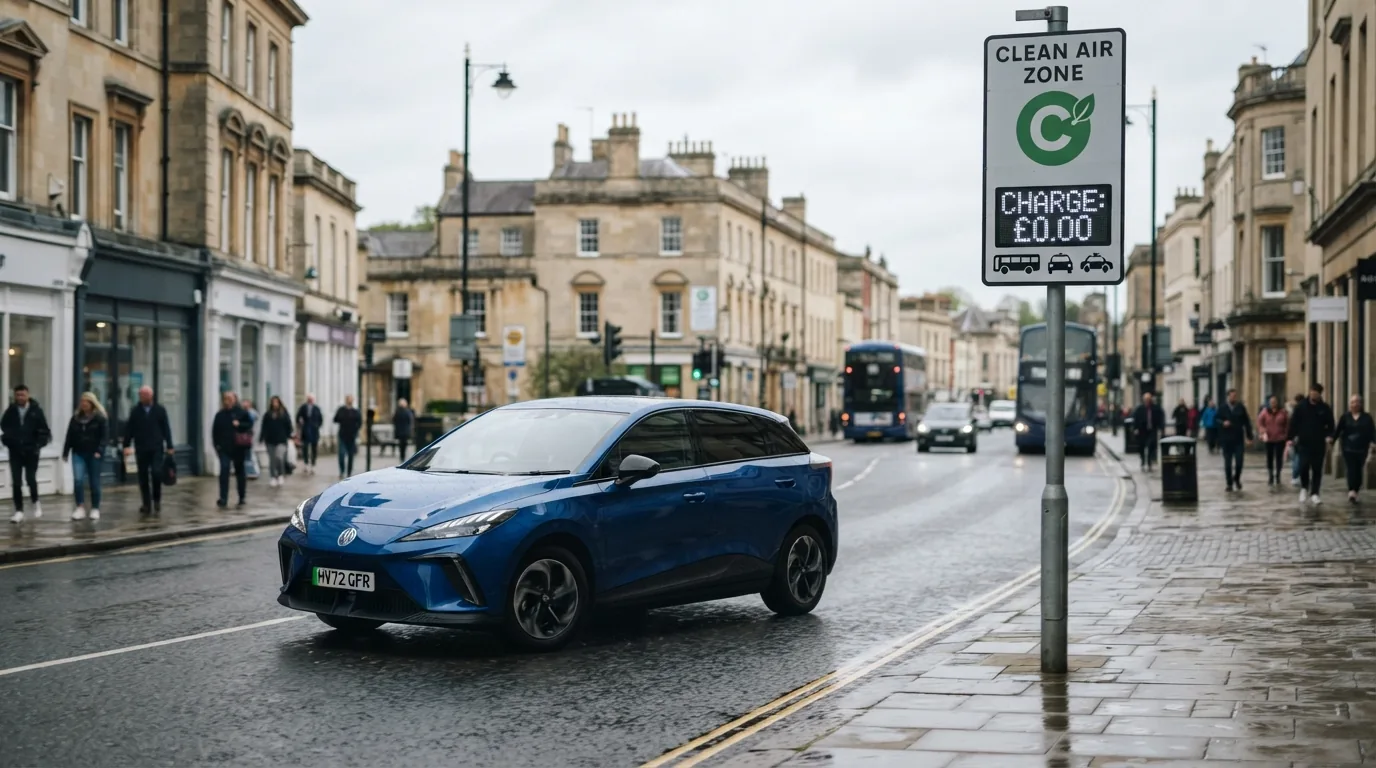
- Every battery electric car sold in the UK is automatically exempt from all Clean Air Zone (CAZ) charges. If you regularly drive into Birmingham, Bristol, Glasgow, Edinburgh or any of the other UK cities with active clean air charging, switching to an EV eliminates the daily charge entirely.
- How CAZ exemptions work for EVs: Battery electric vehicles (BEVs) produce zero tailpipe emissions and meet every Clean Air Zone emission standard by definition.
- Ranked: best EVs for CAZ avoidance in 2026: The Renault 5 with a 52kWh battery earns the maximum £3,750 Electric Car Grant (Band 1), bringing its effective starting price to around £19,250.
- What about models without the grant: Several popular and affordable EVs are not currently eligible for the Electric Car Grant due to their country of manufacture, including the BYD Dolphin and various MG models.
- Do you also need to worry about London: For a full breakdown of how ULEZ works for EV owners, see our guide to how ULEZ affects electric car owners in London.
Every battery electric car sold in the UK is automatically exempt from all Clean Air Zone (CAZ) charges. If you regularly drive into Birmingham, Bristol, Glasgow, Edinburgh or any of the other UK cities with active clean air charging, switching to an EV eliminates the daily charge entirely. In Birmingham, that means saving £8 per day; in Bristol, £9 per day. A daily commuter in Bristol could save up to £2,160 per year by switching to electric.
The question is not whether an EV exempts you, but which EV makes most sense for your driving pattern, budget and whether you can also claim the Electric Car Grant.
How CAZ exemptions work for EVs
Battery electric vehicles (BEVs) produce zero tailpipe emissions and meet every Clean Air Zone emission standard by definition. The ANPR cameras that enforce CAZ charges read your number plate and cross-check it against the DVLA database. Zero-emission vehicles are not charged; the process is automatic and requires no application or registration on your part.
Plug-in hybrids (PHEVs) are not automatically exempt. Their CAZ compliance depends on the specific model’s emission rating (Euro 4 for petrol, Euro 6 for diesel). Many modern PHEVs registered from 2015 are Euro 6-compliant and therefore CAZ-compliant, but they do not benefit from the blanket exemption that BEVs receive. Only a full battery electric or hydrogen fuel cell vehicle is automatically and unconditionally exempt.
The financial case for switching
| City | Daily CAZ charge (non-compliant car) | Annual cost (5 days/week, 48 weeks) | Annual saving with EV |
|---|---|---|---|
| Birmingham | £8 | £1,920 | £1,920 |
| Bristol | £9 | £2,160 | £2,160 |
| Glasgow (LEZ) | Varies | Up to £2,000+ (estimated) | Equivalent saving |
| Edinburgh (LEZ) | Varies | Up to £2,000+ (estimated) | Equivalent saving |
These savings stack directly against the cost of the EV. A car that costs £5,000 more to buy than a non-compliant diesel pays for that premium in three to four years of Birmingham or Bristol CAZ fees avoided, before accounting for lower fuel costs.
What makes a good CAZ-focused EV?
For drivers whose primary motivation is CAZ exemption, the relevant criteria are:
- Price: ideally within the £37,000 Electric Car Grant cap to maximise government support
- Range: sufficient to cover your working week commute and any regular long-distance routes
- Charging access: can you charge at home, at work or at public chargers near your routes?
- Running costs: urban driving is where EVs are most efficient vs petrol
Ranked: best EVs for CAZ avoidance in 2026
1. Renault 5 (52kWh), best overall CAZ choice
The Renault 5 with a 52kWh battery earns the maximum £3,750 Electric Car Grant (Band 1), bringing its effective starting price to around £19,250. Its 239-mile WLTP range is more than enough for urban commuting and regular regional runs. The Renault 5 is compact enough for city parking, comfortable enough for motorway driving and represents the best combination of low purchase cost and maximum grant support in the current market.
- After-grant price: from ~£19,250
- WLTP range: 239 miles
- Grant: £3,750 (Band 1)
2. Citroën e-C3 Aircross, best budget option
The e-C3 Aircross earns the Band 1 £3,750 grant and brings its effective price down to around £21,250. It is a practical crossover with a large boot for its class and a comfortable ride over urban surfaces. With 199 miles of WLTP range, it is best suited to regular city and suburban commutes rather than high-mileage motorway work.
- After-grant price: from ~£21,250
- WLTP range: 199 miles
- Grant: £3,750 (Band 1)
3. Renault 4 (52kWh), best for families
The Renault 4 offers more cabin space and a larger boot than the Renault 5, shares the same 52kWh platform earning Band 1 status and comes in at around £23,250 after the £3,750 grant. Its 290-mile WLTP range is one of the strongest in the sub-£30,000 after-grant segment.
- After-grant price: from ~£23,250
- WLTP range: 290 miles
- Grant: £3,750 (Band 1)
4. Volkswagen ID.3, best mid-range all-rounder
The ID.3 is a solid, well-sorted hatchback with up to 264 miles of WLTP range. It sits in Band 2, so the grant is £1,500 rather than £3,750, but its reliability, widespread dealer network and genuine real-world range make it a strong choice for city-based drivers who occasionally need motorway range. After grant, it starts from around £31,500.
- After-grant price: from ~£31,500
- WLTP range: 264 miles
- Grant: £1,500 (Band 2)
5. Citroën e-C5 Aircross, best for higher mileage CAZ commuters
For drivers who need to enter a CAZ daily but also cover significant distances between cities, the e-C5 Aircross offers 322 miles of WLTP range at a post-grant price of around £32,500. It sits in Band 2 (£1,500 grant) but its range capability makes it the standout option for higher-mileage patterns.
- After-grant price: from ~£32,500
- WLTP range: 322 miles
- Grant: £1,500 (Band 2)
6. Cupra Raval, best for urban character
The Cupra Raval recently joined the eligible list in Band 2 and brings a more distinctive character than mainstream alternatives. Starting from around £28,000 before grant (£26,500 after the £1,500 Band 2 discount), it offers 250 miles of WLTP range in a compact crossover format well-suited to urban environments.
- After-grant price: from ~£26,500
- WLTP range: 250 miles
- Grant: £1,500 (Band 2)
What about models without the grant?
Several popular and affordable EVs are not currently eligible for the Electric Car Grant due to their country of manufacture, including the BYD Dolphin and various MG models. These models are still 100% exempt from CAZ charges, and their list prices may be competitive enough that the absence of a grant is not a decisive factor. The BYD Dolphin Surf, for example, has been available with competitive PCP deals including 0% APR, which can offset the lack of a direct grant.
For CAZ avoidance alone, any battery electric car does the job. The grant eligibility question is secondary to the primary objective of eliminating the daily charge.
Matching the EV to your CAZ city
Birmingham drivers: any BEV eliminates the £8 daily charge. Compact models like the Renault 5 or Citroën e-C3 Aircross suit Birmingham’s inner-city road network well. The city has a growing public rapid charging network for midday top-ups.
Bristol drivers: the £9 daily charge makes the financial case even stronger. Bristol’s hilly terrain means energy consumption is slightly higher than flat urban driving; a larger battery (52kWh+) gives more comfortable headroom.
Glasgow and Edinburgh drivers: Scottish LEZ enforcement applies year-round. Models with a reliable public charging network presence are advisable given Scotland’s spread-out charging infrastructure compared with English cities.
Do you also need to worry about London?
If you commute into London, the position is more nuanced. EVs are permanently exempt from the ULEZ charge (£12.50 per day) but as of January 2026 must pay the Congestion Charge (£13.50 per day with Auto Pay) if entering the central zone. If your route stays outside the central zone, the ULEZ exemption is the only relevant factor and EVs remain entirely free.
For a full breakdown of how ULEZ works for EV owners, see our guide to how ULEZ affects electric car owners in London.
What to do next
Check which CAZ or LEZ applies to your regular routes at the GOV.UK clean air zone checker. Calculate your annual charge exposure based on your typical weekly drive frequency. Then compare that annual saving against the effective cost of purchasing or leasing one of the EVs above, factoring in any applicable Electric Car Grant.
For the full picture of grants and incentives available, return to the grants, policy and legislation hub.
For a shortlist of the best value grant-eligible EVs more broadly, see our guide to best value EVs that qualify for UK grants.
How we test and where our numbers come from
Range figures are official WLTP combined values taken from manufacturer UK specification pages, with real-world estimates drawn from independent comparative testing. Prices are UK list prices at the time of the latest update. Tax, grant and charging-scheme figures come from GOV.UK and HMRC publications. We re-check every guide when pricing, specification or policy changes. Last checked 11 August 2026.
Frequently asked questions
What about models without the grant?
Several popular and affordable EVs are not currently eligible for the Electric Car Grant due to their country of manufacture, including the BYD Dolphin and various MG models. These models are still 100% exempt from CAZ charges, and their list prices may be competitive enough that the absence of a grant is not a decisive factor.
Do you also need to worry about London?
If you commute into London, the position is more nuanced. EVs are permanently exempt from the ULEZ charge (£12.50 per day) but as of January 2026 must pay the Congestion Charge (£13.50 per day with Auto Pay) if entering the central zone.
Sources and further reading
- gov.ukGOV.UK DfTPrimary source referenced in this article.

EV Compared
The EV Compared editorial team tracks the UK electric vehicle market full time: new model launches, list prices, WLTP and real-world range, public charging tariffs and the tax rules that decide what an EV actually costs to run. Every guide is checked against manufacturer specifications and official GOV.UK figures, and updated whenever the numbers move.
Related reading
View all
What Does the 2030 Petrol and Diesel Ban Actually Mean?
Separating the facts from the myths: what changes in 2030, what does not, and what it means for your next car
Best Affordable EVs Under the Electric Car Grant
The electric cars that combine a government grant with the lowest purchase prices in the UK market right now

What Is the Benefit in Kind Rate for Electric Cars?
The electric car BiK rate is 4% for 2026/27, rising to 9% by 2029/30 on a confirmed schedule. Here is what that means for your tax bill, with worked examples and a full multi-year projection.