What Is Bidirectional Charging and Can It Power Your Home?
Bidirectional charging lets your electric car act as a home battery or feed the national grid. Here is how it works, what it costs and which UK cars support it in 2026
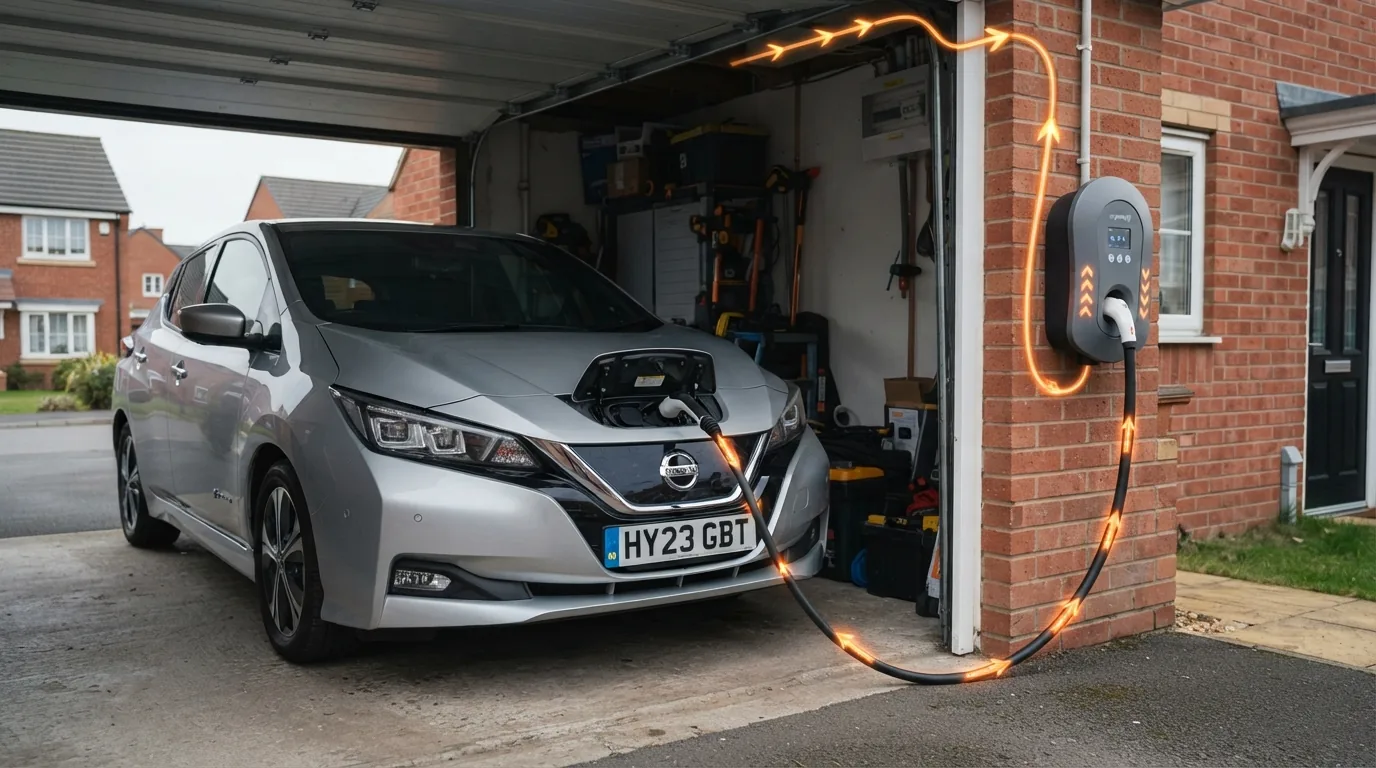
Quick answers
- Bidirectional charging allows energy to flow both into and out of an electric car's battery. Instead of only charging from the mains, a bidirectional system can use the car's stored energy to power your home, export to the national grid, or run appliances directly from the car's battery.
- Octopus Energy's Power Pack tariff modelling, which bundles a BYD Dolphin with a Zaptec Pro bidirectional charger, suggests annual savings of approximately £620 compared with a standard flexible tariff.
- For V2L, nothing beyond the car: Hyundai IONIQ 5, IONIQ 6, Kia EV6, EV9, BYD Dolphin and Atto 3 all have a V2L socket either integrated into the charging port or available as a cable adapter.
- V2L is simpler and available today with no home installation: you plug appliances (a laptop, a fridge, a portable heater, lighting) directly into a socket in the car, similar to a camping generator.
- This is one of the most common questions, and the honest answer is: marginally, in normal use.
- Is bidirectional charging worth setting up: If you own a compatible car, are on a time-of-use tariff, have solar or are considering it, and can absorb the £4,000 to £6,500 upfront hardware cost, then yes, V2H can deliver a clear return over five to ten years.
Bidirectional charging allows energy to flow both into and out of an electric car’s battery. Instead of only charging from the mains, a bidirectional system can use the car’s stored energy to power your home, export to the national grid, or run appliances directly from the car’s battery. In the UK in 2026, the technology is commercially available and increasingly common in new cars, though it requires compatible hardware on both the car and the charger.
What are the different types of bidirectional charging?
There are three variants, each with different capability and complexity:
Vehicle-to-Load (V2L): The simplest form. A standard AC socket built into the car (typically rated at 2.3 kW to 3.6 kW) lets you plug appliances directly into the car as if it were a generator. There is no grid interaction and no specialist installation required. Common in Hyundai, Kia and BYD models.
Vehicle-to-Home (V2H): Power flows from the car battery through a specialist bidirectional charger into your home’s electrical circuits. Your home runs on stored car battery energy during expensive daytime peak hours, having charged at cheap overnight rates. More complex to install than V2L but can power the whole home.
Vehicle-to-Grid (V2G): Power flows back to the national electricity grid, typically managed by an energy supplier. The driver is paid for exported energy, usually at a rate linked to grid demand. Requires a V2G-approved charger and a compatible energy tariff.
Can a bidirectional EV actually power your home?
Yes, effectively. An EV with a 60 kWh usable battery can supply an average UK household (which uses around 8 to 10 kWh per day) for five to seven days on a full charge, assuming the car is parked at home and plugged into a bidirectional charger.
In practice, V2H operates more dynamically than that. The bidirectional charger monitors the home’s electricity demand and draws from the car battery when the grid price is high (typically 28 to 35p per kWh in 2026) and charges when grid prices are low (typically 7 to 9p per kWh on overnight tariffs). Over a year, this arbitrage can generate savings of several hundred pounds.
Octopus Energy’s Power Pack tariff modelling, which bundles a BYD Dolphin with a Zaptec Pro bidirectional charger, suggests annual savings of approximately £620 compared with a standard flexible tariff.
What equipment do you need for bidirectional charging at home?
For V2L, nothing beyond the car: Hyundai IONIQ 5, IONIQ 6, Kia EV6, EV9, BYD Dolphin and Atto 3 all have a V2L socket either integrated into the charging port or available as a cable adapter.
For V2H or V2G, you need:
- A bidirectional charger compatible with your car’s protocol
- A qualified electrician to wire it into your consumer unit
- DNO (Distribution Network Operator) approval for any export greater than 3.68 kW (G99 approval, typically taking 30 to 60 working days)
- A compatible energy tariff if you want to monetise V2G
Current bidirectional charger costs in the UK:
| Charger | Type | Approx. installed cost |
|---|---|---|
| Wallbox Quasar 2 | DC bidirectional | £5,500–£6,500 |
| Zaptec Pro (Octopus bundle) | AC bidirectional | Bundled in £300/month Power Pack |
| Nissan AC Bidirectional | AC bidirectional | Expected ~£3,000–£4,000 (launch pending) |
| Indra Smart PRO V2H | AC bidirectional | ~£3,500–£4,500 installed |
Nissan has committed to launching an affordable AC bidirectional charger in the UK designed to bring the hardware cost in line with a conventional 7 kW wallbox, rather than the £5,000-plus that DC units currently command.
Which cars support bidirectional charging in the UK?
| Car | V2L | V2H | V2G | Notes |
|---|---|---|---|---|
| Nissan Leaf (Gen 2/3) | No | Yes (CHAdeMO) | Yes (CHAdeMO) | Nissan EV Sharing tariff via Ovo |
| Nissan Ariya | No | Yes | No (planned) | AC bidirectional |
| Hyundai IONIQ 5 | Yes (3.6 kW) | Yes | No | V2L via external socket; V2H via charger |
| Hyundai IONIQ 6 | Yes (3.6 kW) | Yes | No | Same E-GMP platform |
| Kia EV6 | Yes (3.6 kW) | Yes | No | V2H confirmed on standard range |
| Kia EV9 | Yes (3.6 kW) | Yes | No | 88 kWh usable battery; good V2H capacity |
| Kia EV3 | Yes | Yes | No | Available under £30,000 from 2026 |
| BYD Dolphin | No | Yes (Octopus bundle) | No | Via Zaptec Pro and Octopus Power Pack |
| BYD Seal | No | Yes | No | Similar arrangement to Dolphin |
| Renault 5 E-Tech | No | Yes (OTA enabled) | No | V2H activated via software update |
| VW ID.3 / ID.4 / ID.7 (77 kWh) | No | Yes | No | OTA-enabled on qualifying builds |
| Tesla (all UK models) | No | No (planned) | No | Bidirectional not yet live in UK |
What is the difference between bidirectional and V2L?
V2L is simpler and available today with no home installation: you plug appliances (a laptop, a fridge, a portable heater, lighting) directly into a socket in the car, similar to a camping generator. The power rating is typically 2.3 kW to 3.6 kW, enough for most household appliances individually but not sufficient to run a whole home simultaneously.
V2H involves a fixed installation and can supply your whole home’s circuits, managing demand intelligently via the bidirectional charger’s software. V2H can also operate during a power cut (in island mode on compatible systems), which V2L generally cannot, as V2L relies on the car’s inverter running while the car is active.
Does bidirectional charging wear out the battery faster?
This is one of the most common questions, and the honest answer is: marginally, in normal use. Each discharge cycle from V2H or V2G adds to the cell’s cycle count. An LFP battery rated for 3,000 to 5,000 cycles and used 300 times per year for V2H would complete its rated cycle life in 10 to 17 years from that use alone, not including driving.
In practice, the battery management system limits the depth of discharge for V2H/V2G, avoiding the damaging extremes, and the cycles involved are shallow. Nissan’s trials of V2G in the UK and the Netherlands found no measurably accelerated degradation from V2G participation within normal use parameters.
LFP chemistry is considered better suited to the additional cycling that V2H and V2G impose. NMC packs degrade faster per cycle, though modern NMC BMS software manages V2H cycles carefully.
Is bidirectional charging worth setting up?
If you own a compatible car, are on a time-of-use tariff, have solar or are considering it, and can absorb the £4,000 to £6,500 upfront hardware cost, then yes, V2H can deliver a clear return over five to ten years. The Octopus Power Pack at £300 per month removes the upfront hardware barrier and may suit those who prefer a single monthly payment that includes car, charger and tariff.
For detailed guidance on tariffs and installation, see our V2G and V2H charging explainer and the EV tech and apps hub. For app tools to manage smart charging, see our best EV charging apps roundup.
How we test and where our numbers come from
Range figures are official WLTP combined values taken from manufacturer UK specification pages, with real-world estimates drawn from independent comparative testing. Prices are UK list prices at the time of the latest update. Tax, grant and charging-scheme figures come from GOV.UK and HMRC publications. We re-check every guide when pricing, specification or policy changes. Last checked 11 August 2026.
Frequently asked questions
Can a bidirectional EV actually power your home?
Yes, effectively. An EV with a 60 kWh usable battery can supply an average UK household (which uses around 8 to 10 kWh per day) for five to seven days on a full charge, assuming the car is parked at home and plugged into a bidirectional charger.
What equipment do you need for bidirectional charging at home?
For V2L, nothing beyond the car: Hyundai IONIQ 5, IONIQ 6, Kia EV6, EV9, BYD Dolphin and Atto 3 all have a V2L socket either integrated into the charging port or available as a cable adapter.
What is the difference between bidirectional and V2L?
V2L is simpler and available today with no home installation: you plug appliances (a laptop, a fridge, a portable heater, lighting) directly into a socket in the car, similar to a camping generator.
Does bidirectional charging wear out the battery faster?
This is one of the most common questions, and the honest answer is: marginally, in normal use. Each discharge cycle from V2H or V2G adds to the cell's cycle count.
Is bidirectional charging worth setting up?
If you own a compatible car, are on a time-of-use tariff, have solar or are considering it, and can absorb the £4,000 to £6,500 upfront hardware cost, then yes, V2H can deliver a clear return over five to ten years.

EV Compared
The EV Compared editorial team tracks the UK electric vehicle market full time: new model launches, list prices, WLTP and real-world range, public charging tariffs and the tax rules that decide what an EV actually costs to run. Every guide is checked against manufacturer specifications and official GOV.UK figures, and updated whenever the numbers move.
Related reading
View all
Apple CarPlay vs Built In EV Software: Which Is Better?
Apple CarPlay is familiar and loved, but built-in EV software controls your battery, charging and range. We explain when each wins and which cars get the balance right.

Best Apps to Find EV Chargers in the UK
With over 120,000 public charge points in the UK, the right app makes the difference between a smooth charging stop and a wasted detour. Here are the options ranked
Best Electric Cars for In Car Technology in 2026
Software is now a key differentiator between electric cars. We rank the UK's best EVs for infotainment, over-the-air updates, driver assistance and connected services.