What Is V2G and V2H Charging and How Does It Work in the UK?
Vehicle-to-home and vehicle-to-grid technology explained for UK drivers, with compatible cars, installation costs and tariff options for 2026
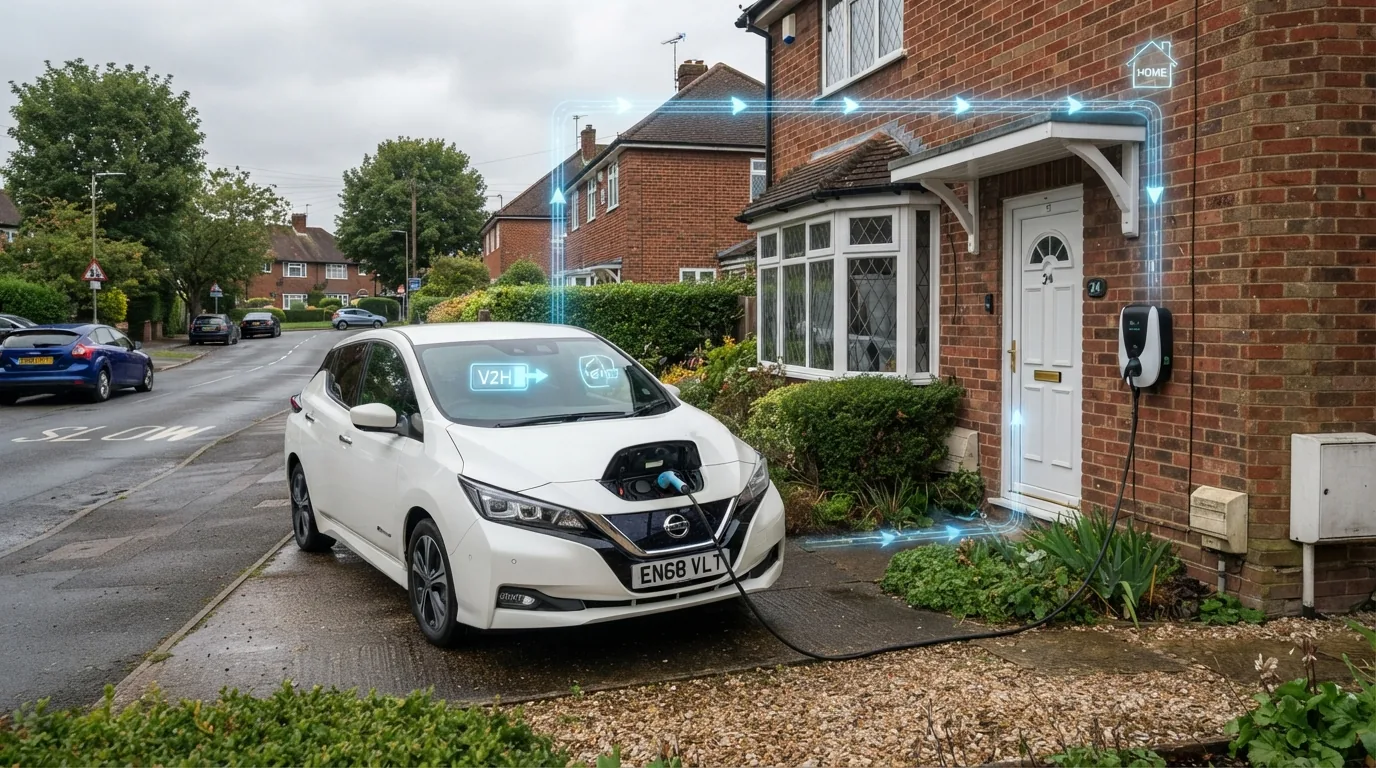
Quick answers
- V2G (vehicle-to-grid) and V2H (vehicle-to-home) are bidirectional charging technologies that allow your electric car to send stored energy back out of its battery, either to power your home or to sell electricity to the national grid.
- What is V2H charging and how does it work: Vehicle-to-Home sends power from your EV's battery directly into your home's electrical circuits, behind your meter.
- Octopus Energy's Power Pack tariff, launched with the BYD Dolphin and a Zaptec Pro bidirectional charger, bundles car, charger, installation and tariff for around £300 per month.
- Which UK cars support V2G and V2H in 2026: Tesla does not currently support V2H or V2G in the UK, though the company has signalled bidirectional capability for future models.
- What equipment do you need for V2H: You need a bidirectional charger, compatible with your car, and in most cases a consumer unit installation by a qualified electrician.
- What tariffs work with V2H and V2G: For V2H to save you money, you need a tariff where overnight prices are significantly cheaper than daytime prices.
V2G (vehicle-to-grid) and V2H (vehicle-to-home) are bidirectional charging technologies that allow your electric car to send stored energy back out of its battery, either to power your home or to sell electricity to the national grid. For a UK driver on a cheap overnight tariff, this means charging at 7–9p per kWh and using that stored energy to run the house during the 28–35p evening peak, or earning money by exporting to the grid at times of high demand.
What is V2H charging and how does it work?
Vehicle-to-Home sends power from your EV’s battery directly into your home’s electrical circuits, behind your meter. A bidirectional charger, wired into your consumer unit, manages the flow. You charge the car overnight on a cheap tariff, and during expensive peak hours the charger draws from the battery rather than the grid.
The process works as follows. The bidirectional charger converts the DC power stored in the EV battery into AC power that your home circuits can use. When the car is plugged in and the battery has charge, it becomes a large domestic battery. A Kia EV9, with around 88 kWh of usable capacity, could cover four to five days of average UK household electricity consumption (approximately 8–10 kWh per day) without recharging.
Unlike a domestic battery storage system such as a Tesla Powerwall or GivEnergy unit, your EV can do double duty: it is your car and your home battery in one asset. The main constraint is that it only works when the car is plugged in.
What is V2G charging and how is it different?
Vehicle-to-Grid goes a step further. Instead of routing power only to your home, energy flows back to the national electricity grid via your Distribution Network Operator. In return, the grid operator or energy supplier pays you for the export, either at a flat rate or at a variable rate that tracks wholesale prices.
The theoretical benefit is significant. If electricity wholesale prices spike to 50p per kWh during a cold winter evening, exporting from your car battery at that price while having charged at 9p overnight represents a very healthy margin. In practice, most current V2G tariffs pay a fixed export rate, but dynamic pricing is beginning to appear.
Octopus Energy’s Power Pack tariff, launched with the BYD Dolphin and a Zaptec Pro bidirectional charger, bundles car, charger, installation and tariff for around £300 per month. Octopus’s own modelling suggests this saves approximately £620 per year compared with a standard flexible tariff.
Which UK cars support V2G and V2H in 2026?
| Car | Bidirectional type | Battery (usable) | Notes |
|---|---|---|---|
| Nissan Leaf (Gen 3) | V2H, V2G | ~36 kWh / ~60 kWh | CHAdeMO-based; specialist charger required |
| Nissan Ariya | V2H | 63 kWh / 87 kWh | AC bidirectional via CHAdeMO adapter |
| Kia EV9 | V2H, V2L | 76.1 kWh / 88.1 kWh | V2H via compatible charger |
| Kia EV3 | V2H, V2L | ~59 kWh | V2H standard across all trims |
| Hyundai IONIQ 5 | V2H, V2L | 58 kWh / 74 kWh | V2L via built-in socket, V2H via charger |
| Hyundai IONIQ 6 | V2H, V2L | 53 kWh / 77.4 kWh | Same platform as IONIQ 5 |
| BYD Dolphin | V2H (Octopus bundle) | 44.9 kWh / 60.4 kWh | Octopus Power Pack offer |
| Renault 5 E-Tech | V2H (software enabled) | 40 kWh / 52 kWh | Activated via OTA update |
| VW ID.3/ID.4/ID.7 (77 kWh) | V2H | 77 kWh | Enabled via update on larger battery versions |
Tesla does not currently support V2H or V2G in the UK, though the company has signalled bidirectional capability for future models.
What equipment do you need for V2H?
You need a bidirectional charger, compatible with your car, and in most cases a consumer unit installation by a qualified electrician. Current hardware costs:
- AC bidirectional charger (such as the Wallbox Quasar 2 or compatible Nissan unit): approximately £3,700 installed
- DC bidirectional charger (higher power, faster response): approximately £5,500 to £6,500 installed
Any V2H installation that exports more than 3.68 kW requires G99 approval from your local Distribution Network Operator. G99 approval typically takes 30 to 60 working days, so factor this into your timeline if you are planning an installation.
The OZEV (Office for Zero Emission Vehicles) has indicated that eligible smart chargers qualify for the Electric Vehicle Chargepoint Grant, though V2H-specific hardware has so far sat outside the standard grant scheme. Check GOV.UK for the current position.
What tariffs work with V2H and V2G?
For V2H to save you money, you need a tariff where overnight prices are significantly cheaper than daytime prices. The main options in 2026:
Octopus Intelligent Go / Octopus Go: Off-peak rates from around 9p/kWh overnight (00:30–05:30 at time of writing), with daytime rates around 28–35p/kWh. You charge the car at 9p and run the home from the battery during the day.
Octopus Agile: Wholesale-linked pricing that can drop to 1–5p/kWh during overnight periods of low demand, and occasionally goes negative (you are paid to consume). Agile rewards more sophisticated control but requires automation to capture the best rates.
Octopus Power Pack (V2G): Bundles car, charger and tariff into one monthly payment. Designed for households that want V2G without managing multiple suppliers.
OVO Drive + Anytime: OVO’s vehicle-smart charging tariff is designed to work with supported chargers and EVs to shift charging automatically.
What is the common mistake to avoid?
The most common mistake is assuming that any EV can do V2H or V2G with any charger. Bidirectional charging requires both the car and the charger to support the relevant standard (CHAdeMO for older Nissan systems, the newer ISO 15118-20 AC or DC bidirectional standard for more recent models). Buying a bidirectional charger and finding your car does not support it is an expensive error.
Check your car’s specification carefully, including whether bidirectional capability requires a software update that may not yet be available in the UK market.
Is V2H worth it for UK drivers?
At current electricity prices and with the £620-per-year saving Octopus quotes, a V2H setup with £4,000 to £6,000 of hardware could pay back in seven to ten years on energy savings alone. That calculation improves significantly if you have solar panels, as V2H lets you store surplus solar in the car during the day and use it in the evening.
If you drive relatively low annual mileage (under 10,000 miles), your car is home and plugged in for more hours each day, which means more opportunity to use it as a home battery. High-mileage drivers get less value because the car is away from the charger more often.
The honest answer is that V2H is not for everyone today, but the economics are improving as electricity prices stay elevated and hardware costs fall. For those who own a compatible car and are building or renovating, it is increasingly worth specifying a consumer unit and cabling that is V2H-ready even before the charger is installed.
For more on managing home charging costs, see our EV tech and apps guide and our roundup of the best EV charging apps.
How we test and where our numbers come from
Range figures are official WLTP combined values taken from manufacturer UK specification pages, with real-world estimates drawn from independent comparative testing. Prices are UK list prices at the time of the latest update. Tax, grant and charging-scheme figures come from GOV.UK and HMRC publications. We re-check every guide when pricing, specification or policy changes. Last checked 11 August 2026.
Frequently asked questions
What is V2H charging and how does it work?
Vehicle-to-Home sends power from your EV's battery directly into your home's electrical circuits, behind your meter. A bidirectional charger, wired into your consumer unit, manages the flow.
What is V2G charging and how is it different?
Vehicle-to-Grid goes a step further. Instead of routing power only to your home, energy flows back to the national electricity grid via your Distribution Network Operator.
Which UK cars support V2G and V2H in 2026?
Tesla does not currently support V2H or V2G in the UK, though the company has signalled bidirectional capability for future models.
What equipment do you need for V2H?
Any V2H installation that exports more than 3.68 kW requires G99 approval from your local Distribution Network Operator. G99 approval typically takes 30 to 60 working days, so factor this into your timeline if you are planning an installation.
What is the common mistake to avoid?
The most common mistake is assuming that any EV can do V2H or V2G with any charger. Bidirectional charging requires both the car and the charger to support the relevant standard (CHAdeMO for older Nissan systems, the newer ISO 15118-20 AC or DC bidirectional standard for more recent models).

EV Compared
The EV Compared editorial team tracks the UK electric vehicle market full time: new model launches, list prices, WLTP and real-world range, public charging tariffs and the tax rules that decide what an EV actually costs to run. Every guide is checked against manufacturer specifications and official GOV.UK figures, and updated whenever the numbers move.
Related reading
View all
Apple CarPlay vs Built In EV Software: Which Is Better?
Apple CarPlay is familiar and loved, but built-in EV software controls your battery, charging and range. We explain when each wins and which cars get the balance right.

Best Apps to Find EV Chargers in the UK
With over 120,000 public charge points in the UK, the right app makes the difference between a smooth charging stop and a wasted detour. Here are the options ranked
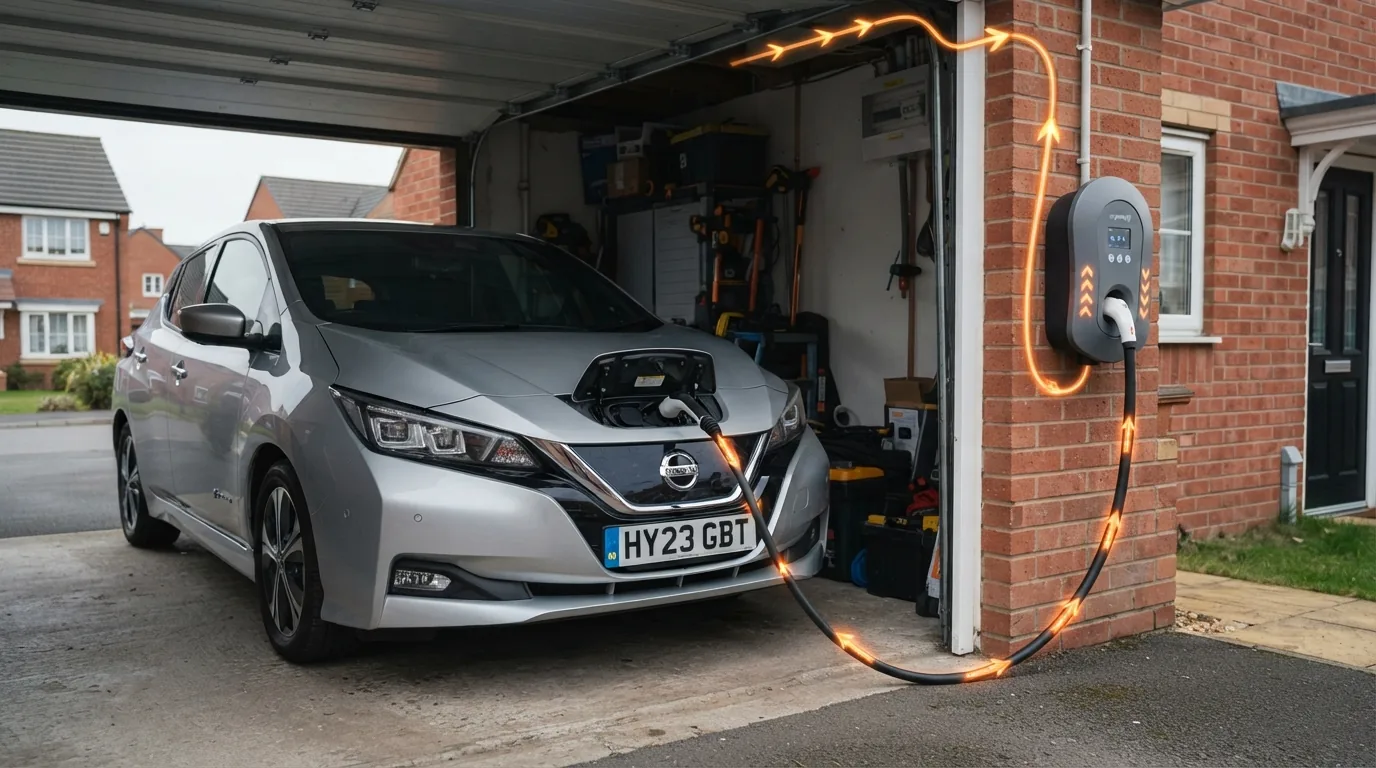
What Is Bidirectional Charging and Can It Power Your Home?
Bidirectional charging lets your electric car act as a home battery or feed the national grid. Here is how it works, what it costs and which UK cars support it in 2026