EV Technology and Apps in the UK: Batteries, Software and Charging Tech
Everything you need to know about how electric cars work, from battery chemistry to charging apps and over-the-air updates
Quick answers
- Electric vehicles are not just cars with a different fuel. They are software-defined machines, and understanding the technology behind them helps you choose the right model, charge smarter and get more from ownership.
- What does "EV technology" actually cover: EV technology splits into three broad areas: what stores the energy (the battery), what manages and improves the car (software and connectivity), and what gets energy into the car (charging hardware and apps).
- How do EV batteries work: Pack sizes across current UK models range from around 40 kWh in the Renault Zoe-class city cars to 123 kWh in the top-spec Tesla Model S Plaid.
- Preconditioning warms the battery to its optimal operating temperature before a fast-charge stop or a cold-weather drive.
- What is Plug and Charge: Plug and Charge, defined in the ISO 15118 standard, lets your car authenticate itself automatically at a compatible charger.
- What is V2G and V2H charging: Vehicle-to-Grid (V2G) and Vehicle-to-Home (V2H) allow power to flow from your car's battery back out to your house or to the national grid.
Electric vehicles are not just cars with a different fuel. They are software-defined machines, and understanding the technology behind them helps you choose the right model, charge smarter and get more from ownership. This guide maps the full landscape of EV tech and apps available to UK drivers in 2026.
What does “EV technology” actually cover?
EV technology splits into three broad areas: what stores the energy (the battery), what manages and improves the car (software and connectivity), and what gets energy into the car (charging hardware and apps).
Each of these has matured rapidly. The UK now has over 120,000 public charge points across more than 46,000 locations, according to Zap-Map data from April 2026, up 11 per cent year-on-year. The cars themselves ship with sophisticated battery management, over-the-air update capability and, increasingly, bidirectional charging that lets power flow back out of the battery.
| Technology area | What it does | Why it matters to you |
|---|---|---|
| Battery pack (cells, modules, BMS) | Stores and delivers energy | Determines range, charge speed and long-term durability |
| Battery chemistry (LFP vs NMC) | Defines energy density and longevity | Affects how you charge and how the car ages |
| Over-the-air (OTA) updates | Delivers software improvements wirelessly | Your car can improve without a dealer visit |
| Plug and Charge (ISO 15118) | Auto-authenticates car and charger | No app or card needed at compatible chargers |
| Preconditioning | Warms or cools the battery before charging or driving | Protects range in cold weather and speeds up fast charging |
| Heat pump | Harvests ambient heat instead of using resistance heating | Cuts the winter range penalty by 20–40% |
| Bidirectional charging (V2G/V2H) | Sends power back to home or grid | Could earn you money or cut bills |
| EV charging apps | Find, start and pay for public charging | Essential for public network access |
| OBD2 adapters | Read live vehicle data on non-Tesla EVs | Unlocks detailed battery health and efficiency stats |
How do EV batteries work?
The battery pack is the heart of any EV. Inside it are thousands of individual lithium-ion cells, grouped into modules, which are then assembled into the complete pack. Cell chemistry varies: nickel manganese cobalt (NMC) cells offer high energy density and suit long-range cars, while lithium iron phosphate (LFP) chemistry is more stable, tolerates 100 per cent charging every day without significant wear, and is increasingly common in city and mid-range models.
Pack sizes across current UK models range from around 40 kWh in the Renault Zoe-class city cars to 123 kWh in the top-spec Tesla Model S Plaid. Most mainstream family EVs sit between 60 and 82 kWh.
A battery management system (BMS) monitors every cell, balancing charge levels, limiting temperature extremes and protecting against damage from overcharging or deep discharge. The BMS is also where many OTA improvements land: new charging curves, thermal limits and state-of-health calculations can all be adjusted remotely by the manufacturer.
Research published in May 2026 found that an AI-governed charging algorithm adapted to a battery’s real-time state of health could extend usable battery life by around 23 per cent without increasing charge times, pointing to where BMS software is heading.
For a full explanation, see our how EV batteries work guide.
What is battery preconditioning and why does it matter?
Preconditioning warms the battery to its optimal operating temperature before a fast-charge stop or a cold-weather drive. When done correctly, with the car still plugged in, the energy comes from the mains rather than the battery itself, so you arrive at the charger with full range and a pack ready to accept power quickly.
Without preconditioning, a cold battery (below around 15°C) charges more slowly and may only accept 50–60 kW when the charger is capable of 150 kW or more. Preconditioning can close most of that gap. Many cars will trigger it automatically when you set a rapid charger as the navigation destination.
See our preconditioning explainer for detail on which models do this best.
What is Plug and Charge?
Plug and Charge, defined in the ISO 15118 standard, lets your car authenticate itself automatically at a compatible charger. There is no app to open, no card to tap. The car and charger exchange digital certificates, agree on your payment method and start the session as soon as the cable clicks in.
It is not yet universal, but ISO 15118 is moving from premium feature to baseline expectation on DC and high-power AC chargers. If you are choosing between two models and one supports Plug and Charge and the other does not, it is a genuine quality-of-life difference.
What is V2G and V2H charging?
Vehicle-to-Grid (V2G) and Vehicle-to-Home (V2H) allow power to flow from your car’s battery back out to your house or to the national grid. V2H routes energy directly into your home circuits, so you can charge on a cheap overnight tariff and run the house on car power during the expensive evening peak. V2G goes a step further: energy is sold back to the grid, and you receive payment.
UK-compatible models in 2026 include the Nissan Leaf and Ariya, Kia EV9, Hyundai IONIQ 5, and a growing list of VW Group and Renault vehicles. The Kia EV3, launching in 2026 at under £30,000, includes V2H as standard across all trims.
V2H installations require a specialist bidirectional charger and, for systems exporting more than 3.68 kW, G99 approval from your Distribution Network Operator, which typically takes 30 to 60 working days. Charger hardware costs currently run from around £3,700 to over £6,000 installed.
Full detail in our V2G and V2H charging guide.
What are over-the-air updates?
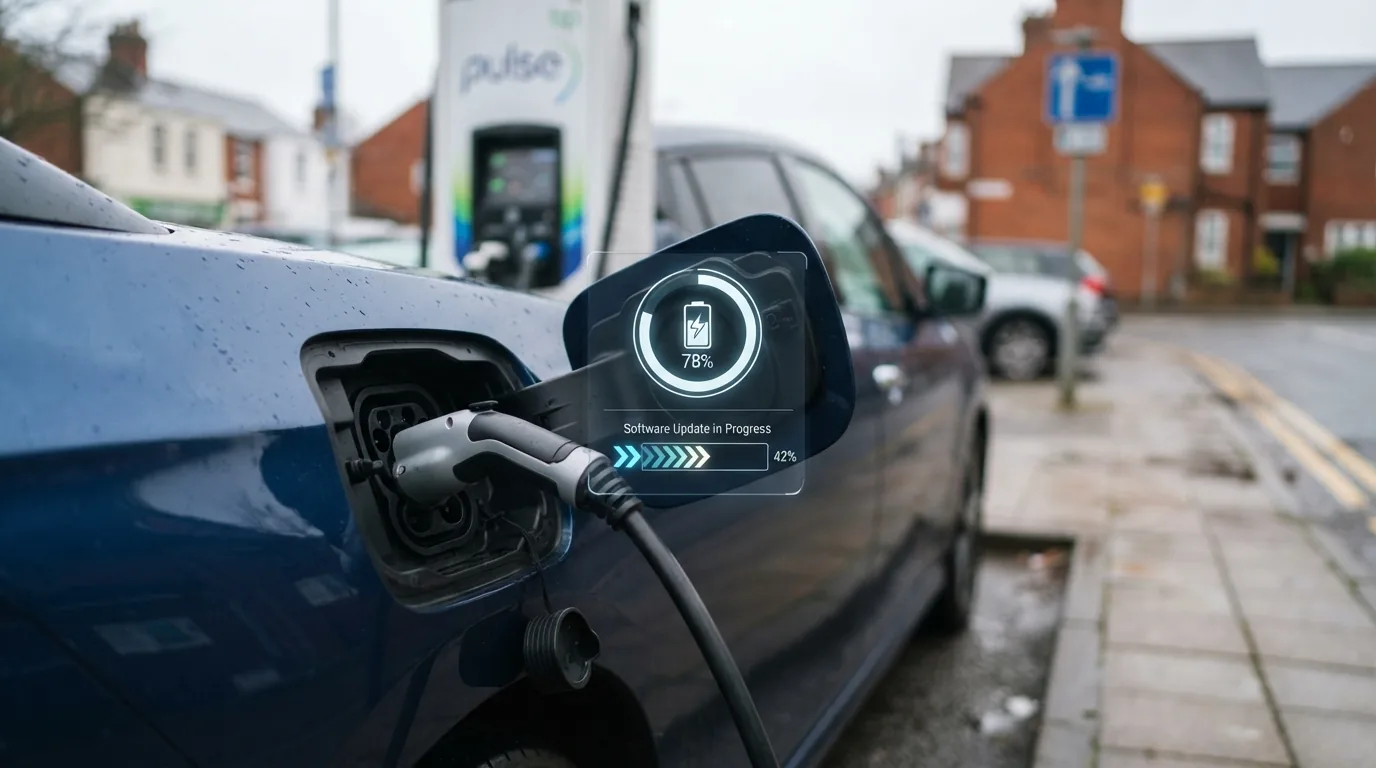
OTA updates let manufacturers push software improvements to your car without you visiting a dealer. Tesla pioneered this and still does it most frequently, delivering everything from new charging curve profiles to entirely new features such as Sentry Mode or improved autopilot behaviour. BMW’s 2026 i3, Volkswagen’s ID range, Hyundai’s IONIQ line and others now all offer meaningful OTA capability.
The practical implication is that the car you buy today can be meaningfully better next year, provided the manufacturer invests in the software. The risk is that not all manufacturers treat OTA as seriously, and some restrict updates to infotainment rather than powertrain.
What EV apps do UK drivers actually need?
The app ecosystem for UK EV drivers has matured into a few clear categories.
Charger-finding and route planning: Zap-Map is the most comprehensive UK network, covering over 120,000 charge points with real-time availability data. A Better Routeplanner (ABRP) is the go-to for long-distance trip planning, calculating where to stop and for how long based on your car’s specific consumption profile, the weather and your speed.
Multi-network payment: Apps like Octopus Electroverse and Bonnet aggregate payment across dozens of UK networks behind a single account, removing the need to hold cards for Osprey, bp pulse, Pod Point and others separately.
Home energy management: If you are on a smart tariff such as Octopus Agile or Go, apps from your energy provider let you schedule charging for the cheapest overnight windows, or pause charging when prices spike. Some work with solar inverters to prioritise solar export before drawing from the grid.
OBD2 monitoring: Plug-in OBD2 adapters, used with apps such as Car Scanner or Torque Pro, unlock live battery data on non-Tesla EVs: state of health, cell voltages, temperature and real energy consumption. The standard EV dashboard typically shows far less.
See our best EV charging apps roundup for current recommendations across each category.
What is a heat pump and does my EV need one?
A heat pump uses the same refrigeration-cycle principle as a domestic heat pump to harvest warmth from the outside air and use it to heat the cabin. This is dramatically more efficient than a simple resistance heater, which converts electricity to heat at roughly 1:1. A heat pump can deliver 2 to 3 kWh of heat per kWh of electricity consumed.
In practice, this means 20 to 40 per cent better range in cold conditions compared to an equivalent car without one. In the UK, where temperatures between November and March frequently fall to 2–8°C, a heat pump is a meaningful specification, not a luxury option.
Not all EVs include one. Budget models and some older designs use resistance heaters instead. When comparing cars, check the spec sheet.
What is an LFP battery and should you care?
LFP (lithium iron phosphate) chemistry is used in the Tesla Model 3 Standard Range, BYD Dolphin, BYD Atto 3 and several other mainstream models. LFP cells have lower energy density than NMC (so the pack is heavier for the same range), but they are more thermally stable, tolerate daily charges to 100 per cent without accelerated degradation, and are generally cheaper to produce.
For a driver who charges at home overnight, an LFP car is often the better long-term ownership proposition: you charge to 100 per cent every night and never think about it. NMC chemistry benefits from keeping the battery between 20 and 80 per cent for daily use, which requires more active management.
Full comparison in our LFP vs NMC batteries guide.
What is solid-state battery technology?
Solid-state batteries replace the liquid electrolyte in a conventional lithium-ion cell with a solid material, improving energy density, safety and potentially charging speed. Toyota has announced limited production of solid-state battery vehicles from 2026–27. Samsung SDI and CATL have pilot lines running.
The honest position: solid-state batteries are not yet in mass-market EVs available to buy in the UK today. When they do arrive, expect higher range figures, faster charging and improved durability, but do not delay a purchase waiting for them. Current lithium-ion technology, particularly LFP and NMC, is already highly capable.
Where should you start?
If you are new to EV technology, the most useful place to start is understanding the battery: what chemistry it uses, how large it is in kWh and what the BMS does to protect it. From there, look at what software features your shortlisted car ships with and what OTA update commitment the manufacturer makes.
For apps, Zap-Map and ABRP are the two installs that make the biggest practical difference for most UK drivers on day one.
Explore the full EV tech and apps hub for guides on every topic listed above, or jump straight to our best EV charging apps comparison.
How we test and where our numbers come from
Range figures are official WLTP combined values taken from manufacturer UK specification pages, with real-world estimates drawn from independent comparative testing. Prices are UK list prices at the time of the latest update. Tax, grant and charging-scheme figures come from GOV.UK and HMRC publications. We re-check every guide when pricing, specification or policy changes. Last checked 11 August 2026.
Frequently asked questions
What does "EV technology" actually cover?
EV technology splits into three broad areas: what stores the energy (the battery), what manages and improves the car (software and connectivity), and what gets energy into the car (charging hardware and apps).
How do EV batteries work?
The battery pack is the heart of any EV. Inside it are thousands of individual lithium-ion cells, grouped into modules, which are then assembled into the complete pack.
What is battery preconditioning and why does it matter?
Preconditioning warms the battery to its optimal operating temperature before a fast-charge stop or a cold-weather drive. When done correctly, with the car still plugged in, the energy comes from the mains rather than the battery itself, so you arrive at the charger with full range and a pack ready to accept power quickly.
What is Plug and Charge?
Plug and Charge, defined in the ISO 15118 standard, lets your car authenticate itself automatically at a compatible charger. There is no app to open, no card to tap.
What is V2G and V2H charging?
Vehicle-to-Grid (V2G) and Vehicle-to-Home (V2H) allow power to flow from your car's battery back out to your house or to the national grid. V2H routes energy directly into your home circuits, so you can charge on a cheap overnight tariff and run the house on car power during the expensive evening peak.

EV Compared
The EV Compared editorial team tracks the UK electric vehicle market full time: new model launches, list prices, WLTP and real-world range, public charging tariffs and the tax rules that decide what an EV actually costs to run. Every guide is checked against manufacturer specifications and official GOV.UK figures, and updated whenever the numbers move.
Related reading
View all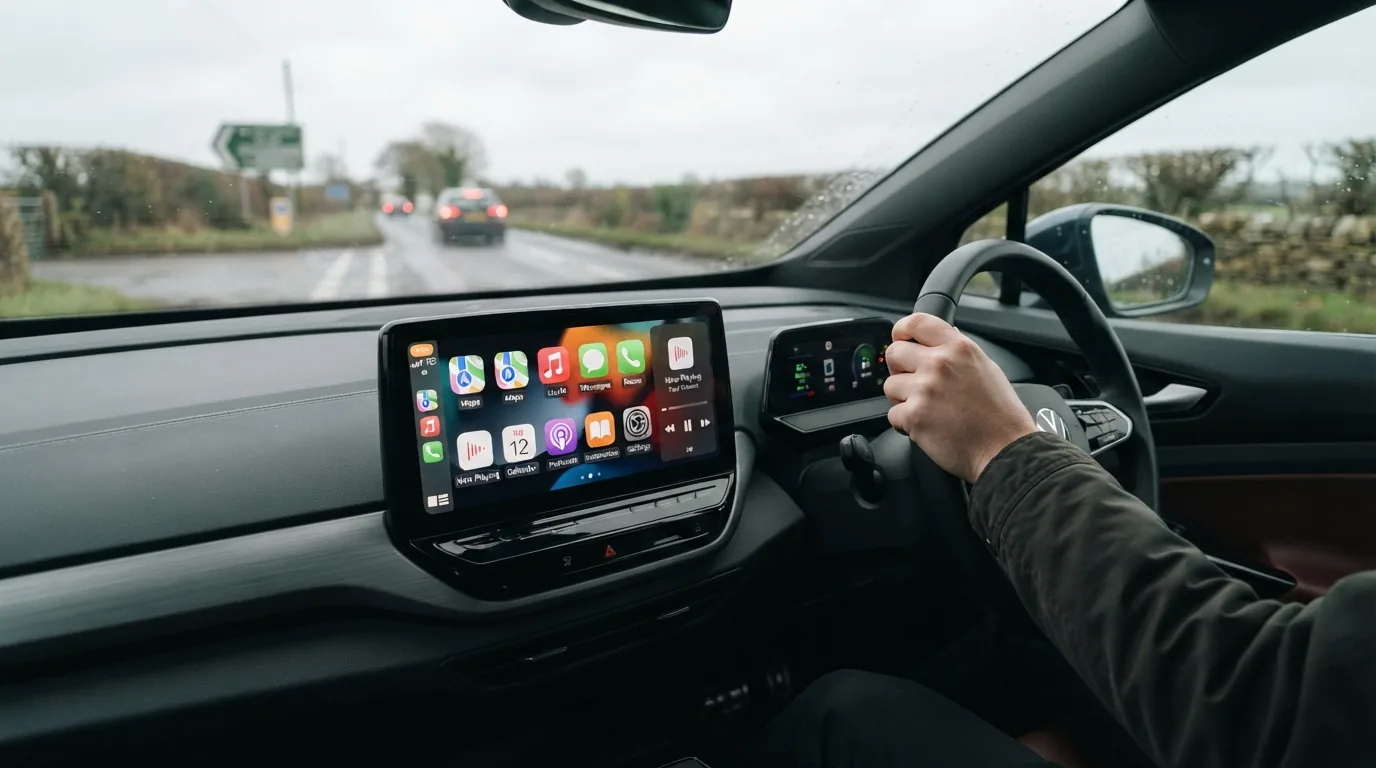
Apple CarPlay vs Built In EV Software: Which Is Better?
Apple CarPlay is familiar and loved, but built-in EV software controls your battery, charging and range. We explain when each wins and which cars get the balance right.

Best Apps to Find EV Chargers in the UK
With over 120,000 public charge points in the UK, the right app makes the difference between a smooth charging stop and a wasted detour. Here are the options ranked
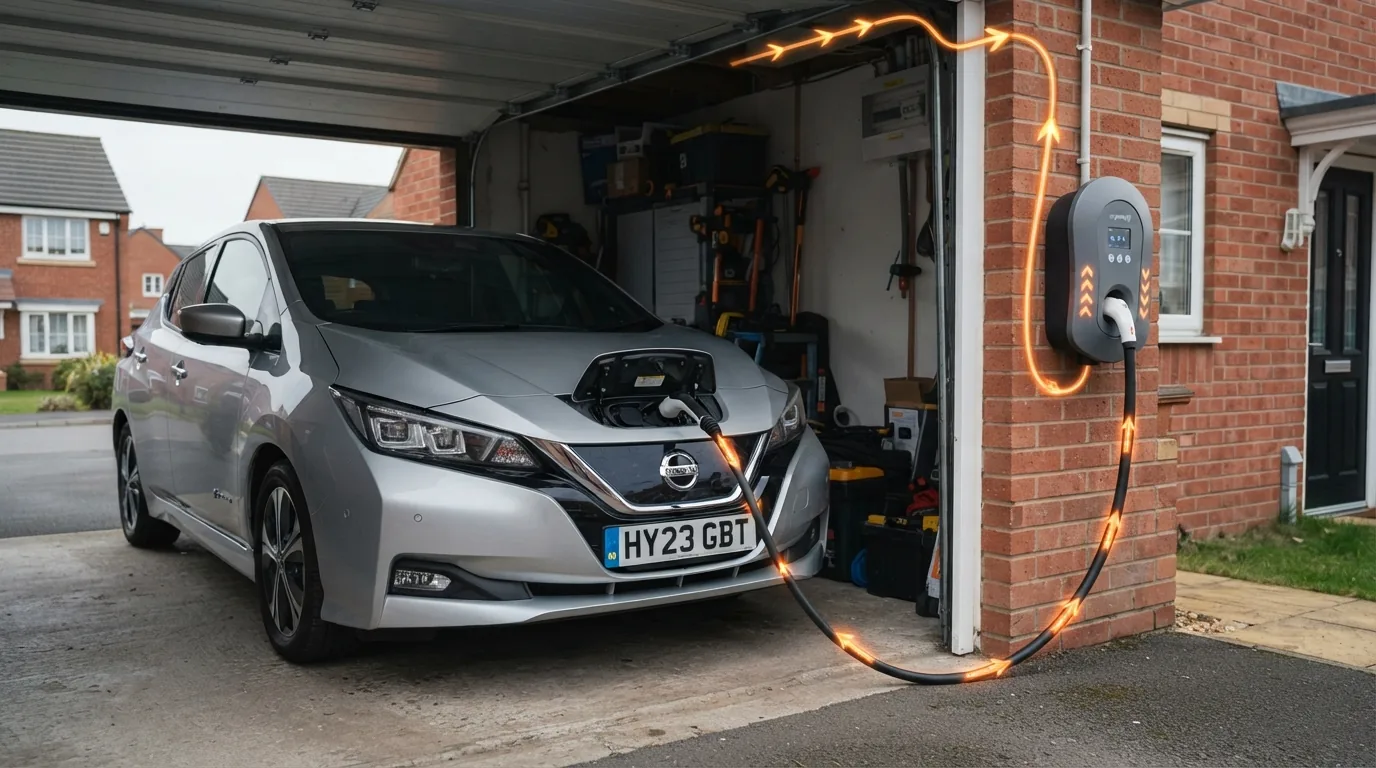
What Is Bidirectional Charging and Can It Power Your Home?
Bidirectional charging lets your electric car act as a home battery or feed the national grid. Here is how it works, what it costs and which UK cars support it in 2026