What Is Preconditioning and How Does It Help EV Range?
Battery preconditioning can recover 20 to 30 per cent of the winter range loss typical UK EV drivers experience. Here is how it works and how to use it
Quick answers
- Preconditioning is the process of warming (or cooling) an EV's battery and cabin to their optimal temperature before driving or before a fast-charge session, using power from the mains rather than from the battery itself.
- Why does cold weather reduce EV range: Lithium-ion battery cells work most efficiently between roughly 15°C and 35°C.
- What does preconditioning actually do: Preconditioning warms the battery using the car's thermal management system: a liquid-cooled loop heats the cells using energy from the charging cable (if plugged in) or from the battery itself (if not).
- Preconditioning the battery before arriving at a rapid charger closes most of this gap.
- How do you use preconditioning: The two main methods are departure-time scheduling and remote triggering via a smartphone app.
- Preconditioning still works when the car is not connected to a charger, but the energy comes from the battery rather than the mains.
Preconditioning is the process of warming (or cooling) an EV’s battery and cabin to their optimal temperature before driving or before a fast-charge session, using power from the mains rather than from the battery itself. When the car is still plugged in, preconditioning costs you nothing from your driving range. When done correctly, it can recover 20 to 30 per cent of the range penalty that cold weather imposes on a UK winter morning.
Why does cold weather reduce EV range?
Lithium-ion battery cells work most efficiently between roughly 15°C and 35°C. When the temperature drops below this range, internal resistance within the cells rises. Higher internal resistance means:
- The pack delivers less current for a given voltage, reducing available power
- The BMS may limit motor output to protect the battery
- Effective usable capacity decreases, so the battery gauge reads lower than it would at 20°C
- The car also draws more energy to heat the cabin using resistance heating (on cars without a heat pump) or to run the heat pump (on cars with one)
At 0°C, a typical NMC battery may deliver 15 to 25 per cent less usable range than in ideal conditions. LFP chemistry is more sensitive: some models lose 25 to 35 per cent at the same temperature. A car with a claimed 300-mile WLTP range might realistically deliver 200 to 220 miles on a cold January morning without preconditioning.
What does preconditioning actually do?
Preconditioning warms the battery using the car’s thermal management system: a liquid-cooled loop heats the cells using energy from the charging cable (if plugged in) or from the battery itself (if not). On cars with a heat pump, the heat pump’s refrigerant circuit also contributes to battery warming.
For the cabin, preconditioning runs the heating or air conditioning to bring the interior to your target temperature before you set off. Heated seats and a heated steering wheel are usually included.
The combined result when started while plugged in: you depart with a warm battery and a comfortable cabin, without having drawn on the battery for either. Your driving range is the same as if you had left from a warm garage.
How much does preconditioning improve charging speed?
This is the most significant and least-publicised benefit. A cold battery cannot accept DC rapid charge at its rated peak speed. At 0°C, a battery capable of 150 kW peak charging may only accept 40 to 60 kW until it warms up. This can add 15 to 25 minutes to a rapid-charge stop in winter compared to a warm battery.
Preconditioning the battery before arriving at a rapid charger closes most of this gap. Many EVs trigger automatic battery preconditioning when you set a rapid charger as the navigation destination, though the implementation varies significantly:
- Tesla: Automatically preconditions the battery when you navigate to a Supercharger or select a fast charger via the navigation system. One of the most consistent implementations.
- Hyundai IONIQ 5 and IONIQ 6: Automatic when navigating to a fast charger; can also be triggered manually via the BlueLink app.
- Kia EV6 and EV9: Same as Hyundai; automatic via navigation or manual via Kia Connect app.
- Volkswagen ID. range: Triggers when navigating to a compatible charger; uses the We Connect app for remote triggering.
- BMW i-series: MyBMW app allows manual preconditioning; automatic trigger on navigation to a fast charger.
- Renault models: Via My Renault app with departure schedule.
How do you use preconditioning?
The two main methods are departure-time scheduling and remote triggering via a smartphone app.
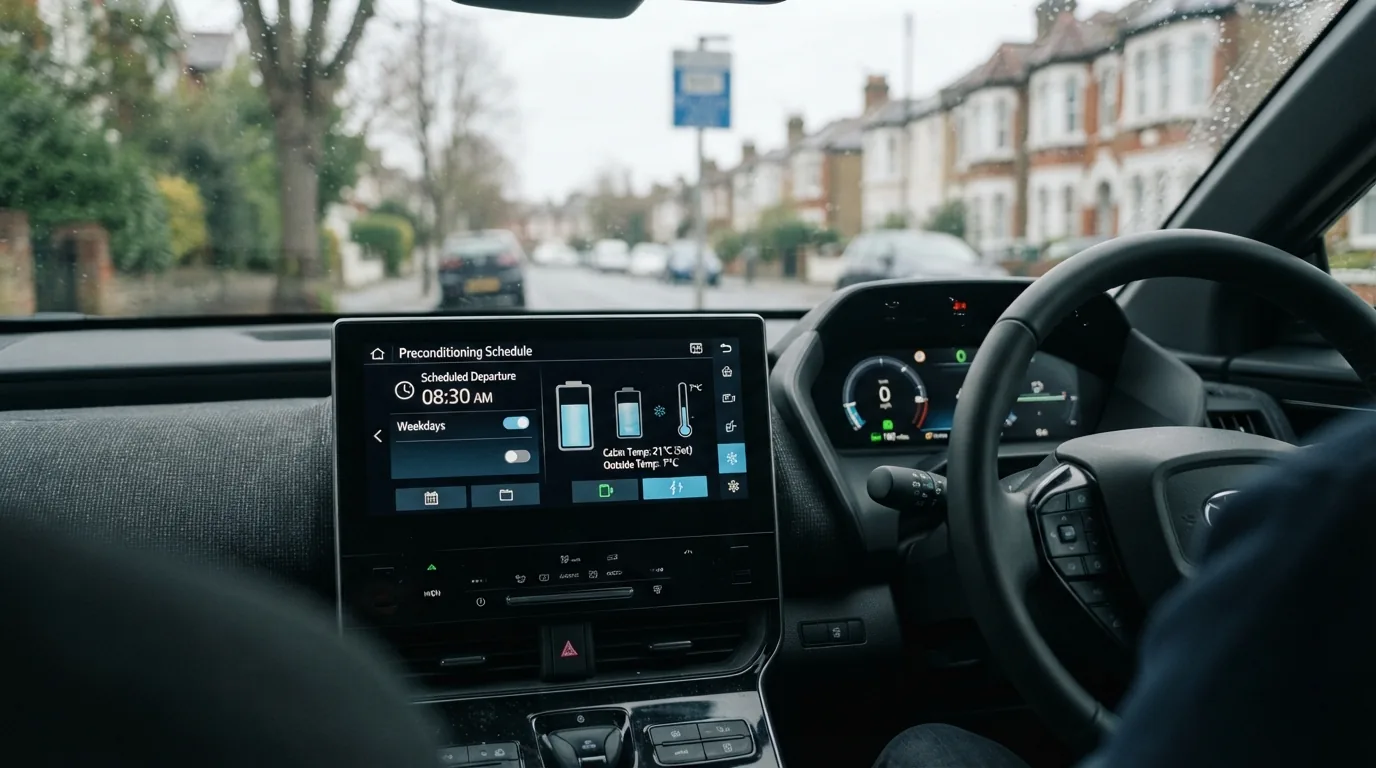
Departure scheduling: You set a departure time in the car’s infotainment system or the manufacturer’s app. The car calculates when to begin preconditioning to reach target temperature by your scheduled departure. This is the most energy-efficient method: the car runs while still plugged in and draws energy from the mains, not the battery.
Remote triggering: Most manufacturer apps allow you to start preconditioning manually from your phone. You check the time, decide you want the car warm in 20 minutes and press the button. This is useful for unplanned departures or when you forget to schedule the night before.
Navigation-triggered battery preconditioning: Separate from cabin preconditioning, this starts automatically on compatible cars when a rapid charger is entered as a destination. No action required from the driver.
What if I start preconditioning when the car is not plugged in?
Preconditioning still works when the car is not connected to a charger, but the energy comes from the battery rather than the mains. Cabin heating or cooling from an unplugged car will reduce your starting range, sometimes significantly: running the heat pump or resistance heater for 20 to 30 minutes can consume 0.5 to 2 kWh, reducing range by 2 to 8 miles before you move.
The guidance is simple: if you can plug in, do so before running preconditioning. If the car is at a workplace or public charger when you want to precondition before the drive home, the energy draw will come from the battery, but it is still worthwhile for the fast-charge benefit if you plan to rapid-charge on the return journey.
Does preconditioning work in summer too?
Yes, though the rationale differs. In warm weather, above around 35°C (rare in the UK but possible during heat waves), an NMC or LFP battery operating at high temperature degrades faster. Preconditioning in summer means cooling the battery before a fast-charge session to keep peak temperatures within the safe range during charging.
For cabin cooling, preconditioning is simply comfort: walking to a 40°C car is unpleasant, and running the air conditioning before you set off means the battery is less taxed by A/C during the first part of the drive.
Which cars handle preconditioning best?
| Car | Automatic charging precondition | Scheduled cabin precondition | App remote trigger | Notes |
|---|---|---|---|---|
| Tesla Model 3 / Y | Yes | Yes (via app) | Yes | Best integration; nav-triggered is consistent |
| Hyundai IONIQ 5 / 6 | Yes | Yes | Yes (BlueLink) | Very effective; automatic on fast-charge nav |
| Kia EV6 / EV9 | Yes | Yes | Yes (Kia Connect) | Same platform as IONIQ |
| Volkswagen ID.3 / ID.4 | Yes (most builds) | Yes | Yes (We Connect) | Some early models less consistent |
| BMW i4 / iX | Partial | Yes | Yes (MyBMW) | Cabin excellent; charging auto-trigger variable |
| Renault Megane E-Tech | No | Yes | Yes (My Renault) | No automatic charging precondition |
| Peugeot e-3008 | No | Yes | Yes (MyPeugeot) | Manual/scheduled only |
| Nissan Ariya | Partial | Yes | Yes | Better than older Leaf |
| Nissan Leaf (older) | No | Limited | Limited | Basic; manual only on many builds |
| MG4 | No | Yes | Yes (iSMART) | Cabin preconditioning available; charging auto not standard |
What is the common mistake?
The most common mistake is leaving preconditioning until after you unplug the car, so the energy comes from the battery rather than the mains. The second most common mistake is not using automatic charging preconditioning, often because the driver does not know it exists or does not set a fast charger as the navigation destination.
For new EV owners, the actionable habit is this: always enter your rapid-charge destination into the car’s navigation at the start of the journey, not once you are already close. This gives the car maximum time to warm the battery, and it means you arrive at the charger with the pack ready to accept peak charge rate.
For more on EV technology, see the EV tech and apps hub. For apps to manage charging and scheduling, see our best EV charging apps roundup.
How we test and where our numbers come from
Range figures are official WLTP combined values taken from manufacturer UK specification pages, with real-world estimates drawn from independent comparative testing. Prices are UK list prices at the time of the latest update. Tax, grant and charging-scheme figures come from GOV.UK and HMRC publications. We re-check every guide when pricing, specification or policy changes. Last checked 11 August 2026.
Frequently asked questions
Why does cold weather reduce EV range?
Lithium-ion battery cells work most efficiently between roughly 15°C and 35°C. When the temperature drops below this range, internal resistance within the cells rises.
What does preconditioning actually do?
Preconditioning warms the battery using the car's thermal management system: a liquid-cooled loop heats the cells using energy from the charging cable (if plugged in) or from the battery itself (if not). On cars with a heat pump, the heat pump's refrigerant circuit also contributes to battery warming.
How much does preconditioning improve charging speed?
This is the most significant and least-publicised benefit. A cold battery cannot accept DC rapid charge at its rated peak speed.
How do you use preconditioning?
The two main methods are departure-time scheduling and remote triggering via a smartphone app.
What if I start preconditioning when the car is not plugged in?
Preconditioning still works when the car is not connected to a charger, but the energy comes from the battery rather than the mains.

EV Compared
The EV Compared editorial team tracks the UK electric vehicle market full time: new model launches, list prices, WLTP and real-world range, public charging tariffs and the tax rules that decide what an EV actually costs to run. Every guide is checked against manufacturer specifications and official GOV.UK figures, and updated whenever the numbers move.
Related reading
View all
Apple CarPlay vs Built In EV Software: Which Is Better?
Apple CarPlay is familiar and loved, but built-in EV software controls your battery, charging and range. We explain when each wins and which cars get the balance right.
Best Apps to Find EV Chargers in the UK
With over 120,000 public charge points in the UK, the right app makes the difference between a smooth charging stop and a wasted detour. Here are the options ranked
What Is Bidirectional Charging and Can It Power Your Home?
Bidirectional charging lets your electric car act as a home battery or feed the national grid. Here is how it works, what it costs and which UK cars support it in 2026