What Is the Difference Between LFP and NMC EV Batteries?
LFP and NMC are the two dominant battery chemistries in UK electric cars. Here is what each means for charging habits, range, cost and longevity
Quick answers
- LFP (lithium iron phosphate) and NMC (nickel manganese cobalt) are the two most common battery chemistries in UK electric cars.
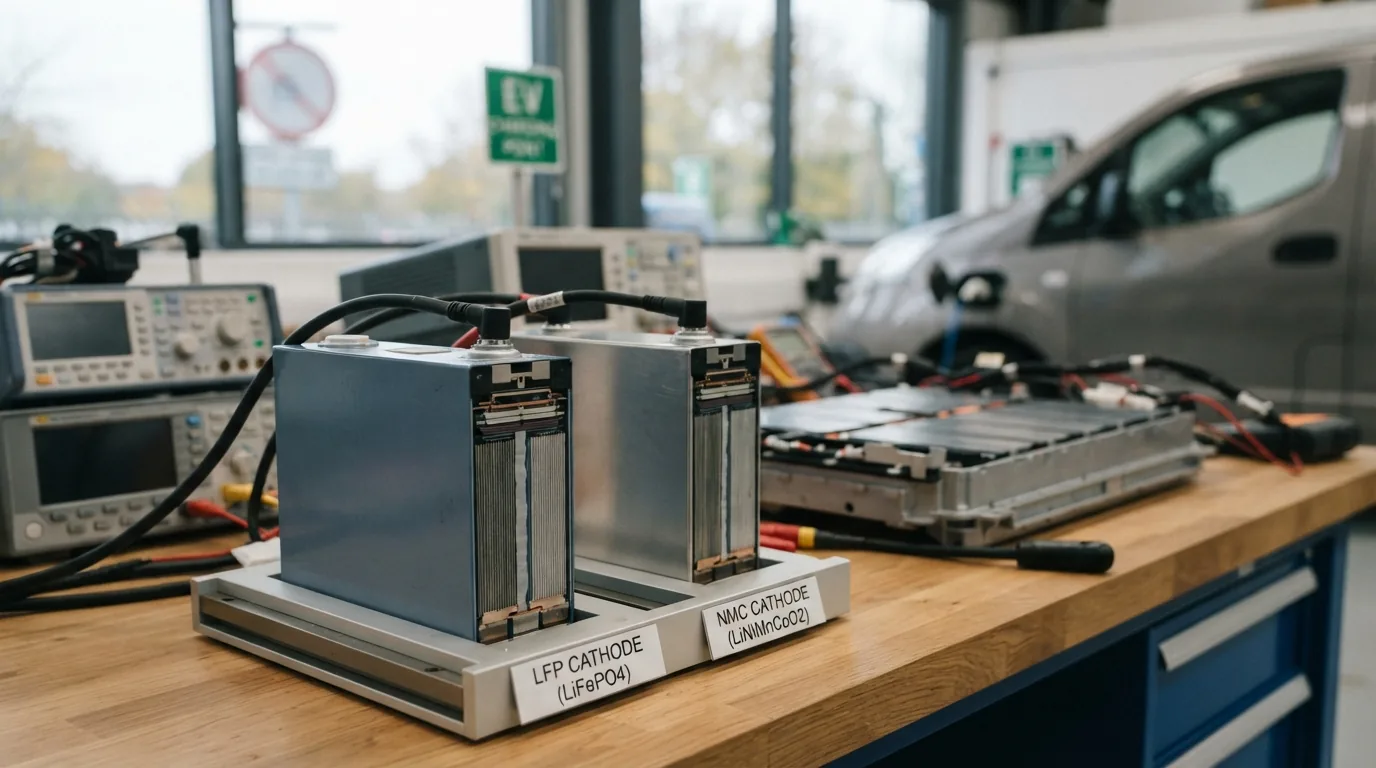
- What is LFP chemistry: LFP stands for lithium iron phosphate, referring to the cathode material: lithium iron phosphate (LiFePO4).
- What is NMC chemistry: NMC (lithium nickel manganese cobalt oxide) uses a mixed-metal cathode.
- Which UK models use LFP: LFP has moved from being a budget-only chemistry to appearing in mainstream family cars.
- The myth to correct: many new EV owners set their NMC car's charge limit to 80% and think they are missing out on range.
- The difference narrows if the battery is preconditioned: warming the pack before driving or before a fast charge session restores most of the cold-weather performance loss in both chemistries.
LFP (lithium iron phosphate) and NMC (nickel manganese cobalt) are the two most common battery chemistries in UK electric cars. LFP is cheaper, safer and designed for daily 100% charging; NMC offers higher energy density and better cold-weather performance but prefers to be kept between 20% and 80% for everyday use. The right choice depends on how and where you drive.
What is LFP chemistry?
LFP stands for lithium iron phosphate, referring to the cathode material: lithium iron phosphate (LiFePO4). It is a relatively mature chemistry, developed in the 1990s and now produced at huge scale, primarily in China. The key advantages are thermal stability (the cathode decomposes at around 270°C, versus 210°C for NMC), very long cycle life and the absence of cobalt in the supply chain.
LFP cells cost approximately £65 to £80 per kWh at the cell level in 2026, versus £80 to £120 per kWh for NMC. This cost gap is a significant reason why many budget and mid-range EVs have moved to LFP.
The key drawback is lower energy density. You need more mass and volume to store the same number of kWh as an NMC pack, which means an LFP car must either accept a shorter range or carry a heavier pack. This trade-off is becoming less important as cell engineering improves: BYD’s Blade Battery and CATL’s latest LFP cells have significantly narrowed the density gap.
What is NMC chemistry?
NMC (lithium nickel manganese cobalt oxide) uses a mixed-metal cathode. The specific ratio of nickel, manganese and cobalt varies: NMC 811 (80% nickel, 10% manganese, 10% cobalt) is common in premium long-range applications, while NMC 622 and NMC 532 are used in others. Higher nickel content increases energy density but reduces thermal stability, which is why premium NMC packs invest heavily in thermal management.
NMC is the chemistry in most premium and long-range EVs: the BMW iX, Mercedes EQS, Hyundai IONIQ 6 Long Range, Kia EV6 and many others. The Tesla Model 3 Long Range and Performance use NMC (a variant called NCA, nickel cobalt aluminium, but with similar characteristics).
Side-by-side comparison
| Characteristic | LFP | NMC |
|---|---|---|
| Energy density (typical) | 150–200 Wh/kg | 200–280 Wh/kg |
| Recommended daily charge limit | 100% (no degradation concern) | 80% (100% occasionally) |
| Cycle life (to ~80% capacity) | 3,000–5,000 cycles | 1,500–2,500 cycles |
| Cold weather performance | Lower; range drops 25–35% at 0°C | Better; range drops 15–25% at 0°C |
| Thermal runaway risk | Lower (safer) | Higher (well-managed in modern packs) |
| Contains cobalt? | No | Yes (reducing in newer high-nickel versions) |
| Typical cell cost (2026) | ~£65–£80/kWh | ~£80–£120/kWh |
| SoC gauge accuracy | Less precise; BMS calibration needed | More precise |
Which UK models use LFP?
LFP has moved from being a budget-only chemistry to appearing in mainstream family cars. UK models using LFP batteries in 2026 include:
- Tesla Model 3 Standard Range (RWD): Tesla recommends daily charging to 100% for LFP variants
- BYD Dolphin: 44.9 kWh or 60.4 kWh LFP pack
- BYD Atto 3: 58.56 kWh LFP
- BYD Seal: 82.56 kWh LFP in Standard Range variant
- Citroën ë-C3: 44 kWh LFP
- Leapmotor T03 and C10: LFP throughout the range
- MG4 Standard Range: 51 kWh LFP
Which UK models use NMC?
NMC dominates the longer-range and premium end of the market:
- Tesla Model 3 Long Range and Performance: NCA chemistry (NMC variant)
- Hyundai IONIQ 5 and IONIQ 6 (long range versions): NMC
- Kia EV6 and EV9: NMC
- BMW iX and i4: NMC
- Volkswagen ID.4 and ID.7 (77 kWh versions): NMC
- Mercedes EQS and EQE: NMC
- Audi Q4 e-tron (77 kWh): NMC
Does the chemistry change how you should charge?
Yes, meaningfully.
LFP charging advice: Charge to 100% whenever you need to. The chemistry is engineered for this. Tesla’s own manual for LFP-equipped cars says to set the charge limit to 100% for daily charging and recommends a full charge at least once a week if you are not charging every day. Running the battery down to 0% regularly is still not recommended, but LFP is far more tolerant of a full charge than NMC.
NMC charging advice: For daily home charging, keep the limit at 80%. Full charges are fine for long trips but should not be the daily habit. Avoid leaving an NMC car parked at 100% for more than a day or two when you can help it. Deep discharges (below 10–15%) are also harder on NMC than LFP.
The myth to correct: many new EV owners set their NMC car’s charge limit to 80% and think they are missing out on range. You are not missing out; you are extending battery life. The 20% buffer is built into the car’s real-world range figures in most cases, and driving 80% of the time at 80% state of charge keeps cells in a low-stress condition.
Does chemistry affect cold weather performance?
Yes. LFP is more sensitive to cold. At 0°C, an LFP-equipped car can lose 25 to 35% of its effective range compared to warm conditions. NMC typically loses 15 to 25% over the same temperature drop.
The difference narrows if the battery is preconditioned: warming the pack before driving or before a fast charge session restores most of the cold-weather performance loss in both chemistries. For UK drivers who commute short distances on cold mornings and charge at home, preconditioning (set a departure time in the car’s app) is the practical fix.
What you should not do with any chemistry in cold weather is attempt to fast-charge a deeply cold battery. The BMS will limit the charge rate to protect the cells, and a very cold LFP pack may only accept 20–30% of its peak charge rate until it warms up.
Does chemistry affect battery longevity?
LFP wins clearly on cycle life. Rated for 3,000 to 5,000 full equivalent cycles versus 1,500 to 2,500 for NMC means an LFP car used for 10,000 miles per year (roughly 50 to 100 full cycles annually for a 40–60 kWh pack) could sustain its cycle life for 30 to 100 years in theory, well beyond the life of the car. The thermal stability advantage compounds this: LFP packs are less susceptible to the heat-driven degradation that is the primary cause of capacity fade in the real world.
In practice, real-world monitoring data from services tracking UK EVs suggests most well-managed NMC packs retain 85–90% capacity after eight years of normal use. LFP packs tend to show even less degradation over the same period.
Which chemistry is right for you?
Choose LFP if:
- Most of your daily driving is under 80 miles
- You charge at home overnight and want simplicity (charge to 100% every night, done)
- Budget is a priority and you want the cheapest lease or purchase price
- You want the lowest long-term maintenance risk
Choose NMC if:
- You frequently drive 200+ miles between charges and need maximum range per charge
- You regularly travel in winter and do not have indoor parking or easy preconditioning
- You want a premium long-range EV where NMC is the only available chemistry
- Charging speed (kW) is critical, as NMC packs often have higher peak charge rates
For more on how batteries work in practice, see our how EV batteries work guide and the full EV tech and apps hub. For app recommendations to help you manage charging, see our best EV charging apps roundup.
How we test and where our numbers come from
Range figures are official WLTP combined values taken from manufacturer UK specification pages, with real-world estimates drawn from independent comparative testing. Prices are UK list prices at the time of the latest update. Tax, grant and charging-scheme figures come from GOV.UK and HMRC publications. We re-check every guide when pricing, specification or policy changes. Last checked 11 August 2026.
Frequently asked questions
What is LFP chemistry?
LFP stands for lithium iron phosphate, referring to the cathode material: lithium iron phosphate (LiFePO4). It is a relatively mature chemistry, developed in the 1990s and now produced at huge scale, primarily in China.
What is NMC chemistry?
NMC (lithium nickel manganese cobalt oxide) uses a mixed-metal cathode. The specific ratio of nickel, manganese and cobalt varies: NMC 811 (80% nickel, 10% manganese, 10% cobalt) is common in premium long-range applications, while NMC 622 and NMC 532 are used in others.
Does the chemistry change how you should charge?
The myth to correct: many new EV owners set their NMC car's charge limit to 80% and think they are missing out on range. You are not missing out; you are extending battery life.
Does chemistry affect cold weather performance?
The difference narrows if the battery is preconditioned: warming the pack before driving or before a fast charge session restores most of the cold-weather performance loss in both chemistries.
Does chemistry affect battery longevity?
LFP wins clearly on cycle life. Rated for 3,000 to 5,000 full equivalent cycles versus 1,500 to 2,500 for NMC means an LFP car used for 10,000 miles per year (roughly 50 to 100 full cycles annually for a 40–60 kWh pack) could sustain its cycle life for 30 to 100 years in theory, well beyond the life of the car.

EV Compared
The EV Compared editorial team tracks the UK electric vehicle market full time: new model launches, list prices, WLTP and real-world range, public charging tariffs and the tax rules that decide what an EV actually costs to run. Every guide is checked against manufacturer specifications and official GOV.UK figures, and updated whenever the numbers move.
Related reading
View all
Apple CarPlay vs Built In EV Software: Which Is Better?
Apple CarPlay is familiar and loved, but built-in EV software controls your battery, charging and range. We explain when each wins and which cars get the balance right.

Best Apps to Find EV Chargers in the UK
With over 120,000 public charge points in the UK, the right app makes the difference between a smooth charging stop and a wasted detour. Here are the options ranked
What Is Bidirectional Charging and Can It Power Your Home?
Bidirectional charging lets your electric car act as a home battery or feed the national grid. Here is how it works, what it costs and which UK cars support it in 2026