What Is Charge Point Etiquette in the UK?
The unwritten rules and legal realities of public EV charging, from ICEing to idle fees
Quick answers
- Charge point etiquette is a set of broadly agreed behaviours around public EV charging that keep the experience fair and frustration-free for everyone.
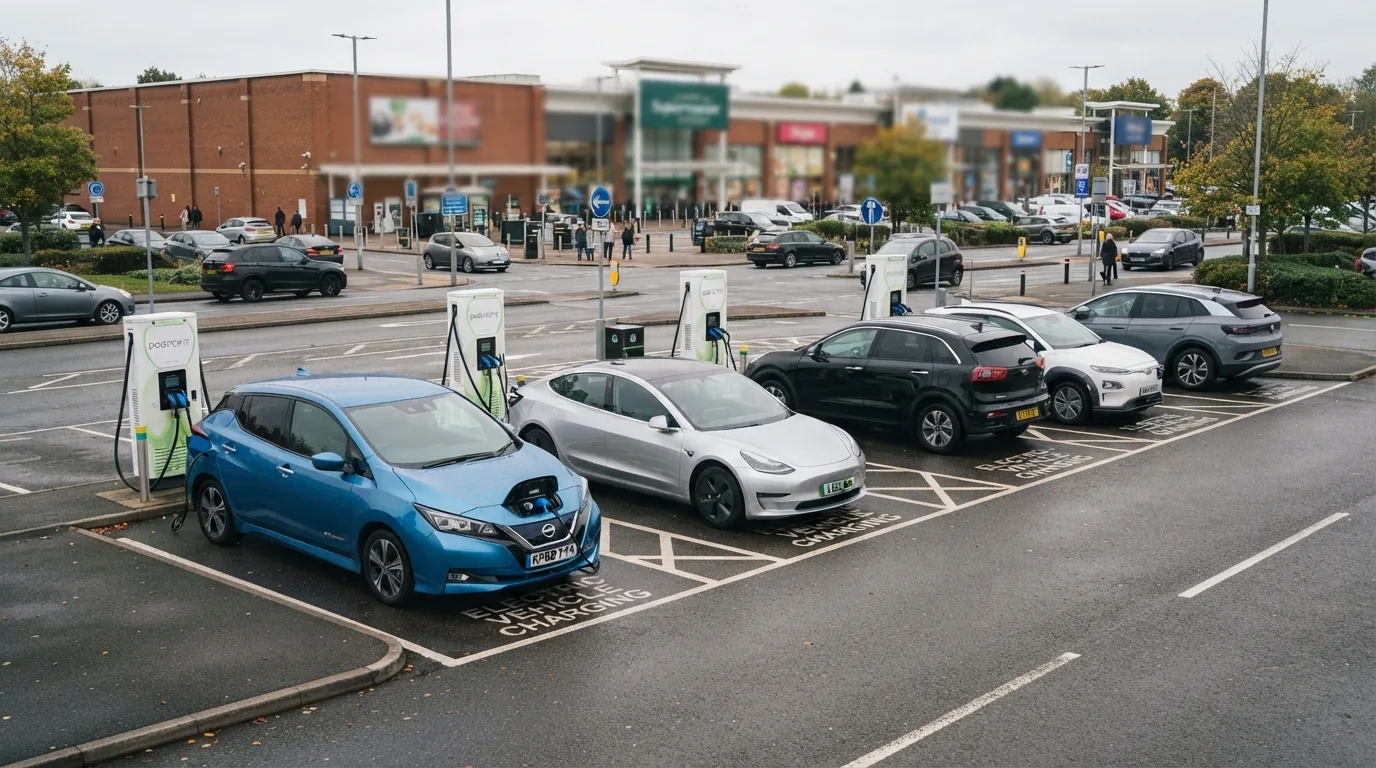
- ICEing is when a petrol or diesel vehicle (an internal combustion engine car) parks in an EV charging bay, blocking access to the infrastructure.
- The exception is if the car's owner is present and gives explicit permission.
- What are idle fees and how do they work: Idle fees are charges levied by the network after your charging session has ended and you have left your car plugged in without charging.
- What is the "80% rule": The 80% rule is an informal guideline that says EV drivers should charge to 80% at rapid chargers on a shared site, then free the bay, rather than occupying the charger while the battery slowly fills the last 20%.
- Many UK rapid chargers have two cables and two bays but can only charge one car at full power at once.
Charge point etiquette is a set of broadly agreed behaviours around public EV charging that keep the experience fair and frustration-free for everyone. Unlike the highway code, most of it is not law, but some aspects now have real financial and legal consequences, including idle fees that can exceed £20, council fines of up to £130, and the social displeasure of an EV community that notices when someone overstays a rapid charger. Here is what you need to know.
What is ICEing and what can you do about it?
ICEing is when a petrol or diesel vehicle (an internal combustion engine car) parks in an EV charging bay, blocking access to the infrastructure. It is the most common complaint among public charging users and it is genuinely frustrating because it is not always possible to find another rapid charger within easy reach.
What you can do depends on the car park:
- Private car parks (supermarkets, retail parks, NCP): The operator can issue a private parking charge notice, typically £50 to £100. Report the vehicle to the site’s car park attendant or operator helpline. Most private operators have an enforcement process.
- Council-operated car parks and on-street bays: An ICEd charging bay is a parking contravention. The council can issue a Penalty Charge Notice of £70 to £130, depending on the area. Contact the council parking hotline.
- Do not move or unplug the blocking vehicle. You have no legal right to do so, and doing so may expose you to liability.
Reporting via the Zap-Map app is also useful: marking a charger as obstructed lets other drivers know before they travel to the site.
Should you unplug another EV that has finished charging?
No. Unplugging someone else’s car without their permission is considered bad practice and potentially unlawful in some circumstances. Even if an EV has clearly finished charging and is simply occupying the bay, you should not unplug it. Contact the charging network’s helpline; some operators can remotely trigger the charger to unlock the cable once a session is complete, but this varies by hardware.
The exception is if the car’s owner is present and gives explicit permission. In that case, a quick conversation solves the problem far better than an unannounced unplug.
What are idle fees and how do they work?
Idle fees are charges levied by the network after your charging session has ended and you have left your car plugged in without charging. They exist because charging bays are a scarce resource at busy sites, and an EV sitting in a rapid charger bay for 20 minutes after reaching 80% occupies infrastructure that someone else needs.
Key idle fee examples in 2026:
| Network | Idle fee policy |
|---|---|
| Tesla Supercharger | 50p per minute when station is over 50% full; waived if you move within 5 minutes |
| BP Pulse | £10 if your car remains in the bay after 90 minutes at some rapid chargers |
| Osprey | No idle fees currently, but it reserves the right to introduce them |
| Islington Council (on-street) | £130 fine if EV stays in charging bay more than 10 minutes after session ends |
The practical lesson is simple: once your car reaches your target state of charge (usually 80–85% for a journey), move your car promptly. If you cannot do so immediately, set an alarm on your phone. An extra 30 minutes of charging above 80% rarely adds meaningful range but can cost you £10 or more at busier networks.
What is the “80% rule”?
The 80% rule is an informal guideline that says EV drivers should charge to 80% at rapid chargers on a shared site, then free the bay, rather than occupying the charger while the battery slowly fills the last 20%. This makes sense for several reasons:
- Charging slows significantly above 80%: The battery management system tapers the charge rate from around 70 to 75% upwards, so the last 20% takes disproportionately long at a rapid charger.
- It keeps bays available: At a busy motorway stop, one driver charging from 70 to 100% can block a bay for 30 to 45 extra minutes unnecessarily.
- It is better for battery health: Regularly charging to 100% accelerates battery degradation more than charging to 80%.
There is no law requiring you to stop at 80%, and on a long journey you may genuinely need more. The point is to be aware of the impact and move on when you reasonably can.
Is it acceptable to use only one cable at a dual-headed charger?
Many UK rapid chargers have two cables and two bays but can only charge one car at full power at once. Others genuinely provide full power to both simultaneously. Check the network’s charger spec before assuming. If a charger at a site is limited to one simultaneous session, and both bays are showing the same unit, be aware that plugging in when someone is already charging may result in a slower rate for both of you.
Networks are improving hardware and installation design to reduce power-sharing issues at popular sites.
Should you always charge in an EV-only bay?
If you drive an EV, yes, you should use the EV bay. Many EV charging bays are dual-use: open to any vehicle as a parking space but with the charger available for EVs only. Parking in an EV bay without intending to charge (or if your car is not an EV) is poor form and increasingly enforced.
Some EV drivers themselves take charging bays after they finish their session and do not need more charge, purely for the parking convenience. This is also poor etiquette when alternative parking is available and other EVs may need to charge.
What if another driver is rude or confrontational?
Conflicts at charge points, while rare, do happen. If another driver is aggressive or confrontational, do not engage with the dispute. Report obstructions or antisocial behaviour to the car park operator or via the charging network’s helpline. Keep a record (time, location, registration plate if relevant) in case formal enforcement is needed.
The one thing most new EV drivers forget
The most commonly overlooked aspect of charge point etiquette is checking in on Zap-Map after a session. Posting a brief “working, 10 minute wait, paying fine” update takes 20 seconds and is enormously useful to every other EV driver planning to visit that charger in the next few hours. The real-time accuracy of Zap-Map depends on drivers sharing their experience, and communities that do so have far fewer wasted journeys.
Where to find out more
For the full picture on how the UK public charging network works, visit our Public Charging guide.
For a ranked guide to the most reliable networks, see Best Public EV Charging Networks in the UK.
How we test and where our numbers come from
Range figures are official WLTP combined values taken from manufacturer UK specification pages, with real-world estimates drawn from independent comparative testing. Prices are UK list prices at the time of the latest update. Tax, grant and charging-scheme figures come from GOV.UK and HMRC publications. We re-check every guide when pricing, specification or policy changes. Last checked 11 August 2026.
Frequently asked questions
What is ICEing and what can you do about it?
ICEing is when a petrol or diesel vehicle (an internal combustion engine car) parks in an EV charging bay, blocking access to the infrastructure. It is the most common complaint among public charging users and it is genuinely frustrating because it is not always possible to find another rapid charger within easy reach.
Should you unplug another EV that has finished charging?
No. Unplugging someone else's car without their permission is considered bad practice and potentially unlawful in some circumstances.
What are idle fees and how do they work?
Idle fees are charges levied by the network after your charging session has ended and you have left your car plugged in without charging. They exist because charging bays are a scarce resource at busy sites, and an EV sitting in a rapid charger bay for 20 minutes after reaching 80% occupies infrastructure that someone else needs.
What is the "80% rule"?
There is no law requiring you to stop at 80%, and on a long journey you may genuinely need more. The point is to be aware of the impact and move on when you reasonably can.
Is it acceptable to use only one cable at a dual-headed charger?
Many UK rapid chargers have two cables and two bays but can only charge one car at full power at once. Others genuinely provide full power to both simultaneously.
Sources and further reading
- rac.co.ukRACPrimary source referenced in this article.

EV Compared
The EV Compared editorial team tracks the UK electric vehicle market full time: new model launches, list prices, WLTP and real-world range, public charging tariffs and the tax rules that decide what an EV actually costs to run. Every guide is checked against manufacturer specifications and official GOV.UK figures, and updated whenever the numbers move.
Related reading
View all
BP Pulse vs Shell Recharge: Which UK Network Wins?
Two of the UK's biggest charging networks compared on price, reliability and which type of driver each suits
Can You Charge Any EV at Any Public Charger in the UK?
Why almost any new EV works at almost any UK public charger, and the two exceptions you need to know
Can You Charge an EV From a Three-Pin Plug in the UK?
Yes, most cars ship with the cable, but speed and safety limits mean it works best for occasional or emergency use