Can You Charge Any EV at Any Public Charger in the UK?
Why almost any new EV works at almost any UK public charger, and the two exceptions you need to know
Quick answers
- In practice, almost any new EV can use almost any UK public charger: Type 2 covers AC, CCS Combo 2 covers DC rapid charging.
- The only real hardware exceptions are older CHAdeMO-only cars and a few older AC cars needing a Type 1 to Type 2 cable.
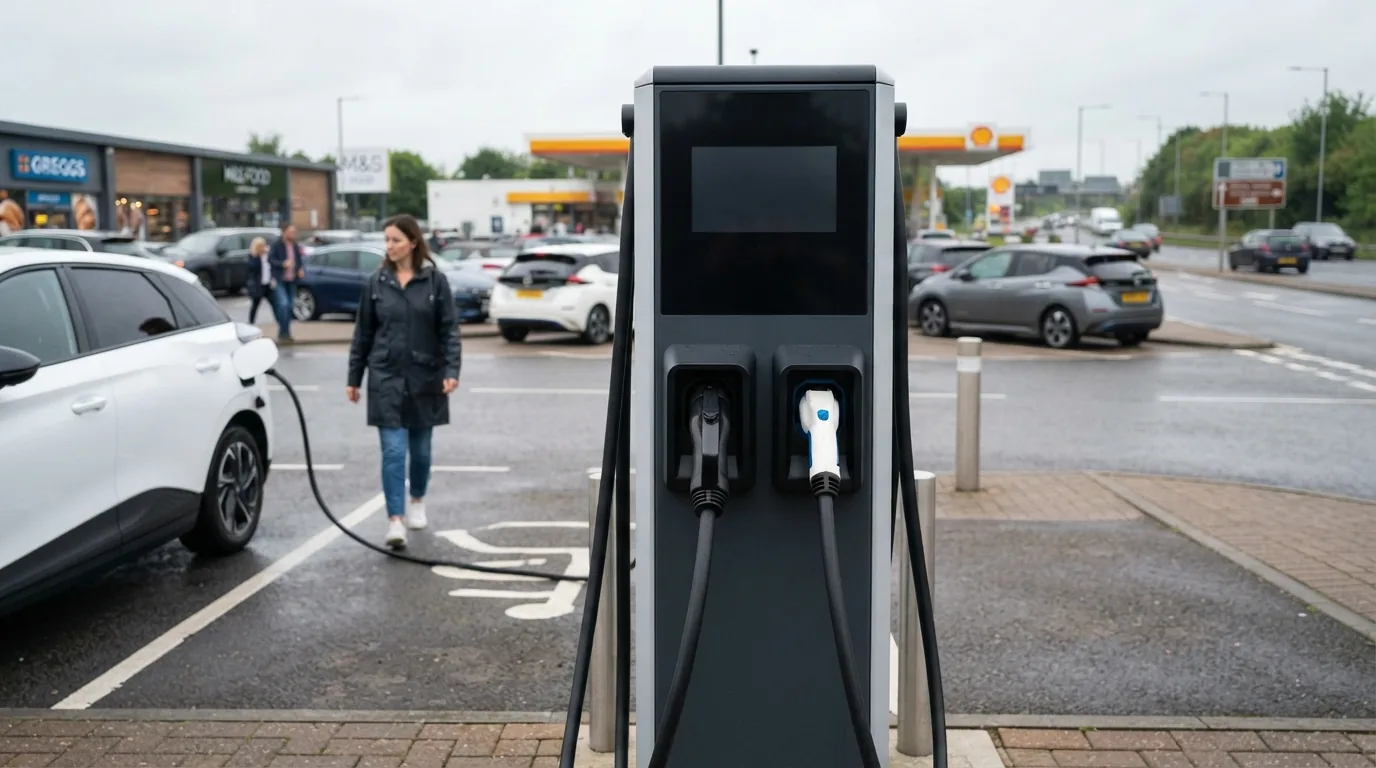
- Rapid and ultra-rapid chargers come with tethered cables; many slower AC posts do not, so carry your own Type 2 cable.
- Non-Tesla cars can now charge at a growing list of UK Tesla Supercharger sites via the Tesla app, but not all sites are open.
- Payment is standardised by law: chargers of 8kW and above must take contactless, show the price in p/kWh upfront, and rapid networks must hit 99% reliability.
In practice, yes. Almost any new EV can use almost any UK public charger because the country has standardised on Type 2 for AC charging and CCS Combo 2 for DC rapid charging. The two real exceptions are older CHAdeMO-only cars and situations where an untethered AC post requires you to bring your own cable. Payment access is also now standardised: under the Public Charge Point Regulations 2023, contactless bank card payment is legally required on all chargers of 8kW and above.
As of early 2026, Zapmap counts 120,388 public chargers across 46,333 UK locations, including 28,089 rapid or ultra-rapid units. The physical standards that cover the vast majority of those chargers are Type 2, CCS Combo 2, and to a declining extent, CHAdeMO. Tesla Supercharger infrastructure runs alongside these, with a growing number of sites now open to non-Tesla cars.
So can you charge any EV at any public charger, in plain terms?
For most drivers with a car bought in the last few years, the answer is yes. The UK has settled on two dominant standards: Type 2 for AC charging and CCS Combo 2 for DC rapid and ultra-rapid charging. If your car can use both, the public network is essentially open to you.
Can you charge any electric car at any charging station? Nearly, but not quite. The exceptions are narrow:
- Older CHAdeMO-only cars (for example, an early Nissan Leaf) cannot use CCS rapid chargers, only CHAdeMO posts, which are now being phased out.
- Some older AC cars were built with a Type 1 inlet, not Type 2. They can still use UK public AC posts, but only with a Type 1 to Type 2 cable, which you must carry yourself.
- Type 2 AC posts that are untethered require you to plug in your own cable, regardless of which car you drive.
For anyone who bought a mainstream EV in the last three to four years, type 2 versus CCS is the only distinction to understand: Type 2 for slower AC charging, CCS for rapid DC.
What connector does your EV use, and what fits each charger?
Your car’s inlet type decides which chargers it can physically connect to. AC charging is near-universal for modern cars; DC rapid charging depends entirely on whether you have CCS or CHAdeMO.
The table below covers every EV connector type you will encounter in the UK. Do all EVs use the same connector? No, but the spread has narrowed significantly, and CHAdeMO is being phased out.
| Connector | Current type | Typical power | Found on which chargers | Compatible cars |
|---|---|---|---|---|
| Type 1 | AC | Up to 7.4kW | Some older AC posts | A few older EVs, eg early Nissan Leaf (needs Type 1 to Type 2 cable) |
| Type 2 (Mennekes) | AC | 3.7kW to 22kW (rarely 43kW) | Almost all home, on-street and destination AC chargers | Almost all EVs and PHEVs |
| CCS Combo 2 | DC | 50kW to 350kW+ | Almost all rapid and ultra-rapid chargers | Almost all new EVs sold in UK/Europe |
| CHAdeMO | DC | Mostly 50kW | Many older rapid units, being phased out | Older Japanese models, eg early Nissan Leaf |
| Tesla (Type 2 / CCS) | AC and DC | Up to 250kW (Supercharger) | Tesla destination and Supercharger sites | Tesla; some sites now open to CCS cars |
Type 2 (Mennekes, the 7-pin standard) runs from 3.7kW to 22kW, with rare 43kW AC units. CCS Combo 2 adds two DC pins beneath the Type 2 shape and supports 50kW to 350kW or more at rapid and ultra-rapid sites. CHAdeMO sits at mostly 50kW, is found on older rapid units, and covers a shrinking number of older Japanese models. Type 1 (5-pin) is an older AC connector, up to 7.4kW, used by a small number of older cars; it needs a Type 1 to Type 2 cable for UK public posts.
Do you need to bring your own charging cable?
This is a practical trap worth understanding before you set off. Whether you need a cable depends on the type of charger you plan to use, not on your car alone.
- Rapid and ultra-rapid DC chargers come with tethered cables. Select the CCS or CHAdeMO lead that fits your inlet and plug in. You need nothing of your own.
- Many slower AC posts, including lamp-post chargers, on-street bays and destination chargers at hotels or car parks, are untethered. You connect your own cable between the post and your car.
- Always carry a Type 2 to Type 2 cable if your car has a Type 2 inlet (which covers almost all modern EVs and PHEVs). Carry a Type 1 to Type 2 cable only if your car has a Type 1 inlet.
Check before you travel. Zapmap shows whether each listed charge point is tethered or untethered, so you can confirm what you will need for any specific stop.
Can non-Tesla cars charge at Tesla Superchargers in the UK?
Yes, at a growing number of UK sites, and the process is straightforward if your car has a CCS inlet. Tesla has opened a growing list of UK Supercharger sites to non-Tesla EVs with CCS, accessed through the Tesla app.
Some early sites used a Magic Dock built-in adapter for CCS cars; UK non-Tesla access is now mostly handled through app-based stall selection rather than a physical adapter at the post. The key points to remember:
- Download the Tesla app and set up an account before you arrive.
- Not every UK Supercharger site is open to non-Tesla EVs; the list changes as Tesla expands access progressively.
- Always check the Tesla app before relying on a specific Supercharger site, particularly if it is the only rapid option on your route.
Because the open-site list changes frequently, do not rely on any published list of specific locations as permanently current. The app reflects live availability.
How do you pay, and will every charger let you in?
Access is the second half of compatibility, and the Public Charge Point Regulations 2023 have transformed it. Since 24 November 2024, all public chargers rated at 8kW and above must accept contactless bank card payment. For most rapid and ultra-rapid charging, that means you can pull up, tap your card and start charging without any app, account or RFID card.
The regulations go further than just contactless:
- Transparent pricing: operators must display the maximum price in pence per kWh before charging starts, and cannot raise that price mid-charge.
- Roaming: from 24 November 2025, operators must support payment via at least one third-party roaming provider, which means accessing multiple networks through a single platform becomes a legal right, not a commercial nicety.
- Reliability: rapid charge points (50kW and above) must achieve 99% reliability, measured as an average across each operator’s rapid network over the calendar year, with annual reports from 2026 covering 2025 data.
- Helpline: operators must provide a free, staffed 24/7 telephone helpline with real-time assistance.
You can also pay by network app or RFID card if you prefer, or for potentially lower rates. But contactless means no account is needed at most rapid chargers today.
Once you know your car can physically connect, the next question is which operator to use. Our guide to the best public EV charging networks in the UK ranks them on reliability, pricing and motorway coverage.
What should you check before pulling up to a charger?
A short pre-arrival checklist removes almost all compatibility uncertainty:
- Confirm your inlet type: Type 2 and CCS for new cars; Type 1 or CHAdeMO for older ones. Check your car’s manual or charge port if unsure.
- Use Zapmap to confirm the connector type, charging speed and live availability at your chosen stop before you arrive. Zapmap shows EV connector types in real time across the UK network.
- Carry a Type 2 cable for untethered AC posts. If your car has a Type 1 inlet, also carry a Type 1 to Type 2 cable.
- Check the Tesla app if you plan to use a Supercharger in a non-Tesla car, to confirm the site is open to other brands.
- Contactless is available at any compliant rapid charger (8kW and above), so you do not need a network account as a fallback.
For a broader look at how the UK public charging system works, including network maps and charger types by location, see our public charging guide.
Now you know your car will connect at almost any UK public charger, the practical decision is which operator gives you the best reliability and price for your driving pattern. Our guide to the best public EV charging networks in the UK compares the major operators on motorway coverage, pricing, contactless availability and real-world uptime.
Useful Resources
Zapmap connector types guide https://www.zapmap.com/ev-guides/connector-types/
GOV.UK Public Charge Point Regulations 2023 guidance https://www.gov.uk/government/publications/the-public-charge-point-regulations-2023-guidance/public-charge-point-regulations-2023-guidance
RAC charger types, connectors and speeds https://www.rac.co.uk/drive/electric-cars/charging/charger-types-connectors-speed/
Tesla UK non-Tesla Supercharging https://www.tesla.com/en_gb/support/non-tesla-supercharging
Zapmap UK charging statistics https://www.zapmap.com/ev-stats/how-many-charging-points
How we test and where our numbers come from
Range figures are official WLTP combined values taken from manufacturer UK specification pages, with real-world estimates drawn from independent comparative testing. Prices are UK list prices at the time of the latest update. Tax, grant and charging-scheme figures come from GOV.UK and HMRC publications. We re-check every guide when pricing, specification or policy changes. Last checked 11 August 2026.
Frequently asked questions
Can you charge any electric car at any charging station?
Almost any new EV can use almost any UK public charger, because the country has standardised on Type 2 for AC and CCS Combo 2 for DC rapid charging. The two exceptions are older CHAdeMO-only cars, which cannot use CCS posts, and untethered AC posts, which require you to bring your own Type 2 cable. For cars bought in the last few years, compatibility is rarely a practical problem.
Do all EVs use the same connector?
No. New EVs sold in the UK use Type 2 for AC charging and CCS Combo 2 for DC rapid charging, which is why they are broadly interchangeable across the public network. Some older cars use a Type 1 inlet for AC, and some older models use CHAdeMO for DC rapid charging rather than CCS.
Can a non-Tesla use a Tesla Supercharger in the UK?
Yes, at a growing number of UK Supercharger sites that Tesla has opened to non-Tesla EVs with CCS, accessed through the Tesla app. Not every site is open to other brands and the list changes as Tesla expands access progressively, so check the app before relying on a specific Supercharger location.
How do you pay at a public EV charger in the UK?
Under the Public Charge Point Regulations 2023, all public chargers rated at 8kW and above must accept contactless bank card payment, which has been in force since 24 November 2024. You can also pay by network app or RFID card, and some drivers use roaming platforms to access multiple networks through a single account. Contactless means no account is needed at most rapid chargers.
Do you need to bring your own cable to charge an EV in public?
For rapid and ultra-rapid DC chargers, no: they come with tethered CCS (and often CHAdeMO) cables, so you simply select the one that fits. For many slower AC posts, including on-street and destination chargers, you do need your own Type 2 cable. Always carry one if your car has a Type 2 inlet, which covers almost all modern EVs and PHEVs.
Sources and further reading
- gov.ukGOV.UKPrimary source referenced in this article.

EV Compared
The EV Compared editorial team tracks the UK electric vehicle market full time: new model launches, list prices, WLTP and real-world range, public charging tariffs and the tax rules that decide what an EV actually costs to run. Every guide is checked against manufacturer specifications and official GOV.UK figures, and updated whenever the numbers move.
Related reading
View all
BP Pulse vs Shell Recharge: Which UK Network Wins?
Two of the UK's biggest charging networks compared on price, reliability and which type of driver each suits
Can You Charge an EV From a Three-Pin Plug in the UK?
Yes, most cars ship with the cable, but speed and safety limits mean it works best for occasional or emergency use
What Is Charge Point Etiquette in the UK?
The unwritten rules and legal realities of public EV charging, from ICEing to idle fees