BP Pulse vs Shell Recharge: Which UK Network Wins?
Two of the UK's biggest charging networks compared on price, reliability and which type of driver each suits
Quick answers
- BP Pulse and Shell Recharge are the two large-network operators most closely associated with traditional fuel companies entering EV charging.
- Shell Recharge is the UK's largest charging network by total chargepoint count, primarily because it absorbed Ubitricity's extensive on-street lamppost charging network.
- BP Pulse's PAYG contactless rate of 89p per kWh is one of the highest among major UK rapid networks, rivalled only by InstaVolt's peak rate.
- Reliability: both have work to do: This is the most important area for practical day-to-day use, and it is where both networks have the most room for improvement.
- User experience: BP Pulse's app and payment experience has historically been more problematic than average: users report payment terminal issues, session authentication failures and poor helpline response at older sites.
- The realistic verdict: BP Pulse and Shell Recharge are big-network operators that cover more of the UK than many alternatives, but coverage is not the same as quality.
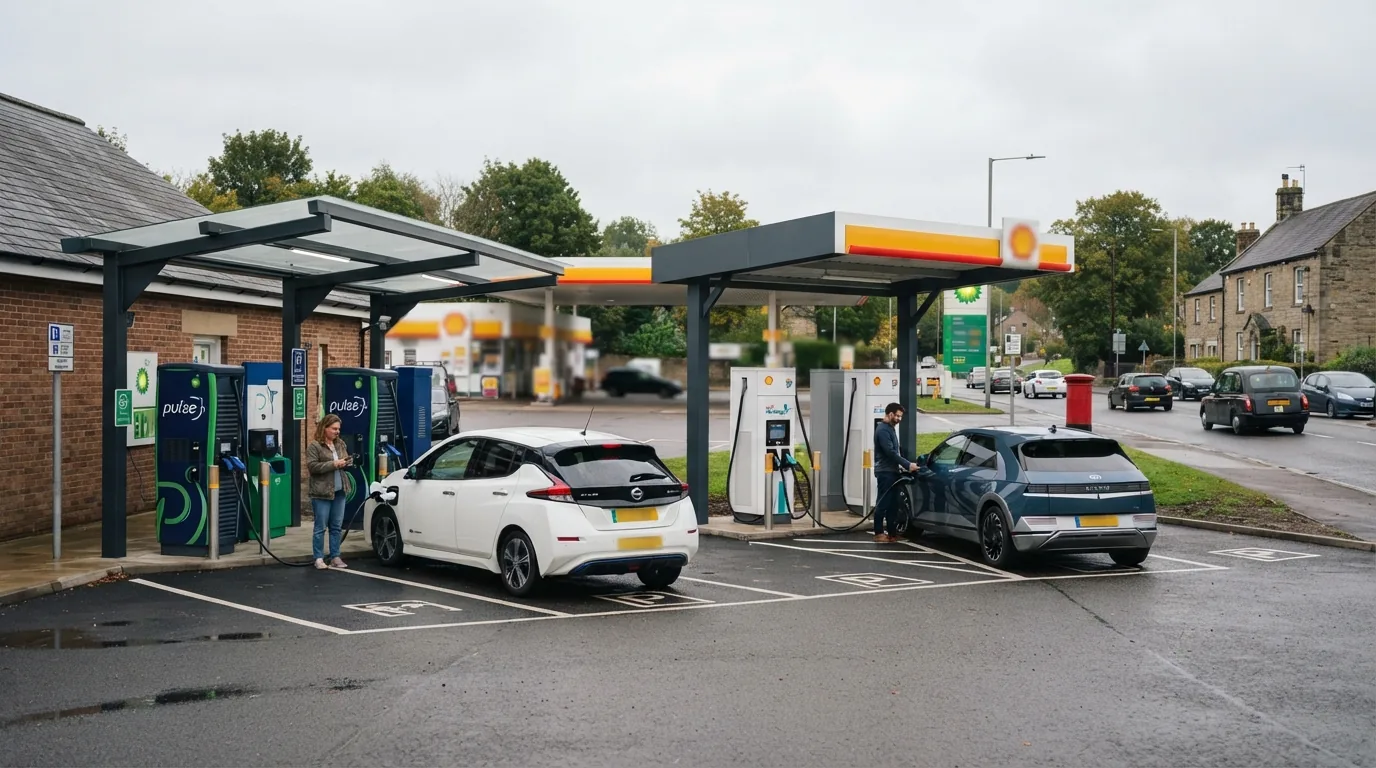
BP Pulse and Shell Recharge are the two large-network operators most closely associated with traditional fuel companies entering EV charging. Both have enormous chargepoint footprints, BP Pulse with around 2,491 rapid units plus slower chargers, Shell Recharge with approximately 14,500 chargepoints overall through its absorption of Ubitricity’s on-street estate. Both have also attracted criticism for reliability. This comparison tells you where each network genuinely performs and which is the better choice for your driving pattern.
Bottom line: Shell Recharge wins on urban and on-street coverage. BP Pulse wins on subscription savings if you regularly use its motorway rapid chargers. Neither is the best network for reliability, InstaVolt, Osprey and Tesla are the benchmarks for that.
Head to head: the key numbers
| Factor | BP Pulse | Shell Recharge |
|---|---|---|
| Total UK chargepoints | ~2,491 rapid + legacy slower | ~14,500 (mostly on-street and slow) |
| Rapid/ultra-rapid power | Up to 150 kW | Up to 150 kW (selected rapid sites) |
| PAYG rapid rate | 89p/kWh | 79p/kWh |
| PAYG slow/AC rate | 65p/kWh | 52–85p/kWh (Ubitricity on-street) |
| Subscription fee | £7.85/month | £9.99/month |
| Subscriber rapid rate | 69p/kWh | ~56p/kWh (30% off) |
| Connection fee | No | No |
| Typical locations | Motorway services, BP forecourts | On-street, retail, urban car parks |
| Reliability (user surveys) | Mixed–poor on older kit | Mixed on-street; better at dedicated rapid |
| Published uptime data | Limited | Limited |
Coverage: Shell Recharge is bigger, BP Pulse has better motorway rapid coverage
Shell Recharge is the UK’s largest charging network by total chargepoint count, primarily because it absorbed Ubitricity’s extensive on-street lamppost charging network. This makes Shell Recharge dominant for on-street residential charging in cities, particularly London, where tens of thousands of lamppost chargers are operated under the Shell Recharge Ubitricity brand. For drivers without off-street parking in urban areas, Shell Recharge’s footprint is effectively unmatched.
BP Pulse’s 2,491 rapid chargepoints are a smaller but more focused fleet. BP Pulse is found at BP forecourts, motorway services and some destination locations. It was historically the second-largest rapid charging network after GRIDSERVE, and its motorway presence means it appears on routes where other networks may not.
Winner on overall coverage: Shell Recharge (by total chargepoints, especially on-street). Winner on motorway rapid coverage: Broadly equal, with GRIDSERVE and MFG EV Power both superior to either for motorway-specific rapid charging.
Price: Shell Recharge is cheaper PAYG; BP Pulse subscription is lower-fee
BP Pulse’s PAYG contactless rate of 89p per kWh is one of the highest among major UK rapid networks, rivalled only by InstaVolt’s peak rate. The £7.85/month subscription drops this to 69p per kWh, a saving of 20p per kWh. At that saving, a driver charging 50 kWh per month at rapid speed breaks even on the subscription after around 2 full charge sessions.
Shell Recharge’s PAYG rate of 79p per kWh for rapid chargers is 10p per kWh cheaper than BP Pulse contactless, giving a lower entry cost for occasional users. The £9.99/month subscription (30% off app pricing) brings the rate to around 56p per kWh for regular users, significantly cheaper than BP Pulse’s subscriber rate of 69p per kWh, though at a higher monthly fee.
Example: 40 kWh rapid charge
| Scenario | BP Pulse | Shell Recharge |
|---|---|---|
| PAYG contactless | 40 x 89p = £35.60 | 40 x 79p = £31.60 |
| With subscription | 40 x 69p = £27.60 + £7.85/month | 40 x 56p = £22.40 + £9.99/month |
| Break-even sessions/month | ~2 | ~2–3 |
Winner on PAYG price: Shell Recharge (79p vs 89p per kWh). Winner on subscription value: Shell Recharge subscriber rate (56p) beats BP Pulse (69p), but Shell Recharge’s monthly fee is £2.14 higher. For high-usage drivers, Shell Recharge subscription delivers better savings.
Reliability: both have work to do
This is the most important area for practical day-to-day use, and it is where both networks have the most room for improvement.
BP Pulse received the lowest reliability ratings in multiple independent surveys including What Car? and Parkers in 2025 and early 2026. The 2026 audit of rapid charging operators found BP Pulse among those that did not clearly demonstrate compliance with the 99% reliability standard. The network’s large size encompasses hardware from many different generations and suppliers, and the older kit drags down average reliability significantly. Newer BP Pulse hardware (installed from 2023 onwards) performs better.
Shell Recharge presents a more divided picture. The dedicated rapid charger estate at petrol station locations and retail parks is more reliable than the on-street Ubitricity lamppost estate. On-street lamppost chargers are older on average, harder to maintain at scale, and more prone to connectivity faults. Shell Recharge’s app and payment system have received better scores for ease of use than BP Pulse’s, which is a distinct advantage.
Winner on reliability: Shell Recharge, but marginally. Neither network is a reliability leader; both are mid-tier in this respect. For critical motorway stops, both are better used as backups to InstaVolt, GRIDSERVE or Osprey.
User experience
BP Pulse’s app and payment experience has historically been more problematic than average: users report payment terminal issues, session authentication failures and poor helpline response at older sites. Newer BP Pulse hardware and app updates from 2024 have improved this, but legacy reputation lingers.
Shell Recharge’s contactless payment experience is generally rated better than BP Pulse’s for straightforward sessions. The on-street Ubitricity chargers are simpler devices (lamp post or bollard) that work or do not work, with less complexity in the user interaction than a full screen-equipped rapid charger. Where they are working, they are easy to use.
Who should choose which?
Choose BP Pulse if you:
- Live near or regularly drive past BP forecourts with reliable rapid chargers
- Know specific BP Pulse rapid charger sites that work well for your routes
- Want to pay the lower £7.85/month subscription fee rather than £9.99
Choose Shell Recharge if you:
- Live in a city without off-street parking and need on-street charging as your primary source
- Are in London, where Ubitricity lamppost coverage is extensive
- Want the cheaper PAYG contactless rapid rate (79p vs 89p)
- Use on-street slow charging regularly (Shell Recharge has the best footprint)
Choose neither as your primary network if:
- You want the most reliable rapid charging for a motorway journey (use GRIDSERVE, InstaVolt or Osprey instead)
- You are making a critical long-distance stop and cannot afford a charger fault (use Tesla Supercharger where available)
The realistic verdict
BP Pulse and Shell Recharge are big-network operators that cover more of the UK than many alternatives, but coverage is not the same as quality. For day-to-day on-street urban charging, Shell Recharge’s footprint is genuinely useful and hard to avoid. For rapid charging on longer journeys, both networks are better treated as fallback options than primary choices.
The sensible approach for most EV drivers is to have a Shell Recharge account if you live in a city and regularly need on-street charging, and to know the BP Pulse helpline number (0330 016 5126) for the motorway stops where BP Pulse is the only or most convenient option.
Where to find more
For a full ranking of UK charging networks by reliability and use case, see Best Public EV Charging Networks in the UK.
For an overview of how to choose between UK charging networks for long journeys, visit Best EV Charging Networks for Long Journeys.
For the complete guide to UK public charging, see our Public Charging overview.
How we test and where our numbers come from
Range figures are official WLTP combined values taken from manufacturer UK specification pages, with real-world estimates drawn from independent comparative testing. Prices are UK list prices at the time of the latest update. Tax, grant and charging-scheme figures come from GOV.UK and HMRC publications. We re-check every guide when pricing, specification or policy changes. Last checked 11 August 2026.
Sources and further reading
- zapmap.comZap-MapPrimary source referenced in this article.

EV Compared
The EV Compared editorial team tracks the UK electric vehicle market full time: new model launches, list prices, WLTP and real-world range, public charging tariffs and the tax rules that decide what an EV actually costs to run. Every guide is checked against manufacturer specifications and official GOV.UK figures, and updated whenever the numbers move.
Related reading
View all
Can You Charge Any EV at Any Public Charger in the UK?
Why almost any new EV works at almost any UK public charger, and the two exceptions you need to know
Can You Charge an EV From a Three-Pin Plug in the UK?
Yes, most cars ship with the cable, but speed and safety limits mean it works best for occasional or emergency use
What Is Charge Point Etiquette in the UK?
The unwritten rules and legal realities of public EV charging, from ICEing to idle fees