Best EV Charging Networks for Long Journeys in the UK
Which networks to rely on for motorway miles, multi-stop routes and trips to Scotland
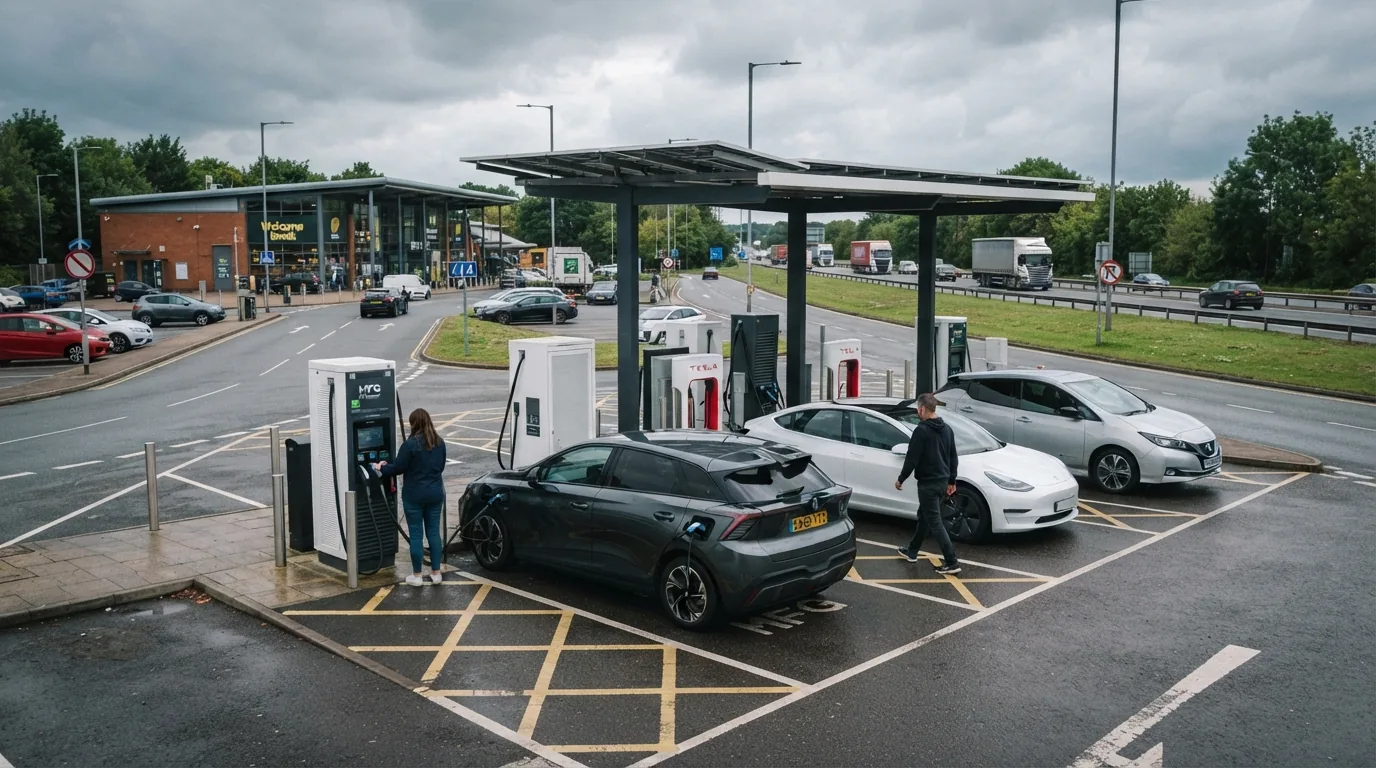
Quick answers
- A long journey in an EV is only as good as the charging infrastructure on your route. For most UK drivers, "long journey" means 150 to 400 miles with one or two planned charging stops.
- Networks that score well on all four, GRIDSERVE, Tesla Supercharger and IONITY, are the ones to build your journey planning around.
- GRIDSERVE is present at approximately 85% of UK motorway service stations, making it the default choice for motorway driving.
- Route-by-route network coverage: For every route, use Zap-Map route planner or A Better Route Planner (ABRP) to model your specific car and battery size.
- Where to find more: For a head-to-head comparison of the top networks on reliability specifically, see Best EV Charging Networks for Reliability in Britain.
A long journey in an EV is only as good as the charging infrastructure on your route. For most UK drivers, “long journey” means 150 to 400 miles with one or two planned charging stops. At that scale, you need networks with rapid or ultra-rapid chargers at predictable intervals, consistent reliability, and pricing that does not make the trip financially painful. This guide ranks the best networks for exactly that.
What makes a network good for long journeys?
Four factors matter most:
- Coverage: Are there chargers at the right intervals on your likely routes?
- Speed: Can you add 100 miles of range in 20 to 30 minutes rather than 60?
- Reliability: Will the charger actually work when you arrive?
- Price: Is the cost per kWh reasonable, especially without a subscription?
Networks that score well on all four, GRIDSERVE, Tesla Supercharger and IONITY, are the ones to build your journey planning around. Networks that excel on one or two but fail on others are useful backup options.
The best networks for long-distance driving
1. GRIDSERVE Electric Highway: best for coverage
GRIDSERVE is present at approximately 85% of UK motorway service stations, making it the default choice for motorway driving. No other network comes close to this coverage density on the strategic road network.
What you get:
- 90 kW to 400 kW hardware at newer Super Hub sites
- Contactless payment accepted at all units
- Live availability via GRIDSERVE app and Zap-Map
- Covered bays, lighting, toilets and Costa Coffee at most sites
What it costs: Around 75p per kWh PAYG. No subscription needed, no membership required.
The weak point: Older GRIDSERVE sites that still use refurbished Ecotricity hardware have lower reliability than new-build Super Hubs. For critical stops, use Zap-Map user comments to judge the specific site.
New Super Hub sites opening through late 2026 at Beaconsfield, Baldock, Cambridge, Cobham, Cullompton, Leeds Skelton Lake and Peterborough will add 400 kW-capable ultra-rapid bays with 12 to 20+ spaces per site.
Best for: Any long journey on the UK motorway network.
2. IONITY: best value for frequent long-haul drivers
IONITY operates 788 ultra-rapid chargers (150 kW to 350 kW) at Extra motorway services and village hotel car parks. Coverage is more selective than GRIDSERVE but hardware quality is high and pricing on the annual Power plan is unmatched.
What you get:
- Ultra-rapid hardware at 150 kW minimum, up to 350 kW
- Village hotel locations where you can eat inside while the car charges
- Annual Power plan at 43p per kWh, the cheapest rate on any major UK rapid network
What it costs: 74p per kWh PAYG; 43p per kWh with the annual Power plan (~£10.50/month).
The weak point: 788 chargers across the UK means you cannot rely on IONITY as your sole network for every stop. Use it where it is available and supplement with GRIDSERVE elsewhere.
Best for: Planned long journeys on IONITY-served routes where the annual plan pays for itself.
3. Tesla Supercharger: best reliability, best value for Tesla drivers
Tesla’s UK network of around 2,900 chargepoints at 600+ sites is the most reliable rapid charging network in the country. For Tesla owners, pricing (22p to 30p per kWh) and reliability make this the automatic first choice for any long journey.
For non-Tesla EVs, around half of UK Supercharger sockets now accept CCS connections at 45p to 56p per kWh. Non-Tesla access varies by site, so plan with the Tesla app or Zap-Map before committing to a Supercharger stop in a non-Tesla.
The weak point for non-Tesla: Higher pricing than IONITY or InstaVolt off-peak; not all sites are open to non-Tesla yet.
Best for: Tesla drivers on any route; non-Tesla on confirmed open sites.
4. MFG EV Power: best geographic distribution for ultra-rapid
Motor Fuel Group operates around 2,866 ultra-rapid chargepoints (150 kW to 360 kW) at fuel station forecourts, which are often near motorway junctions and A-roads rather than at service areas themselves. This makes MFG a useful alternative when major service areas are busy.
What you get:
- The widest ultra-rapid geographic footprint of any single operator
- 150 kW to 360 kW hardware at most sites
- 24-hour access, forecourt amenities, no membership requirement
What it costs: Around 79p per kWh PAYG. No subscription option currently.
Best for: Supplementary stops when primary networks are full or unavailable; excellent A-road coverage.
5. InstaVolt: best reliability plus off-peak pricing
InstaVolt’s 2,100 rapid and ultra-rapid chargepoints (50 kW to 300 kW) consistently top reliability rankings. No membership is required, contactless works at every unit, and off-peak pricing of 55p per kWh (8pm to 7am via the free app) is one of the best value rapid rates available.
InstaVolt is spread across supermarkets, retail parks and forecourts rather than concentrated at motorway services. It is excellent for stopping in towns and retail areas but may not be the first choice at a motorway service junction.
Best for: Planned stops at retail locations on or near long-distance routes, especially in the evening.
Route-by-route network coverage
Different routes have different network strengths:
| Route | Primary network | Secondary | Notes |
|---|---|---|---|
| M25 / M4 corridor | GRIDSERVE + Tesla | IONITY (Cobham, Reading) | Very well served |
| M1 (London to Leeds) | GRIDSERVE + Tesla | MFG EV Power | Good coverage throughout |
| M6 (Birmingham to Scotland) | GRIDSERVE | BP Pulse + Tesla (Keele, Lancaster) | Good to border; patchy in southern Scotland |
| A1 / East Coast | GRIDSERVE | InstaVolt, MFG | Good in England; thins north of Newcastle |
| M5 (Bristol to Exeter) | GRIDSERVE + IONITY | Tesla | Strong; IONITY at Exeter |
| Scotland (major cities) | GRIDSERVE + ScottishPower | BP Pulse, Osprey | Urban adequate; rural more limited |
| North Wales | GRIDSERVE | BP Pulse | Thinner coverage; plan carefully |
| Devon and Cornwall | GRIDSERVE | BP Pulse | Improving but plan carefully in summer |
For every route, use Zap-Map route planner or A Better Route Planner (ABRP) to model your specific car and battery size. These apps account for range, planned charging stops and charger availability more accurately than any static table.
Planning tips for long journeys
Use two apps: Zap-Map for live availability and user comments; your in-car navigation or ABRP for route modelling.
Always have a backup charger identified for each stop: Never arrive at a service area without knowing where the next nearest charger is, in case your primary is broken or fully occupied.
Charge to 80%, not 100%: Above 80%, most EV batteries taper their acceptance rate significantly. Two shorter charges are faster overall than one charge to 100%.
Set off earlier in the day on summer weekends: Peak charger queuing occurs between 10am and 2pm at busy motorway services. Leaving at 7am or 8am on a Saturday means reliably shorter waits.
Check if your car preconditions: Models from Tesla, Hyundai, Kia, Polestar and BMW automatically warm the battery when you navigate to a fast charger, increasing your acceptance rate on arrival. Enable this feature for faster stops.
Comparison table for long journeys
| Network | UK coverage (motorway) | Typical max speed | PAYG rapid rate | Reliability |
|---|---|---|---|---|
| GRIDSERVE | ~85% of motorways | 400 kW | ~75p/kWh | Good–very good |
| IONITY | Extra MSA locations | 350 kW | 74p/kWh (43p sub) | Good |
| Tesla Supercharger | Selected services + retail | 250 kW | 22–56p/kWh | Excellent |
| MFG EV Power | Very wide (forecourts) | 360 kW | ~79p/kWh | Good |
| InstaVolt | Retail/forecourt (not MSA) | 300 kW | 55–92p/kWh | Very good |
| BP Pulse | Motorway + forecourts | 150 kW | 69–89p/kWh | Mixed |
| Osprey | A-road and retail | 150 kW | 82–87p/kWh | Very good |
Where to find more
For a head-to-head comparison of the top networks on reliability specifically, see Best EV Charging Networks for Reliability in Britain.
For all motorway service area options including which services have the most bays, see Best Motorway Services for EV Charging in the UK.
For the complete guide to UK public charging, visit our Public Charging guide.
For the full network ranking across all use cases, see Best Public EV Charging Networks in the UK.
How we test and where our numbers come from
Range figures are official WLTP combined values taken from manufacturer UK specification pages, with real-world estimates drawn from independent comparative testing. Prices are UK list prices at the time of the latest update. Tax, grant and charging-scheme figures come from GOV.UK and HMRC publications. We re-check every guide when pricing, specification or policy changes. Last checked 11 August 2026.
Frequently asked questions
What makes a network good for long journeys?
Networks that score well on all four, GRIDSERVE, Tesla Supercharger and IONITY, are the ones to build your journey planning around. Networks that excel on one or two but fail on others are useful backup options.
Sources and further reading
- zapmap.comZap-MapPrimary source referenced in this article.

EV Compared
The EV Compared editorial team tracks the UK electric vehicle market full time: new model launches, list prices, WLTP and real-world range, public charging tariffs and the tax rules that decide what an EV actually costs to run. Every guide is checked against manufacturer specifications and official GOV.UK figures, and updated whenever the numbers move.
Related reading
View all
BP Pulse vs Shell Recharge: Which UK Network Wins?
Two of the UK's biggest charging networks compared on price, reliability and which type of driver each suits
Can You Charge Any EV at Any Public Charger in the UK?
Why almost any new EV works at almost any UK public charger, and the two exceptions you need to know
Can You Charge an EV From a Three-Pin Plug in the UK?
Yes, most cars ship with the cable, but speed and safety limits mean it works best for occasional or emergency use