Best Motorway Services for EV Charging in the UK
Which service areas have the most chargers, fastest speeds and fewest queues in 2026
Quick answers
- Motorway service area EV charging in the UK improved dramatically between 2023 and 2026.
- The motorway charging landscape in 2026: GRIDSERVE covers approximately 85% of UK motorway service stations following its takeover of the Ecotricity Electric Highway contract.
- Best motorway service operators ranked: GRIDSERVE has invested heavily in hardware quality since taking over the Electric Highway in 2022.
- For current charger counts at a specific service area, Zap-Map's site search is the definitive reference.
- Further reading: For an overview of the UK public charging landscape, visit our Public Charging guide.
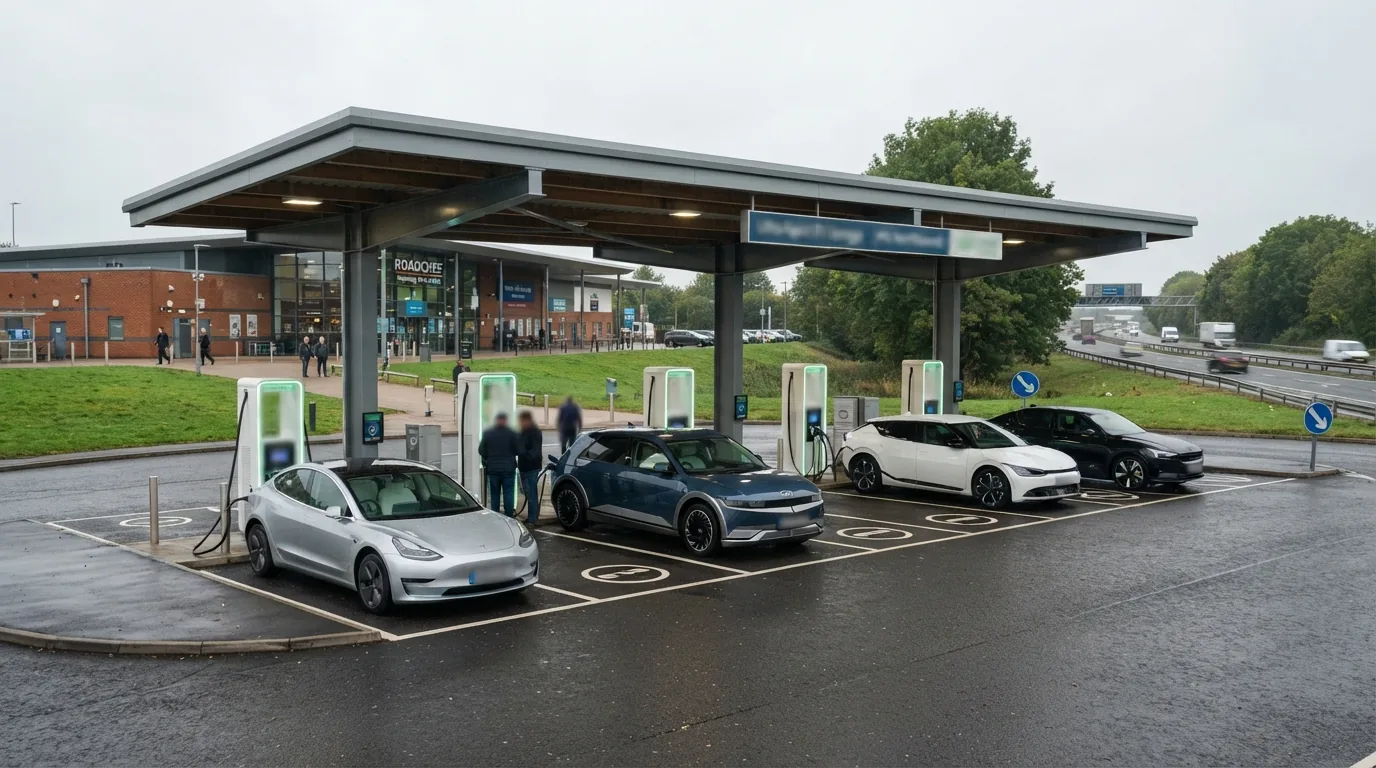
Motorway service area EV charging in the UK improved dramatically between 2023 and 2026. The collapse of Ecotricity’s ageing Electric Highway and its replacement by GRIDSERVE transformed the motorway charging experience, and the arrival of IONITY, MFG EV Power, BP Pulse and Tesla at key services has created genuine competition. Some service areas now offer 20 or more rapid bays; others still have two or three slow chargers hidden at the back of an overflow car park. This guide ranks the best services and operators for long-distance EV driving in 2026.
The motorway charging landscape in 2026
GRIDSERVE covers approximately 85% of UK motorway service stations following its takeover of the Ecotricity Electric Highway contract. IONITY is present at Extra MSA locations with ultra-rapid hardware up to 350 kW. MFG EV Power operates ultra-rapid forecourt hubs at fuel stations, including many near or adjacent to service areas. Tesla Superchargers are installed at selected services, particularly on the M40, M4 and M6 corridors.
The result is that most major motorway stops now have adequate rapid or ultra-rapid charging capacity, but the quality varies significantly by operator and by how recently the hardware was installed.
Best motorway service operators ranked
1. GRIDSERVE Electric Highway
GRIDSERVE has invested heavily in hardware quality since taking over the Electric Highway in 2022. The newest GRIDSERVE Super Hub sites, developed with Extra MSA Group, offer:
- Up to 400 kW-capable ultra-rapid chargers
- 12 to 20+ bays per site
- Covered canopies protecting cables from weather
- Contactless payment on all units
- Live availability via GRIDSERVE app and Zap-Map
New Super Hub locations opening through late 2026 include Beaconsfield, Baldock (M25/A1), Cambridge, Cobham (M25), Cullompton (M5), Leeds Skelton Lake and Peterborough. Each site has a minimum of 12 high-power bays.
The Electric Forecourt sites (not motorway services, but accessible from major routes) at Braintree, Norwich, Stevenage and London Gatwick Airport are arguably the best EV charging destinations in the UK: 24-plus bays, Costa Coffee, retail, toilets and car cleaning.
Best for: Consistent motorway coverage across England and Wales.
2. IONITY at Extra MSA
IONITY operates at Extra’s motorway service areas with hardware from 150 kW to 350 kW. Extra’s sites include Cobham (M25), Reading (M4), Exeter (M5) and others. IONITY’s strength is ultra-rapid power: even a large-battery EV will get maximum charge rate at an IONITY site if the hardware allows it.
PAYG pricing is 74p per kWh. The IONITY Power annual plan at 43p per kWh makes IONITY the best-value rapid option for frequent long-distance drivers. IONITY’s 788 UK chargers are concentrated at motorway services and village hotel car parks rather than spread across the full motorway network, so it is not the most universal option.
Best for: Ultra-rapid speeds for planned stops on IONITY-served routes.
3. MFG EV Power
Motor Fuel Group (MFG) has installed ultra-rapid forecourt hubs at 170+ fuel station sites across the UK, many near or adjacent to motorway service areas. Charger power is 150 kW to 360 kW, prices around 79p per kWh PAYG, and the network does not charge a membership fee.
MFG carries the most rapid and ultra-rapid chargers of any single operator in the UK, with around 2,866 units. The forecourt model, open 24 hours, with food and toilet facilities nearby, works well for motorway drivers who want a clean, fast top-up.
Best for: Ultra-rapid speed with the widest motorway footprint outside of GRIDSERVE.
4. Tesla Supercharger at motorway services
Tesla Superchargers are available at selected motorway service areas, particularly on the M40 (Cherwell Valley, Warwick), M4 (Reading), M6 (Lancaster, Keele) and M1 (Woolley Edge). For Tesla drivers, these are unambiguously the best option: fast, reliable, with V3 chargers at up to 250 kW, and pricing around 22p to 30p per kWh for Tesla account holders.
For non-Tesla EVs, around half of UK Supercharger sockets accept CCS connections at a higher rate (45p to 56p per kWh). Non-Tesla availability at motorway Superchargers is expanding but not universal. Check the Tesla app or Zap-Map before planning a non-Tesla stop at a Supercharger.
Best for: Tesla drivers at any Supercharger site; non-Tesla drivers at sites confirmed as open to third parties.
5. BP Pulse at motorway services
BP Pulse has around 2,491 rapid chargers, including at motorway services. Reliability has historically been variable, though newer BP Pulse hardware installed from 2023 onwards is more dependable than older units. PAYG rate is 89p per kWh (highest of the main networks), with the £7.85/month subscription reducing this to 69p per kWh.
BP Pulse’s advantage is that it is present at BP forecourts directly on or adjacent to motorway exits, which sometimes means charging without the service station’s car park fee, access restrictions or crowding.
Best for: Backup option when GRIDSERVE, IONITY or Supercharger bays are full.
Comparison table: motorway service operators
| Operator | Power available | PAYG rate | Number of rapid sites | Best feature |
|---|---|---|---|---|
| GRIDSERVE | Up to 400 kW | ~75p/kWh | ~85% of motorway services | Widest motorway coverage |
| IONITY | 150–350 kW | 74p/kWh (43p with annual plan) | Extra MSA locations | Cheapest with annual plan |
| MFG EV Power | 150–360 kW | ~79p/kWh | 170+ forecourt hubs | Most ultra-rapid chargers |
| Tesla Supercharger | 72–250 kW | 22–56p/kWh | Selected services | Best for Tesla; good reliability |
| BP Pulse | Up to 150 kW | 89p/kWh (69p subscriber) | Motorway + forecourts | Widely present but expensive PAYG |
Which motorway services have the most chargers?
The services with the highest concentration of rapid and ultra-rapid bays as of May 2026 include:
- Cobham (M25): GRIDSERVE + IONITY + Tesla
- Reading (M4): GRIDSERVE + IONITY + Tesla
- Beaconsfield (M40): GRIDSERVE Super Hub (opening late 2026) + Tesla
- Baldock (A1/M25): GRIDSERVE Super Hub + GRIDSERVE Freightway
- Exeter (M5): GRIDSERVE + IONITY
For current charger counts at a specific service area, Zap-Map’s site search is the definitive reference. Filter for “50 kW+” to show rapid and ultra-rapid bays only.
Tips for stress-free motorway charging
Leave with more range than you think you need. Arriving at a motorway charger at 15% means less patience for a queue and less buffer for a fault. Aim to arrive with 20% or more.
Check Zap-Map before you exit the motorway. If your planned stop shows multiple bays in use and the queue indicator is active, it takes 2 minutes to identify the next service area and adjust your route.
Avoid peak times when possible. 10am to 2pm on summer Saturdays and during school holiday Fridays are consistently the busiest times at motorway charging sites. Off-peak (early morning or evening) means shorter waits and more charger choice.
Charge to 80%, not 100%. Above 80%, rapid charger throughput slows as the battery management system tapers the rate. Moving at 80% and charging again later is faster overall and keeps bays available for other drivers.
Further reading
For an overview of the UK public charging landscape, visit our Public Charging guide.
For a ranked comparison of UK charging networks including non-motorway locations, see Best Public EV Charging Networks in the UK.
How we test and where our numbers come from
Range figures are official WLTP combined values taken from manufacturer UK specification pages, with real-world estimates drawn from independent comparative testing. Prices are UK list prices at the time of the latest update. Tax, grant and charging-scheme figures come from GOV.UK and HMRC publications. We re-check every guide when pricing, specification or policy changes. Last checked 11 August 2026.
Frequently asked questions
Which motorway services have the most chargers?
For current charger counts at a specific service area, Zap-Map's site search is the definitive reference. Filter for "50 kW+" to show rapid and ultra-rapid bays only.
Sources and further reading
- gridserve.comGRIDSERVEPrimary source referenced in this article.

EV Compared
The EV Compared editorial team tracks the UK electric vehicle market full time: new model launches, list prices, WLTP and real-world range, public charging tariffs and the tax rules that decide what an EV actually costs to run. Every guide is checked against manufacturer specifications and official GOV.UK figures, and updated whenever the numbers move.
Related reading
View all
BP Pulse vs Shell Recharge: Which UK Network Wins?
Two of the UK's biggest charging networks compared on price, reliability and which type of driver each suits
Can You Charge Any EV at Any Public Charger in the UK?
Why almost any new EV works at almost any UK public charger, and the two exceptions you need to know
Can You Charge an EV From a Three-Pin Plug in the UK?
Yes, most cars ship with the cable, but speed and safety limits mean it works best for occasional or emergency use