Smart EV Charging Explained: How It Cuts Your UK Bills
What smart charging actually does, why it matters for your bill, and how to set it up without any technical knowledge
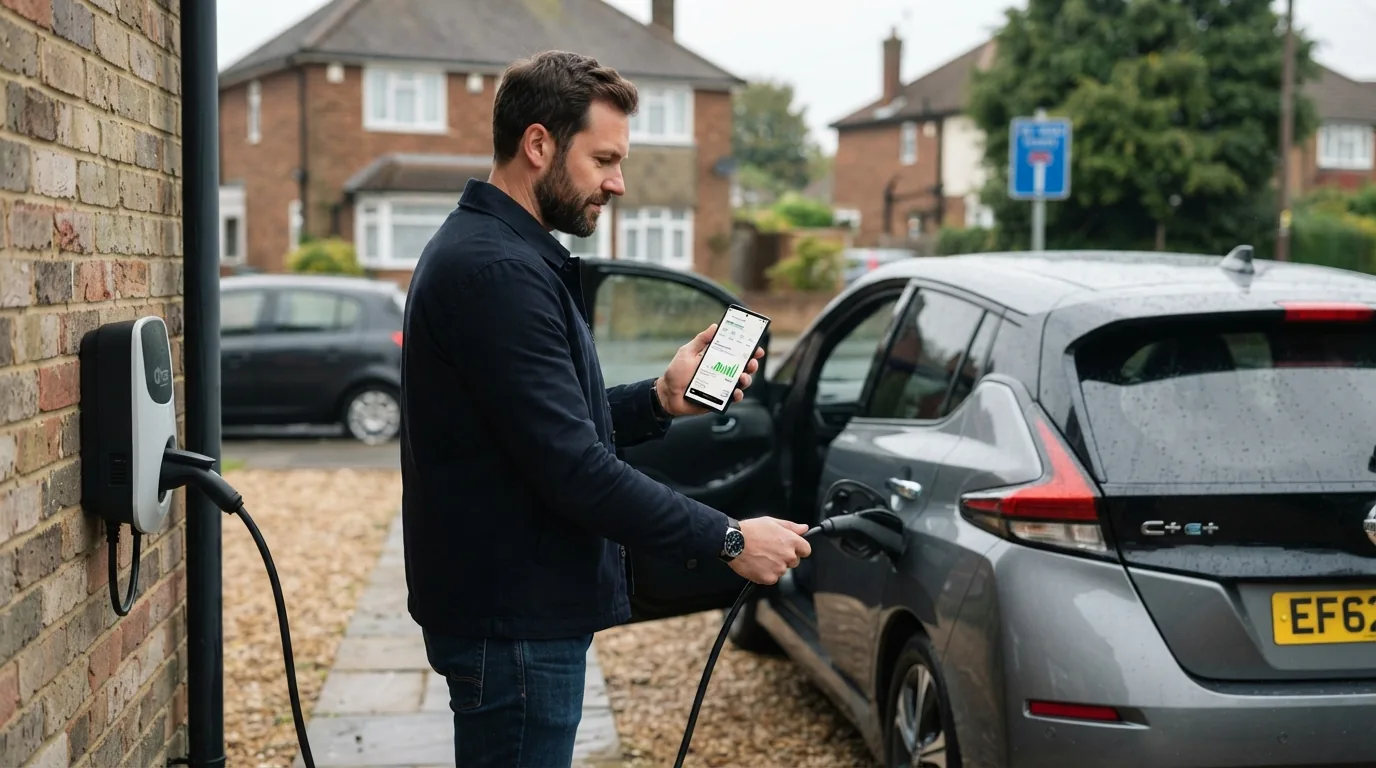
Quick answers
- Smart EV charging is the combination of a connected home charger, an off-peak electricity tariff, and a scheduling app that works together to charge your car when electricity is cheapest.
- What is a smart EV charger: A smart EV charger is a home wallbox that connects to your home Wi-Fi and, in many cases, directly to your energy supplier's systems.
- How do smart chargers save money: The core saving comes from scheduling charging to run during off-peak hours when electricity is cheapest.
- Octopus Intelligent Go customers saved an average of £771 in the 12 months to April 2026 compared with the standard Flexible Octopus tariff, based on real customer data.
- How does Intelligent Octopus Go work: Intelligent Octopus Go is the most sophisticated UK EV tariff.
- Not all smart chargers integrate at the API level with Octopus.
Smart EV charging is the combination of a connected home charger, an off-peak electricity tariff, and a scheduling app that works together to charge your car when electricity is cheapest. It can reduce your home EV charging costs from around £634 to roughly £206 per year for a typical driver covering 9,000 miles. That saving of £428 per year requires almost zero daily effort once set up.
What is a smart EV charger?
A smart EV charger is a home wallbox that connects to your home Wi-Fi and, in many cases, directly to your energy supplier’s systems. It can:
- Schedule charging to run during pre-set time windows.
- Respond to live tariff data to find the cheapest available charging slots.
- Be controlled and monitored remotely via a smartphone app.
- Interact with your car’s charging management system.
- Divert surplus solar energy to your car (on solar-aware models).
Since June 2022, UK law requires all new home EV chargers sold in the UK to be smart chargers. If you buy a new charger today, it will be a smart charger.
How do smart chargers save money?
The core saving comes from scheduling charging to run during off-peak hours when electricity is cheapest.
At the Q2 2026 Ofgem variable rate of 24.67p per kWh, charging a typical 60kWh battery from 20% to 100% costs about £11.85. On Intelligent Octopus Go’s off-peak rate of 8p per kWh, the same charge costs £3.84. That is a saving of £8 per charge.
For a driver charging four times per week, that is £32 per week saved, or £1,664 per year. For a more typical driver charging twice weekly, the saving is around £832 per year.
The UK electricity price gap between peak and off-peak rates in 2026 is unusually large, which means the financial case for smart charging is unusually strong right now.
What are the key off-peak EV tariffs in 2026?
| Tariff | Off-peak rate | Off-peak window | Notes |
|---|---|---|---|
| Intelligent Octopus Go | 8p/kWh | 11:30pm-5:30am | Smart-dispatch, can find extra cheap slots |
| Octopus Go | 9.5p/kWh | 12:30am-5:30am | No car/charger API needed |
| EDF GoElectric | 6.99p/kWh | 11pm-6am | Fixed window, simple setup |
| E.ON Next Drive Smart | 8.5p/kWh | Midnight-6am | Standard home benefits too |
| OVO Charge Anytime | 14p/kWh | Any time | Add-on to existing tariff, EV only |
Octopus Intelligent Go customers saved an average of £771 in the 12 months to April 2026 compared with the standard Flexible Octopus tariff, based on real customer data.
How does Intelligent Octopus Go work?
Intelligent Octopus Go is the most sophisticated UK EV tariff. It works as follows:
- You connect your EV or smart charger to the Octopus Energy app via API (Ohme, Hypervolt, Easee, Pod Point Solo 3S, Zappi, and others are compatible).
- You set a departure time and target charge level in the app.
- Octopus automatically schedules charging sessions during the guaranteed off-peak window (11:30pm to 5:30am at 8p/kWh).
- Additionally, the system may identify extra low-cost slots outside that window when renewable generation is high, charging at the same 8p rate.
- The whole home benefits from the 8p rate during the off-peak window, not just the EV charging.
As of 2026, Octopus has also introduced a six-hour cap on discounted smart charging per 24-hour period. Charging beyond six hours in a day is billed at the standard daytime rate.
What chargers are compatible with Intelligent Octopus Go?
Not all smart chargers integrate at the API level with Octopus. Compatible models as of May 2026 include:
- Ohme Home Pro and Ohme ePod
- Hypervolt Home 3 Pro
- myenergi Zappi
- Easee One
- Pod Point Solo 3S
- Indra Smart Pro and Smart Lux
- Andersen A3 and Quartz
- VCHRGD Seven Pro
Any EV or charger not on the compatibility list can still use Octopus Go (the simpler version) with a manual overnight schedule. It just does not benefit from the smart-dispatch system that finds the cheapest slots dynamically.
Do you need a smart meter for smart charging?
Yes. Intelligent Octopus Go and most other off-peak EV tariffs require a smart meter capable of sending half-hourly readings (SMETS2 standard, or some SMETS1 meters). Smart meters are available free of charge from your energy supplier. If you do not yet have one, request an upgrade before switching tariff.
What does a smart charger do beyond scheduling?
Good smart chargers also offer:
- Real-time energy monitoring: See exactly how much you spent on each charge session.
- Solar diversion: On Zappi, Ohme, and Hypervolt units with CT clamp support, surplus solar energy is automatically routed to the car.
- Load balancing: Some chargers (Easee, EO Mini Pro 3) monitor total household power draw and reduce charging rate if the home approaches the supply limit, preventing blown fuses.
- Remote control: Pause or resume a charge session from anywhere via app.
- Over-the-air firmware updates: Smart chargers receive software improvements without a service visit.
Is smart charging complicated to set up?
No. The typical setup process:
- Have the wallbox installed by a certified electrician.
- Download the charger’s app and connect to home Wi-Fi.
- If using Intelligent Octopus Go, link the charger to your Octopus account in the app (usually two to three steps).
- Set a default departure time (e.g. 7:30am on weekdays).
- That is it. The system handles the rest.
Most users report that after the initial setup, they plug in each evening and do not think about charging again until they unplug in the morning.
The common mistake: not switching tariff
The single most expensive error in home EV charging is owning a smart charger and staying on a standard variable tariff. A smart charger on the standard rate saves nothing compared with a dumb timer on the same rate. The savings come from the combination of the charger’s scheduling capability and the tariff’s off-peak rate.
If you have a smart charger and have not yet switched to an EV tariff, switching to Intelligent Octopus Go is likely the highest-return financial action available to you as an EV owner. Octopus reports that their Intelligent Go customers saved an average of £771 in 2025-26 versus the standard variable rate.
See our best EV charging tariffs comparison for a full breakdown of current UK EV tariff options. For the complete picture on home charging, visit the guide to charging an EV at home.
How we test and where our numbers come from
Range figures are official WLTP combined values taken from manufacturer UK specification pages, with real-world estimates drawn from independent comparative testing. Prices are UK list prices at the time of the latest update. Tax, grant and charging-scheme figures come from GOV.UK and HMRC publications. We re-check every guide when pricing, specification or policy changes. Last checked 11 August 2026.
Frequently asked questions
What is a smart EV charger?
Since June 2022, UK law requires all new home EV chargers sold in the UK to be smart chargers. If you buy a new charger today, it will be a smart charger.
How do smart chargers save money?
The core saving comes from scheduling charging to run during off-peak hours when electricity is cheapest.
What are the key off-peak EV tariffs in 2026?
Octopus Intelligent Go customers saved an average of £771 in the 12 months to April 2026 compared with the standard Flexible Octopus tariff, based on real customer data.
How does Intelligent Octopus Go work?
As of 2026, Octopus has also introduced a six-hour cap on discounted smart charging per 24-hour period. Charging beyond six hours in a day is billed at the standard daytime rate.
What chargers are compatible with Intelligent Octopus Go?
Any EV or charger not on the compatibility list can still use Octopus Go (the simpler version) with a manual overnight schedule. It just does not benefit from the smart-dispatch system that finds the cheapest slots dynamically.
Sources and further reading
- octopus.energyOctopus Energy, OfgemPrimary source referenced in this article.

EV Compared
The EV Compared editorial team tracks the UK electric vehicle market full time: new model launches, list prices, WLTP and real-world range, public charging tariffs and the tax rules that decide what an EV actually costs to run. Every guide is checked against manufacturer specifications and official GOV.UK figures, and updated whenever the numbers move.
Related reading
View all
BP Pulse vs Shell Recharge: Which UK Network Wins?
Two of the UK's biggest charging networks compared on price, reliability and which type of driver each suits
Can You Charge Any EV at Any Public Charger in the UK?
Why almost any new EV works at almost any UK public charger, and the two exceptions you need to know
Can You Charge an EV From a Three-Pin Plug in the UK?
Yes, most cars ship with the cable, but speed and safety limits mean it works best for occasional or emergency use