Do You Need Permission to Install a Home EV Charger in the UK?
The four permission layers explained: planning, building regulations, landlord consent and DNO notification
Quick answers
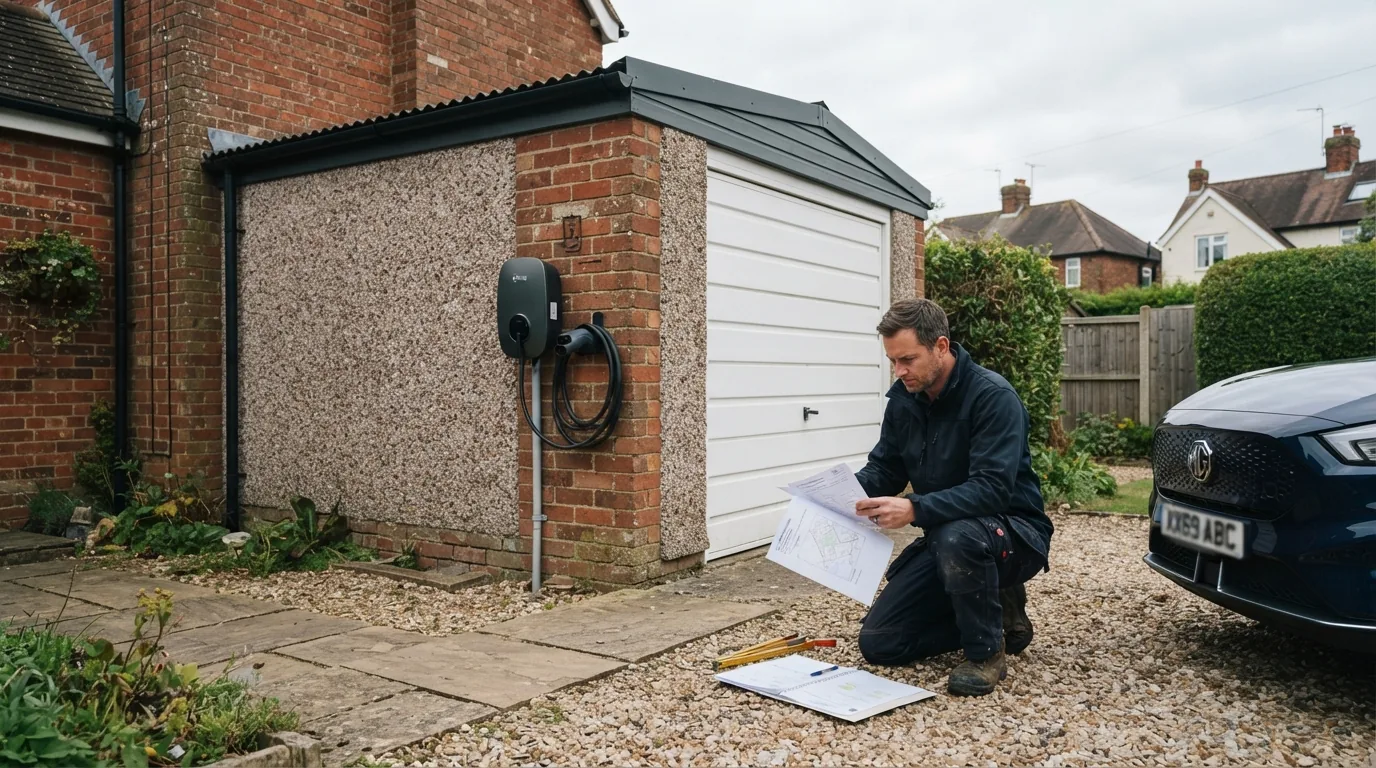
- For most houses with off-street parking, no planning permission is needed: a wall-mounted charger under 0.2 cubic metres is permitted development in England.
- Listed buildings need listed building consent, and conservation areas or Article 4 areas may need a planning application, so check with your council first.
- If you rent or own a flat, you need written consent from your landlord or freeholder, which is also a condition of the chargepoint grant (now £500 per socket from 1 April 2026).
- Your installer must notify the DNO; a standard 7kW charger can typically be notified within 28 days of installation under G98, figures vary, verify current data with your installer.
- You cannot legally fit it yourself unless you are a registered competent electrician, because the work is notifiable under Part P and must meet BS 7671.
In most cases, no. If you own a house with off-street parking, you do not need planning permission to fit a home EV charger. The installation falls under Permitted Development Rights, so no planning application is required. You do, however, need a competent installer who complies with Building Regulations Part P, a DNO (Distribution Network Operator) notification, and, if you rent or own a flat, written consent from your landlord or freeholder.
Those are the four permission layers. Most owner-occupiers with a driveway only face the last two, and their installer handles the DNO side. Tenants and leaseholders have an extra consent step. Listed buildings and conservation areas are the main exception where the Planning Portal rules change. This guide maps out every scenario.
Do you need planning permission for a home EV charger?
For most houses in England with a driveway or garage, no planning application is needed. A wall-mounted charge point is treated as permitted development under Class D of the General Permitted Development Order, which means the government has pre-approved it subject to size conditions. The same framework includes freestanding upstands under Class E.
The permitted development conditions are:
- A wall-mounted charger must not exceed 0.2 cubic metres in volume.
- An upstand charger must not exceed 1.6 metres in height within the curtilage of a dwellinghouse or block of flats, or 2.7 metres on other land, with only one upstand per parking space.
- As of 29 May 2025, the old restriction preventing a charger or upstand from being within 2 metres of a highway was removed in England, so proximity to the road is no longer a reason to refuse permitted development status.
These figures apply in England. Scotland, Wales and Northern Ireland operate separate planning systems, so if you are outside England, check with your own planning authority before proceeding.
When does planning permission apply?
Permitted development does not cover every situation. There are specific cases where you need to apply before any work starts.
- Within the curtilage of a listed building, permitted development rights do not apply and listed building consent is required.
- Within a site designated as a scheduled monument, permitted development rights do not apply either.
- In conservation areas and Article 4 Direction areas, local authorities can remove permitted development rights, meaning you may need a full planning application even for a standard wall-mounted unit.
If you are unsure whether your property falls into any of these categories, check your council’s planning records before booking an installer. Getting this wrong can mean having to remove an installed charger, so it is worth a ten-minute search on your local authority’s website.
Do you need your landlord’s or freeholder’s permission?
If you rent your home or own a leasehold flat, written consent is not optional; it is a requirement before the work can begin and before you can claim any grant funding.
- A tenant cannot fix a charge point to the property without the landlord’s written consent. Many tenancies contain a qualified alterations clause, which means a landlord should not unreasonably withhold permission; any refusal should be given in writing with clear reasons.
- Flat owners must obtain written permission from the freeholder or managing agent before applying for a grant. The permission letter must name the person giving consent, the applicant and the full property address.
- In flats, cable runs often cross communal areas, so the freeholder or building management company must sign off on the route as well as the installation itself.
The EV chargepoint grant now covers up to £500 per socket (75% of cost) since the uplift on 1 April 2026, up from the previous £350. That is a meaningful sum, and you cannot access it without landlord or freeholder consent in writing, so getting that letter sorted early avoids delay.
Permission needed by scenario
One table covers the four most common situations. Find your own and you will see immediately what you need before booking an installer.
| Your situation | Planning permission | DNO notification | Landlord/freeholder consent | Qualified installer |
|---|---|---|---|---|
| Owner-occupier house with driveway | No (permitted development) | Yes | Not applicable | Yes |
| Tenant (rented house) | Usually no | Yes | Yes, in writing | Yes |
| Leaseholder/flat | Usually no | Yes | Yes, in writing | Yes |
| Listed building (any tenure) | Listed building consent required | Yes | Yes if not owner-occupier | Yes |
Conservation area and Article 4 area properties sit between the top two rows and the listed building row; check with your local planning authority before assuming permitted development applies.
What is a DNO notification and do you have to do it?
The DNO is the company that owns and manages the electricity distribution network in your area. Any new domestic charger adds load to that network, so the DNO must be told. This is a permission layer most people miss because the installer handles it, but it is legally required and the responsibility ultimately falls on the installation being compliant.
- For a standard 7kW single-phase charger where the total property demand stays within 60 amps (typically around 13.8 kVA), the installer can notify the DNO after the work under the G98 process, within 28 days of commissioning. These thresholds are widely cited figures; your installer should confirm the exact position for your property, as they can vary slightly by DNO.
- Where prospective load exceeds 60 amps, or for three-phase or vehicle-to-grid systems, the installer must obtain DNO approval before installation under the G99 process.
- Your OZEV-approved installer is responsible for choosing the correct application type and liaising with the DNO directly. There is usually no direct fee to you.
Think of it this way: the DNO notification is not your job to file, but it is your job to confirm your installer has done it correctly.
Who can legally fit it, and can you do it yourself?
In the UK there is no US-style electrical permit to obtain, but the work is notifiable and the legal bar is high enough that DIY is off the table for most people.
- EV charger installation is notifiable work under Part P of the Building Regulations in England and Wales. It must be carried out by a registered competent person who can self-certify the work, or formally notified to building control before work begins. A competent person scheme registration (NICEIC, NAPIT, ELECSA or equivalent) allows the installer to self-certify without separate building control involvement.
- The work must comply with BS 7671 (the 18th Edition Wiring Regulations), including Section 722, which sets requirements specific to EV charging installations such as a dedicated circuit and RCD protection.
- Only an OZEV-approved installer can claim the chargepoint grant on your behalf, deducting it directly from your invoice.
Because the work must be done by a qualified, OZEV-approved installer rather than yourself, it pays to settle on the unit first. Our guide to choosing the right home EV charger compares the leading models on price, smart features and grant eligibility so you can brief your installer with confidence.
Once you know your permissions are in order and your installer is booked, the unit you choose matters as much as the paperwork. See our full comparison of the best home EV chargers to find models that are grant-eligible, smart-tariff compatible and suited to your property type.
Useful Resources
Planning Portal - Permitted development for EV chargers https://www.planningportal.co.uk/permission/common-projects/electric-vehicle-charging/permitted-development/
GOV.UK - Electric vehicle chargepoint grants https://www.gov.uk/guidance/electric-vehicle-chargepoint-grants
GOV.UK - Changes to chargepoint grant schemes from 1 April 2026 https://www.gov.uk/guidance/changes-to-electric-vehicle-chargepoint-grant-schemes-from-1-april-2026
GOV.UK - Changes to permitted development rights for EV charging https://www.gov.uk/government/consultations/electric-vehicle-charging-changes-to-permitted-development-rights/changes-to-various-permitted-development-rights-for-ev-charging
Planning Portal - Approved Document S (Part S) https://www.planningportal.co.uk/applications/building-control-applications/building-control/approved-documents/part-s-infrastructure-for-charging-electric-vehicles/approved-document-s/
How we test and where our numbers come from
Range figures are official WLTP combined values taken from manufacturer UK specification pages, with real-world estimates drawn from independent comparative testing. Prices are UK list prices at the time of the latest update. Tax, grant and charging-scheme figures come from GOV.UK and HMRC publications. We re-check every guide when pricing, specification or policy changes. Last checked 11 August 2026.
Frequently asked questions
Do tenants need planning permission for an EV charger?
In most cases, no. A standard home charger installation is permitted development in England, so no planning application is needed unless the property is a listed building or sits within a conservation area or Article 4 Direction area. The bigger requirement for a tenant is obtaining written landlord consent before work begins, not securing planning permission.
Can a landlord refuse permission to install an EV charger?
Yes, a landlord can refuse, but where the tenancy contains a qualified alterations clause, consent should not be unreasonably withheld and any refusal should be given in writing with clear reasons. A professional written request that covers the charger model, proposed location, the installer's qualifications and any reinstatement terms generally improves the chances of agreement.
Does the installer need specific qualifications?
Yes. The installer must be a competent electrician trained in EV charger installation and registered under a recognised competent person scheme, which allows the work to be self-certified under Part P of the Building Regulations. To claim the government chargepoint grant on your behalf, the installer must also be OZEV-approved.
Can a tenant remove the charger when moving out?
This should be agreed with the landlord in advance and recorded in the original written permission. Some landlords prefer the charger left in place as a property improvement; others want the wall reinstated. Settling reinstatement terms before work starts avoids disputes when you move.
Do you need planning permission for an EV charger in a conservation area?
Possibly. Permitted development rights can be removed in conservation areas and Article 4 Direction areas, which means a formal planning application may be required even for a standard wall-mounted unit. Always check with your local planning authority before booking an installer, as the rules are stricter than for a property outside a designated area.
Sources and further reading
- gov.ukGOV.UKPrimary source referenced in this article.

EV Compared
The EV Compared editorial team tracks the UK electric vehicle market full time: new model launches, list prices, WLTP and real-world range, public charging tariffs and the tax rules that decide what an EV actually costs to run. Every guide is checked against manufacturer specifications and official GOV.UK figures, and updated whenever the numbers move.
Related reading
View all
BP Pulse vs Shell Recharge: Which UK Network Wins?
Two of the UK's biggest charging networks compared on price, reliability and which type of driver each suits
Can You Charge Any EV at Any Public Charger in the UK?
Why almost any new EV works at almost any UK public charger, and the two exceptions you need to know
Can You Charge an EV From a Three-Pin Plug in the UK?
Yes, most cars ship with the cable, but speed and safety limits mean it works best for occasional or emergency use