How Does Solar Panel EV Charging Work in the UK?
The mechanics of diverting surplus solar electricity to your car, which chargers do it, and whether the numbers stack up
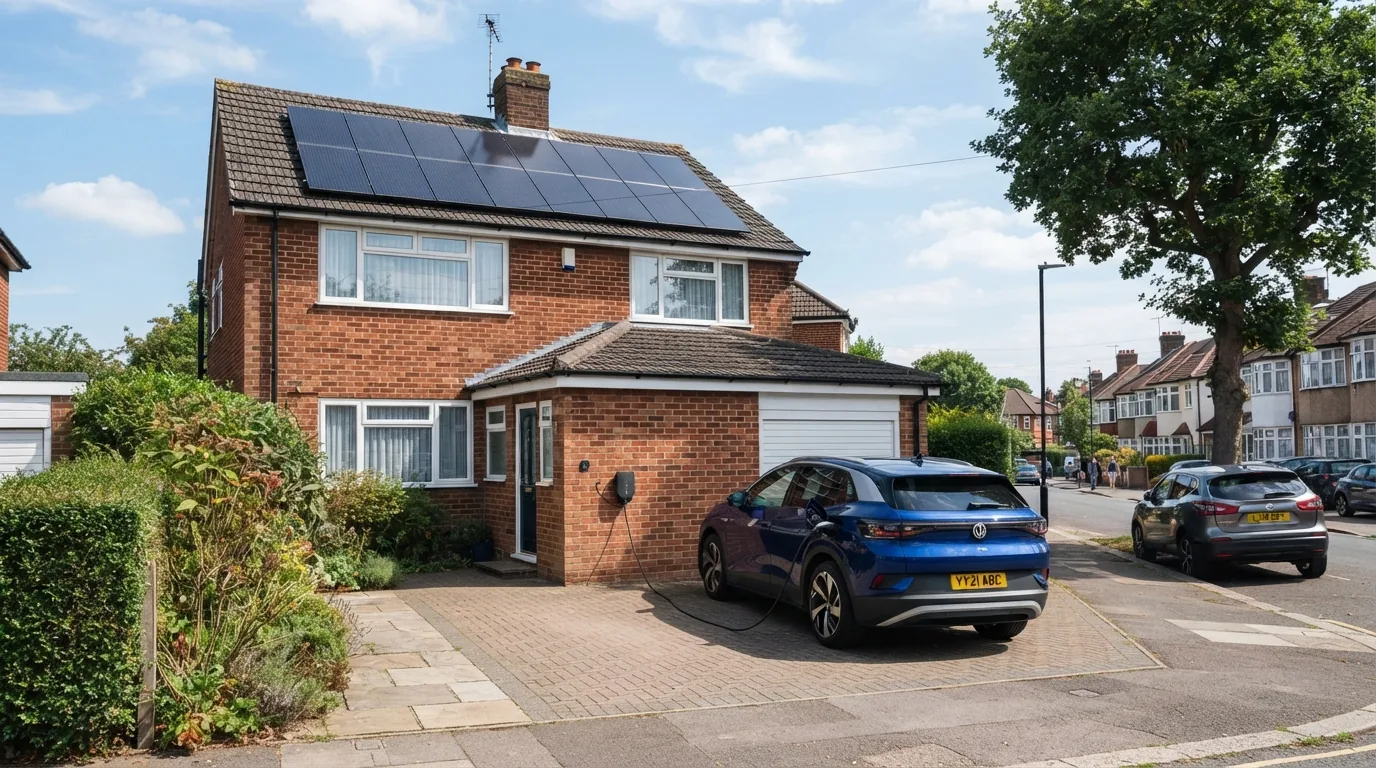
Quick answers
- Solar panel EV charging in the UK works by detecting surplus solar generation (electricity your home is producing but not consuming) and automatically routing it to charge your electric car instead of exporting it to the grid.
- What is solar diversion for EV charging: Solar diversion is a function in certain smart home EV chargers that reads your home's live electricity flow and identifies when you are generating more power than your home is consuming.
- How does solar diversion work technically: The charger uses a current transformer (CT) clamp, a sensor fitted around the main incoming electricity cable, to measure power flowing between your home and the grid.
- The myenergi Zappi is the UK market leader for solar diversion.
- How much solar do you need: A home solar EV charging setup makes practical sense with at least 3-4kWp of panels.
- Can solar charging work in UK weather: In winter months, the combination of shorter days, lower sun angle, and higher household consumption of that solar power means little surplus is available for EV diversion.
Solar panel EV charging in the UK works by detecting surplus solar generation (electricity your home is producing but not consuming) and automatically routing it to charge your electric car instead of exporting it to the grid. This uses electricity that would otherwise earn you just 4-15p per kWh under the Smart Export Guarantee, and charges your car instead, saving you the grid import rate of 24-26p per kWh. A household with 4kWp of solar, a compatible charger, and an EV can realistically save £800-£1,200 per year in total energy costs versus charging from the grid at standard rates.
What is solar diversion for EV charging?
Solar diversion is a function in certain smart home EV chargers that reads your home’s live electricity flow and identifies when you are generating more power than your home is consuming. That surplus is diverted to the car’s battery instead of being exported.
Without solar diversion, your inverter exports surplus generation to the grid at the Smart Export Guarantee (SEG) rate. In 2026, SEG rates typically range from 4p to 15p per kWh depending on your supplier. A solar divert charger captures that same energy and puts it into your car, where it replaces grid electricity worth 24.67p per kWh (the Ofgem standard variable rate). The financial benefit is the difference: roughly 10-21p per unit diverted.
How does solar diversion work technically?
The charger uses a current transformer (CT) clamp, a sensor fitted around the main incoming electricity cable, to measure power flowing between your home and the grid. The clamp reports in real time whether your home is importing or exporting power and by how much.
The charger’s control system reads this data and adjusts charging power dynamically:
- When surplus generation exceeds 1.4kW (the minimum needed to charge an EV), the charger starts drawing that surplus into the car.
- As cloud cover reduces generation or household appliances switch on, the charger reduces its draw to stay within the surplus.
- When surplus drops below the minimum threshold, charging pauses.
- The charger can also blend grid import and solar surplus, charging at a fixed rate using a mix of both.
This real-time adjustment happens continuously and automatically.
Which chargers support solar diversion in the UK?
| Charger | Solar diversion mode | CT clamp included | App quality |
|---|---|---|---|
| myenergi Zappi | Yes, dedicated Eco/Eco+ modes | Yes (or wireless Harvi) | Good |
| Hypervolt Home 3 Pro | Yes, via CT clamp | Yes | Excellent |
| Ohme Home Pro | Tariff integration only (not true solar divert) | No | Excellent |
| Indra Smart Pro | Yes | Yes | Good |
| EO Mini Pro 3 | Yes | Yes | Good |
| Easee One | No native solar mode | No | Good |
| Pod Point Solo 3 | No | No | Average |
| Wallbox Pulsar Max | No | No | Good |
The myenergi Zappi is the UK market leader for solar diversion. Its dedicated Eco and Eco+ modes, designed from the ground up for solar self-consumption, remain the most refined implementation available. Eco mode charges using surplus solar only, with no grid import for charging. Eco+ mode can draw a defined minimum from the grid (as low as 1.4kW) to keep charging moving in overcast conditions.
How much solar do you need?
A home solar EV charging setup makes practical sense with at least 3-4kWp of panels.
A 4kWp system in the UK generates approximately 3,400kWh per year. Assuming roughly 40% is self-consumed by the home (1,360kWh), the potential surplus available for EV charging is approximately 2,040kWh. At typical EV efficiency of 3.5 miles per kWh, that is around 7,100 miles of effectively free driving per year.
| Solar array size | Annual generation (UK avg) | Surplus for EV (est.) | EV miles available |
|---|---|---|---|
| 2kWp | ~1,700 kWh | ~680 kWh | ~2,380 miles |
| 4kWp | ~3,400 kWh | ~2,040 kWh | ~7,140 miles |
| 6kWp | ~5,100 kWh | ~3,300 kWh | ~11,550 miles |
These are averages. UK solar generation is seasonal: you will generate much more in summer than winter. Most solar EV charging happens between April and September.
Can solar charging work in UK weather?
Yes, though output is lower than sunnier climates. UK solar panels generate electricity any time there is daylight, not only when the sun is directly shining. On overcast days, a 4kWp system still produces 0.5-1.5kW of power, enough to add some charge to the car.
In winter months, the combination of shorter days, lower sun angle, and higher household consumption of that solar power means little surplus is available for EV diversion. Most UK solar EV charging users plan to use grid charging (ideally on an off-peak tariff) in winter and maximise solar in summer.
Does solar charging combine with EV tariffs?
Yes, and the combination is powerful. A solar divert charger like the Zappi can operate in solar divert mode by day and switch to smart tariff mode overnight. The myenergi ecosystem (Zappi, Libbi battery storage, and the Hub) integrates with Octopus Energy tariffs to manage both solar and grid charging automatically.
A household with solar panels, an EV, and Octopus Intelligent Go can:
- Charge from surplus solar during daylight hours at near-zero cost.
- Charge from the grid overnight at 8p per kWh.
- Export any remaining surplus at SEG rates.
Total savings for such a setup versus a standard variable tariff are often in the range of £1,200-£1,800 per year.
Do I need a battery storage system to benefit?
No. Solar divert charging works without home battery storage. The surplus is used in real time to charge the car. Battery storage (like the Powerwall or myenergi Libbi) adds additional flexibility by storing solar surplus for use in the evening, but it is an optional enhancement, not a requirement.
Is it worth adding solar diversion to your setup?
If you already have solar panels, a solar divert charger costs approximately the same as a standard smart charger (Zappi units typically cost £700-£800 before installation). The additional saving of 10-21p per unit on diverted electricity pays back the small premium in months.
If you are buying solar and a charger together for the first time, the combination is compelling. However, the priority decision is getting a smart charger on an off-peak tariff. If you then have or plan to add solar, choose a charger that supports solar diversion.
See our best EV chargers for solar panel owners for a ranked comparison of solar-compatible chargers. The complete home charging guide and best home EV chargers guide cover the wider picture.
How we test and where our numbers come from
Range figures are official WLTP combined values taken from manufacturer UK specification pages, with real-world estimates drawn from independent comparative testing. Prices are UK list prices at the time of the latest update. Tax, grant and charging-scheme figures come from GOV.UK and HMRC publications. We re-check every guide when pricing, specification or policy changes. Last checked 11 August 2026.
Frequently asked questions
What is solar diversion for EV charging?
Solar diversion is a function in certain smart home EV chargers that reads your home's live electricity flow and identifies when you are generating more power than your home is consuming. That surplus is diverted to the car's battery instead of being exported.
How does solar diversion work technically?
The charger uses a current transformer (CT) clamp, a sensor fitted around the main incoming electricity cable, to measure power flowing between your home and the grid. The clamp reports in real time whether your home is importing or exporting power and by how much.
Which chargers support solar diversion in the UK?
The myenergi Zappi is the UK market leader for solar diversion. Its dedicated Eco and Eco+ modes, designed from the ground up for solar self-consumption, remain the most refined implementation available.
How much solar do you need?
A home solar EV charging setup makes practical sense with at least 3-4kWp of panels.
Can solar charging work in UK weather?
Yes, though output is lower than sunnier climates. UK solar panels generate electricity any time there is daylight, not only when the sun is directly shining.
Sources and further reading
- gov.ukGOV.UK OZEV, Octopus EnergyPrimary source referenced in this article.

EV Compared
The EV Compared editorial team tracks the UK electric vehicle market full time: new model launches, list prices, WLTP and real-world range, public charging tariffs and the tax rules that decide what an EV actually costs to run. Every guide is checked against manufacturer specifications and official GOV.UK figures, and updated whenever the numbers move.
Related reading
View all
BP Pulse vs Shell Recharge: Which UK Network Wins?
Two of the UK's biggest charging networks compared on price, reliability and which type of driver each suits
Can You Charge Any EV at Any Public Charger in the UK?
Why almost any new EV works at almost any UK public charger, and the two exceptions you need to know
Can You Charge an EV From a Three-Pin Plug in the UK?
Yes, most cars ship with the cable, but speed and safety limits mean it works best for occasional or emergency use