Best EV Chargers for Solar Panel Owners in the UK
Solar diversion chargers ranked, with UK prices and a clear explanation of what each one actually does with your surplus
Quick answers
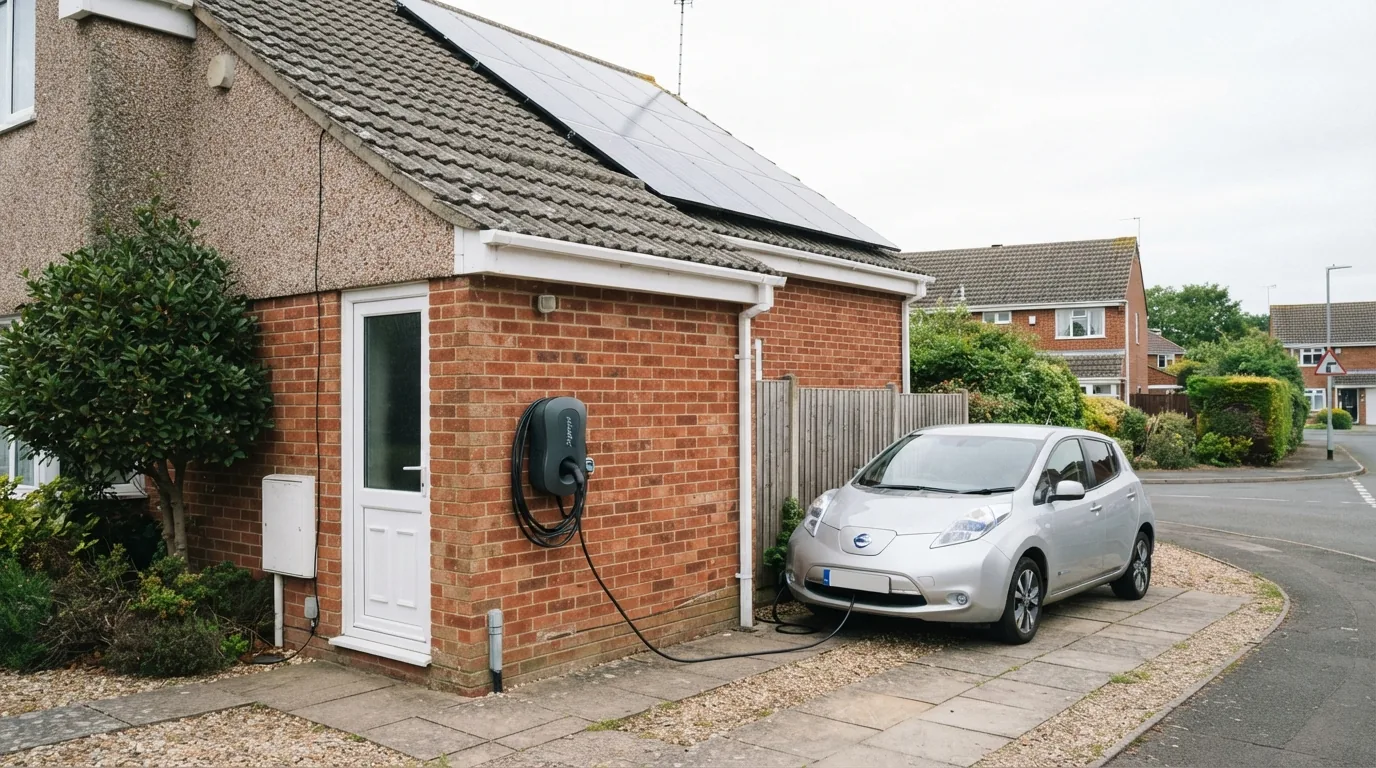
- If you have solar panels, the right EV charger can reduce your home charging cost to near zero during daylight hours, all year from April to September, by routing surplus generation directly to your car.
- The Zappi has been the UK's leading solar EV charger since its launch and remains unbeaten in 2026 for solar diversion sophistication.
- The combination that saves the most: A household with 4kWp solar, an EV, and this setup realistically saves £1,200-£1,800 per year in total energy costs versus charging from the standard variable rate with no solar integration.
- The right setup uses both: solar diversion during the day when there is surplus, and off-peak tariff charging overnight.
If you have solar panels, the right EV charger can reduce your home charging cost to near zero during daylight hours, all year from April to September, by routing surplus generation directly to your car. The best solar-aware charger for most UK solar homeowners is the myenergi Zappi, which has the most sophisticated diversion system available. The Hypervolt Home 3 Pro and Indra Smart Pro are strong alternatives with good solar modes and Octopus integration. The Ohme Home Pro, despite being excellent for tariff scheduling, does not support true solar diversion.
What makes a charger suitable for solar?
A solar-capable EV charger needs:
- CT clamp support: The current transformer clamp reads power flow between your home and the grid in real time.
- Dynamic power adjustment: The charger adjusts its output continuously as solar generation changes.
- Diversion logic: Software that distinguishes between surplus (export) and net household consumption, routing only genuine surplus to the car.
- Minimum threshold: The ability to function at low power levels (most EVs need at least 1.4kW to begin charging).
A charger without these features cannot do solar diversion. It can schedule overnight charging on a cheap tariff, but it cannot react to daytime solar surplus.
Solar charger comparison table
| Charger | Solar diversion | CT clamp included | Min charging power | Tariff integration | Unit price |
|---|---|---|---|---|---|
| myenergi Zappi | Yes (Eco/Eco+ modes) | Yes (or wireless Harvi) | 1.4kW | Octopus, Agile | ~£700-£800 |
| Hypervolt Home 3 Pro | Yes | Yes | ~1.4kW | Octopus Intelligent Go | ~£690 |
| Indra Smart Pro | Yes | Yes | 1.4kW | Octopus Intelligent Go | ~£500-£600 |
| EO Mini Pro 3 | Yes | Yes | ~1.4kW | Octopus Go | ~£550 |
| Ohme Home Pro | No (tariff scheduling only) | No | N/A | Octopus, OVO, EDF | ~£535 |
| Pod Point Solo 3 | No | No | N/A | BG, EDF, E.ON | ~£350 |
| Easee One | No | No | N/A | Octopus | ~£405 |
| Wallbox Pulsar Max | No | No | N/A | Octopus | ~£500-£550 |
1. myenergi Zappi (Recommended for most solar homes)
The Zappi has been the UK’s leading solar EV charger since its launch and remains unbeaten in 2026 for solar diversion sophistication. Its three charging modes cover every scenario:
- Fast mode: Charges from the grid at full rated speed (7.4kW), ignoring solar generation. For when you need charge quickly.
- Eco mode: Uses all available solar surplus to charge the car. No grid import for charging. Pauses when surplus drops below 1.4kW.
- Eco+ mode: Uses solar surplus plus a configurable minimum from the grid (you set the minimum, as low as 1.4kW). Keeps charging in overcast conditions by drawing a small grid amount alongside solar.
The CT clamp (included) or the wireless Harvi sensor (£70, eliminates the need to run a wire from the clamp to the charger) reads live generation and household consumption continuously. The adjustment is dynamic and continuous: as a cloud passes over, the Zappi reduces charging power within seconds.
Integration with the myenergi Hub allows the Zappi to coordinate with Octopus Intelligent Go for overnight grid charging, completing the picture. You can set it to prioritise solar during the day and switch to off-peak grid charging overnight, automatically.
The seven-year warranty is the longest available for any UK home EV charger.
Unit price: ~£700-£800. Installed from ~£1,100.
Best for: Solar homeowners who want the best-in-class diversion system and a long warranty.
2. Hypervolt Home 3 Pro (Best build + solar)
The Hypervolt Home 3 Pro combines one of the best-built enclosures on the market (IP66, IK10) with a functional solar CT clamp mode. The 2026 app refresh improved energy monitoring, showing solar generation, grid import/export, and charging power on a single dashboard. Octopus Intelligent Go integration is native, allowing automatic smart dispatch for overnight grid charging alongside daytime solar diversion.
The solar mode is less sophisticated than the Zappi’s Eco/Eco+ system, but it works well for the majority of solar homeowners who want a set-it-and-forget-it approach.
Unit price: ~£690. Installed from ~£1,100+.
Best for: Solar owners who also want the best weatherproofing and a premium design.
3. Indra Smart Pro (Value solar option)
The Indra Smart Pro is a less well-known charger that deserves more attention. It includes a CT clamp for solar diversion, supports Octopus Intelligent Go, and has a lower unit price than either the Zappi or Hypervolt. The app is functional rather than polished, but the core solar diversion and tariff integration work as they should.
Unit price: ~£500-£600. Installed from ~£950+.
Best for: Solar owners who want proven solar mode at a lower cost than the Zappi.
4. EO Mini Pro 3 (Budget solar option)
The EO Mini Pro 3 is the smallest home charger on the UK market and includes CT clamp solar diversion as standard. Its solar mode is less refined than the Zappi’s, but it works. At around £550 for the unit, it is the most affordable solar-capable charger.
Unit price: ~£550. Installed from ~£1,000+.
Best for: Solar owners on a tighter budget.
The combination that saves the most
The maximum saving from solar EV charging in the UK comes from combining:
- Solar divert charger (Zappi or Hypervolt) to capture daylight surplus.
- Octopus Intelligent Go for overnight charging at 8p per kWh.
- Smart export tariff (e.g., Octopus Outgoing) at a decent SEG rate for any surplus the car does not use.
A household with 4kWp solar, an EV, and this setup realistically saves £1,200-£1,800 per year in total energy costs versus charging from the standard variable rate with no solar integration.
Does a solar charger replace the need for an EV tariff?
No. UK solar generation is seasonal: a 4kWp system generates well in spring and summer but produces little surplus in November to February. In winter, most EV charging is from the grid. An off-peak EV tariff at 8p per kWh is essential year-round to keep charging costs low.
The right setup uses both: solar diversion during the day when there is surplus, and off-peak tariff charging overnight. The Zappi with myenergi Hub on Octopus Intelligent Go handles this automatically.
For the full guide to solar EV charging, see how does solar panel EV charging work?. The best home EV chargers guide covers all categories. For the full home charging picture, see the guide to charging at home.
How we test and where our numbers come from
Range figures are official WLTP combined values taken from manufacturer UK specification pages, with real-world estimates drawn from independent comparative testing. Prices are UK list prices at the time of the latest update. Tax, grant and charging-scheme figures come from GOV.UK and HMRC publications. We re-check every guide when pricing, specification or policy changes. Last checked 11 August 2026.
Frequently asked questions
What makes a charger suitable for solar?
A charger without these features cannot do solar diversion. It can schedule overnight charging on a cheap tariff, but it cannot react to daytime solar surplus.
Does a solar charger replace the need for an EV tariff?
No. UK solar generation is seasonal: a 4kWp system generates well in spring and summer but produces little surplus in November to February.
Sources and further reading
- gov.ukGOV.UK OZEV, manufacturer specsPrimary source referenced in this article.

EV Compared
The EV Compared editorial team tracks the UK electric vehicle market full time: new model launches, list prices, WLTP and real-world range, public charging tariffs and the tax rules that decide what an EV actually costs to run. Every guide is checked against manufacturer specifications and official GOV.UK figures, and updated whenever the numbers move.
Related reading
View all
BP Pulse vs Shell Recharge: Which UK Network Wins?
Two of the UK's biggest charging networks compared on price, reliability and which type of driver each suits
Can You Charge Any EV at Any Public Charger in the UK?
Why almost any new EV works at almost any UK public charger, and the two exceptions you need to know
Can You Charge an EV From a Three-Pin Plug in the UK?
Yes, most cars ship with the cable, but speed and safety limits mean it works best for occasional or emergency use