Ohme vs Hypervolt: Best Smart Home EV Charger for the UK?
A direct head-to-head on specs, tariff integration, solar, app quality, and price, with a clear verdict for each use case
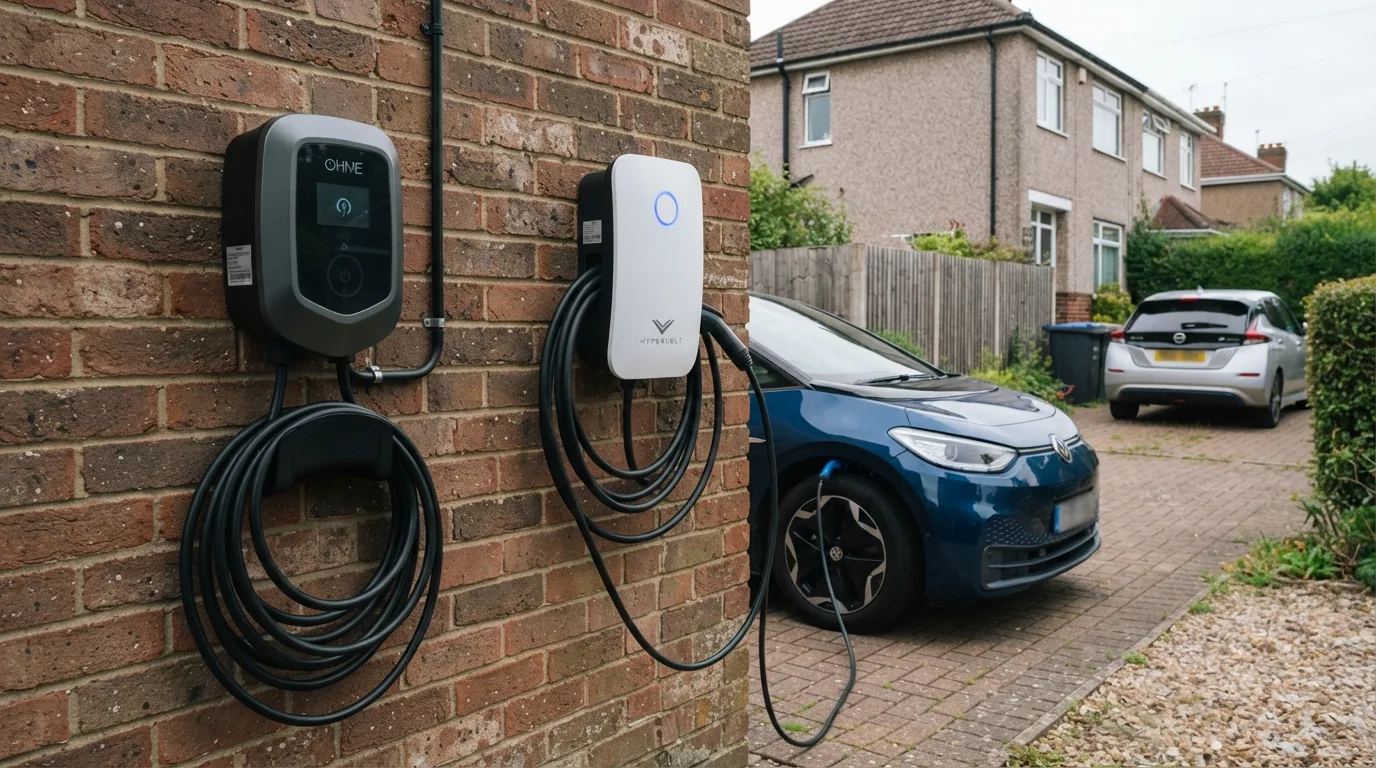
Quick answers
- The Ohme Home Pro and Hypervolt Home 3 Pro are the two most talked-about smart home EV chargers in the UK in 2026. Both work with Octopus Intelligent Go.
- Tariff integration: Ohme wins clearly: The Ohme Home Pro's standout capability is the depth of its energy tariff integration.
- The Hypervolt Home 3 Pro is the best-built mainstream home EV charger in the UK.
- Solar integration: Hypervolt edges ahead: Both chargers support solar diversion via CT clamp, but with different implementations.
- The Hypervolt app 2026 refresh improved energy monitoring significantly, and the combined solar, grid, and charging view on a single dashboard is the best in the market for energy-conscious users.
- Price comparison: The £155 difference in unit price is meaningful but not decisive.
The Ohme Home Pro and Hypervolt Home 3 Pro are the two most talked-about smart home EV chargers in the UK in 2026. Both work with Octopus Intelligent Go. Both are well-built. Both have genuinely good apps. The decision between them comes down to three things: tariff integration depth (Ohme wins), build quality and weatherproofing (Hypervolt wins), and solar mode quality (Hypervolt edges ahead). Our verdict: buy the Ohme if smart tariff scheduling is your priority. Buy the Hypervolt if you need IP66 weatherproofing, a 10-metre cable option, or the better solar integration.
Head-to-head spec comparison
| Spec | Ohme Home Pro | Hypervolt Home 3 Pro |
|---|---|---|
| Output | 7.4kW | 7.4kW |
| Tethered/socket | Tethered (5m or 8m) | Both available |
| IP rating | IP55 | IP66 |
| Impact rating | Not specified | IK10 |
| Connectivity | Wi-Fi + 4G SIM (3 yrs incl.) | Wi-Fi + Ethernet |
| Display | Built-in colour screen | None |
| Solar mode | Basic (CT clamp support, basic divert) | Yes (CT clamp included) |
| Intelligent Octopus Go | Yes (native API) | Yes (native API) |
| Octopus Agile integration | Yes | Limited |
| OVO, EDF, BG, E.ON integration | Yes (all four) | No |
| App | Ohme (iOS/Android) | Hypervolt (iOS/Android) |
| Warranty | 3 years | 3 years |
| Unit price | ~£535 | ~£690 |
| Price difference | Hypervolt costs ~£155 more |
Tariff integration: Ohme wins clearly
The Ohme Home Pro’s standout capability is the depth of its energy tariff integration. It connects directly via API to:
- Octopus Energy (Intelligent Go, Agile, Go)
- OVO Charge Anytime
- EDF GoElectric
- British Gas Electric Driver
- E.ON Next Drive Smart
On Octopus Agile, the Ohme reads tomorrow’s half-hourly pricing and automatically books the cheapest slots overnight, without any user input. No other home EV charger does this.
The Hypervolt supports Octopus Intelligent Go natively and works well, but it does not have the same breadth of supplier integrations. If you are with OVO, British Gas, EDF, or E.ON, the Ohme is the only charger that integrates automatically with those tariffs.
The built-in colour screen is another Ohme-only feature: it shows the current tariff rate, session cost, and energy delivered without needing to open the app. This is genuinely useful when you want a quick glance at what the session is costing.
The 4G SIM (included for three years, then £2/month) means Ohme’s scheduling continues to work even if home Wi-Fi drops out overnight, an important reliability advantage.
Verdict on tariff integration: Ohme Home Pro is the clear winner. If getting the most from smart tariffs is your primary goal, choose Ohme.
Build quality and weatherproofing: Hypervolt wins
The Hypervolt Home 3 Pro is the best-built mainstream home EV charger in the UK. IP66 (fully dust-tight, protected against powerful water jets) combined with IK10 impact resistance means it is built for the most exposed UK outdoor positions.
The Ohme Home Pro is rated IP55, which is adequate for standard UK outdoor positions but below IP65 for exposed locations. In a sheltered position (garage overhang, recessed wall, car port), IP55 is fine. For a fully exposed driveway wall facing prevailing rain, the Hypervolt’s IP66 rating provides meaningful additional protection.
The Hypervolt is also designed and manufactured in the UK, which the brand argues means the engineering was optimised for British weather patterns specifically.
Verdict on build quality: Hypervolt Home 3 Pro wins on weatherproofing. If the installation is exposed, this matters.
Solar integration: Hypervolt edges ahead
Both chargers support solar diversion via CT clamp, but with different implementations.
The Hypervolt Home 3 Pro includes the CT clamp in the box and has a well-developed solar monitoring dashboard in the app, showing solar generation, grid import/export, and EV charging power simultaneously. The solar mode works cleanly.
The Ohme Home Pro added solar CT clamp support in a 2024-2025 firmware update, but solar diversion is not where the Ohme’s design priorities lie. The implementation is functional but less refined than Hypervolt’s, and the app’s solar monitoring is less detailed.
Neither charger’s solar mode is as sophisticated as the myenergi Zappi’s dedicated Eco/Eco+ system, which is still the best-in-class for solar diversion. For solar-first households, the Zappi remains the right choice.
Verdict on solar: Hypervolt edges ahead for solar owners who also want tariff integration. Zappi remains the recommendation if solar diversion is the primary need.
App quality: both excellent, Ohme slightly ahead
Both apps are genuinely good. The Ohme app has a slight edge in tariff scheduling functionality: on Octopus Agile specifically, the experience of seeing tomorrow’s price schedule and having the app automatically identify the cheapest slots is polished and reliable.
The Hypervolt app 2026 refresh improved energy monitoring significantly, and the combined solar, grid, and charging view on a single dashboard is the best in the market for energy-conscious users.
For reliability, both apps are solid in 2026. Neither has the historical connectivity issues that have affected some charger brands in previous years.
Verdict on app: Ohme has the edge for tariff scheduling; Hypervolt has the edge for energy monitoring.
Price comparison
| Item | Ohme Home Pro | Hypervolt Home 3 Pro |
|---|---|---|
| Unit only | ~£535 | ~£690 |
| Standard installation | ~£400-£500 | ~£400-£500 |
| Total installed | ~£999+ | ~£1,100-£1,200 |
| Difference | ~£155-£200 more for Hypervolt |
The £155 difference in unit price is meaningful but not decisive. Over five years of charging, the tariff savings from switching to Intelligent Octopus Go (typical £770/year saving) dwarf the price difference between the two chargers.
Which should you choose?
Choose the Ohme Home Pro if:
- You are on or switching to Octopus Energy (especially Agile or Intelligent Go).
- You are with OVO, British Gas, EDF, or E.ON and want automatic tariff integration.
- You want the best smart tariff automation.
- Budget matters and £155 is meaningful.
- The installation position is sheltered (IP55 is sufficient).
Choose the Hypervolt Home 3 Pro if:
- The installation is fully exposed to UK weather (IP66 is the right tool).
- You want a 10-metre cable option (Hypervolt offers this; Ohme maximum is 8m).
- Solar integration is important alongside Octopus Go.
- You value the UK design and manufacturing provenance.
- The best energy monitoring dashboard matters to you.
What about the Ohme ePod?
Ohme also offers the ePod, a more affordable charger (~£400-£450 unit price) with slightly simpler features than the Home Pro. It retains Intelligent Octopus Go and basic tariff integration but loses the colour screen and some premium features. It is a reasonable alternative if budget is tight and Hypervolt’s IP66 weatherproofing is not needed.
For the full range of home charger options, see the best home EV chargers guide. The smart EV charging guide explains the tariff integration in more detail. The complete guide to home EV charging covers the whole picture.
How we test and where our numbers come from
Range figures are official WLTP combined values taken from manufacturer UK specification pages, with real-world estimates drawn from independent comparative testing. Prices are UK list prices at the time of the latest update. Tax, grant and charging-scheme figures come from GOV.UK and HMRC publications. We re-check every guide when pricing, specification or policy changes. Last checked 11 August 2026.
Frequently asked questions
What about the Ohme ePod?
Ohme also offers the ePod, a more affordable charger (~£400-£450 unit price) with slightly simpler features than the Home Pro. It retains Intelligent Octopus Go and basic tariff integration but loses the colour screen and some premium features.
Sources and further reading
- ohme-ev.comManufacturer specs, Octopus EnergyPrimary source referenced in this article.

EV Compared
The EV Compared editorial team tracks the UK electric vehicle market full time: new model launches, list prices, WLTP and real-world range, public charging tariffs and the tax rules that decide what an EV actually costs to run. Every guide is checked against manufacturer specifications and official GOV.UK figures, and updated whenever the numbers move.
Related reading
View all
BP Pulse vs Shell Recharge: Which UK Network Wins?
Two of the UK's biggest charging networks compared on price, reliability and which type of driver each suits
Can You Charge Any EV at Any Public Charger in the UK?
Why almost any new EV works at almost any UK public charger, and the two exceptions you need to know
Can You Charge an EV From a Three-Pin Plug in the UK?
Yes, most cars ship with the cable, but speed and safety limits mean it works best for occasional or emergency use