Can You Install an EV Charger Without a Driveway in the UK?
Cross-pavement channels, the updated £500 grant, and on-street options for UK drivers with no off-street parking in 2026
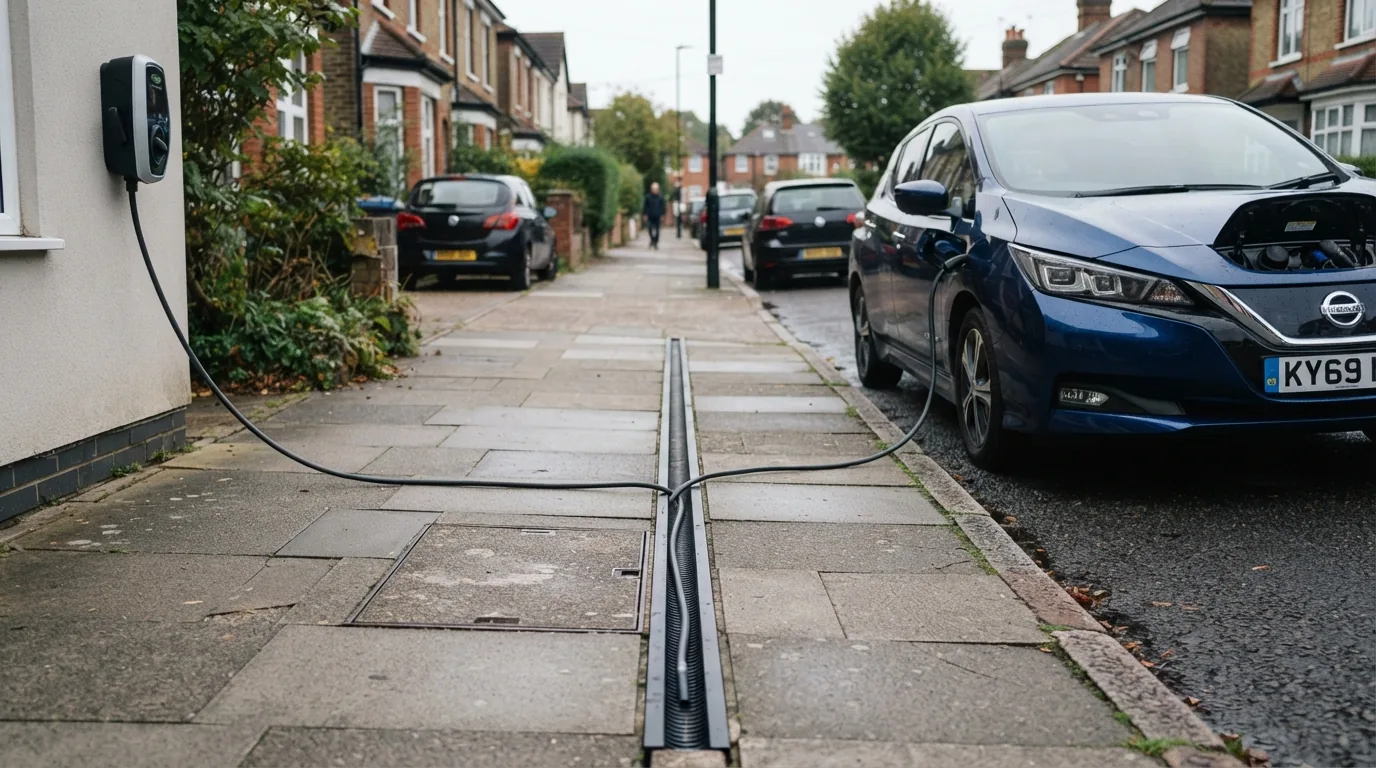
Quick answers
- You do not need a driveway to run an EV, but you cannot simply trail a cable across a public pavement; you need either a permitted cross-pavement channel or a public on-street charger.
- Cross-pavement channels from providers such as Kerbo Charge and Gul-e typically cost around £1,000 fitted and require local highways authority permission (figures vary, verify current data).
- As of 1 April 2026, the cross-pavement and on-street parking grant is worth up to £500 per socket, up from £350, and runs until 31 March 2027 (figures vary, verify current data).
- Trailing a cable across a public pavement without consent is an offence under the Highways Act 1980, and trip-hazard liability sits with you; household insurance usually stops at your boundary.
- On-street and lamppost charging is expanding under the LEVI fund, with ubitricity, char.gy and Connected Kerb leading residential roll-out; you can ask your council to prioritise your street.
- A mix of workplace, destination and occasional rapid charging makes EV ownership practical even where home charging is not possible.
Many UK homes have no private driveway or off-street parking (figures vary, verify current data), which has historically made home EV charging difficult. In 2026 the position is considerably better: cross-pavement cable channels let some households run a cable safely from their home to the kerb, the government grant that helps pay for them has risen, and public on-street and lamppost charging is expanding rapidly under the LEVI fund. None of these options are as straightforward as a standard wallbox, but charging without a driveway is now genuinely workable for a growing number of drivers. If you do have off-street parking, a standard wallbox is usually the cheapest and most convenient way to charge; see our complete guide to charging an EV at home for how that works. If you park on the street, read on.
Can you have a home wallbox without a driveway?
The short answer is: not in the conventional sense. A standard wallbox mounted to your house wall is fine if you have off-street parking directly beside your property, because you can plug in without crossing a public footpath. If you park on the public road, you cannot simply trail a cable across the pavement to charge your car. Even with a cable protector laid on top, doing so without consent from your local highways authority is likely to breach the Highways Act 1980, and trip-hazard liability sits with you personally. Household insurance generally stops at the property boundary, which leaves you exposed if someone trips on your cable.
The two realistic routes for charging from home without a driveway are: a permitted cross-pavement channel installed into the pavement (requiring council approval), or relying on public and on-street chargers near your home. Approval is council-dependent and not available everywhere, so the first step is always to contact your local highways authority to find out what is possible in your street.
What is a cross-pavement cable channel?
A cross-pavement cable channel (sometimes called a charging gully or EVCC) is a narrow conduit cut into the pavement surface and fitted with a self-closing flap. When you want to charge, you open the flap, route your charging cable through the channel from your house to the car at the kerb, and connect up. When you are done, the cable is removed and the flap seals flush with the pavement surface. Because the cable sits below the surface while in use, the trip hazard that a trailing cable creates is eliminated.
The two main providers operating in the UK market are Kerbo Charge and Gul-e. Both handle the council liaison and S50 highways licence application as part of their installation service. Fitted cost including council approval typically runs to around £1,000, though prices vary by provider and location (figures vary, verify current data). Cheaper alternatives exist, such as basic cable protector ramps that sit on top of the pavement, but many councils will not approve these for permanent use. More expensive cable arm or cantilever systems that reach over the pavement are available where the footpath width makes a ground channel impractical.
Is it legal to run a charging cable across the pavement?
Not without highways authority consent. The Highways Act 1980 makes placing apparatus across a public highway without permission an offence. Even if you use a cable tidy or ramp, running a cable across a public footpath without approval is generally not permitted, and councils vary in what they will sanction, even temporarily. Some permit cables only during active charging and with a compliant cover; others refuse any surface cable and will only approve an in-ground channel.
What this means for you:
- Always apply to your local highways authority before installing any cross-pavement solution.
- Do not assume a cable cover makes the arrangement legal; your council decides what it will licence.
- Trip-hazard liability sits with you, not with the cable manufacturer or installer.
- Household insurance typically stops at the property boundary, so an uninsured trip claim on the pavement falls to you personally.
- A permitted in-ground channel from a provider such as Kerbo Charge or Gul-e is the safest route because it is installed to the council’s specification as part of a formal approval process.
Permission rules vary by council; always check with your own highways authority before proceeding (figures vary, verify current data).
Is there a grant for charging without a driveway?
Yes. As of 1 April 2026, the government’s cross-pavement and on-street parking chargepoint grant rose from £350 to £500 per socket (figures vary, verify current data). The scheme runs until 31 March 2027. The grant covers up to 75% of eligible costs per socket, whichever is lower.
| Before 1 April 2026 | From 1 April 2026 | |
|---|---|---|
| Maximum grant per socket | £350 | £500 |
| Scheme end date | 31 March 2026 | 31 March 2027 |
To be eligible for the on-street parking grant, you must:
- Own or rent the property where the chargepoint will be installed.
- Have no exclusive off-street parking space available to you.
- Have suitable on-street parking outside your property.
- Obtain permission from your local highways authority for the cross-pavement solution.
- Own or have ordered an eligible EV from the OZEV-approved list.
- Claim no more than one socket per property.
A separate grant applies to residents in flats and renters with dedicated parking, also uplifted to £500 per socket from 1 April 2026. Always verify the current figures and full eligibility conditions on GOV.UK at the time of applying; older sources and comparison sites still quote the previous £350 amount and 2026 deadline.
On-street and lamppost public charging
If a cross-pavement channel is not viable at your property, the growing network of on-street residential charge points is the most practical alternative. The Local Electric Vehicle Infrastructure (LEVI) fund, worth around £450m for English local authorities (figures vary, verify current data), is paying councils to install slow and fast chargers on residential streets across England. Similar programmes operate in Scotland and Wales.
Lamppost chargers, operated primarily by ubitricity (trading as Shell Recharge), convert existing street lighting columns into charge points using the column’s existing electricity supply, which means no new grid connection is needed and installation is faster and cheaper than a standalone unit. ubitricity operates the UK’s largest lamppost and bollard charging network.
char.gy and Connected Kerb are two other operators running residential on-street networks. Connected Kerb was awarded a North Northamptonshire LEVI contract in January 2026 for over 1,500 sockets backed by £2.9m in government funding, which gives a sense of the scale of rollout underway in some areas.
Coverage is patchy by area. To find out what is planned or available near you, contact your local council directly. Most councils have an active LEVI application or existing deployment; asking formally puts you on the record as a resident with a need, which can influence where new points go in.
Other ways to charge without a driveway
Building a practical charging routine from a mix of sources is the realistic approach for most drivers without off-street parking.
Workplace charging. If your employer has chargers, plugging in during the working day is often the cheapest and most convenient option. Workplace charging is frequently subsidised or free, and the GOV.UK Workplace Charging Scheme provides grants to eligible employers who want to install points. If your employer does not yet have chargers, it is worth asking; many are actively considering it.
Destination charging. Supermarkets, gyms, retail parks and leisure venues increasingly install AC chargers, typically at 7 to 22 kW, as a visitor amenity. A two-hour shopping trip can add 50 to 100 miles of range at no cost or a modest fee. This works well as regular top-up charging if your daily mileage is moderate.
Public rapid charging. Rapid chargers at 50 kW or above give a meaningful charge in 20 to 45 minutes and are the most practical option when you need a larger top-up quickly. The trade-off is cost: public rapid charging at 65 to 85p per kWh is significantly more expensive per mile than home off-peak charging, so treat it as a backstop rather than a daily habit.
Peer-to-peer sharing. Apps such as Co Charger and JustPark let you rent access to a neighbour’s home charger by the hour. In densely populated areas this can provide something close to home charging at home-charging prices. Availability depends entirely on your location.
What if you live in a flat?
Living in a flat adds a layer of complexity, but there is still a path. The EV chargepoint grant for flats and renters also rose to a maximum of £500 per socket from 1 April 2026, running to 31 March 2027 (figures vary, verify current data). Eligibility requires dedicated parking at the property and, where parking is shared or cabling crosses communal space, you will need written permission from your landlord or freeholder before proceeding.
Where there is no dedicated parking, flat dwellers are in the same position as any other on-street parker: on-street LEVI chargers, lamppost chargers and public networks are the practical routes. Some housing associations and large freeholders are proactively installing shared charge points in communal bays; if yours is not, raising it formally with the management company is worthwhile.
Going electric without a driveway takes more planning than for drivers who can simply mount a wallbox on their garage wall, but it is now entirely realistic for most people. A permitted cross-pavement channel from a provider like Kerbo Charge or Gul-e is the best home-charging solution where your council allows it, and the updated £500 grant makes it meaningfully more affordable. Where that is not an option, the LEVI-funded on-street network is growing fast. For the broader picture on home charging options, see our complete guide to charging an EV at home.
How we test and where our numbers come from
Range figures are official WLTP combined values taken from manufacturer UK specification pages, with real-world estimates drawn from independent comparative testing. Prices are UK list prices at the time of the latest update. Tax, grant and charging-scheme figures come from GOV.UK and HMRC publications. We re-check every guide when pricing, specification or policy changes. Last checked 11 August 2026.
Frequently asked questions
Can you have a home wallbox without a driveway?
The short answer is: not in the conventional sense. A standard wallbox mounted to your house wall is fine if you have off-street parking directly beside your property, because you can plug in without crossing a public footpath.
What is a cross-pavement cable channel?
A cross-pavement cable channel (sometimes called a charging gully or EVCC) is a narrow conduit cut into the pavement surface and fitted with a self-closing flap. When you want to charge, you open the flap, route your charging cable through the channel from your house to the car at the kerb, and connect up.
Is it legal to run a charging cable across the pavement?
Not without highways authority consent. The Highways Act 1980 makes placing apparatus across a public highway without permission an offence.
Is there a grant for charging without a driveway?
Yes. As of 1 April 2026, the government's cross-pavement and on-street parking chargepoint grant rose from £350 to £500 per socket (figures vary, verify current data).
What if you live in a flat?
Living in a flat adds a layer of complexity, but there is still a path. The EV chargepoint grant for flats and renters also rose to a maximum of £500 per socket from 1 April 2026, running to 31 March 2027 (figures vary, verify current data).
Sources and further reading
- gov.ukGOV.UK OZEVPrimary source referenced in this article.
- gov.ukGOV.UK: Changes to EV chargepoint grant schemes from 1 April 2026confirms the £350 to £500 uplift and the 31 March 2027 end date.
- planningportal.co.ukPlanning Portal: Approved pavement crossings (EV charging)authoritative guidance on the Highways Act position and the permissions process.
- ubitricity.comubitricity: LEVI fund for local authoritiesbackground on the LEVI programme and lamppost charging.

EV Compared
The EV Compared editorial team tracks the UK electric vehicle market full time: new model launches, list prices, WLTP and real-world range, public charging tariffs and the tax rules that decide what an EV actually costs to run. Every guide is checked against manufacturer specifications and official GOV.UK figures, and updated whenever the numbers move.
Related reading
View all
BP Pulse vs Shell Recharge: Which UK Network Wins?
Two of the UK's biggest charging networks compared on price, reliability and which type of driver each suits
Can You Charge Any EV at Any Public Charger in the UK?
Why almost any new EV works at almost any UK public charger, and the two exceptions you need to know
Can You Charge an EV From a Three-Pin Plug in the UK?
Yes, most cars ship with the cable, but speed and safety limits mean it works best for occasional or emergency use