Best EV Chargers With an App in the UK (2026)
Every home charger sold since June 2022 has an app by law, so which ones are genuinely useful and which are just ticking a box
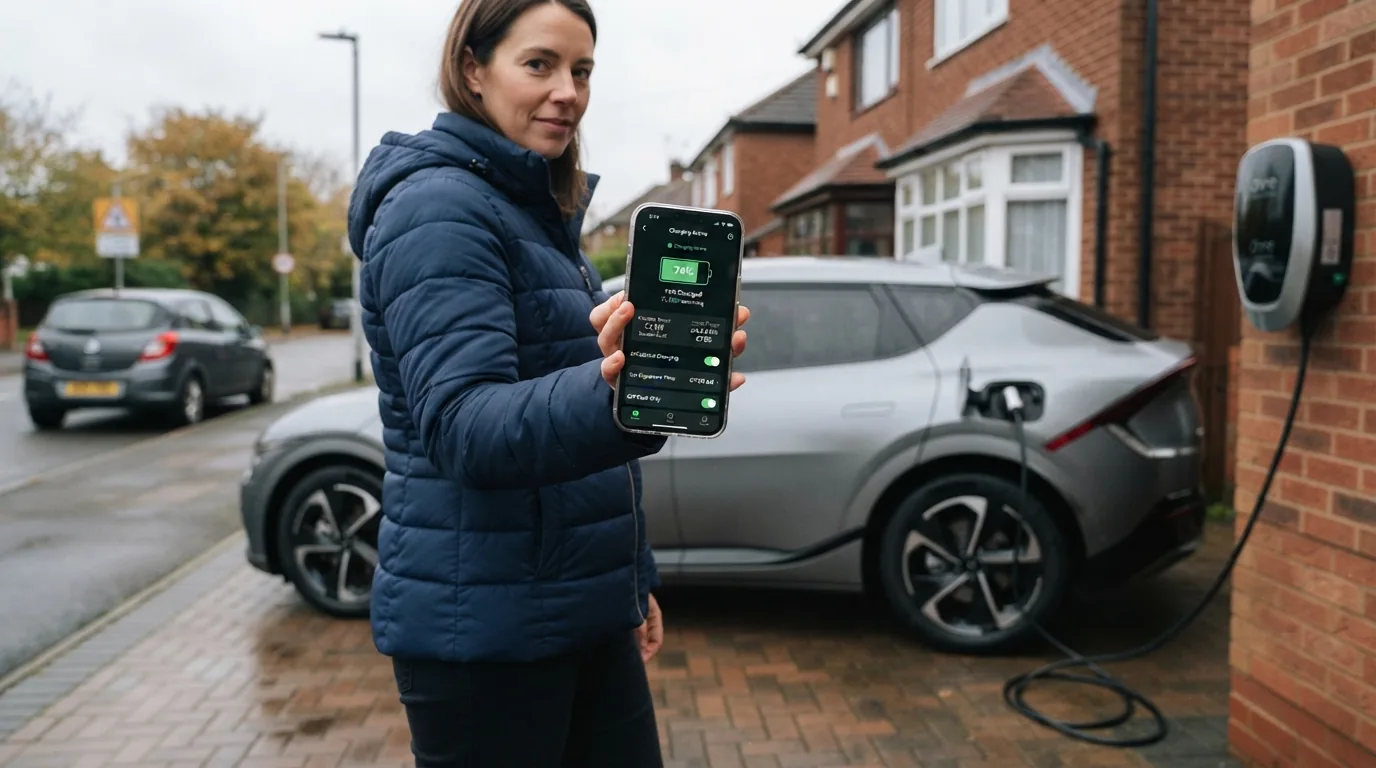
Quick answers
- Every home charger sold in the UK since 30 June 2022 must have an app by law, so the question is app quality, not whether one exists.
- Ohme has the strongest app for cutting bills through smart tariffs; it pairs directly with Intelligent Octopus Go for automatic dynamic charging up to six hours of cheap slots per day.
- The myenergi Zappi app is the pick for solar homes because it actively diverts surplus solar generation to the car, something other chargers cannot do.
- Hypervolt offers the most polished app experience; Pod Point the simplest and most reliable everyday control.
- Expect to pay roughly £800 to £1,290 installed; renters and flat owners can claim up to £500 per socket from the EV chargepoint grant, extended to March 2027.
Every home EV charger sold in the UK since 30 June 2022 must come with an app and a live data connection by law, so asking “does it have an app?” is the wrong question. The right question is whether the app is any good. Ohme leads for smart-tariff savings, myenergi Zappi for solar homes, Hypervolt for the most polished experience, and Pod Point for simple, reliable scheduling. Wallbox rounds out the field with solid everyday control.
The app is often more important than the box on the wall. Your charger does what the app tells it, and a weak app means missed sessions, manual overrides, and higher bills. Here is how the main UK contenders stack up.
Do all home EV chargers come with an app?
Yes, and it is not optional. The Electric Vehicles (Smart Charge Points) Regulations 2021 require every relevant home charger sold from 30 June 2022 onwards to support smart functionality, including a data connection that measures and communicates electricity usage and an app to control it.
The practical implications:
- Every new charger must connect to the internet and allow you to monitor and control charging through an app.
- New chargers come preset to avoid peak hours (8am to 11am and 4pm to 10pm on weekdays) by default; you can accept this or change it in the app on first use.
- From 30 December 2022, Phase 2 added privacy and security requirements, including encryption of data transmitted to and from the charge point.
- Chargers installed before 30 June 2022 are exempt, but fitting a new unit triggers all of these requirements.
Smart functionality is the floor, not the ceiling. The question now is which apps deliver genuine value on top of that minimum.
Which EV charger has the best app?
There is no single winner because the best app depends on what matters most to you. Here is the EV Compared verdict by use case:
-
Best for tariff savings: Ohme. The Ohme app works on cost rather than kilowatts. You set how much charge you need and a ready-by time, and it handles the rest. When paired with Intelligent Octopus Go, the app auto-enables Dynamic Charging, turning off the price cap and letting Octopus find the cheapest slots. Intelligent Octopus Go delivers cheap electricity for the whole house from 11:30pm to 5:30am, plus extra dynamic cheap slots when connected via an Ohme charger, up to a limit of six hours of super-cheap smart charging per 24 hours.
-
Best for solar homes: myenergi Zappi. The Zappi is the leading mainstream UK charger with built-in surplus-solar diversion, sending excess generation directly to your car rather than exporting it at a lower rate. Its app shows clear solar-versus-grid energy flow in real time. Other chargers, including Ohme, Wallbox, and Pod Point, can co-schedule charging with solar generation but cannot follow surplus solar dynamically.
-
Best app experience: Hypervolt Home 3 Pro. The Hypervolt app received a 2026 refresh adding Hypervolt Connect household sharing and improved energy monitoring. It is the most refined app interface in the UK home-charger market, with real-time energy insights and clean navigation.
-
Best for simplicity: Pod Point Solo 3S. The Pod Point app is the most straightforward and consistent. The Solo 3S has no physical display, so the app is your only control interface, which has pushed Pod Point to keep it dependable. If you want to set a schedule and forget it, this is the least fussy option.
App-enabled EV chargers compared
The table below covers the four front-runners, ranked by app strength. Prices are approximate 2026 figures based on retailer and comparison sources; they vary by installer and change frequently, so verify against manufacturer sites before buying (figures vary, verify current data).
| Charger | Best for | App strength | Smart tariff control | Solar following | Tethered/untethered | Typical installed price |
|---|---|---|---|---|---|---|
| Ohme Home Pro | Tariff savings | Excellent | Excellent (Intelligent Octopus Go, dynamic pricing) | Co-schedule only | Tethered (5m cable) | From £999 |
| Hypervolt Home 3 Pro | App experience | Very good | Good (Octopus) | Eco solar mode | Tethered or untethered | £1,090 to £1,290 |
| myenergi Zappi | Solar homes | Good | Good (Octopus via Hub) | True surplus diversion | Tethered or untethered | £800 to £1,050 |
| Pod Point Solo 3S | Simple reliability | Good | Good | Co-schedule only | Tethered or untethered | From £999 |
If you want the full picture on price, installation and warranty as well as the app, see our guide to the best home EV chargers ranked by use case.
What makes a good EV charger app?
The gap between a genuinely useful app and a compliance-checkbox one comes down to a handful of features:
-
Smart-tariff integration that acts automatically. The Ohme app auto-enables Dynamic Charging with Intelligent Octopus Go, booking the cheapest slots without you touching anything. Scheduling manually around a tariff is a weaker substitute.
-
Cost-based control rather than raw kilowatt scheduling. Setting how much charge you need and a ready-by time, and letting the app work out when to run, is far more practical than manually picking windows.
-
True solar following for panel owners. The Zappi diverts surplus solar to the car in real time. Apps that can only co-schedule charging with expected solar output miss the dynamic nature of actual generation.
-
Reliable connectivity and accurate monitoring. The data connection and usage reporting are now a legal minimum, but good apps go further with per-session cost breakdowns and running totals. Check independent owner reviews for connectivity drops and paywalled features before buying, as these are real-world frustrations that spec sheets do not mention.
How much do app-enabled chargers cost, and is there a grant?
Typical installed prices run from roughly £800 to £1,290, depending on the model and installation complexity. The Zappi sits at the lower end of that range (£800 to £1,050 installed), while the Hypervolt Home 3 Pro can reach £1,090 to £1,290. Ohme and Pod Point start from around £999 installed.
On grants:
- The EV chargepoint grant maximum rose from £350 to £500 per socket on 1 April 2026.
- The grant is available to people who rent or own a flat with dedicated off-street parking.
- You must use an OZEV-approved installer and an approved chargepoint.
- The scheme runs until 31 March 2027.
The grant does not apply to homeowners with their own house. If you are a homeowner in a house, you are covering the full cost. If you are in a flat or renting, it is worth checking eligibility before getting quotes.
For a full breakdown of what to look for beyond the app, including installation costs, tethered versus untethered options, and warranty terms, our guide to charging at home covers the whole picture.
Ready to choose? Our independent comparison covers every major model with up-to-date pricing and installation guidance: best home EV chargers ranked by use case.
Useful Resources
GOV.UK Regulations: electric vehicle smart charge points https://www.gov.uk/guidance/regulations-electric-vehicle-smart-charge-points
GOV.UK Changes to chargepoint grant schemes from 1 April 2026 https://www.gov.uk/guidance/changes-to-electric-vehicle-chargepoint-grant-schemes-from-1-april-2026
Octopus Energy Intelligent Octopus Go and Ohme FAQs https://octopus.energy/blog/intelligent-ohme-faqs/
How we test and where our numbers come from
Range figures are official WLTP combined values taken from manufacturer UK specification pages, with real-world estimates drawn from independent comparative testing. Prices are UK list prices at the time of the latest update. Tax, grant and charging-scheme figures come from GOV.UK and HMRC publications. We re-check every guide when pricing, specification or policy changes. Last checked 11 August 2026.
Frequently asked questions
Do all home EV chargers have an app?
Yes. Every relevant home charger sold in the UK since 30 June 2022 must be a smart charge point with a data connection and app control under the Electric Vehicles (Smart Charge Points) Regulations 2021. An app is now a legal requirement on new units, not a premium add-on.
Which EV charger has the best app?
There is no single best app because it depends on your priority. Ohme leads for smart-tariff savings, myenergi Zappi for solar homes, Hypervolt for the most polished interface, and Pod Point for simple reliability. Match the charger to how you actually charge rather than picking the top-rated app in isolation.
Which app saves the most money on charging?
Apps that integrate with smart tariffs save the most. The Ohme app pairs with Intelligent Octopus Go to charge automatically in the cheapest dynamic windows, on top of the standard cheap-rate period from 11:30pm to 5:30am. Octopus applies a limit of up to six hours of super-cheap smart charging per 24-hour period when using this combination.
Do I need a smart charger for my EV?
For any new home charger installed in the UK, yes. Smart functionality and app control are legally required on all new units. In practice this means you set how much charge you need and a ready-by time, and the app schedules the session around peak hours and your energy tariff automatically.
Can I use any charging app with any EV?
A home charger's app controls its own hardware regardless of car brand, handling scheduling, tariff integration and session data. Public-network apps such as Zap-Map and Octopus Electroverse are entirely separate products designed for finding and paying at chargers away from home.
Sources and further reading
- gov.ukGOV.UKPrimary source referenced in this article.

EV Compared
The EV Compared editorial team tracks the UK electric vehicle market full time: new model launches, list prices, WLTP and real-world range, public charging tariffs and the tax rules that decide what an EV actually costs to run. Every guide is checked against manufacturer specifications and official GOV.UK figures, and updated whenever the numbers move.
Related reading
View all
BP Pulse vs Shell Recharge: Which UK Network Wins?
Two of the UK's biggest charging networks compared on price, reliability and which type of driver each suits
Can You Charge Any EV at Any Public Charger in the UK?
Why almost any new EV works at almost any UK public charger, and the two exceptions you need to know
Can You Charge an EV From a Three-Pin Plug in the UK?
Yes, most cars ship with the cable, but speed and safety limits mean it works best for occasional or emergency use