Best Weatherproof Outdoor EV Chargers for UK Homes
Which home EV chargers stand up to British weather, and why IP rating matters more than most buyers realise
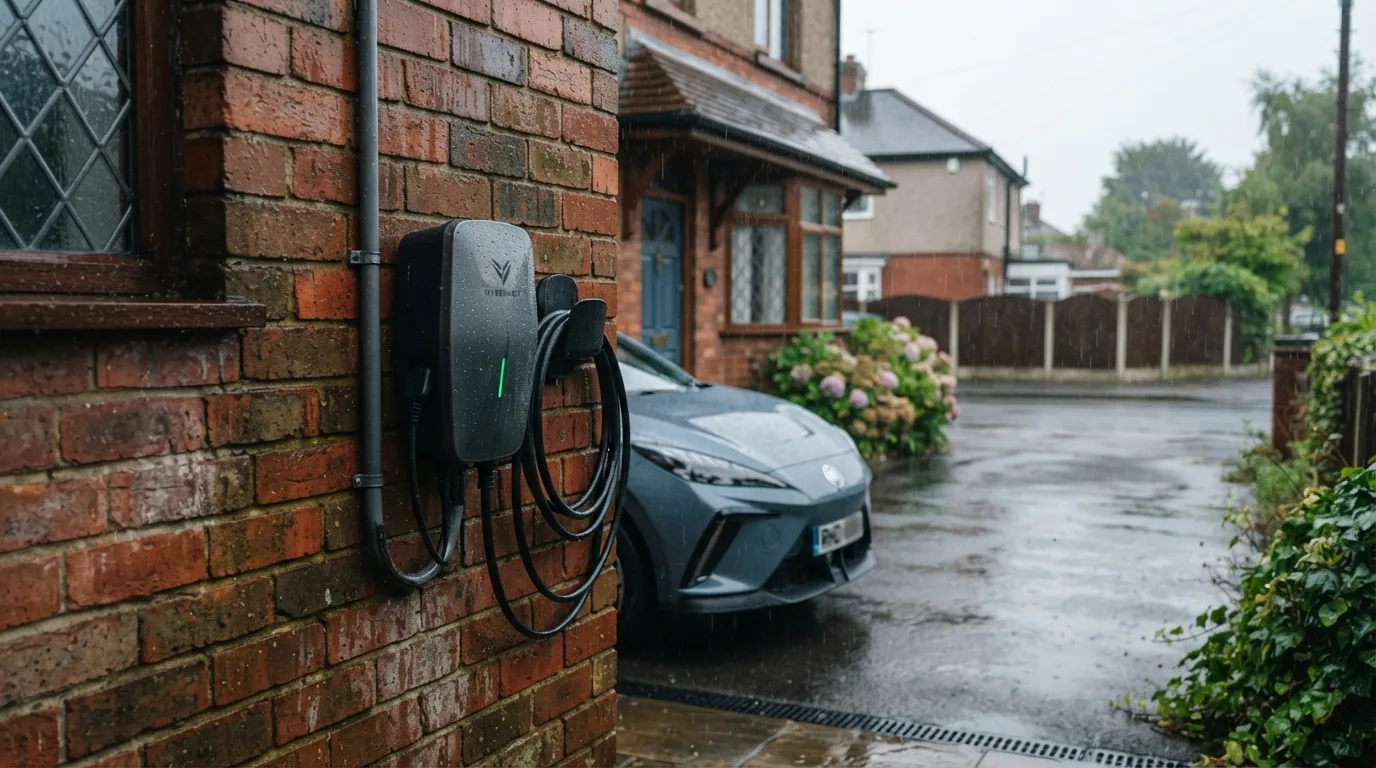
Quick answers
- All home EV chargers sold in the UK must be rated for outdoor installation. In practice, however, there is a significant difference between a charger that technically passes an outdoor standard and one built to withstand years of British weather reliably.
- What does IP rating mean for EV chargers: IP (Ingress Protection) ratings describe how well an enclosure is sealed against dust and water.
- The Hypervolt Home 3 Pro is the only mainstream home EV charger to achieve IP66 combined with IK10 impact resistance.
- The Zappi is rated IP65 and IK10, adequate for fully exposed UK positions.
- The Pod Point Solo 3: IP65 at lowest cost: The Pod Point Solo 3 achieves IP65 at a significantly lower unit price than the Hypervolt or Zappi.
- What about the Ohme Home Pro: The Ohme Home Pro has the best smart tariff integration of any home charger, but its IP55 rating makes it less suitable than IP65+ alternatives for fully exposed positions.
All home EV chargers sold in the UK must be rated for outdoor installation. In practice, however, there is a significant difference between a charger that technically passes an outdoor standard and one built to withstand years of British weather reliably. The Hypervolt Home 3 Pro has the best weatherproofing of any mainstream home charger (IP66), making it the top choice for exposed installations. The Zappi, Pod Point Solo 3, and Ohme Home Pro are solid at IP65. The Easee One at IP54 is the weakest and is best suited to sheltered positions.
What does IP rating mean for EV chargers?
IP (Ingress Protection) ratings describe how well an enclosure is sealed against dust and water. The two digits indicate:
- First digit (dust): 6 = completely dust-tight.
- Second digit (water): 4 = splash-proof from any direction; 5 = protected against water jets; 6 = protected against powerful water jets; 7 = immersion up to 1m for 30 minutes.
For UK outdoor EV charger installations:
| IP rating | Water protection | Suitable for UK outdoor use? |
|---|---|---|
| IP54 | Splash from any direction | Yes, sheltered positions only |
| IP55 | Water jets from any direction | Yes, most outdoor positions |
| IP65 | Water jets from any direction + fully dust-tight | Yes, fully exposed positions |
| IP66 | Powerful water jets + fully dust-tight | Yes, fully exposed, best for UK |
| IP67 | Immersion up to 1m | Yes, exceptional protection |
For UK homes, IP65 is the minimum recommended for a fully exposed driveway or garage wall position. IP66 provides greater confidence in wet and windy conditions.
Many chargers also carry an IK rating (impact resistance). IK10 (the highest grade) indicates the enclosure can withstand a 20-joule impact, equivalent to being struck by a 5kg mass from 40cm. This matters for chargers in accessible positions where accidental or deliberate impact is possible.
Weatherproof EV charger comparison
| Charger | IP rating | IK rating | Best installation position |
|---|---|---|---|
| Hypervolt Home 3 Pro | IP66 | IK10 | Fully exposed, any UK position |
| myenergi Zappi | IP65 | IK10 | Exposed outdoor positions |
| Pod Point Solo 3 | IP65 | Not specified | Standard outdoor positions |
| Ohme Home Pro | IP55 | Not specified | Standard outdoor, sheltered preferred |
| Wallbox Pulsar Max | IP55 | IK08 | Standard outdoor positions |
| EO Mini Pro 3 | IP55 | Not specified | Standard outdoor positions |
| Indra Smart Pro | IP55 | Not specified | Standard outdoor positions |
| Easee One | IP54 | Not specified | Sheltered positions only |
The Hypervolt Home 3 Pro: best for exposed positions
The Hypervolt Home 3 Pro is the only mainstream home EV charger to achieve IP66 combined with IK10 impact resistance. IP66 means the enclosure is sealed against powerful water jets from any direction, providing a meaningful safety margin over IP65 in genuinely exposed positions.
In practice, IP66 versus IP65 matters most in positions where:
- The charger faces a prevailing wind carrying rain directly at the unit.
- A hosepipe might accidentally be directed at the unit during car washing.
- The installation is in a coastal location with salt spray.
- The unit is in a position where ponding water might occur around the base.
The Hypervolt’s UK design and manufacture means the engineering team has optimised for British conditions specifically. The 2026 model also carries a three-year warranty, with the company based in the UK for support.
Verdict: The clear choice for exposed outdoor UK installations.
Unit price: ~£690. Installed from ~£1,100.
The myenergi Zappi: IP65 with solar integration
The Zappi is rated IP65 and IK10, adequate for fully exposed UK positions. Its primary advantage over the Hypervolt for outdoor solar owners is the dedicated Eco and Eco+ solar diversion modes. For solar panel owners with an exposed south-facing driveway, the Zappi is the natural choice.
The seven-year warranty is the longest in the market and provides particular confidence for an outdoor installation where replacement would be disruptive.
Unit price: ~£700-£800. Installed from ~£1,100.
The Pod Point Solo 3: IP65 at lowest cost
The Pod Point Solo 3 achieves IP65 at a significantly lower unit price than the Hypervolt or Zappi. For buyers whose primary concern is reliable outdoor protection at a budget price, the Solo 3 delivers. The five-year warranty also compares favourably.
The trade-off is simpler smart features and less depth of tariff integration compared with premium alternatives.
Unit price: ~£350. Installed from ~£800.
What about the Ohme Home Pro?
The Ohme Home Pro has the best smart tariff integration of any home charger, but its IP55 rating makes it less suitable than IP65+ alternatives for fully exposed positions. Ohme recommends that the Home Pro be installed in a position that avoids direct water jet exposure. In a sheltered position (recessed wall, garage entrance overhang, car port), IP55 is perfectly adequate for UK conditions.
For fully exposed driveway walls, consider the Hypervolt Home 3 Pro if build quality is the priority, or accept the slightly increased exposure risk with the Ohme for the superior tariff integration it offers.
Unit price: ~£535. Installed from ~£999.
Installation considerations for outdoor chargers
The charger’s own IP rating is only part of the weatherproofing picture. The installation itself must also be weatherproof:
- Cable entry: All cable entry points into the charger enclosure should be sealed with appropriate cable glands. Your installer should confirm this.
- Back-box moisture: If the charger mounts on a damp wall (common in older UK properties), a back-box or air gap may be needed to prevent moisture ingress from behind the unit.
- Cable conduit: Surface-mounted cable runs outdoors should be in UV-resistant conduit rated for outdoor use.
- Height: Mounting the charger high enough (typically 750-1200mm from ground) reduces risk from surface water splash and accidental damage from vehicles.
Does cable choice matter outdoors?
For tethered chargers, the cable is also exposed to UV light, temperature cycling, and physical wear. Cables on quality chargers (Hypervolt, Zappi, Ohme) are UV-stabilised and rated for outdoor use. Avoid leaving the cable coiled in direct sunlight for extended periods, as this can degrade the jacket more quickly.
For untethered installations, the cable you supply should be rated for outdoor use (look for IP65 or outdoor-rated markings on reputable cables). Cheap cables without outdoor ratings degrade faster in UV and cold temperatures.
Does outdoor installation affect the OZEV grant?
No. The OZEV grant (up to £500 for eligible buyers) applies regardless of whether the charger is installed inside a garage, on an exterior wall, or in an exposed position. The charger must be OZEV-approved, installed by an OZEV-approved installer, and the buyer must meet eligibility criteria (renter, landlord, or flat owner).
See the best home EV chargers guide for full comparisons across all categories, and the complete guide to charging at home for the full picture on installation, costs, and tariffs.
How we test and where our numbers come from
Range figures are official WLTP combined values taken from manufacturer UK specification pages, with real-world estimates drawn from independent comparative testing. Prices are UK list prices at the time of the latest update. Tax, grant and charging-scheme figures come from GOV.UK and HMRC publications. We re-check every guide when pricing, specification or policy changes. Last checked 11 August 2026.
Frequently asked questions
What does IP rating mean for EV chargers?
For UK homes, IP65 is the minimum recommended for a fully exposed driveway or garage wall position. IP66 provides greater confidence in wet and windy conditions.
What about the Ohme Home Pro?
The Ohme Home Pro has the best smart tariff integration of any home charger, but its IP55 rating makes it less suitable than IP65+ alternatives for fully exposed positions. Ohme recommends that the Home Pro be installed in a position that avoids direct water jet exposure.
Does cable choice matter outdoors?
For tethered chargers, the cable is also exposed to UV light, temperature cycling, and physical wear. Cables on quality chargers (Hypervolt, Zappi, Ohme) are UV-stabilised and rated for outdoor use.
Does outdoor installation affect the OZEV grant?
No. The OZEV grant (up to £500 for eligible buyers) applies regardless of whether the charger is installed inside a garage, on an exterior wall, or in an exposed position.
Sources and further reading
- gov.ukManufacturer specs, GOV.UK OZEVPrimary source referenced in this article.

EV Compared
The EV Compared editorial team tracks the UK electric vehicle market full time: new model launches, list prices, WLTP and real-world range, public charging tariffs and the tax rules that decide what an EV actually costs to run. Every guide is checked against manufacturer specifications and official GOV.UK figures, and updated whenever the numbers move.
Related reading
View all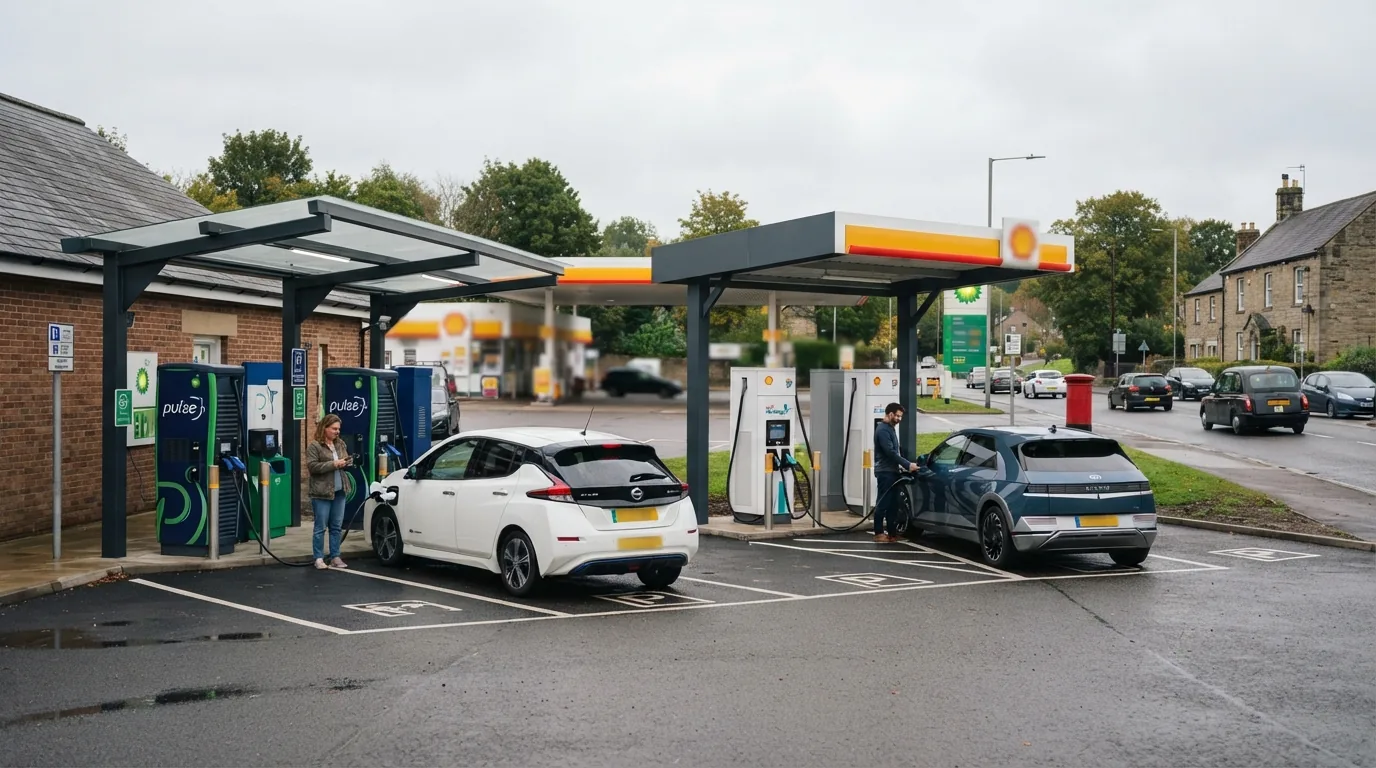
BP Pulse vs Shell Recharge: Which UK Network Wins?
Two of the UK's biggest charging networks compared on price, reliability and which type of driver each suits
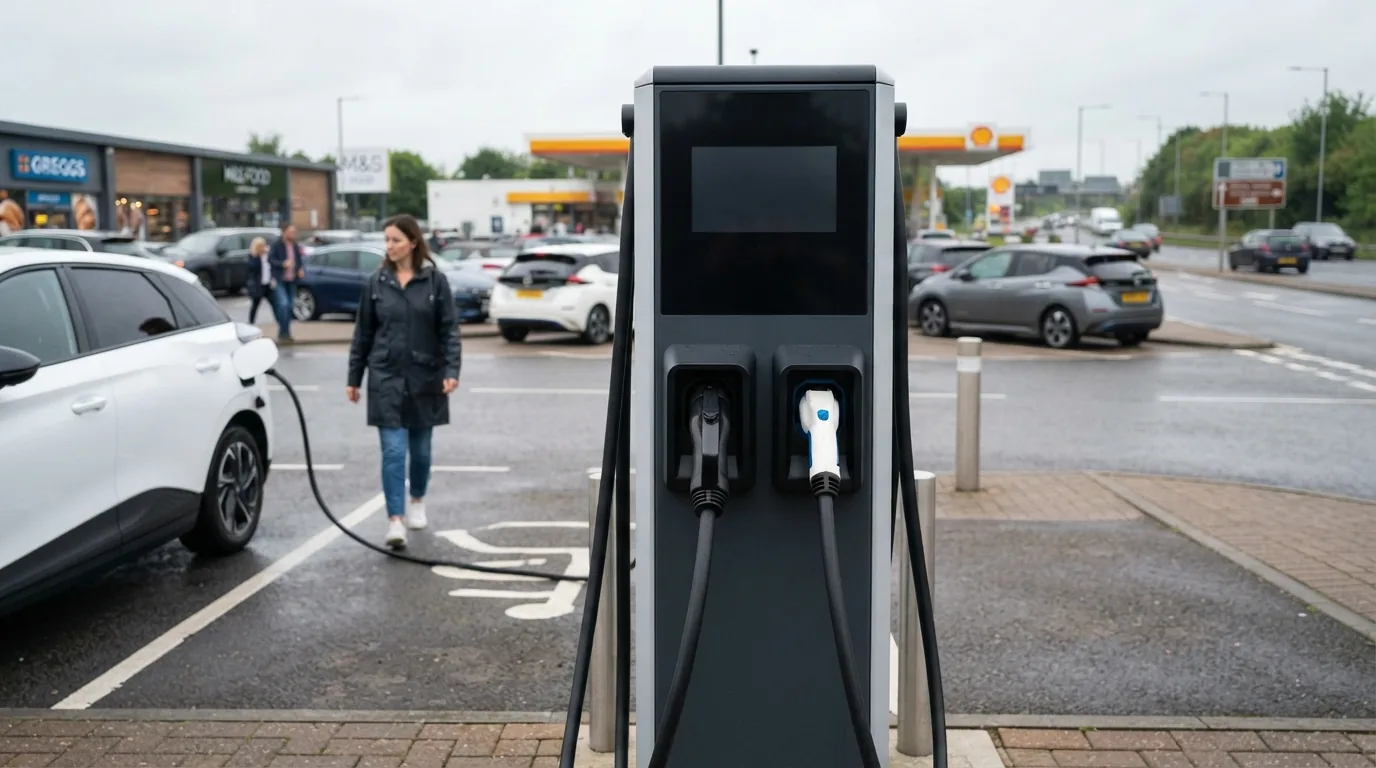
Can You Charge Any EV at Any Public Charger in the UK?
Why almost any new EV works at almost any UK public charger, and the two exceptions you need to know
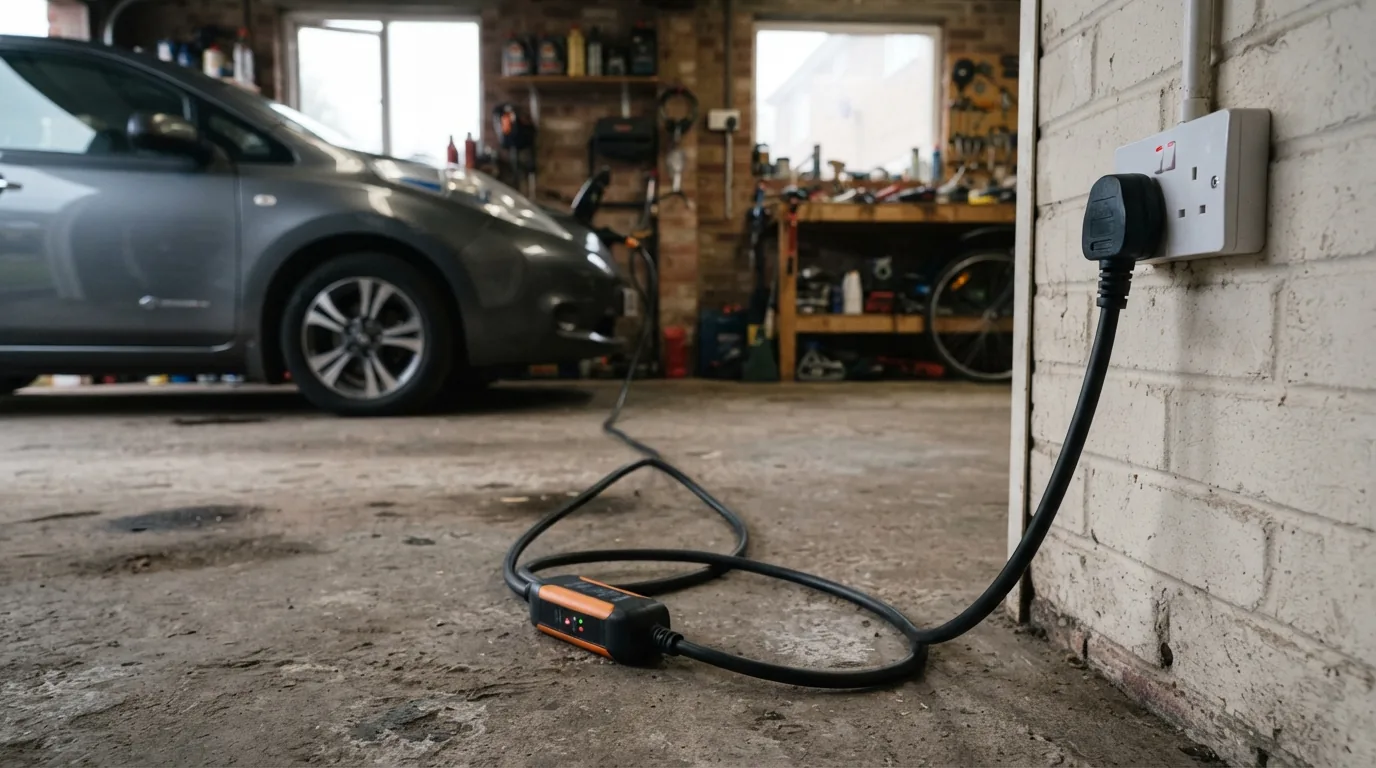
Can You Charge an EV From a Three-Pin Plug in the UK?
Yes, most cars ship with the cable, but speed and safety limits mean it works best for occasional or emergency use