Best EV Charging Solutions for Flats and Shared Parking
Your realistic options if you live in a flat, rent, or park in a communal space, including grants and what they actually cover
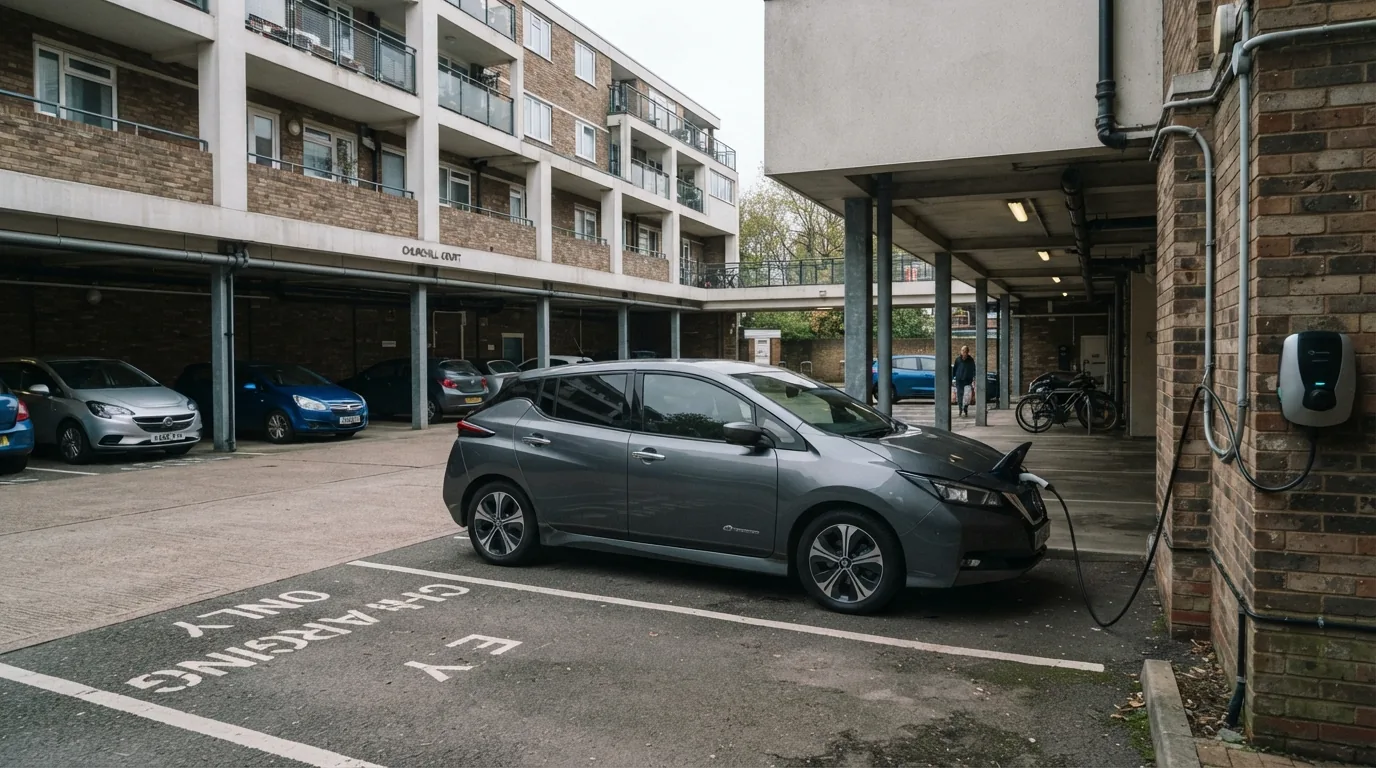
Quick answers
- EV charging for flat residents and renters in shared parking is genuinely more complicated than for homeowners with driveways, but it is not impossible.
- If you have a parking space that is legally assigned to you (whether leasehold, tenancy agreement, or deeded), you can potentially install a personal wallbox on or adjacent to that space.
- If parking is communal or managed, the appropriate route is a coordinated installation organised by the freeholder or management company.
- For residents with no off-street parking at all, cross-pavement cable channels (EVCCs) installed in the pavement allow a cable to run safely from a home charger to a car parked at the kerb.
- The LEVI (Local Electric Vehicle Infrastructure) fund is financing a major expansion of on-street residential charge points across England, Scotland, and Wales.
- Option 5: Workplace charging: If your employer has EV charge points (and many now do, supported by the OZEV Workplace Charging Scheme), daily top-up at work effectively replaces home charging.
EV charging for flat residents and renters in shared parking is genuinely more complicated than for homeowners with driveways, but it is not impossible. The OZEV grant now covers up to £500 for eligible flat owners and renters, a separate EV Infrastructure Grant is available for communal car parks, and cross-pavement channels are expanding for those with only street parking. The key variable is your specific situation: who owns the parking space, who controls the cable route, and how many permissions you need to gather.
Who can access EV charging in flats and shared properties?
| Living situation | Route to charging |
|---|---|
| Flat owner with dedicated parking bay (off-street) | OZEV grant + wallbox with freeholder/management consent |
| Private renter with dedicated parking bay | OZEV grant + wallbox with landlord consent |
| Flat owner/renter, communal parking | EV Infrastructure Grant for Residential Car Parks (through freeholder) |
| Social housing tenant | Housing association or council-managed scheme |
| On-street parking only | Cross-pavement cable channel (where available) or public on-street charging |
Option 1: Individual charger on a dedicated bay
If you have a parking space that is legally assigned to you (whether leasehold, tenancy agreement, or deeded), you can potentially install a personal wallbox on or adjacent to that space.
What you need:
- Written consent from the freeholder, management company, or landlord. This is mandatory. Without it, no OZEV-approved installer will proceed, and the grant cannot be claimed.
- Confirmation of cable routing: from your electrical supply to the charge point, through any shared areas.
- Agreement from the management company if the cable must pass through communal electrical infrastructure.
- An OZEV-approved installer to carry out the work and claim the grant.
OZEV grant available: Up to £500 per socket (75% of cost). Effective from 1 April 2026, extended to 31 March 2027.
Chargers suited to this scenario:
The Easee One is particularly well-suited to shared residential settings. Its dynamic load balancing supports up to three units sharing one electrical fuse, and its 4G eSIM means it works without relying on the building’s Wi-Fi network. The ability to lock the Type 2 socket also provides security against unauthorised use.
The Zaptec Go is a purpose-built multi-unit residential charger. Designed for apartment blocks, it supports billing individual users separately through the Zaptec portal, making it manageable for a freeholder or management company rolling out charging across multiple bays.
Option 2: Communal car park charging via the freeholder
If parking is communal or managed, the appropriate route is a coordinated installation organised by the freeholder or management company. The relevant grant is the EV Infrastructure Grant for Residential Car Parks:
- Available to landlords of rental accommodation (including freeholders of leasehold blocks).
- Covers multiple charge points in a communal car park.
- Covers up to 75% of the cost of installing the charge points and any required cabling/infrastructure upgrades.
- Properties must have at least five parking spaces to qualify.
- Also covers the cost of upgrading the building’s electrical capacity (cable, switchgear, metering) to support future expansion, even if not all bays are charged immediately.
How to push this forward: Write formally to your freeholder or management company requesting that they apply for the grant. Reference the government scheme at gov.uk. Many freeholders are unaware the grant exists or have not prioritised it. A formal letter from multiple residents is more effective than a verbal request.
Option 3: On-street parking with cross-pavement channels
For residents with no off-street parking at all, cross-pavement cable channels (EVCCs) installed in the pavement allow a cable to run safely from a home charger to a car parked at the kerb.
Rollout is uneven across the UK. As of early 2026:
- Around 42% of UK councils plan to have cross-pavement charging available by end of 2026.
- Seven councils have live operational schemes; 21 more are in trials or pilots.
- The OZEV grant (up to £500) covers the chargepoint unit. The LEVI capital fund covers the channel installation itself (up to £1,200 per channel on average).
To access this option, contact your local council’s highways department. If a scheme is planned but not live, put your name on a waiting list.
Option 4: Public on-street residential charging
The LEVI (Local Electric Vehicle Infrastructure) fund is financing a major expansion of on-street residential charge points across England, Scotland, and Wales. These are public charge points designed for residential areas without off-street parking, typically:
- Lamp-post chargers (5-6kW)
- Kerbside pedestal units (7kW)
- Operated by networks such as Char.gy, ubitricity, and Pod Point
You pay via app or RFID card, typically 30-55p per kWh. More expensive than home off-peak charging, but cheaper than rapid public chargers and increasingly convenient as coverage expands.
Use Zap-Map or ChargePlace Scotland to find residential on-street charge points near you.
Option 5: Workplace charging
If your employer has EV charge points (and many now do, supported by the OZEV Workplace Charging Scheme), daily top-up at work effectively replaces home charging. Workplace charging is often at AC speeds (7-22kW) and may be subsidised or free. This is a viable primary charging option for commuters who drive 20-50 miles each way.
Chargers recommended for shared residential settings
| Charger | Key feature for shared use | Unit price |
|---|---|---|
| Easee One | Load balancing across multiple units, 4G built-in | ~£405 |
| Zaptec Go | Purpose-built for multi-unit billing and management | ~£500-£700 |
| Hypervolt Home 3 Pro | IP66 weatherproofing, robust in unmonitored outdoor bays | ~£690 |
| EO Mini Pro 3 | Compact, suitable for constrained installation positions | ~£550 |
Common obstacles and how to address them
The freeholder won’t consent: Under the Landlord and Tenant Act, freeholders cannot unreasonably withhold consent for improvements. A formal request backed by the government’s EV charging guidance and the available grants is difficult to refuse without grounds. If consent is unreasonably refused, legal advice may be appropriate.
No spare electrical capacity: Older blocks may have limited main supply capacity. The EV Infrastructure Grant covers the cost of upgrading cabling and switchgear to prepare for EV charging, even if only one charger is installed initially.
Metering complexity: In shared car parks, the charger must be connected to the correct electricity supply and metered separately from the building’s communal supply. OZEV-approved installers handle this as part of the design process.
Cable routing across common areas: This requires management company permission. Document all consents in writing before installation begins.
The complete guide to home EV charging has more on the general charging landscape, and the best home EV chargers guide covers the top wallboxes including those suited to shared settings.
How we test and where our numbers come from
Range figures are official WLTP combined values taken from manufacturer UK specification pages, with real-world estimates drawn from independent comparative testing. Prices are UK list prices at the time of the latest update. Tax, grant and charging-scheme figures come from GOV.UK and HMRC publications. We re-check every guide when pricing, specification or policy changes. Last checked 11 August 2026.
Sources and further reading
- gov.ukGOV.UK OZEVPrimary source referenced in this article.

EV Compared
The EV Compared editorial team tracks the UK electric vehicle market full time: new model launches, list prices, WLTP and real-world range, public charging tariffs and the tax rules that decide what an EV actually costs to run. Every guide is checked against manufacturer specifications and official GOV.UK figures, and updated whenever the numbers move.
Related reading
View all
BP Pulse vs Shell Recharge: Which UK Network Wins?
Two of the UK's biggest charging networks compared on price, reliability and which type of driver each suits
Can You Charge Any EV at Any Public Charger in the UK?
Why almost any new EV works at almost any UK public charger, and the two exceptions you need to know
Can You Charge an EV From a Three-Pin Plug in the UK?
Yes, most cars ship with the cable, but speed and safety limits mean it works best for occasional or emergency use