The State of UK Public Charging in 2026
Over 120,000 charge points now live, ultra-rapid chargers up 40% year on year -- but reliability and pricing remain the real story
Quick answers
- There are now more than 120,000 public electric vehicle charge points across the UK. If that number feels reassuring, it should -- partly.
- At the end of April 2026, Zap-Map recorded 120,388 EV charge points across the UK, located on 93,394 devices at 46,333 charging locations.
- Is the number of chargers actually enough: If you charge primarily at home overnight and use public charging only occasionally, the current network is broadly adequate.
- Public charging in the UK is significantly more expensive than home charging and the prices have risen over the past two years, partly tracking energy costs and partly reflecting network operators investing in infrastructure.
- Reliability has been the most persistent criticism of UK public charging.
- The most widespread misconception is that EV drivers primarily rely on public charging in the same way petrol drivers use petrol stations.
There are now more than 120,000 public electric vehicle charge points across the UK. If that number feels reassuring, it should — partly. The infrastructure is genuinely growing, ultra-rapid chargers are proliferating at motorway service areas, and new hubs are opening every week. But the quantity figure tells an incomplete story. Price, reliability and the experience of using public charging remain more variable than the raw count suggests.
Here is an honest picture of where UK public charging stands in 2026 — what has improved, what has not, and what it means if you own or are considering an electric car.
How many public chargers are there in the UK?
At the end of April 2026, Zap-Map recorded 120,388 EV charge points across the UK, located on 93,394 devices at 46,333 charging locations. This represents an 11% year-on-year increase compared to April 2025, when 108,819 charge points were recorded.
The number is growing consistently. In April 2026 alone, 1,308 net new charge points were added to the Zap-Map database.
| Charger type | Power range | UK count (April 2026) | YoY growth |
|---|---|---|---|
| Standard | 3-7.9 kW | ~60,000 | ~8% |
| Standard Plus | 8-49 kW | ~28,000 | ~10% |
| Rapid | 50-149 kW | ~19,000 | ~18% |
| Ultra-rapid | 150 kW+ | 13,346 | ~40% |
Total: 120,388 charge points at 46,333 locations
The most significant growth is at the top of the power spectrum. Ultra-rapid chargers — those capable of 150 kW and above — have grown by 40% year on year. These are the chargers that can take a typical 77 kWh battery from 20% to 80% in 20-30 minutes, making long-distance EV travel genuinely convenient.
Is the number of chargers actually enough?
That depends on your perspective.
If you charge primarily at home overnight and use public charging only occasionally, the current network is broadly adequate. The ratio of about one public charge point per 17 EVs on UK roads is not as tight as it sounds when most EV owners charge at home 90% of the time.
If you cannot charge at home — because you live in a flat, do not have off-street parking, or rent — the picture is less comfortable. Destination chargers at supermarkets and car parks are plentiful but often slow (7-22 kW) and can be occupied. Finding a rapid charger when you need one in a city centre remains a more variable experience than it should be.
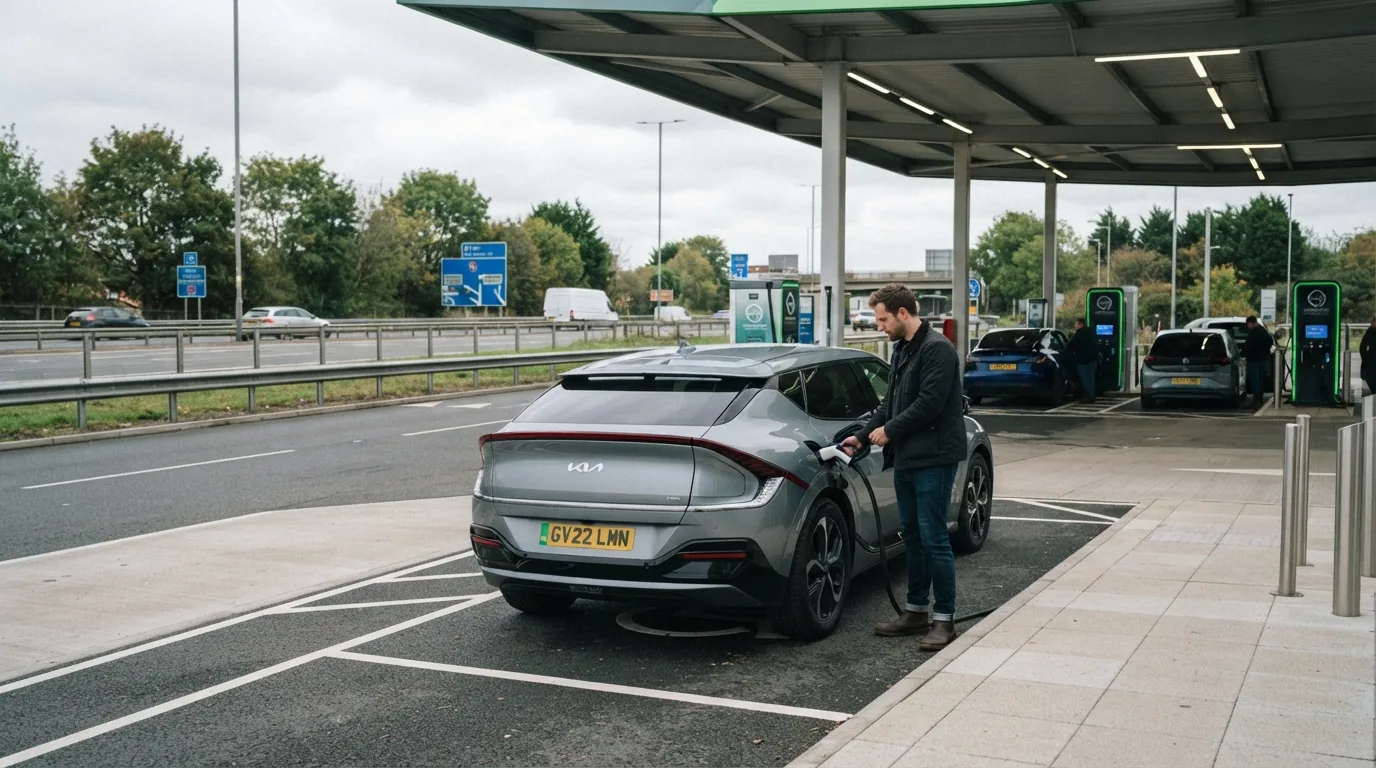
For motorway driving, the situation has improved substantially. Major service areas now have dedicated EV charging hubs, often with 6-12 rapid or ultra-rapid bays. GRIDSERVE opened or expanded 12 Electric Super Hubs in Q1 2026 alone, adding 120 new charging bays across the country. However, at peak times on busy holiday routes, queues at motorway chargers do still occur — though they are becoming less common as capacity grows.
The honest assessment: UK public charging is good and getting better. It is not yet uniformly excellent.
What does it cost to charge publicly in the UK?
Public charging in the UK is significantly more expensive than home charging and the prices have risen over the past two years, partly tracking energy costs and partly reflecting network operators investing in infrastructure.
As of May 2026, the Zap-Map price index for pay-as-you-go (PAYG) rates shows:
- Rapid and ultra-rapid chargers (50 kW+): weighted average of 79p/kWh
- Standard chargers (3-49 kW): weighted average of 54p/kWh
Individual network prices vary widely:
- InstaVolt: 92p/kWh (highest major network)
- Tesla Supercharger: 63p/kWh (for non-Tesla vehicles)
- Fastned: 79p/kWh
- Believ: 66p/kWh
At 79p/kWh on a rapid charger, charging a 77 kWh battery from 20% to 80% costs around £36.55 — roughly equivalent to 4.7 litres per 100 km at current petrol prices, depending on the car’s efficiency. For a car achieving 3.5 miles per kWh, that puts public rapid charging at roughly 23p per mile.
Home charging remains far cheaper — a typical overnight home tariff of 24-28p/kWh (on a standard tariff) gives a cost of roughly 7-8p per mile. On an EV-optimised overnight tariff like Octopus Energy’s Intelligent Go, off-peak rates of around 7p/kWh put the cost at under 2p per mile.
The gap between home and public charging is the biggest argument for ensuring you have home charging if you can.
Which networks are considered most reliable?
Reliability has been the most persistent criticism of UK public charging. A charger that is listed on Zap-Map but is broken or out of service is not useful, and historically around 5-10% of public charge points have been out of service at any given time, with wide variation between networks.
The networks with the strongest reliability reputations as of 2026 are:
Tesla Supercharger: Consistently rated highest for reliability in independent surveys. Now open to non-Tesla vehicles. Downside is pricing (non-Tesla PAYG rates are higher than Tesla owner rates) and the fact that some older Supercharger sites are V2 chargers (up to 150 kW) rather than V3 (250 kW).
GRIDSERVE: Strong reliability record with good customer service response times. Expanding rapidly in 2026 with the Super Hub programme.
BP Pulse: Large network with improving reliability following significant infrastructure investment. Coverage is broad, including many supermarket car parks.
Pod Point (EDF): Solid performance at destination charger locations. Primarily 7-22 kW rather than rapid.
Networks with more variable reliability records historically have included Osprey and some smaller regional operators, though performances vary by site.
What is actually changing in 2026?
Three things are substantively different about UK public charging in 2026 compared to two years ago:
1. Ultra-rapid motorway infrastructure is reaching genuine scale. GRIDSERVE, BP Pulse, MFG EV Power and Osprey have all opened new high-power hubs at motorway service areas in 2026. The government’s Rapid Charging Fund has supported some of these installations. Journey planning software (Zap-Map, A Better Route Planner, the native nav in most new EVs) now reliably identifies motorway charging stops with high certainty of finding a working rapid charger.
2. Pricing transparency has improved. New legislation from April 2026 requires network operators to display prices per kWh clearly, not buried in app screens or membership T&Cs. PAYG pricing (without a subscription) is now mandatory for all public rapid chargers. This makes it easier to compare costs between networks and removes the requirement to hold multiple memberships.
3. Reliability reporting is more robust. Zap-Map and the government’s new ChargePoint Data Portal collect real-time uptime data, creating greater accountability for network operators. The government has set a minimum 99% uptime requirement for publicly funded rapid charge points.
What is the biggest myth about public charging?
The most widespread misconception is that EV drivers primarily rely on public charging in the same way petrol drivers use petrol stations. They do not. Around 85% of EV charging in the UK happens at home or at work. Public charging is a supplement for longer journeys and for those without home charging, not the primary energy source.
This matters because it means the public charging network is usable and practical for most EV owners even in its current state — as long as you have home charging. For buyers without off-street parking, the calculus is different and genuinely requires more research into local public charging availability before buying.
What should you do next?
For guidance on home charging options, installation costs and tariffs, and how to choose the right charger for your home, see our public charging guide. For comparison of the main public charging networks on price, reliability and coverage, see our best public EV charging networks page.
The state of UK public charging in 2026 is: substantially better than it was, and improving month by month. The remaining gaps are real — urban on-street charging density and reliability at peak times chief among them — but they are narrowing.
How we test and where our numbers come from
Range figures are official WLTP combined values taken from manufacturer UK specification pages, with real-world estimates drawn from independent comparative testing. Prices are UK list prices at the time of the latest update. Tax, grant and charging-scheme figures come from GOV.UK and HMRC publications. We re-check every guide when pricing, specification or policy changes. Last checked 11 August 2026.
Frequently asked questions
How many public chargers are there in the UK?
At the end of April 2026, Zap-Map recorded 120,388 EV charge points across the UK, located on 93,394 devices at 46,333 charging locations. This represents an 11% year-on-year increase compared to April 2025, when 108,819 charge points were recorded.
Is the number of chargers actually enough?
If you charge primarily at home overnight and use public charging only occasionally, the current network is broadly adequate. The ratio of about one public charge point per 17 EVs on UK roads is not as tight as it sounds when most EV owners charge at home 90% of the time.
What does it cost to charge publicly in the UK?
Public charging in the UK is significantly more expensive than home charging and the prices have risen over the past two years, partly tracking energy costs and partly reflecting network operators investing in infrastructure.
Which networks are considered most reliable?
Reliability has been the most persistent criticism of UK public charging. A charger that is listed on Zap-Map but is broken or out of service is not useful, and historically around 5-10% of public charge points have been out of service at any given time, with wide variation between networks.
What is the biggest myth about public charging?
The most widespread misconception is that EV drivers primarily rely on public charging in the same way petrol drivers use petrol stations. They do not.
Sources and further reading
- zapmap.comZap-Map / GRIDSERVE / RAC Charge WatchPrimary source referenced in this article.

EV Compared
The EV Compared editorial team tracks the UK electric vehicle market full time: new model launches, list prices, WLTP and real-world range, public charging tariffs and the tax rules that decide what an EV actually costs to run. Every guide is checked against manufacturer specifications and official GOV.UK figures, and updated whenever the numbers move.
Related reading
View all
BYD in the UK: Full Model Range and Prices for 2026
From the £18,650 Dolphin Surf to the £47,025 Sealion 7 -- a complete guide to every BYD you can buy in Britain right now
Cheapest New EVs You Can Buy in the UK Right Now
From £14,495 to £30,000: the new electric cars that offer the most genuine value in the current market
Chinese EV Brands in the UK: Who Is Here and Are They Any Good?
BYD, MG, Xpeng, NIO, Leapmotor and Jaecoo are all selling in Britain -- here is an honest assessment of what each offers