BYD in the UK: Full Model Range and Prices for 2026
From the £18,650 Dolphin Surf to the £47,025 Sealion 7 -- a complete guide to every BYD you can buy in Britain right now
Quick answers
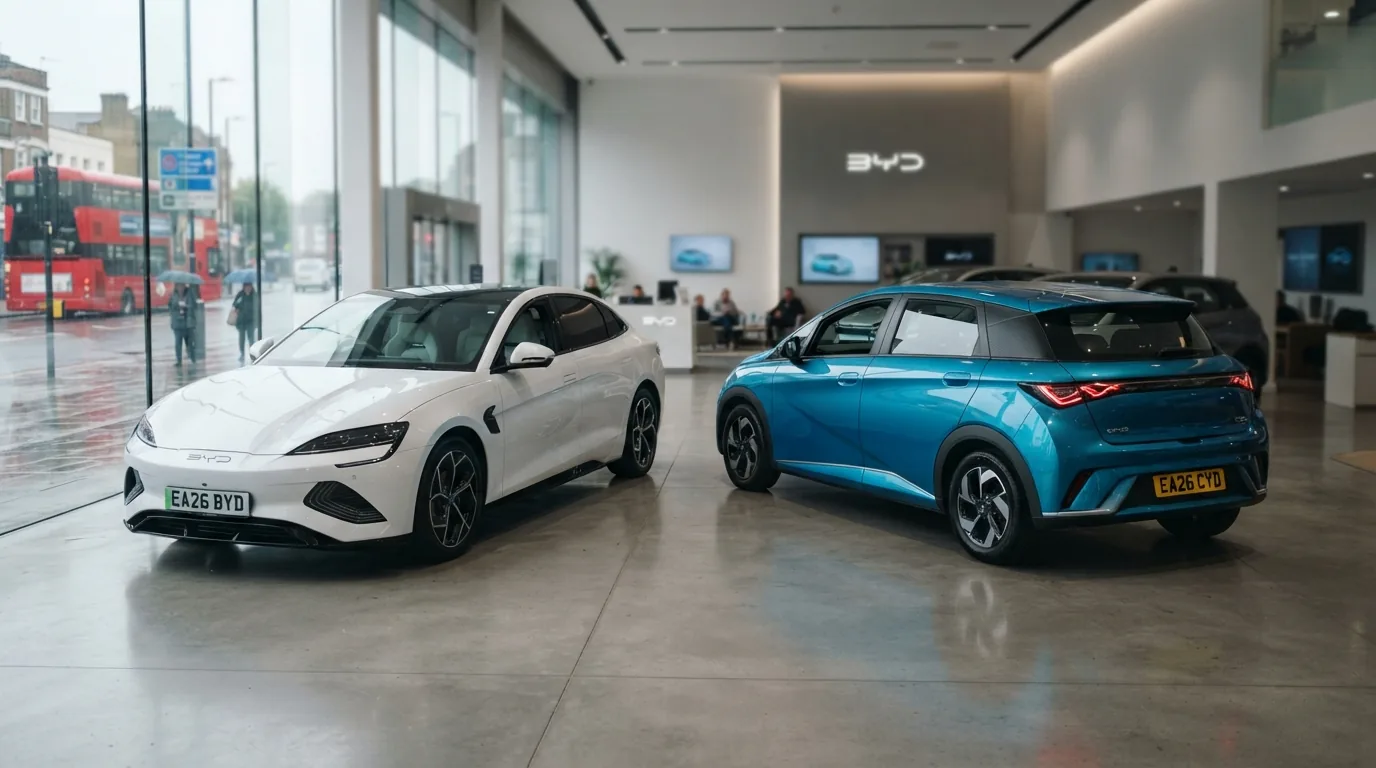
- BYD is now the world's largest manufacturer of electric vehicles by volume and, in 2025, became the first Chinese car brand to outsell Tesla in the UK -- registering 51,422 vehicles against Tesla's 45,513. In 2026, BYD's UK model range has expanded and its pricing has become more competitive.
- Prices are on-the-road list prices and correct at time of writing.
- BYD Dolphin Surf: the entry point: The Dolphin Surf is currently the cheapest pure-electric car from a major established manufacturer available in the UK at £18,650.
- BYD Atto 2: the compact SUV option: The Atto 2 fills the compact-SUV slot that the Atto 3 EVO used to occupy before BYD pushed that model upmarket.
- BYD Atto 3 EVO: the mid-range family SUV: The Atto 3 EVO is BYD's most established UK model and the one with the longest sales history in Britain.
- BYD Seal: the executive saloon: The Seal is BYD's most technically impressive UK model and its clearest challenger to the Tesla Model 3.
BYD is now the world’s largest manufacturer of electric vehicles by volume and, in 2025, became the first Chinese car brand to outsell Tesla in the UK — registering 51,422 vehicles against Tesla’s 45,513. In 2026, BYD’s UK model range has expanded and its pricing has become more competitive. If you have not looked at BYD recently, it is worth doing so.
This page covers every BYD model currently available to buy in the UK, with pricing, specifications and an honest assessment of each one.
BYD’s UK model range at a glance (May 2026)
| Model | Body type | Battery | WLTP range | DC charge (peak) | Price from |
|---|---|---|---|---|---|
| Dolphin Surf | Small hatchback | 38.7 kWh | ~200 miles | 60 kW | £18,650 |
| Atto 2 | Small SUV | 49.9 kWh | ~260 miles | 60 kW | ~£28,000 |
| Atto 3 EVO | Compact SUV | 60.5 kWh | 260 miles | 80 kW | ~£32,000 |
| Seal | Executive saloon | 82.5 kWh | 354 miles | 150 kW | £45,730 |
| Sealion 7 | Large SUV | 82.5 kWh | 323 miles | 150 kW | £47,025 |
Prices are on-the-road list prices and correct at time of writing. Dealer offers and finance deals vary. BYD models are not currently eligible for the UK Electric Car Grant.
BYD Dolphin Surf: the entry point
The Dolphin Surf is currently the cheapest pure-electric car from a major established manufacturer available in the UK at £18,650. That is the full on-the-road price for a car with a 38.7 kWh battery, around 200 miles of WLTP range and genuine five-door practicality.
The Dolphin Surf is based on BYD’s e-Platform 3.0, which brings 60 kW DC charging (0-80% in roughly 35 minutes at a compatible charger), a 12.8-inch rotating touchscreen and a full suite of ADAS safety features including autonomous emergency braking, adaptive cruise control and blind-spot monitoring. All of that for under £19,000 from a brand with 100-plus UK service points.
The honest limitations: the 60 kW DC charge rate is adequate but slower than newer rivals in this segment (the Citroën ë-C3 charges at 100 kW; the Renault 5 at 80 kW). At 200 miles of WLTP range, real-world range in winter on motorways will be closer to 155-165 miles, which is enough for most daily use but needs planning for longer journeys.
Who is it for? Primarily charging at home, driving under 80-100 miles per day, and wanting the lowest entry price on a genuinely capable car from a credible brand.
BYD Atto 2: the compact SUV option
The Atto 2 fills the compact-SUV slot that the Atto 3 EVO used to occupy before BYD pushed that model upmarket. With a 49.9 kWh Blade battery and around 260 miles of WLTP range, the Atto 2 is positioned to compete with the MG ZS EV and the Vauxhall Mokka Electric at around £28,000.
The Atto 2 has 60 kW DC charging, which is the most significant specification limitation at this price point compared with rivals that charge at 100 kW. In everyday use on a home charger this does not matter. On longer journeys or when relying on public rapid chargers, the slower charge rate adds time.
Who is it for? Buyers who want SUV practicality and BYD’s safety and technology reputation at a lower price than the Atto 3 EVO.
BYD Atto 3 EVO: the mid-range family SUV
The Atto 3 EVO is BYD’s most established UK model and the one with the longest sales history in Britain. It uses a 60.5 kWh Blade battery, has 260 miles of WLTP range and 80 kW DC charging. It carries a five-star Euro NCAP rating.
At around £32,000, the Atto 3 EVO competes directly with the MG4 Long Range, the Volkswagen ID.3, the Kia Niro EV and the Hyundai KONA Electric. In this comparison it holds its own on specification and price. The interior is distinctive — BYD’s Ocean design language uses wave-inspired shapes and a rotating central screen — which some buyers will love and others will find too stylised.
The 8-year/125,000-mile battery warranty is one of the strongest available at this price and represents a genuine selling point for buyers concerned about long-term ownership costs.
Who is it for? Families wanting compact-SUV space, a strong safety record and a competitive price, with home charging as the primary energy source.
BYD Seal: the executive saloon
The Seal is BYD’s most technically impressive UK model and its clearest challenger to the Tesla Model 3. Starting from £45,730 for the 2026 model year, it offers a 82.5 kWh Blade battery, 354 miles of WLTP range, rear-wheel drive with a 308 bhp motor, and 150 kW DC charging.
The 2026 model year Seal was updated with a Dynaudio 12-speaker sound system, an enhanced 15.6-inch high-definition touchscreen, a panoramic sunroof, increased storage space and a new Driver Monitoring System. These are meaningful improvements rather than cosmetic refreshes.
Key comparisons:
- Against the Tesla Model 3 Long Range AWD (£47,990): the Seal is roughly £2,000 cheaper, has slightly shorter range (354 miles vs 410 miles for the AWD), but offers 150 kW DC charging versus Tesla’s 250 kW Supercharger speed. Charging away from the Tesla Supercharger network, the real-world gap is smaller than it sounds.
- Against the BMW i4 eDrive40 (from ~£53,000): the Seal is roughly £7,000 cheaper with similar range and a stronger standard equipment level.
- Against the Polestar 2 Standard Range (from ~£46,000): comparable pricing, BYD’s Blade battery safety advantage, Polestar’s arguably superior build quality and brand recognition.
The Seal has five Euro NCAP stars and has been well received in UK long-term tests. Residual values are improving but still lag behind Tesla and BMW equivalents.
Who is it for? Executive saloon buyers who want a credible alternative to the Model 3 at a slightly lower price, and who do not need the Supercharger network advantage.
BYD Sealion 7: the large SUV
The Sealion 7 at £47,025 is BYD’s large-SUV offering, competing in the same bracket as the Tesla Model Y Long Range, the Kia EV6 and the Hyundai IONIQ 5.
It uses the same 82.5 kWh battery as the Seal, with a claimed WLTP range of 323 miles. Its dual motors produce 523 bhp in this configuration, making it rapid (0-62 mph in 4.5 seconds). The 150 kW DC charge rate is the same as the Seal.
The Sealion 7 is a large, well-equipped SUV at a price that undercuts most European large-SUV EVs by a meaningful margin. The compromise versus the Tesla Model Y Long Range (at around £51,990) is mostly brand prestige and the Supercharger network. On hardware alone, the Sealion 7 is competitive.
Who is it for? Buyers who want large-SUV space and rapid performance at a lower price than the premium European and Korean alternatives.
What about BYD’s Blade battery? Is it actually better?
BYD’s Blade battery uses lithium iron phosphate (LFP) chemistry in a structural, cell-to-pack arrangement that eliminates the intermediate module layer used in most batteries. The result is higher energy density for LFP chemistry than most rivals achieve, and an inherently safer chemistry.
LFP does not contain the nickel, cobalt and manganese compounds that enable thermal runaway in NMC batteries. In independent nail-penetration tests (a standard stress test for battery safety), BYD’s Blade battery has consistently performed better than NMC alternatives.
The practical trade-off is that LFP batteries lose a slightly larger percentage of their nominal capacity in cold weather than NMC batteries. BYD addresses this with thermal management systems in all Blade-equipped models. In real-world UK winter use, the impact on range is noticeable but not dramatic — typically a 15-20% range reduction in very cold conditions, comparable to most NMC rivals.
What should you do next?
For a comparison of BYD models against their main rivals in each segment, see our best electric cars to buy guide. For help understanding the full cost of ownership — including charging, insurance and service costs for a Chinese-brand EV — our Buying and Owning guide has the detail.
BYD’s UK range is genuinely competitive in 2026. The engineering is serious, the prices are honest and the after-sales network, while still growing, is now substantial enough to make ownership practical for most UK buyers.
How we test and where our numbers come from
Range figures are official WLTP combined values taken from manufacturer UK specification pages, with real-world estimates drawn from independent comparative testing. Prices are UK list prices at the time of the latest update. Tax, grant and charging-scheme figures come from GOV.UK and HMRC publications. We re-check every guide when pricing, specification or policy changes. Last checked 11 August 2026.
Frequently asked questions
What about BYD's Blade battery? Is it actually better?
BYD's Blade battery uses lithium iron phosphate (LFP) chemistry in a structural, cell-to-pack arrangement that eliminates the intermediate module layer used in most batteries. The result is higher energy density for LFP chemistry than most rivals achieve, and an inherently safer chemistry.
Sources and further reading
- byd.comBYD UK / Auto Express / The Electric Car SchemePrimary source referenced in this article.

EV Compared
The EV Compared editorial team tracks the UK electric vehicle market full time: new model launches, list prices, WLTP and real-world range, public charging tariffs and the tax rules that decide what an EV actually costs to run. Every guide is checked against manufacturer specifications and official GOV.UK figures, and updated whenever the numbers move.
Related reading
View all
Cheapest New EVs You Can Buy in the UK Right Now
From £14,495 to £30,000: the new electric cars that offer the most genuine value in the current market
Chinese EV Brands in the UK: Who Is Here and Are They Any Good?
BYD, MG, Xpeng, NIO, Leapmotor and Jaecoo are all selling in Britain -- here is an honest assessment of what each offers

Electric Car Grant 2026: Latest Eligible Models and Discounts
Up to £3,750 off qualifying new EVs -- 45 models are now confirmed eligible, but Tesla, MG, BYD and Fiat are all excluded