Best Places to Charge an EV for Free in the UK
Where free public EV charging still exists in 2026, and how to find it near you
Quick answers
- Free public EV charging is now rare in the UK. Of the 120,000-plus public chargepoints listed on Zap-Map in spring 2026, approximately 1,837 are free to use, roughly 1.5% of the total.
- Accommodation venues host the highest number of free EV charging devices in the UK, with around 352 available nationwide.
- How to find free chargers near you: Always verify before planning a journey specifically to use a free charger.
- The honest assessment: Free public charging in the UK is a declining resource, not a strategy.
- Where to find more: For the cheapest paid options when free is not available, see Best Cheap Public EV Charging Options.
Free public EV charging is now rare in the UK. Of the 120,000-plus public chargepoints listed on Zap-Map in spring 2026, approximately 1,837 are free to use, roughly 1.5% of the total. The supermarket free-charging era largely ended by 2023 as operators moved to paid models to fund maintenance and expansion. That said, free chargers do still exist, and for drivers who know where to look, they can meaningfully reduce the cost of EV ownership, particularly for those without home charging.
Where free EV charging still exists in 2026
Hotels and accommodation: the largest single category
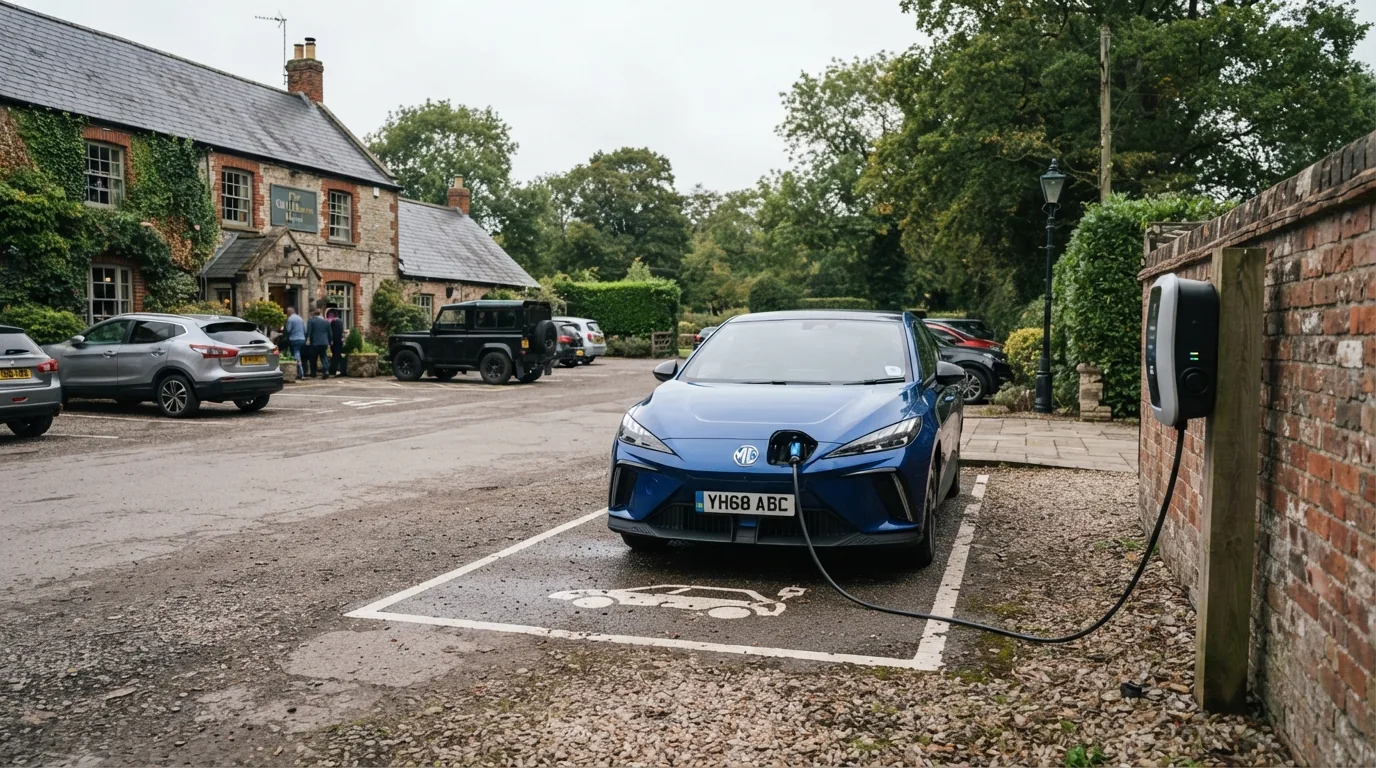
Accommodation venues host the highest number of free EV charging devices in the UK, with around 352 available nationwide. Many hotels and B&Bs offer free charging as an amenity for guests, particularly at independent hotels, Premier Inn, Holiday Inn and some Marriott properties.
The key caveat is that access is usually for registered guests only. Hotel chargers are typically slow (3 kW to 7 kW), meaning an overnight stay adds 40 to 80 miles of range. This is sufficient for most purposes if you are stopping anyway. Always call ahead: hotel charger policies vary, and the Zap-Map listing may not reflect whether access requires a room key or reception check-in.
Supermarkets: still free in a handful of stores
A small number of Asda, Aldi and Sainsbury’s stores retain free slow or medium-speed chargers. Tesco stopped offering free charging in 2022 and all its Pod Point units are now paid. By 2026, the majority of supermarket charging across all major chains is paid.
The remaining free supermarket chargers are typically older 3 kW to 7 kW units at stores that have not yet upgraded or switched to paid hardware. They are not worth planning a journey around, but if you happen to shop at an Asda or Aldi that still has a free bay, it is worth adding 20 or 30 miles of range while you are inside.
To find them: open Zap-Map, filter by “Free to use”, and search near your local supermarkets. Confirm the status by reading recent user comments, as policies change without notice.
Workplaces
Many employers offer free EV charging as a staff benefit. Since April 2022, HMRC has confirmed that charging electricity at an employer’s charger is not a taxable benefit, making it genuinely free at the point of use with no benefit-in-kind tax implication.
Workplace charging is the most impactful category for employed EV drivers. A free 7 kW charger for an 8-hour working day adds 40 to 55 miles of range at zero cost. Over a working week, that is 200 to 275 miles of free charging, which covers the average UK driver’s entire weekly mileage without any home or public charging cost.
If your employer does not currently offer charging, Pod Point, Osprey and GRIDSERVE all offer employer installation schemes, and the government’s Workplace Charging Scheme provides a grant of up to £350 per socket (up to 40 sockets per applicant) toward installation cost.
Leisure centres, libraries and public buildings
Some local authority leisure centres, libraries and council buildings have installed free chargers as a public amenity or to attract footfall. These are usually slow (3 kW to 7 kW) and in locations where you might spend an hour or more anyway, making them practical despite the low power.
Councils in Wales have historically been more active in providing free on-street and destination charging than English councils. In Scotland, the ChargePlace Scotland network (transitioning to ScottishPower in 2026) still includes some subsidised or free charging points in rural areas as part of the Scottish Government’s EV access policy.
Car dealerships
Many EV and hybrid dealerships offer free charging while your car is in for service or a test drive. This is not a regular charging source, but for owners who use their dealership for servicing, it is worth asking.
Some premium marques (BMW, Audi, Volvo) offer free charging at dealerships for registered owners. Tesla owners can sometimes access free Supercharging credits at certain locations through promotional arrangements.
Selected retail parks and shopping centres
A small number of retail park operators still offer free 7 kW or 22 kW chargers as a footfall incentive. These are harder to find than hotel or workplace charging and are disappearing as operators switch to paid models. Westfield, Intu and independent shopping centres each make their own decisions on charging pricing.
Use Zap-Map filtered for free chargers near shopping centres and read the comments before planning a visit.
Summary table: free EV charging locations
| Location type | Typical charger speed | Access condition | Availability |
|---|---|---|---|
| Hotels (for guests) | 3–7 kW | Guest registration | ~352 points nationally |
| Workplaces (for staff) | 7–22 kW | Employment/employer | Very widespread |
| Selected Asda, Aldi, Sainsbury’s | 3–22 kW | No restriction (while stocks last) | Declining, check Zap-Map |
| Council leisure/library | 3–7 kW | Open public | Varies by area |
| Retail parks (selected) | 7–22 kW | No restriction (time-limited) | Rare, check locally |
| Rural ChargePlace Scotland | 7–50 kW | Open public | Scotland only, transitioning |
| Car dealerships | 7–22 kW | Customer/owner | By appointment |
How to find free chargers near you
- Zap-Map: Open the app, tap the filter icon, select “Free to use”. This filters the map to show only chargepoints listed as free. Read recent comments to confirm the policy is current.
- PlugShare: Similar filtering capability, with particularly good user reviews on whether a free charger genuinely works and whether it requires any access code.
- Electroverse: Some roaming plans include free-to-use chargers in their network access.
Always verify before planning a journey specifically to use a free charger. Policies change frequently, and a charger marked free in Zap-Map may have switched to paid since the listing was last updated.
The honest assessment
Free public charging in the UK is a declining resource, not a strategy. For the roughly 60% of UK households who have off-street parking and a home wallbox, charging at home on a smart tariff at 7p to 9p per kWh is far more impactful than chasing free public chargers. For the 40% without off-street parking, free public charging is valuable where it exists, but it is insufficient as a primary charging strategy.
The most accessible form of free charging for most employed EV drivers is workplace charging, where the infrastructure is reliable, the access is consistent, and the miles added are genuinely free. If your employer does not offer it, raising it as a staff benefit is worth doing: the employer’s cost is modest, the benefit-in-kind tax position is clear, and the demand among EV-driving staff is growing.
Where to find more
For the cheapest paid options when free is not available, see Best Cheap Public EV Charging Options.
For a full overview of the UK public charging network, visit our Public Charging guide.
For a ranked comparison of networks by price and reliability, see Best Public EV Charging Networks in the UK.
How we test and where our numbers come from
Range figures are official WLTP combined values taken from manufacturer UK specification pages, with real-world estimates drawn from independent comparative testing. Prices are UK list prices at the time of the latest update. Tax, grant and charging-scheme figures come from GOV.UK and HMRC publications. We re-check every guide when pricing, specification or policy changes. Last checked 11 August 2026.
Sources and further reading
- rac.co.ukRACPrimary source referenced in this article.

EV Compared
The EV Compared editorial team tracks the UK electric vehicle market full time: new model launches, list prices, WLTP and real-world range, public charging tariffs and the tax rules that decide what an EV actually costs to run. Every guide is checked against manufacturer specifications and official GOV.UK figures, and updated whenever the numbers move.
Related reading
View all
BP Pulse vs Shell Recharge: Which UK Network Wins?
Two of the UK's biggest charging networks compared on price, reliability and which type of driver each suits
Can You Charge Any EV at Any Public Charger in the UK?
Why almost any new EV works at almost any UK public charger, and the two exceptions you need to know
Can You Charge an EV From a Three-Pin Plug in the UK?
Yes, most cars ship with the cable, but speed and safety limits mean it works best for occasional or emergency use