Ionity vs Tesla Supercharger: Best for Non-Tesla EVs in the UK?
Two ultra-rapid networks compared on price, speed, coverage and real-world experience for CCS drivers
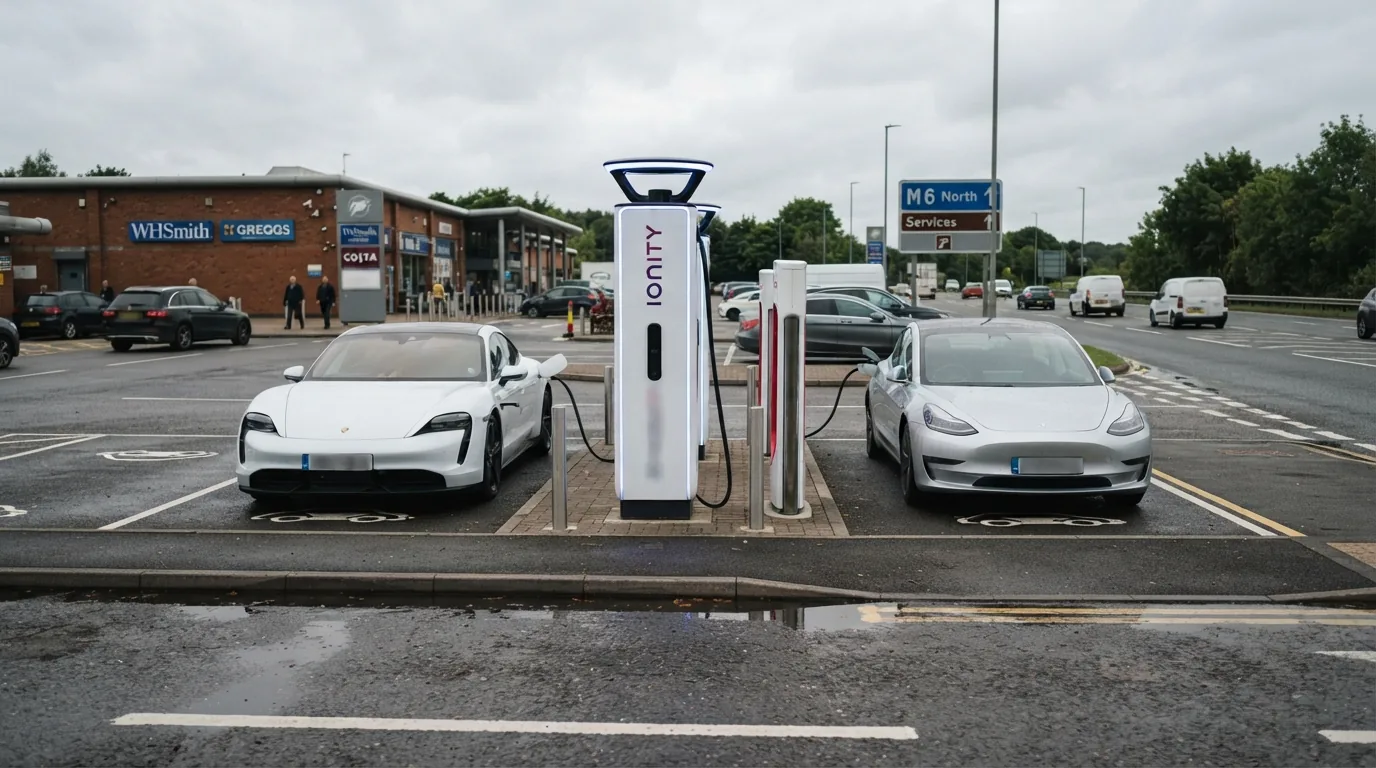
Quick answers
- IONITY and Tesla Supercharger are the two UK networks most associated with ultra-rapid charging and European long-distance travel. For Tesla drivers, the comparison is simple: Superchargers win on price and reliability every time.
- Tesla's 2,900-strong UK network dwarfs IONITY's 788 chargepoints.
- At PAYG contactless, Tesla Supercharger now charges non-Tesla drivers around 45p to 56p per kWh in the UK.
- Speed: IONITY has the higher ceiling: Where the distinction begins to matter is with future-proof ultra-high-acceptance-rate EVs.
- Reliability: Tesla wins: Tesla's reliability record is the benchmark for UK public charging.
- User experience: IONITY requires either contactless PAYG or the IONITY app for access.
IONITY and Tesla Supercharger are the two UK networks most associated with ultra-rapid charging and European long-distance travel. For Tesla drivers, the comparison is simple: Superchargers win on price and reliability every time. For drivers of all other EVs, Hyundai, Kia, BMW, Volkswagen, Polestar, Mercedes, Audi and every other CCS-compatible car, the question is more interesting. Tesla now allows non-Tesla EVs to charge at a growing number of UK Superchargers, making it a genuine competitor to IONITY for the first time.
Bottom line: For non-Tesla EVs, IONITY’s annual Power plan at 43p per kWh is the best-value ultra-rapid option in the UK if you can commit to the annual subscription. If not, Tesla Supercharger PAYG at 45p to 56p per kWh is now cheaper than IONITY PAYG at 74p per kWh, wherever open Supercharger sites are available.
Head to head: the key numbers
| Factor | IONITY | Tesla Supercharger (non-Tesla) |
|---|---|---|
| UK chargepoints | ~788 | ~2,900 (total); ~50% open to non-Tesla |
| Maximum power | 350 kW | 250 kW (V3); newer V4 sites higher |
| PAYG rate (non-Tesla) | 74p/kWh | 45–56p/kWh |
| App/IONITY Go rate | 71p/kWh | Same as PAYG (no separate app discount) |
| Subscription (Motion) | 53p/kWh, £6.99/month | N/A |
| Subscription (Power) | 43p/kWh, ~£10.50/month | N/A |
| Tesla account (Tesla cars) | N/A | 22–30p/kWh |
| Connector type | CCS (always tethered) | CCS (when open to non-Tesla) |
| Contactless payment | Yes | Yes (at open sites) |
| Typical locations | Extra MSA, village hotels | Motorway services, retail, urban |
| UK charger count (open to non-Tesla) | 788 (all accessible) | ~1,450 (approx) |
Coverage: Tesla wins on sheer numbers; IONITY has the motorway services
Tesla’s 2,900-strong UK network dwarfs IONITY’s 788 chargepoints. However, only around half of Tesla Supercharger sockets were open to non-Tesla vehicles as of May 2026, giving an effective non-Tesla figure of approximately 1,450 sockets, still nearly double IONITY’s total.
IONITY’s locations are specifically chosen for motorway and trunk-road convenience. Extra MSA locations (Cobham on the M25, Reading on the M4, Exeter on the M5, and others) are at precisely the points where long-distance EV drivers need them most. Village hotel IONITY sites give drivers the option to eat inside while the car charges outside.
Tesla’s non-Tesla open sites are less predictable in location. Some are at motorway services; others are at retail parks, Tesla showrooms and urban hubs. Check the Tesla app before planning a non-Tesla stop to confirm whether your intended site is accessible.
Winner on coverage for non-Tesla: IONITY is more consistently accessible (all 788 chargers are open to non-Tesla by design). Tesla’s open non-Tesla sites add more absolute numbers but require site-by-site verification.
Price: Tesla PAYG beats IONITY PAYG; IONITY Power plan beats everything
At PAYG contactless, Tesla Supercharger now charges non-Tesla drivers around 45p to 56p per kWh in the UK. This is substantially cheaper than IONITY’s 74p per kWh PAYG. For a 40 kWh charge:
- IONITY PAYG: £29.60
- Tesla PAYG (non-Tesla): £18–£22.40
That is a gap of £7 to £11.60 per session, significant on a long journey with multiple stops.
However, IONITY’s annual Power plan at approximately 43p per kWh changes the equation for frequent long-distance drivers:
- IONITY Power (annual): 40 x 43p = £17.20 + monthly fee element
- Tesla PAYG (non-Tesla): 40 x 50p = £20
At three or more motorway stops per month using IONITY Power, the subscription pays for itself and IONITY becomes the cheaper option overall.
Winner on PAYG price: Tesla Supercharger (45–56p vs IONITY’s 74p). Winner for frequent subscribers: IONITY Power plan (43p, lowest rate on any major UK ultra-rapid network).
Speed: IONITY has the higher ceiling
IONITY’s hardware delivers up to 350 kW. Tesla’s V3 Superchargers deliver up to 250 kW; newer V4 hardware deployed at some UK sites can theoretically exceed this, though the UK rollout of V4 is ongoing.
For most EVs in 2026, the practical difference is minimal. A Hyundai Ioniq 6 accepts 233 kW maximum; a Kia EV6 up to 235 kW; a BMW iX up to 200 kW. Both IONITY (350 kW) and Tesla V3 (250 kW) provide more power than any of these cars can accept, so neither charger becomes the limiting factor. The session speed is determined by the car’s battery management system, not the charger ceiling.
Where the distinction begins to matter is with future-proof ultra-high-acceptance-rate EVs. As cars with 300 kW+ acceptance rates arrive in the UK later in the 2020s, IONITY’s higher hardware ceiling will deliver faster sessions.
Winner on speed: IONITY (350 kW ceiling vs Tesla V3’s 250 kW), though irrelevant for most current EVs.
Reliability: Tesla wins
Tesla’s reliability record is the benchmark for UK public charging. Its vertically integrated hardware-software-backend model means faults are identified in real time and resolved faster than on third-party networks. Uptime consistently exceeds 99%, and Tesla’s monitoring detects and flags faults to drivers before they arrive.
IONITY’s reliability is generally good but not at Tesla’s level. Hardware quality is high and the network is relatively small and new (fewer aging units), but it relies on third-party site operators for access and maintenance in ways that Tesla does not.
Winner on reliability: Tesla Supercharger, convincingly.
User experience
IONITY requires either contactless PAYG or the IONITY app for access. Non-Tesla drivers at Superchargers need to set up a Tesla account (free) and use the Tesla app to activate a session; contactless payment is also available at open sites.
IONITY’s site experience at Extra MSA locations is clean and professional. Village hotel IONITY sites vary by property quality. Tesla Supercharger sites at motorway services are well-lit and well-maintained; the brand consistency of a Tesla site is notable.
For IONITY subscribers, session management and billing are handled through the IONITY app, which is functional if not feature-rich. Tesla’s app integration for non-Tesla cars is improving but still less seamless than the native Tesla experience.
Who should choose which?
Choose IONITY if you:
- Drive long distances frequently on routes served by Extra MSA or village hotel sites
- Are willing to commit to an annual subscription for 43p per kWh
- Need 350 kW ultra-rapid hardware for a very high-acceptance-rate EV
- Want guaranteed access without checking site-by-site non-Tesla eligibility
Choose Tesla Supercharger if you:
- Drive a non-Tesla and make occasional long journeys (PAYG at 45–56p is cheaper than IONITY PAYG)
- Are a Tesla driver (the comparison is not close: Supercharger wins outright)
- Want the best reliability and support infrastructure
- Are flexible on planning and can verify site accessibility via the Tesla app
Where to find more
For a full ranking of UK ultra-rapid charging hubs, see Best Ultra-Rapid Charging Hubs in the UK.
For a complete comparison of all UK charging networks, see Best Public EV Charging Networks in the UK.
For the complete overview of UK public charging, visit our Public Charging guide.
How we test and where our numbers come from
Range figures are official WLTP combined values taken from manufacturer UK specification pages, with real-world estimates drawn from independent comparative testing. Prices are UK list prices at the time of the latest update. Tax, grant and charging-scheme figures come from GOV.UK and HMRC publications. We re-check every guide when pricing, specification or policy changes. Last checked 11 August 2026.
Sources and further reading
- zapmap.comZap-MapPrimary source referenced in this article.

EV Compared
The EV Compared editorial team tracks the UK electric vehicle market full time: new model launches, list prices, WLTP and real-world range, public charging tariffs and the tax rules that decide what an EV actually costs to run. Every guide is checked against manufacturer specifications and official GOV.UK figures, and updated whenever the numbers move.
Related reading
View all
BP Pulse vs Shell Recharge: Which UK Network Wins?
Two of the UK's biggest charging networks compared on price, reliability and which type of driver each suits
Can You Charge Any EV at Any Public Charger in the UK?
Why almost any new EV works at almost any UK public charger, and the two exceptions you need to know
Can You Charge an EV From a Three-Pin Plug in the UK?
Yes, most cars ship with the cable, but speed and safety limits mean it works best for occasional or emergency use