EV Charging Prices in 2026: Are They Going Up or Down?
Public rapid charging now averages 79p/kWh -- more than three times the cost of home charging -- and the trend is not uniformly improving
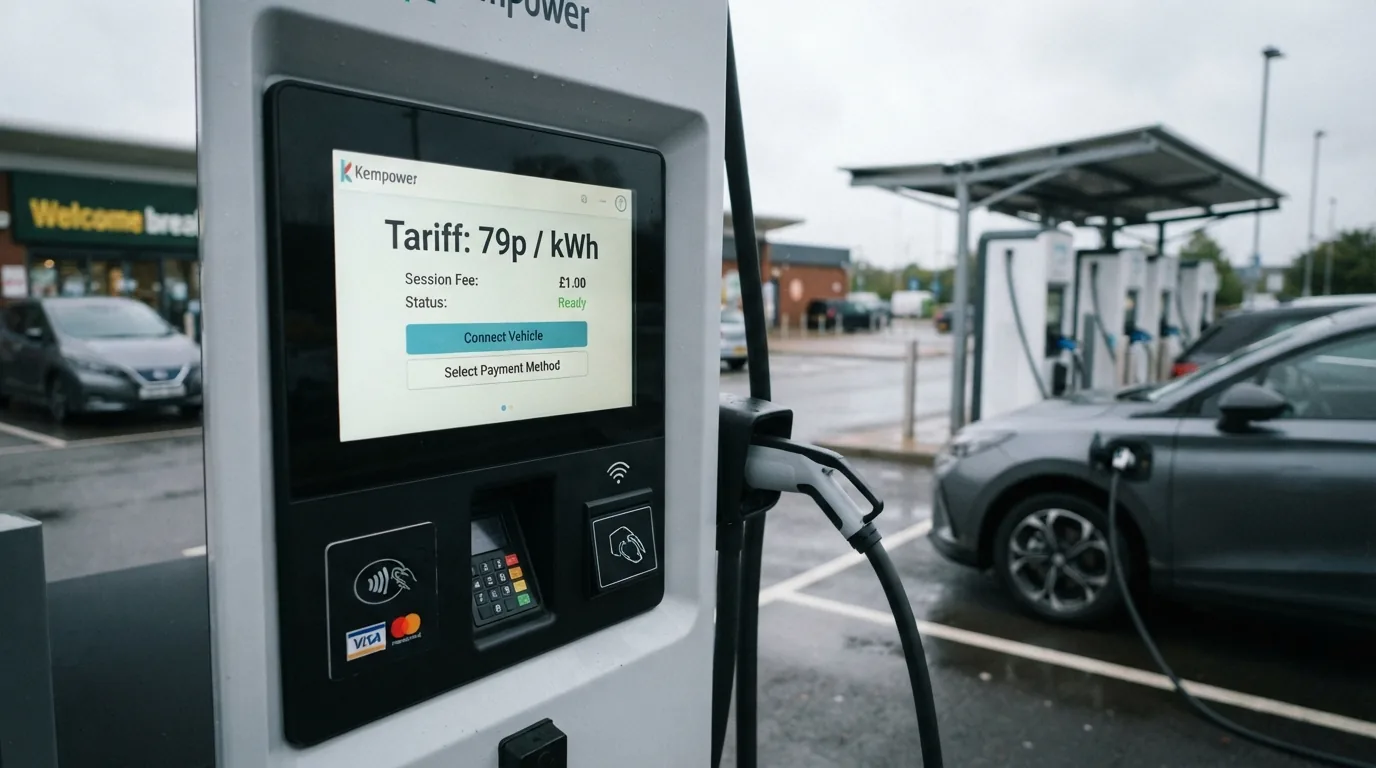
Quick answers
- Public EV charging in the UK is not cheap. The average pay-as-you-go price on a rapid charger (50 kW and above) reached 79p/kWh in April 2026, according to Zap-Map's charging price index.
- These are PAYG (pay-as-you-go) rates without any network subscription.
- Are charging prices going up or down: The honest answer: public rapid charging prices have largely gone up over the past two years, driven by increased energy costs and network operators recovering infrastructure investment.
- At 79p/kWh (rapid charger), charging a car with 3.5 miles per kWh efficiency costs 22.6p per mile.
- Which charging network is cheapest: Note that Tesla Supercharger rates for non-Tesla vehicles have a separate PAYG and subscription structure.
- These requirements address one of the most persistent complaints from EV drivers: that public charging prices were unclear or required navigating multiple apps to find.
Public EV charging in the UK is not cheap. The average pay-as-you-go price on a rapid charger (50 kW and above) reached 79p/kWh in April 2026, according to Zap-Map’s charging price index. At some networks it is as high as 92p/kWh. That puts the cost of a rapid-charger top-up at roughly 23p per mile for a typical EV — not dramatically different from petrol at today’s pump prices, and a very different calculation from the frequently cited 2-3p per mile figure that applies only to off-peak home charging.
Understanding where charging prices are, how they vary and where they are heading matters far more than most EV buyers realise before they purchase.
What does it cost to charge an EV in the UK right now?
The cost depends entirely on where you charge. The range is wide:
| Charge type | Location | Cost (May 2026) | Cost per mile (typical EV) |
|---|---|---|---|
| Home (off-peak tariff) | Home wallbox | ~7-10p/kWh | ~2-3p/mile |
| Home (standard tariff) | Home wallbox | ~24-28p/kWh | ~7-8p/mile |
| Standard / slow public | Destination charger | ~54p/kWh (average) | ~15-16p/mile |
| Rapid public (50-149 kW) | Service area / hub | ~79p/kWh (average) | ~22-23p/mile |
| Ultra-rapid (150 kW+) | Motorway hub | ~79-92p/kWh | ~23-26p/mile |
These are PAYG (pay-as-you-go) rates without any network subscription. Membership or subscription plans typically reduce costs by 10-20%. Tesla Supercharger non-member PAYG rates are among the lower end at 63p/kWh as of May 2026; InstaVolt is the highest major network at 92p/kWh.
Are charging prices going up or down?
The honest answer: public rapid charging prices have largely gone up over the past two years, driven by increased energy costs and network operators recovering infrastructure investment. Home charging prices have broadly tracked domestic electricity tariffs, which have eased from the 2022-23 peak but remain elevated by historical standards.
The picture is more complicated than a simple up/down answer:
Public rapid chargers: higher than two years ago. In early 2024, typical rapid charging rates were in the 65-72p/kWh range at most major networks. By May 2026, the average has moved to 79p/kWh. The main drivers are the energy price component (rapid chargers draw significant grid power and network operators pay commercial electricity rates), infrastructure cost recovery and the removal of some earlier promotional pricing that kept launch-phase rates artificially low.
Home charging: broadly stable with some improvement. Domestic electricity prices peaked in 2022-23 and have eased somewhat. Ofgem’s current energy price cap puts the unit rate for electricity at approximately 24.5p/kWh (from July 2026). EV-specific off-peak tariffs — Octopus Energy Intelligent Go, EDF GoElectric, E.ON Next Drive — are available at 7-10p/kWh for off-peak overnight charging. These tariffs have been broadly stable in 2025-26 as energy wholesale prices have moderated.
The VAT gap persists. A key structural unfairness in UK EV charging remains in place: home electricity attracts 5% VAT while public charging attracts 20% VAT. This adds roughly 13-15p/kWh to the effective public charging cost relative to what it would be at the home charging VAT rate. Consumer groups including Which? and the RAC have repeatedly called for equalisation. The government consulted on the issue in 2025 but no change has been implemented for 2026.
How does public charging cost compare to petrol?
At 79p/kWh (rapid charger), charging a car with 3.5 miles per kWh efficiency costs 22.6p per mile. A petrol car achieving 40 mpg at a fuel price of 153p/litre costs approximately 17.3p per mile. At the high end of rapid charging (92p/kWh, 26p/mile), public EV charging is more expensive per mile than petrol for average-efficiency cars.
This is a significant departure from the “EVs are always cheaper to run” narrative that was accurate when home charging rates and petrol prices were at their respective 2021 levels.
The important context: most EV owners do not primarily rely on public rapid charging. Around 85% of charging happens at home, where costs remain dramatically lower. An EV owner charging primarily at home on an off-peak tariff at 7p/kWh is paying roughly 2p per mile — around one-eighth the cost of petrol. Public rapid charging is a supplement for long journeys, not the primary energy source for typical ownership.
For buyers without home charging access — those who live in flats or do not have off-street parking — the calculation is less favourable. If you rely primarily on public charging, the running cost advantage of an EV over petrol is much smaller or can disappear entirely at current rapid-charge prices.
Which charging network is cheapest?
Based on PAYG rates in May 2026, from cheapest to most expensive among the major networks:
- Tesla Supercharger (non-Tesla PAYG): 63p/kWh
- Believ: 66p/kWh
- Sainsbury’s Smart Charge: 72p/kWh
- Fastned: 79p/kWh
- Pod Point (EDF): varies by location, often 74-80p/kWh
- bp pulse: approximately 79-85p/kWh
- GRIDSERVE: approximately 79-85p/kWh
- InstaVolt: 92p/kWh
Note that Tesla Supercharger rates for non-Tesla vehicles have a separate PAYG and subscription structure. The 63p/kWh figure is the PAYG rate at the majority of open Tesla locations.
Subscription plans can significantly reduce costs. Several networks offer monthly memberships at £5-10/month that reduce per-kWh rates by 10-20%. If you regularly use a specific network on long journeys, a membership typically pays for itself quickly.
What changed from April 2026 on pricing transparency?
New regulations that came into force in April 2026 require public rapid charge point operators to:
- Display the price per kWh clearly at the charger, before a session begins
- Offer a PAYG option without requiring a subscription, app or RFID card for all rapid chargers above 50 kW
- Not display prices as “per session” or “per minute” without also showing the per-kWh equivalent
These requirements address one of the most persistent complaints from EV drivers: that public charging prices were unclear or required navigating multiple apps to find. The implementation has been broadly positive, with most major networks now meeting the requirement.
What is the most common myth about EV charging costs?
The myth most worth correcting: that EVs are necessarily cheaper to run than petrol cars in 2026. They can be — if you charge primarily at home on an off-peak tariff. They are not necessarily cheaper if you rely heavily on public rapid charging.
The honest breakdown for a driver covering 10,000 miles per year:
- Home charging (off-peak, 8p/kWh): approximately £228/year in energy costs
- Mixed home and public charging (70/30 split): approximately £600-700/year
- Primarily public rapid charging: approximately £1,600-2,000/year (comparable to or more than petrol for many cars)
The running cost advantage of an EV is real and significant for home chargers. It is much reduced for those without that option.
What should you do next?
For a comparison of public charging networks on price, reliability and coverage, see our best public EV charging networks page. For guidance on setting up home charging and choosing the right tariff, see our public charging guide.
The most important financial decision in EV ownership is not which car you buy — it is whether you can access home charging. Get that question answered before you buy, and the numbers work strongly in your favour.
How we test and where our numbers come from
Range figures are official WLTP combined values taken from manufacturer UK specification pages, with real-world estimates drawn from independent comparative testing. Prices are UK list prices at the time of the latest update. Tax, grant and charging-scheme figures come from GOV.UK and HMRC publications. We re-check every guide when pricing, specification or policy changes. Last checked 11 August 2026.
Frequently asked questions
What does it cost to charge an EV in the UK right now?
These are PAYG (pay-as-you-go) rates without any network subscription. Membership or subscription plans typically reduce costs by 10-20%.
Are charging prices going up or down?
The honest answer: public rapid charging prices have largely gone up over the past two years, driven by increased energy costs and network operators recovering infrastructure investment.
How does public charging cost compare to petrol?
At 79p/kWh (rapid charger), charging a car with 3.5 miles per kWh efficiency costs 22.6p per mile. A petrol car achieving 40 mpg at a fuel price of 153p/litre costs approximately 17.3p per mile.
Which charging network is cheapest?
Note that Tesla Supercharger rates for non-Tesla vehicles have a separate PAYG and subscription structure. The 63p/kWh figure is the PAYG rate at the majority of open Tesla locations.
What changed from April 2026 on pricing transparency?
These requirements address one of the most persistent complaints from EV drivers: that public charging prices were unclear or required navigating multiple apps to find. The implementation has been broadly positive, with most major networks now meeting the requirement.
Sources and further reading
- zapmap.comZap-Map Charging Price Index / RAC Charge WatchPrimary source referenced in this article.

EV Compared
The EV Compared editorial team tracks the UK electric vehicle market full time: new model launches, list prices, WLTP and real-world range, public charging tariffs and the tax rules that decide what an EV actually costs to run. Every guide is checked against manufacturer specifications and official GOV.UK figures, and updated whenever the numbers move.
Related reading
View all
BYD in the UK: Full Model Range and Prices for 2026
From the £18,650 Dolphin Surf to the £47,025 Sealion 7 -- a complete guide to every BYD you can buy in Britain right now
Cheapest New EVs You Can Buy in the UK Right Now
From £14,495 to £30,000: the new electric cars that offer the most genuine value in the current market
Chinese EV Brands in the UK: Who Is Here and Are They Any Good?
BYD, MG, Xpeng, NIO, Leapmotor and Jaecoo are all selling in Britain -- here is an honest assessment of what each offers