UK EV Charging Network Expansion: Where New Hubs Are Opening
120 new motorway charging bays from GRIDSERVE, NEC Birmingham's largest public hub, and 7 eHGV hubs coming in 2026 -- the infrastructure picture is moving fast
Quick answers
- UK EV charging infrastructure is growing faster in 2026 than at any previous point. More than 1,300 net new charge points were added in April alone, according to Zap-Map data.
- At the end of April 2026, the UK had 120,388 public charge points across 46,333 locations, according to Zap-Map.
- GRIDSERVE achieved its fastest-ever first quarter in 2026, opening or expanding 12 Electric Super Hubs across the country in Q1 alone.
- BP Pulse is rolling out high-powered electric truck charging on major UK routes in 2026, beginning with three motorway service areas: Lymm (M6), Toddington North (M1) and Toddington South (M1).
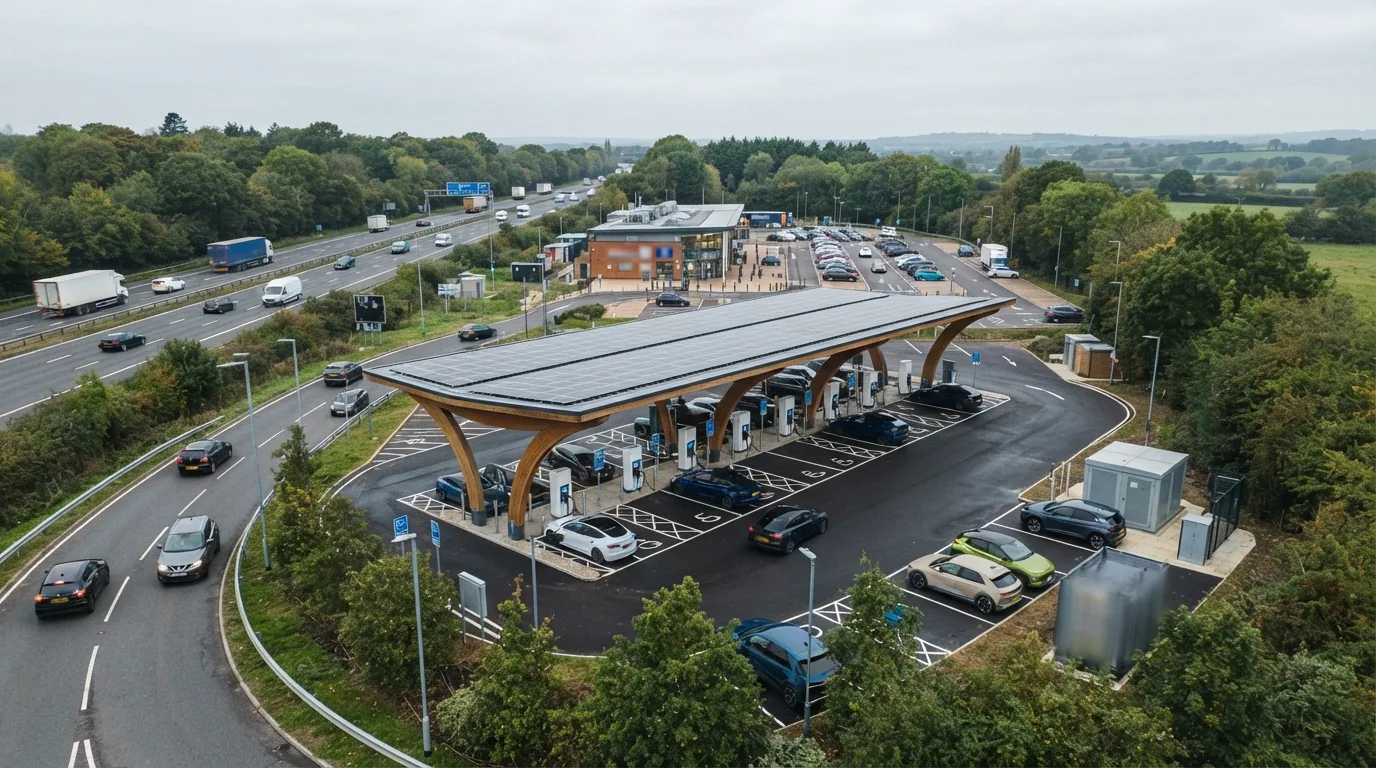
- The UK's largest public EV charging hub: The EV Network (TEN) and bp pulse opened the UK's largest public EV charging hub at the NEC Birmingham in 2026.
- New motorway eHGV charging infrastructure: Seven public electric heavy goods vehicle (eHGV) charging hubs are confirmed to open across the UK in 2026.
UK EV charging infrastructure is growing faster in 2026 than at any previous point. More than 1,300 net new charge points were added in April alone, according to Zap-Map data. Ultra-rapid chargers (150 kW and above) are growing at 40% year on year. And the nature of the investment is changing: the story is no longer about adding destination chargers at car parks and retail parks, but about building proper high-power hubs at motorway service areas that can support genuine long-distance travel.
Here is a guide to where new charging hubs are opening, which operators are expanding most aggressively, and what it means for EV owners planning their journeys.
The overall picture: 120,000 charge points and growing
At the end of April 2026, the UK had 120,388 public charge points across 46,333 locations, according to Zap-Map. That is an 11% increase year on year. The government’s target is 300,000 public charge points by 2030 — which requires an accelerating rate of installation from the current position.
The distribution matters more than the headline number. The UK has a reasonable density of standard (3-7 kW) and standard-plus (up to 22 kW) chargers at supermarkets, car parks and residential areas. The gap that most EV drivers feel is at the rapid and ultra-rapid end — the chargers that make long-distance motorway travel genuinely practical.
Ultra-rapid chargers (150 kW+) reached 13,346 units by April 2026, up 40% year on year. These are the chargers that can take a typical EV from 20% to 80% charge in 20-30 minutes. In 2026, their expansion is the central story.
GRIDSERVE: the most aggressive motorway expansion
GRIDSERVE achieved its fastest-ever first quarter in 2026, opening or expanding 12 Electric Super Hubs across the country in Q1 alone. Notable locations include:
- Moto Kinross and Fort Kinnaird in Scotland
- Folkestone M20 Services (near the Channel Tunnel)
- Multiple new hubs across the Extra estate
The Q1 2026 expansion added 120 new charging bays to the GRIDSERVE Electric Highway. Each Super Hub features 400kW-capable chargers — among the fastest available anywhere in the UK — delivering enough energy in under 10 minutes to add over 100 miles of range to the latest 800V-architecture vehicles.
Through a new partnership with Extra motorway services, GRIDSERVE is adding 96 high-power charging bays across the Extra estate by late 2026. New Super Hubs opened or are opening at:
- Beaconsfield Services (M40)
- Baldock Services (A1)
- Cambridge Services (A14)
- Cobham Services (M25)
- Cullompton Services (M5)
- Leeds Skelton Lake Services (M1)
- Peterborough Services (A1)
These are strategically important locations. Beaconsfield on the M40 and Cobham on the M25 are two of the highest-traffic motorway service areas in England. Comprehensive 400 kW charging at these sites significantly improves the case for EV ownership among regular long-distance motorway users.
BP Pulse: expanding into heavy transport charging
BP Pulse is rolling out high-powered electric truck charging on major UK routes in 2026, beginning with three motorway service areas: Lymm (M6), Toddington North (M1) and Toddington South (M1). Each site will have six pull-through bays equipped with Megawatt Charging System (MCS) chargers — the standard designed for charging electric heavy goods vehicles at up to 1 MW.
For passenger EV drivers, this matters less directly but signals the broader commitment of major fuel retailers to electrifying UK transport infrastructure. BP Pulse is simultaneously expanding its passenger vehicle rapid charging capacity at its existing and new sites.
The company’s collaboration with Moto on electric truck charging also demonstrates that the motorway service area estate is becoming the hub of UK EV infrastructure in a way that mirrors its petrol-era role.
The UK’s largest public EV charging hub
The EV Network (TEN) and bp pulse opened the UK’s largest public EV charging hub at the NEC Birmingham in 2026. The NEC hub includes multiple rapid and ultra-rapid charge points and is designed to serve the complex’s high visitor footfall — a key location for demonstrating that urban mega-venue charging can scale.
The NEC hub is relevant not just for its size but as a template: large event venues, stadiums and convention centres are among the highest-traffic locations where reliable public charging can convert large numbers of occasional EV users into regular public-charging customers, building familiarity with the network.
New motorway eHGV charging infrastructure
Seven public electric heavy goods vehicle (eHGV) charging hubs are confirmed to open across the UK in 2026. The most significant is Baldock Services on the A1(M), confirmed as the UK’s first dedicated motorway eHGV charging hub.
While eHGV charging does not directly affect passenger EV users, the infrastructure investment signals a commitment from the National Highways authority and service area operators to building out the grid connections and physical footprint required for high-power charging at scale. Grid connections that support 1 MW truck chargers can also support large numbers of 150-350 kW passenger car chargers on the same sites.
On-street residential charging: progress but gaps remain
The expansion of hub charging at service areas has been much faster than the expansion of on-street residential charging in urban areas. This remains the most significant infrastructure gap for the significant portion of the UK population who live in terraced streets, flats or rented accommodation without off-street parking.
Local authorities have access to government funding through the Local Electric Vehicle Infrastructure (LEVI) fund. OZEV has allocated over £380 million through LEVI for local authority on-street and destination charging projects. However, the pace of installation has been slower than hoped, partly due to planning complexity and grid connection timescales.
Notable urban on-street charging programmes in 2026 include London boroughs installing kerbside lamppost chargers at scale (several hundred per borough), and a number of cities using the LEVI fund to install dedicated on-street rapid-charge bays in high-density residential areas.
For buyers without off-street parking, checking what is available within 5 minutes’ walk of their home — on Zap-Map, their council’s local EV charging page, or via their local authority’s published LEVI plan — is important before committing to EV ownership.
What is actually new in 2026 compared to previous years?
Power levels have increased significantly. In 2022-23, a “rapid” charger typically meant 50-150 kW. In 2026, new hub installations are routinely 150-400 kW. Vehicles with 800V architecture (BMW i3, Kia EV6 GT, Xpeng G6, Hyundai IONIQ 5 N) can use the full output of these chargers, cutting a 20-80% charge from around 25 minutes to under 15 minutes.
Reliability data is now published. New government requirements from April 2026 mean network operators must report uptime data. The government’s minimum standard is 99% uptime for publicly funded rapid charge points. This creates accountability that did not previously exist and should drive improvements in underperforming networks.
Pricing is more transparent. PAYG pricing displayed clearly at the charger, without requiring an app or subscription, is now legally required for all public rapid chargers above 50 kW.
What should you do next?
For a full comparison of the main public charging networks, including reliability ratings, coverage maps and membership pricing, see our best public EV charging networks page. For guidance on how public charging fits into the overall EV ownership picture, including how to plan long journeys, see our public charging guide.
The UK charging network is genuinely improving. The specific locations opening in 2026 are strategically significant. For anyone who was put off EV ownership by concerns about long-distance charging, 2026 is the year to revisit those concerns with fresh information.
How we test and where our numbers come from
Range figures are official WLTP combined values taken from manufacturer UK specification pages, with real-world estimates drawn from independent comparative testing. Prices are UK list prices at the time of the latest update. Tax, grant and charging-scheme figures come from GOV.UK and HMRC publications. We re-check every guide when pricing, specification or policy changes. Last checked 11 August 2026.
Sources and further reading
- gridserve.comGRIDSERVE / bp pulse / Zap-MapPrimary source referenced in this article.

EV Compared
The EV Compared editorial team tracks the UK electric vehicle market full time: new model launches, list prices, WLTP and real-world range, public charging tariffs and the tax rules that decide what an EV actually costs to run. Every guide is checked against manufacturer specifications and official GOV.UK figures, and updated whenever the numbers move.
Related reading
View all
BYD in the UK: Full Model Range and Prices for 2026
From the £18,650 Dolphin Surf to the £47,025 Sealion 7 -- a complete guide to every BYD you can buy in Britain right now
Cheapest New EVs You Can Buy in the UK Right Now
From £14,495 to £30,000: the new electric cars that offer the most genuine value in the current market
Chinese EV Brands in the UK: Who Is Here and Are They Any Good?
BYD, MG, Xpeng, NIO, Leapmotor and Jaecoo are all selling in Britain -- here is an honest assessment of what each offers