What Is Contactless EV Charging and Where Can You Use It?
Since November 2024, tapping to charge is a legal right at rapid chargers, here is what changed and what remains patchy
Quick answers
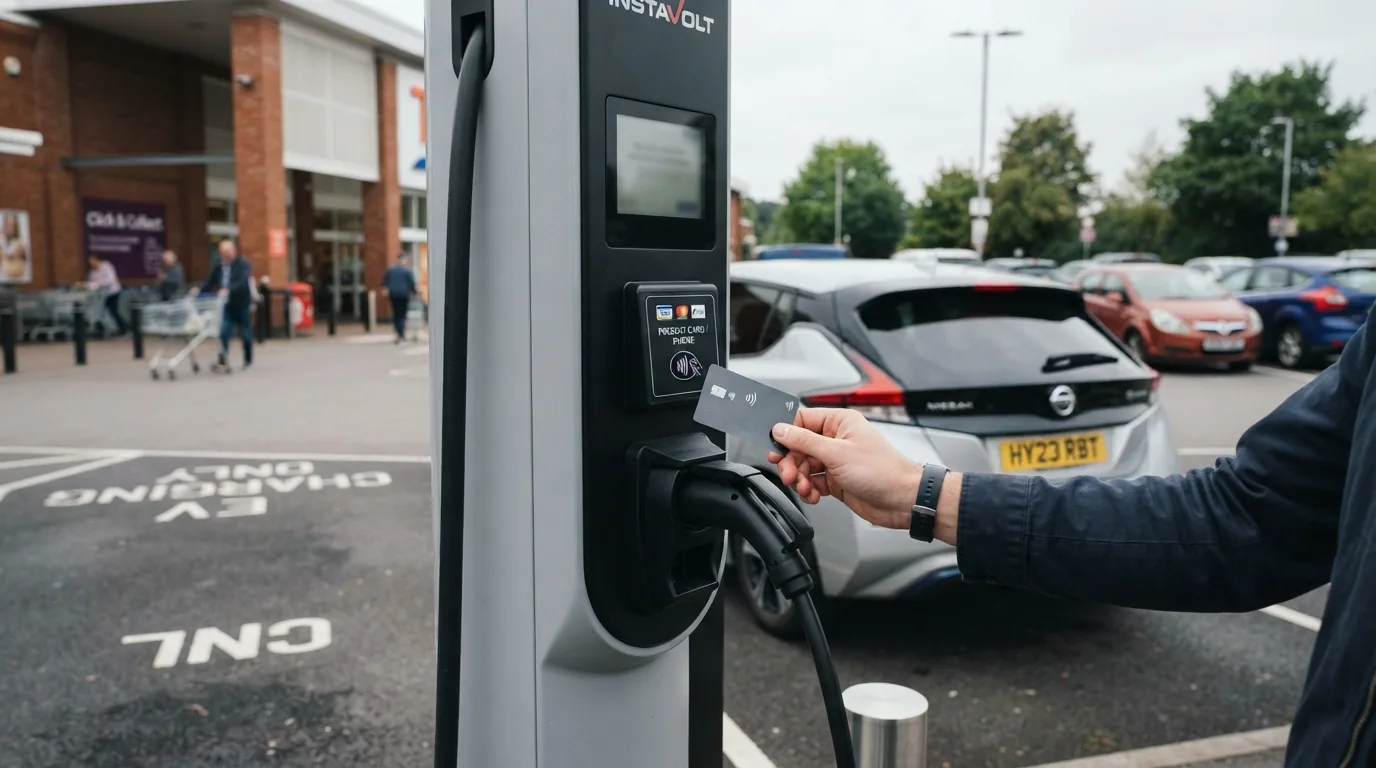
- Contactless EV charging means paying for a public charging session by tapping a debit or credit card, smartphone or smartwatch directly on the charger's payment terminal, without creating an account or downloading an app.
- What changed in November 2024: The UK government introduced the Public Charge Point Regulations 2023, which came into force in stages.
- How does it work in practice: The contactless terminal on an EV charger works exactly like a card reader in a shop.
- Where can you use contactless: The regulations make contactless legally mandatory at all public rapid chargers (50 kW+).
- Is contactless always the cheapest option: For occasional use, the premium over app pricing is worth paying for the convenience of not creating accounts.
- What about the 8 kW to 49 kW chargers: The regulations require that all new charge points at 8 kW and above must accept contactless.
Contactless EV charging means paying for a public charging session by tapping a debit or credit card, smartphone or smartwatch directly on the charger’s payment terminal, without creating an account or downloading an app. Since November 2024, every public rapid charger delivering 50 kW or more must offer this facility by law under the UK’s Public Charge Point Regulations. As of spring 2026, contactless is also standard on the majority of slower public chargers.
What changed in November 2024?
The UK government introduced the Public Charge Point Regulations 2023, which came into force in stages. The contactless payment requirement took effect in November 2024 and applied to:
- All new public charge points with a power output of 8 kW or above
- All existing rapid charge points at 50 kW and above
This was a significant change. Before November 2024, most rapid chargers required either a network RFID card or the operator’s mobile app. New drivers who arrived without a pre-registered account were sometimes unable to charge at all.
The regulations also require that the cost per kWh is clearly displayed before a session starts, so there are no surprises. Price transparency is now a legal requirement alongside payment access.
How does it work in practice?
The contactless terminal on an EV charger works exactly like a card reader in a shop. You tap your card, phone or watch, the charger confirms the connection, and charging begins. You are billed per kWh for the energy delivered, and the payment settles when the session ends.
Most chargers hold an authorisation amount on your card at the start of the session, typically £30 to £50. This is a pre-authorisation to verify your card is valid, not an immediate charge. When the session ends, only the actual cost of energy used is charged, and the hold is released. If this temporary reduction in your available balance is an issue, using a credit card rather than a debit card avoids the immediate impact.
You do not need to stay by the charger during the session. Most networks send a notification via their charger screen or app when charging is complete or when a fault occurs.
Where can you use contactless?
The regulations make contactless legally mandatory at all public rapid chargers (50 kW+). The major networks fully complied by spring 2026:
| Network | Contactless on rapid chargers | Contactless on slower chargers |
|---|---|---|
| GRIDSERVE Electric Highway | Yes | Yes |
| InstaVolt | Yes | Yes |
| Osprey | Yes | Yes |
| BP Pulse | Yes | Partial (newer units) |
| Shell Recharge | Yes | Yes (Ubitricity on-street: mostly yes) |
| MFG EV Power | Yes | Yes |
| IONITY | Yes | N/A (rapid only) |
| Tesla Supercharger (non-Tesla) | Yes | N/A (rapid only) |
| Pod Point | Yes (rapid) | App/RFID or contactless on newer units |
| Connected Kerb | Contactless on most units | Varies by installation |
Older on-street chargers installed before the regulations were announced may still require an RFID card linked to the original operator’s account. These are mostly slower 3 kW to 7 kW lamppost units in residential areas. If you encounter one of these, check the Zap-Map listing for the site, which indicates whether contactless is supported.
Is contactless always the cheapest option?
No, and this is the most important thing to know. Networks set their contactless PAYG rate as the highest tariff, specifically to encourage account sign-ups and subscriptions. Contactless is the most convenient option, but it is rarely the cheapest.
Examples from spring 2026:
- InstaVolt: 92p/kWh contactless peak vs. 55p/kWh off-peak via the app, a difference of 37p/kWh
- BP Pulse: 89p/kWh contactless vs. 69p/kWh with a £7.85/month subscription
- Osprey: 87p/kWh contactless vs. 82p/kWh via the app
For occasional use, the premium over app pricing is worth paying for the convenience of not creating accounts. For regular use, downloading the operator’s free app or signing up for a subscription typically pays for itself within a few sessions.
What about the 8 kW to 49 kW chargers?
The regulations require that all new charge points at 8 kW and above must accept contactless. However, existing units in this range were given a longer transition timeline. This means you will find a mix: newer chargers in retail parks and supermarkets almost always accept contactless, while older units from the same network might still need an app or RFID card.
Always check the Zap-Map listing or the charger screen before arriving somewhere without your network cards. Zap-Map flags contactless availability in the charge point details.
What else do the 2024 regulations require?
Beyond contactless payment, the Public Charge Point Regulations also require:
99% reliability target: All rapid charging networks must maintain 99% average annual reliability and publish their uptime statistics. This gives drivers a right to know how often any given network’s chargers are functional.
Open data: All charge point operators must share location, availability and pricing data via the OCPI standard, so it can appear in Zap-Map, in-vehicle navigation systems and other third-party apps.
Displayed pricing: The price per kWh must be shown on the charger screen before a session begins.
Accessibility: Charger controls must be accessible to people with disabilities, with appropriate height and reach distances.
These requirements collectively represent the most significant improvement to the UK public charging experience since the network began to scale seriously around 2019.
The myth: you need a membership to charge in public
The most common misconception about public EV charging is that you must be a member of a network to use its chargers. This was broadly true before November 2024 for rapid chargers. It is no longer true. You can tap and charge at any compliant rapid charger in the UK without any prior sign-up.
The only scenario where you genuinely need a pre-registered account is accessing a workplace charger, a hotel charger restricted to guests, or a legacy slow charger that predates the regulations and has not been updated.
Next steps
For a full guide to payment options including apps, RFID cards and subscriptions, see How Do You Pay for Public EV Charging?
For everything else about the UK public charging landscape, visit our Public Charging guide.
For network-by-network comparisons, see Best Public EV Charging Networks in the UK.
How we test and where our numbers come from
Range figures are official WLTP combined values taken from manufacturer UK specification pages, with real-world estimates drawn from independent comparative testing. Prices are UK list prices at the time of the latest update. Tax, grant and charging-scheme figures come from GOV.UK and HMRC publications. We re-check every guide when pricing, specification or policy changes. Last checked 11 August 2026.
Frequently asked questions
What changed in November 2024?
This was a significant change. Before November 2024, most rapid chargers required either a network RFID card or the operator's mobile app.
How does it work in practice?
The contactless terminal on an EV charger works exactly like a card reader in a shop. You tap your card, phone or watch, the charger confirms the connection, and charging begins.
Where can you use contactless?
Older on-street chargers installed before the regulations were announced may still require an RFID card linked to the original operator's account. These are mostly slower 3 kW to 7 kW lamppost units in residential areas.
Is contactless always the cheapest option?
No, and this is the most important thing to know. Networks set their contactless PAYG rate as the highest tariff, specifically to encourage account sign-ups and subscriptions.
What about the 8 kW to 49 kW chargers?
The regulations require that all new charge points at 8 kW and above must accept contactless. However, existing units in this range were given a longer transition timeline.
Sources and further reading
- chargepoint.comChargePointPrimary source referenced in this article.

EV Compared
The EV Compared editorial team tracks the UK electric vehicle market full time: new model launches, list prices, WLTP and real-world range, public charging tariffs and the tax rules that decide what an EV actually costs to run. Every guide is checked against manufacturer specifications and official GOV.UK figures, and updated whenever the numbers move.
Related reading
View all
BP Pulse vs Shell Recharge: Which UK Network Wins?
Two of the UK's biggest charging networks compared on price, reliability and which type of driver each suits
Can You Charge Any EV at Any Public Charger in the UK?
Why almost any new EV works at almost any UK public charger, and the two exceptions you need to know
Can You Charge an EV From a Three-Pin Plug in the UK?
Yes, most cars ship with the cable, but speed and safety limits mean it works best for occasional or emergency use