Tesla in the UK 2026: Model Range, Prices and What Is New
Model 3 from £37,990, Model Y from £48,990, Cybertruck not coming -- what Tesla's current UK lineup actually looks like
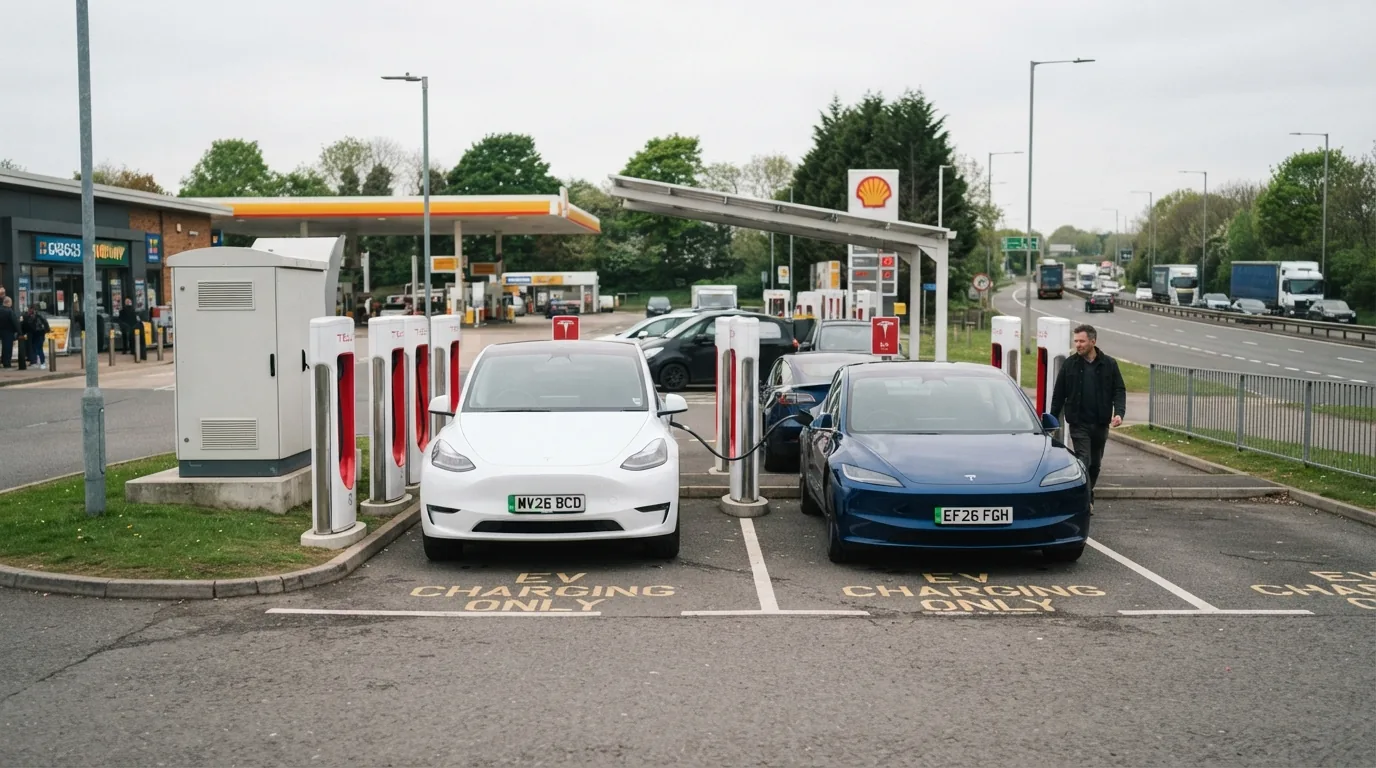
Quick answers
- Tesla remains the best-selling electric car brand in the UK by some measures, but 2026 is a more complicated year for the company than any previous one. Competition has intensified sharply.
- Tesla's current UK model range: Tesla sells four models in the UK: Model 3, Model Y, Model S and Model X.
- Tesla Model 3: the executive saloon: The Model 3 received a thorough "Highland" refresh in late 2023, with updated exterior styling, a redesigned interior and improved range across all variants.
- Tesla Model Y: the market leader: The Model Y "Juniper" refresh launched in the UK in early 2024.
- Tesla Model S and Model X: the flagships: The Model S and Model X remain the flagship offerings but are less central to Tesla's UK volume.
- What is new from Tesla in 2026: Tesla's major product news for 2026 in the UK is not a new model but an evolving software and hardware strategy.
Tesla remains the best-selling electric car brand in the UK by some measures, but 2026 is a more complicated year for the company than any previous one. Competition has intensified sharply. Registrations are trending down year on year. And the brand’s public image, which was largely uncomplicated for a decade, has become a more divisive subject for some buyers.
None of that changes the fundamental proposition of the cars themselves, which remain genuinely strong. Here is an honest look at what Tesla currently offers UK buyers, what the prices are, and where the rivals now compete.
Tesla’s current UK model range
Tesla sells four models in the UK: Model 3, Model Y, Model S and Model X. The Cybertruck is not available in the UK and there is no confirmed timeline for UK introduction. The Roadster, announced in 2017, has still not launched.
Tesla Model 3: the executive saloon
The Model 3 received a thorough “Highland” refresh in late 2023, with updated exterior styling, a redesigned interior and improved range across all variants. That refresh is what you buy today.
| Variant | Battery | WLTP range | 0-62 mph | Price from |
|---|---|---|---|---|
| Rear-Wheel Drive | 70 kWh | 332 miles | 6.1 sec | £37,990 |
| Long Range RWD | ~82 kWh | 466 miles | 5.9 sec | £44,990 |
| Long Range AWD | ~82 kWh | 410 miles | 4.4 sec | £47,990 |
| Performance | ~82 kWh | 354 miles | 2.9 sec | £57,990 |
The Long Range RWD variant is worth particular attention. At 466 miles of WLTP range, it offers the longest real-world usable range of any Model 3 and is genuinely competitive with the BMW i4, Mercedes EQE and Polestar 2 that sit in the same market bracket. Real-world range in mixed UK conditions will typically be 350-380 miles, which puts long-distance motorway driving — London to Edinburgh and back, for example — within comfortable reach without charging stops.
The standard Model 3 at £37,990 is very well equipped as standard. Heated front seats, a 15.4-inch touchscreen, Autopilot (the basic level of driver assistance, not full self-driving), over-the-air software updates and access to the Tesla Supercharger network all come included. There is essentially no options list to navigate — Tesla’s simplified ordering process means what you see on the configurator is what you get.
One important note: the Model 3 is not currently eligible for the UK Electric Car Grant. Tesla has not met the Science Based Targets verification requirement, which excludes it from the OZEV scheme. At £37,990 list, it is above the £37,000 ceiling for Band 1 grant eligibility in any case.
Tesla Model Y: the market leader
The Model Y “Juniper” refresh launched in the UK in early 2024. The update brought revised front and rear styling, an improved interior with ambient lighting, acoustic glass and a powered boot, and updated battery cells that improved efficiency slightly.
| Variant | Battery | WLTP range | 0-62 mph | Price from |
|---|---|---|---|---|
| Standard RWD | ~62 kWh | 314 miles | 6.9 sec | ~£40,990 |
| Premium RWD | ~75 kWh | 387 miles | 5.9 sec | ~£48,990 |
| Premium AWD | ~75 kWh | 391 miles | 5.0 sec | ~£51,990 |
| Performance | ~75 kWh | 360 miles | 4.4 sec | ~£61,990 |
The Model Y remains the UK’s single best-selling electric car year to date in 2026, a position it has held for several years. Its combination of interior space (there is an optional seven-seat configuration), genuine SUV-level practicality, Supercharger access and strong whole-life costs has kept it ahead of rivals despite increasing competition.
The strongest competitor to the Premium Model Y at around £49,000-52,000 is now the Kia EV6 and the BYD Sealion 7 (£47,025). The Xpeng G6, at around £38,000-42,000, undercuts the Model Y by several thousand pounds while offering 800V charging — a faster charge rate than the Model Y’s 250 kW peak. That spec gap is closing.
Tesla Model S and Model X: the flagships
The Model S and Model X remain the flagship offerings but are less central to Tesla’s UK volume.
The Model S starts from around £89,990 in Dual Motor form, offering up to 396 miles of WLTP range. The Plaid version (£104,990) has three motors and a claimed 0-60 mph time of under 2 seconds in the US market — the UK figure is not directly stated but is comparably rapid.
The Model X starts from around £99,990. It offers up to 348 miles of range (Dual Motor) and is the only genuinely usable seven-seat electric SUV available under £120,000 in the UK. The Falcon Wing rear doors are distinctive and either a feature or a liability depending on your parking situation.
Both models have Supercharger access and the full Tesla software and update ecosystem. At these price points they compete with the Porsche Taycan, Mercedes EQS and BMW i7.
What is new from Tesla in 2026?
Tesla’s major product news for 2026 in the UK is not a new model but an evolving software and hardware strategy. The Version 13 of Tesla’s Full Self-Driving (FSD) software — which Tesla prefers to call its “Autopilot” family of features — has seen significant capability improvements, though FSD in the autonomous sense remains unavailable in the UK under current regulatory conditions.
A lower-cost Tesla model has been long anticipated. Tesla’s intention to offer a car starting significantly below the current Model 3 entry price has been confirmed by the company but no UK pricing or launch date has been confirmed for 2026. This is likely to be significant news in 2026 or 2027.
Tesla’s Supercharger network has continued to expand in 2026 and now operates over 1,200 charging bays at UK locations, including major motorway service areas. The network opened to non-Tesla vehicles, with all major charging apps now able to locate and pay at Supercharger sites.
Where has Tesla lost ground to rivals?
Charging speed. Tesla’s Superchargers operate at up to 250 kW for the newest V3 units. The Kia EV6, BYD Seal and Xpeng G6 all use 800V architecture enabling 350 kW peak charging at compatible chargers. The real-world difference in everyday charging is modest — most drivers are not at 350 kW chargers regularly — but on a long motorway trip with the right infrastructure, 800V cars charge meaningfully faster.
Interior quality. The Tesla minimalist interior, with almost all controls on the touchscreen, was groundbreaking in 2017. By 2026, critics note that the absence of physical climate and audio controls is increasingly an inconvenience rather than a design statement. The BMW i4 and Hyundai IONIQ 6 are consistently rated as offering superior interior quality and ergonomics at comparable prices.
Brand perception. Some buyers are choosing not to buy Tesla for reasons unrelated to the cars. This is a real phenomenon, documented in dealer surveys, though quantifying its exact impact on UK sales is difficult.
What is the most common myth about buying a Tesla in the UK?
The most common myth is that Tesla’s Autopilot system constitutes fully autonomous driving. It does not. Autopilot — the version included in all new Teslas — is an advanced adaptive cruise control and lane-keeping system that requires the driver’s hands on the wheel and attention on the road at all times. It reduces driver workload on motorways but is not self-driving. Tesla’s “Full Self-Driving” capability (an add-on) offers more features but also requires full driver supervision and is subject to UK regulatory requirements. Be clear on what you are buying and what it does.
What should you do next?
For a side-by-side comparison of Tesla against its main rivals in each segment, see our best electric cars to buy guide. For help understanding whole-life costs — including charging, insurance and tax — our Buying and Owning guide has the detail.
Tesla’s cars remain strong products. But in 2026 they face the most credible competition they have ever encountered in the UK market. Shopping around is not disloyalty — it is sensible.
How we test and where our numbers come from
Range figures are official WLTP combined values taken from manufacturer UK specification pages, with real-world estimates drawn from independent comparative testing. Prices are UK list prices at the time of the latest update. Tax, grant and charging-scheme figures come from GOV.UK and HMRC publications. We re-check every guide when pricing, specification or policy changes. Last checked 11 August 2026.
Frequently asked questions
What is new from Tesla in 2026?
Tesla's major product news for 2026 in the UK is not a new model but an evolving software and hardware strategy.
What is the most common myth about buying a Tesla in the UK?
The most common myth is that Tesla's Autopilot system constitutes fully autonomous driving. It does not.
Sources and further reading
- tesla.comTesla UK / Autocar / What Car?Primary source referenced in this article.

EV Compared
The EV Compared editorial team tracks the UK electric vehicle market full time: new model launches, list prices, WLTP and real-world range, public charging tariffs and the tax rules that decide what an EV actually costs to run. Every guide is checked against manufacturer specifications and official GOV.UK figures, and updated whenever the numbers move.
Related reading
View all
BYD in the UK: Full Model Range and Prices for 2026
From the £18,650 Dolphin Surf to the £47,025 Sealion 7 -- a complete guide to every BYD you can buy in Britain right now
Cheapest New EVs You Can Buy in the UK Right Now
From £14,495 to £30,000: the new electric cars that offer the most genuine value in the current market
Chinese EV Brands in the UK: Who Is Here and Are They Any Good?
BYD, MG, Xpeng, NIO, Leapmotor and Jaecoo are all selling in Britain -- here is an honest assessment of what each offers