Rapid vs Ultra Rapid Charging: What Is the Difference?
A plain-English guide to the kW bands, real charging times, costs and what each tier means for your EV
Quick answers
- Rapid means 50kW to 149kW; ultra rapid means 150kW and above, under Zapmap's February 2026 bands.
- Rapid typically reaches 80% in 30 to 60 minutes; ultra rapid can do it in 10 to 20 minutes if your car supports the power.
- Public 50kW+ charging averaged about 79p/kWh in April 2026, versus roughly 8.7p/kWh charging at home off-peak.
- Your EV's maximum DC charge rate caps your speed, so ultra rapid is wasted money if your car cannot draw 150kW or more.
- The UK had over 28,000 rapid and ultra-rapid chargers by April 2026, mostly at motorway services, forecourts and hubs.
- Occasional rapid charging does not meaningfully harm a modern EV battery; daily reliance combined with heat is the bigger risk.
Rapid chargers deliver 50kW up to 149kW; ultra rapid chargers deliver 150kW and above. In practice that means rapid typically brings a battery to 80% in 30 to 60 minutes, while ultra rapid can do the same in roughly 10 to 20 minutes on a car that can draw that power. Those are the current Zapmap power band definitions, updated February 2026, and the speed difference is real but comes with one important caveat: your EV’s own maximum DC charge rate is what sets your actual speed, not the charger.
Both are DC charging technologies, far faster than the AC wallboxes most people use at home, and both charge in pence per kWh from public networks. Understanding where each tier sits, and whether your car can take advantage of the faster one, saves time and money on every longer trip.
What is rapid charging?
Zapmap classifies Rapid as any DC charger delivering between 50kW and 149kW. At that rate you can add a meaningful amount of range in about 30 minutes, with 80% state of charge typically reached within 30 to 60 minutes depending on your battery size.
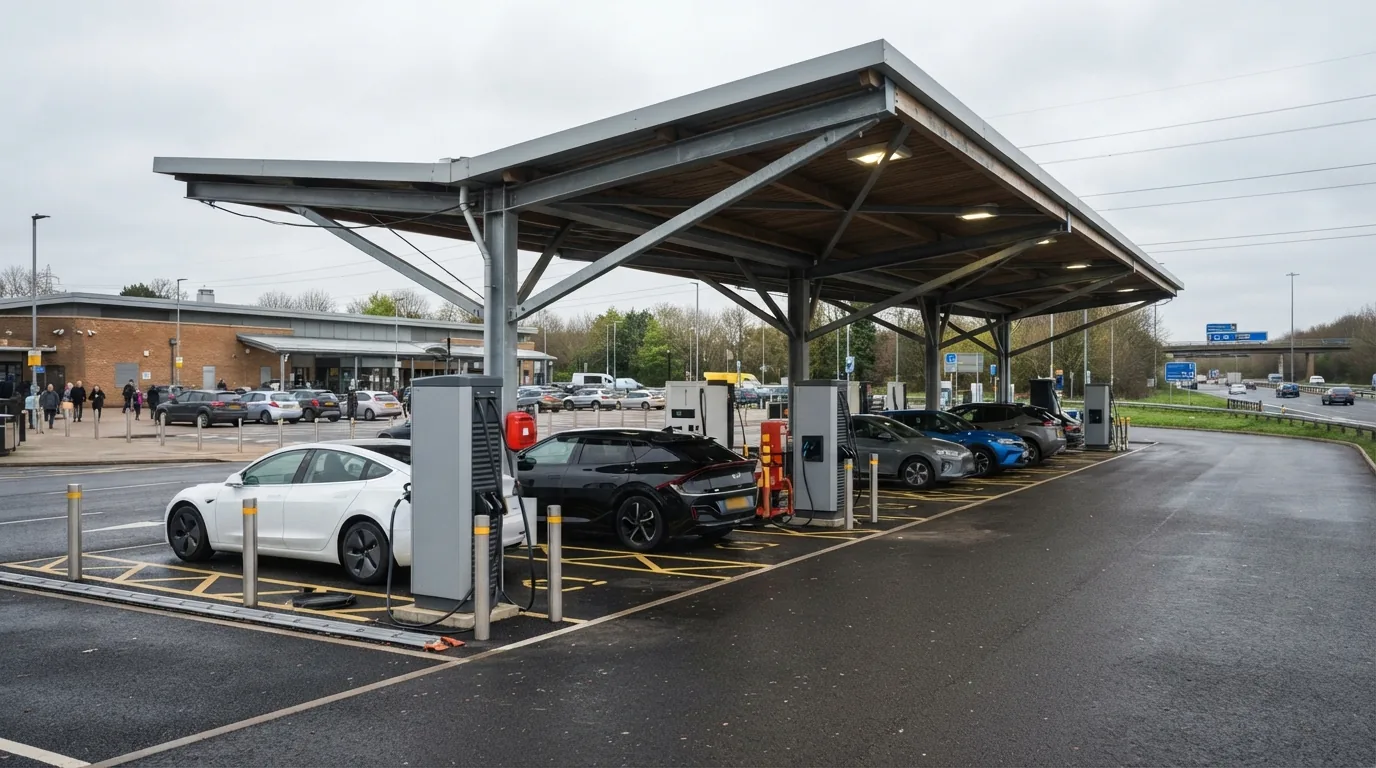
Rapid is the most common DC type you will find away from home. Supermarkets, retail parks and A-road sites tend to carry 50kW to 75kW units, with higher-powered 100kW to 150kW rapids appearing at forecourts and busier motorway locations. Most have a tethered CCS connector, so you plug straight in without needing your own cable.
If you want to understand how DC fast charging fits into the full picture of UK public infrastructure, this is the tier that makes up the bulk of the network.
What is ultra rapid charging?
Zapmap defines Ultra-rapid as 150kW and above. Units now reach up to 350kW and in some cases 400kW at dedicated hubs. Where the car supports it, ultra rapid can take the battery to 80% in roughly 10 to 20 minutes, which makes a genuine difference on a long motorway run where every extra minute at a charger costs you time.
Ultra-rapid is currently the fastest-growing tier on the UK network. Zapmap recorded 9,893 chargers operating at 150kW or more in early 2026, up 41% year on year. These chargers are concentrated at motorway services, purpose-built charging forecourts and major retail hubs rather than spread across the wider network.
The headline time figures assume the car can actually draw 150kW or more. If it cannot, the ultra rapid charger simply delivers what the car will accept.
Why are these speeds possible? AC vs DC explained
Rapid and ultra rapid chargers are DC units. They convert AC mains power to DC inside the charger itself and push the resulting current directly into the car’s battery, bypassing the onboard converter altogether. That is what makes the speed possible.
By contrast, slower AC chargers, the ones you use at home or on an on-street lamp post, rely on a converter built into the car, which limits the incoming power to typically 7kW to 22kW. The car’s onboard charger is the bottleneck, not the cable. Move to a DC rapid charger and that bottleneck disappears, because the conversion happens in the much larger unit on the ground. The result is power delivery an order of magnitude faster than any home setup.
How do rapid and ultra rapid charging compare on speed, time and cost?
The table below puts both tiers in context alongside the Standard and Standard Plus bands Zapmap introduced in February 2026, with real-world time and current UK pricing.
| Tier | Power (kW) | Typical time to 80% | Typical UK cost (p/kWh) | Best for |
|---|---|---|---|---|
| Standard | 3-7.9kW AC | 5-10 hours | Home rate | Overnight home charging |
| Standard Plus | 8-49kW AC/DC | 1-4 hours | Varies | Workplace, destination |
| Rapid | 50-149kW DC | 30-60 minutes | ~74-79p | Retail stops, A-road breaks |
| Ultra-rapid | 150kW+ DC | 10-20 minutes | ~78-79p | Motorway runs, time-critical trips |
The Zapmap Price Index for April 2026 puts the weighted average pay-as-you-go price across all 50kW and above chargers at 79p/kWh. The AA EV Recharge Report (mid-2025) put rapid charging at roughly 74p/kWh and ultra rapid at roughly 78p/kWh on average, figures vary, verify current data. Either way, public rapid charging runs far dearer than home off-peak charging, which Zapmap prices at around 8.7p/kWh on a suitable EV tariff. A 40kWh top-up at the public average costs around £31.60 versus roughly £3.50 at home.
The per-tier price gap between rapid and ultra rapid is small in absolute terms, so cost alone is rarely the deciding factor when choosing between them.
Can every electric car use ultra rapid charging?
Most modern EVs with a CCS DC port can physically connect to a rapid or ultra rapid charger. What varies is how much of that power they can actually draw. Every EV has a published maximum DC charge rate and will never exceed it, regardless of how powerful the charger is.
Charge rate also tapers as the battery fills. The fastest portion of any session is typically below 50% state of charge, with speed easing off progressively as you approach 80%, figures vary, verify current data for your specific model. This is why the time-to-80% measure is more informative than time-to-full.
The practical point is this: if your car peaks at 100kW to 130kW, using an ultra rapid charger rated at 350kW gives you no speed advantage over a 150kW rapid-band unit. You are paying for capacity your car simply cannot access. Check your car’s peak DC charge rate before assuming ultra rapid is worth seeking out; for many mainstream EVs a well-located rapid charger is exactly fast enough.
Does rapid or ultra rapid charging damage your battery?
The evidence suggests occasional use has very little effect. A study of more than 160,000 charging events found no significant difference in range degradation between Teslas that fast-charged frequently and those that rarely did, according to Recurrent. Geotab analysis found average annual battery degradation of around 2.3% across EV fleets, falling to about 1.6% under ideal conditions, figures vary, verify current data as these are not UK-specific.
Modern EVs use battery management systems, thermal management and cell chemistries such as LFP to limit the harm from high charge rates. The car will throttle incoming power if conditions warrant it.
The situation to avoid is not so much rapid charging itself but frequent rapid charging combined with high heat, or consistently charging to 100% at any speed. For most drivers who use rapid or ultra rapid chargers on motorway trips and charge at home the rest of the time, battery health is not a meaningful concern.
Where do you find rapid and ultra rapid chargers?
As of 30 April 2026 the UK had 28,089 rapid or ultra-rapid chargers across 6,902 locations, within a total public network of 120,388 chargers, according to Zapmap. They are concentrated at motorway services, petrol forecourts, dedicated charging hubs and larger retail sites. Rural areas and smaller towns tend to have fewer high-speed options, and a 50kW or 75kW rapid unit is often the fastest charger available off the main routes.
Speed matters most when the charger is working and priced fairly. Before your next longer trip, it pays to know which networks offer the most reliable rapid and ultra rapid coverage: see our guide to the best public EV charging networks to compare them.
Speed figures only translate into shorter stops if the network you pull into is dependable. Our guide to the best public EV charging networks ranks the main UK operators on reliability, coverage and cost so you can plan rapid and ultra rapid stops with confidence. For a broader introduction to how UK public charging works, see our public charging guide.
Useful Resources
Zapmap charging speeds and power bands https://www.zapmap.com/ev-guides/ev-charger-counts-and-power-bands-explained
Zapmap UK charging Price Index https://www.zapmap.com/ev-stats/charging-price-index
Zapmap how many charging points https://www.zapmap.com/ev-stats/how-many-charging-points
How we test and where our numbers come from
Range figures are official WLTP combined values taken from manufacturer UK specification pages, with real-world estimates drawn from independent comparative testing. Prices are UK list prices at the time of the latest update. Tax, grant and charging-scheme figures come from GOV.UK and HMRC publications. We re-check every guide when pricing, specification or policy changes. Last checked 11 August 2026.
Frequently asked questions
What is the difference between rapid and ultra rapid charging?
Rapid charging covers 50kW to 149kW; ultra rapid covers 150kW and above, using Zapmap's current UK power band definitions. Ultra rapid charges a compatible car to 80% in roughly 10 to 20 minutes compared with 30 to 60 minutes on a rapid charger. Both are DC charging technologies, far faster than home AC wallboxes.
How long does ultra rapid charging take?
On a car that can draw 150kW or more, ultra rapid charging typically reaches 80% in around 10 to 20 minutes. Actual time depends on your car's peak DC charge rate, battery size and current state of charge. Speed tapers as the battery fills, so the fastest portion of the session is in the lower half of the charge range.
Is rapid or ultra rapid charging more expensive?
Public charging at 50kW and above averaged around 79p/kWh in April 2026 according to the Zapmap Price Index. The AA EV Recharge Report (mid-2025) estimated rapid at roughly 74p/kWh and ultra rapid at roughly 78p/kWh on average, though figures vary, verify current data. Both are substantially dearer than home off-peak EV tariffs, which Zapmap puts at around 8.7p/kWh.
Can any electric car use a rapid or ultra rapid charger?
Most modern EVs with a CCS DC port can connect to rapid and ultra rapid chargers, but each car has a maximum DC charge rate it cannot exceed regardless of charger power. If your car's peak rate is, say, 100kW, plugging into a 350kW ultra rapid charger gives you no speed advantage over a 150kW unit.
Does rapid or ultra rapid charging damage your EV battery?
Occasional use has little measurable effect. A study of more than 160,000 charging events found no significant range degradation difference between Teslas that fast-charged often and those that rarely did. Modern battery management systems and thermal management limit harm, and Geotab analysis found average annual degradation of around 2.3%.
Sources and further reading
- zapmap.comZapmapPrimary source referenced in this article.

EV Compared
The EV Compared editorial team tracks the UK electric vehicle market full time: new model launches, list prices, WLTP and real-world range, public charging tariffs and the tax rules that decide what an EV actually costs to run. Every guide is checked against manufacturer specifications and official GOV.UK figures, and updated whenever the numbers move.
Related reading
View all
BP Pulse vs Shell Recharge: Which UK Network Wins?
Two of the UK's biggest charging networks compared on price, reliability and which type of driver each suits
Can You Charge Any EV at Any Public Charger in the UK?
Why almost any new EV works at almost any UK public charger, and the two exceptions you need to know
Can You Charge an EV From a Three-Pin Plug in the UK?
Yes, most cars ship with the cable, but speed and safety limits mean it works best for occasional or emergency use