Why Does My EV Charge Slower in Cold Weather?
The battery science behind winter charging and practical tips for keeping sessions fast
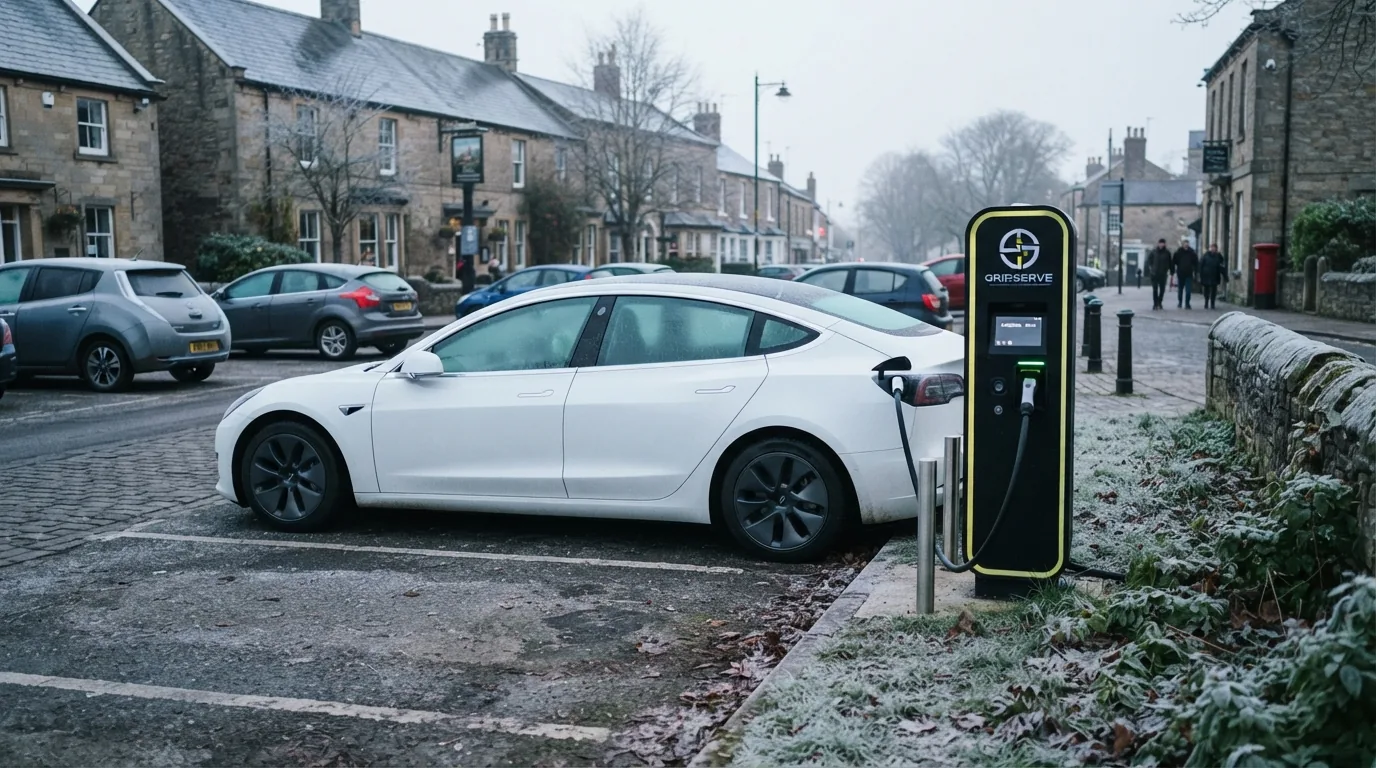
Quick answers
- Your EV charges more slowly in cold weather because lithium-ion batteries have an optimal operating temperature of around 20 to 40 degrees Celsius, and the UK's typical winter temperatures of 0 to 7 degrees are well outside that range.
- What happens inside the battery: A lithium-ion battery works by moving lithium ions between two electrodes through an electrolyte.
- Does preconditioning help: If you set your car to be ready at 7am, the BMS will start warming the battery before you unplug.
- Does cold charging damage the battery: Charging at very low temperatures below 0°C can cause lithium plating, where lithium ions are deposited on the anode surface rather than intercalated properly.
- The UK rarely sees sustained temperatures below -5°C in most of England, Wales and lowland Scotland, so the most severe charging slowdowns mainly affect motorway stops on very cold mornings or evenings in January and February.
- Where to read more: For guidance on planning public charging stops in general, see our Public Charging guide.
Your EV charges more slowly in cold weather because lithium-ion batteries have an optimal operating temperature of around 20 to 40 degrees Celsius, and the UK’s typical winter temperatures of 0 to 7 degrees are well outside that range. When a battery is cold, the electrochemical reactions inside it slow down, meaning it cannot accept power as quickly as it can in warmer conditions. Some of the energy from the charger also goes towards warming the battery rather than adding range, compounding the effect.
This is not a fault. It is how lithium chemistry works, and every EV on sale in the UK is subject to the same physics.
What happens inside the battery?
A lithium-ion battery works by moving lithium ions between two electrodes through an electrolyte. In cold conditions, the electrolyte becomes more viscous, slowing ion movement. This increases the battery’s internal resistance, which limits the rate at which it can safely accept current.
The battery management system (BMS) in your car detects this and reduces the maximum charge rate to protect the cells from damage. If you plug into a 150 kW ultra-rapid charger on a freezing morning after the car has been parked overnight, the BMS may limit actual delivery to 30 or 40 kW until the battery warms up enough to accept more.
Additionally, some of the incoming power is diverted to the battery’s thermal management system. Most modern EVs use a liquid-cooled battery that can also be heated. Warming the pack takes energy, so less of what you are paying for at the charger goes directly into increasing your range.
How much slower is it in practice?
The effect varies by car, temperature and state of charge. As a rough guide:
| Conditions | Typical charge rate vs. optimum |
|---|---|
| Warm weather (20°C+) | 100%, full rated speed |
| Mild (10–19°C) | 85–95% of rated speed |
| Cool (5–9°C) | 70–85% of rated speed |
| Cold (0–4°C) | 50–70% of rated speed |
| Freezing (below 0°C) | 30–60% of rated speed |
Range is also affected. UK EV drivers can typically expect 10 to 30% less range in winter compared to mild conditions, which means starting each journey with a fuller battery becomes more important than in summer.
Does preconditioning help?
Yes, substantially. Preconditioning means warming (or cooling) your battery to its ideal temperature while the car is still plugged in at home, using mains electricity rather than battery power. Most modern EVs with a native heat pump or resistive heating can precondition the battery through their app or scheduled departure settings.
If you set your car to be ready at 7am, the BMS will start warming the battery before you unplug. When you arrive at a public rapid charger later in the journey, the battery is already closer to optimal temperature and can accept charge much faster. The difference between a cold and a preconditioned pack at a rapid charger can be 30 to 40 minutes on a long session.
Some cars also precondition the battery automatically when you navigate to a fast charger. Tesla, Hyundai, Kia, and Polestar all have this feature in their navigation systems. Check your car’s handbook for “battery preconditioning” or “charge preparation”.
| Car | Automatic charger preconditioning |
|---|---|
| Tesla Model 3 / Y | Yes, if navigating to Supercharger |
| Hyundai Ioniq 5 / 6 | Yes (Navigate to Charger feature) |
| Kia EV6 / EV9 | Yes |
| Polestar 2 / 3 | Yes |
| Volkswagen ID.4 / 5 | Partial, via scheduled departures |
| Nissan Leaf | No native preconditioning for battery |
| MG4 | Partial, through scheduled charging |
What else can you do to speed up winter charging?
Plan shorter stops at lower state of charge. The slowdown is worst below about 20% SOC in cold weather. If you arrive at a charger at 25% rather than 10%, the battery is both less stressed and more able to accept power quickly at the start of the session.
Avoid charging to 100% in winter. Not only does the top of the charge curve slow anyway, cold batteries near 100% SOC take much longer per kWh added. Set your charge limit to 80 to 85% and save the session time.
Keep moving before you charge. Driving generates heat in the battery through use. A 20-minute motorway run before stopping to charge will warm the pack meaningfully compared to plugging in immediately after leaving a cold car park.
Use the heated cabin sparingly during charging. Cabin heating draws significant power in winter, particularly on cars that use resistive heating rather than a heat pump. If you need to wait at the charger, lowering the heating setpoint reduces the load on the battery’s thermal system and allows more power to go towards charging.
Does cold charging damage the battery?
Charging at very low temperatures below 0°C can cause lithium plating, where lithium ions are deposited on the anode surface rather than intercalated properly. This can permanently reduce capacity over time. This is why the BMS limits charge rates aggressively in severe cold: not just to manage immediate performance, but to preserve long-term battery health.
Modern EVs manage this automatically. You do not need to avoid cold-weather charging, but you should not force a very fast charge rate by bypassing BMS limits, which consumer-level charging hardware does not allow anyway. Just plug in and let the car manage it.
What should you keep in mind for UK winters?
The UK rarely sees sustained temperatures below -5°C in most of England, Wales and lowland Scotland, so the most severe charging slowdowns mainly affect motorway stops on very cold mornings or evenings in January and February. On a typical UK winter day at 4 to 7°C, the charging slowdown is real but manageable: budget 20 to 30% extra time at the charger compared to a summer stop.
For drivers regularly travelling in Scotland’s Highlands or Northern England in winter, preconditioning and planning for longer stops is more important. Scotland’s infrastructure is expanding, with £17.8 million in government funding announced for 2026 to 27 specifically to support rural charging.
Where to read more
For guidance on planning public charging stops in general, see our Public Charging guide.
For the best-performing networks with high-power chargers that warm batteries faster, see Best Public EV Charging Networks in the UK.
How we test and where our numbers come from
Range figures are official WLTP combined values taken from manufacturer UK specification pages, with real-world estimates drawn from independent comparative testing. Prices are UK list prices at the time of the latest update. Tax, grant and charging-scheme figures come from GOV.UK and HMRC publications. We re-check every guide when pricing, specification or policy changes. Last checked 11 August 2026.
Frequently asked questions
What happens inside the battery?
A lithium-ion battery works by moving lithium ions between two electrodes through an electrolyte. In cold conditions, the electrolyte becomes more viscous, slowing ion movement.
How much slower is it in practice?
Range is also affected. UK EV drivers can typically expect 10 to 30% less range in winter compared to mild conditions, which means starting each journey with a fuller battery becomes more important than in summer.
Does preconditioning help?
Yes, substantially. Preconditioning means warming (or cooling) your battery to its ideal temperature while the car is still plugged in at home, using mains electricity rather than battery power.
Does cold charging damage the battery?
Charging at very low temperatures below 0°C can cause lithium plating, where lithium ions are deposited on the anode surface rather than intercalated properly. This can permanently reduce capacity over time.
What should you keep in mind for UK winters?
The UK rarely sees sustained temperatures below -5°C in most of England, Wales and lowland Scotland, so the most severe charging slowdowns mainly affect motorway stops on very cold mornings or evenings in January and February.
Sources and further reading
- ospreycharging.co.ukOsprey ChargingPrimary source referenced in this article.

EV Compared
The EV Compared editorial team tracks the UK electric vehicle market full time: new model launches, list prices, WLTP and real-world range, public charging tariffs and the tax rules that decide what an EV actually costs to run. Every guide is checked against manufacturer specifications and official GOV.UK figures, and updated whenever the numbers move.
Related reading
View all
BP Pulse vs Shell Recharge: Which UK Network Wins?
Two of the UK's biggest charging networks compared on price, reliability and which type of driver each suits
Can You Charge Any EV at Any Public Charger in the UK?
Why almost any new EV works at almost any UK public charger, and the two exceptions you need to know
Can You Charge an EV From a Three-Pin Plug in the UK?
Yes, most cars ship with the cable, but speed and safety limits mean it works best for occasional or emergency use