Gridserve vs InstaVolt: Best UK Rapid Charging Network?
Two of the most trusted rapid networks compared on price, reliability, coverage and speed
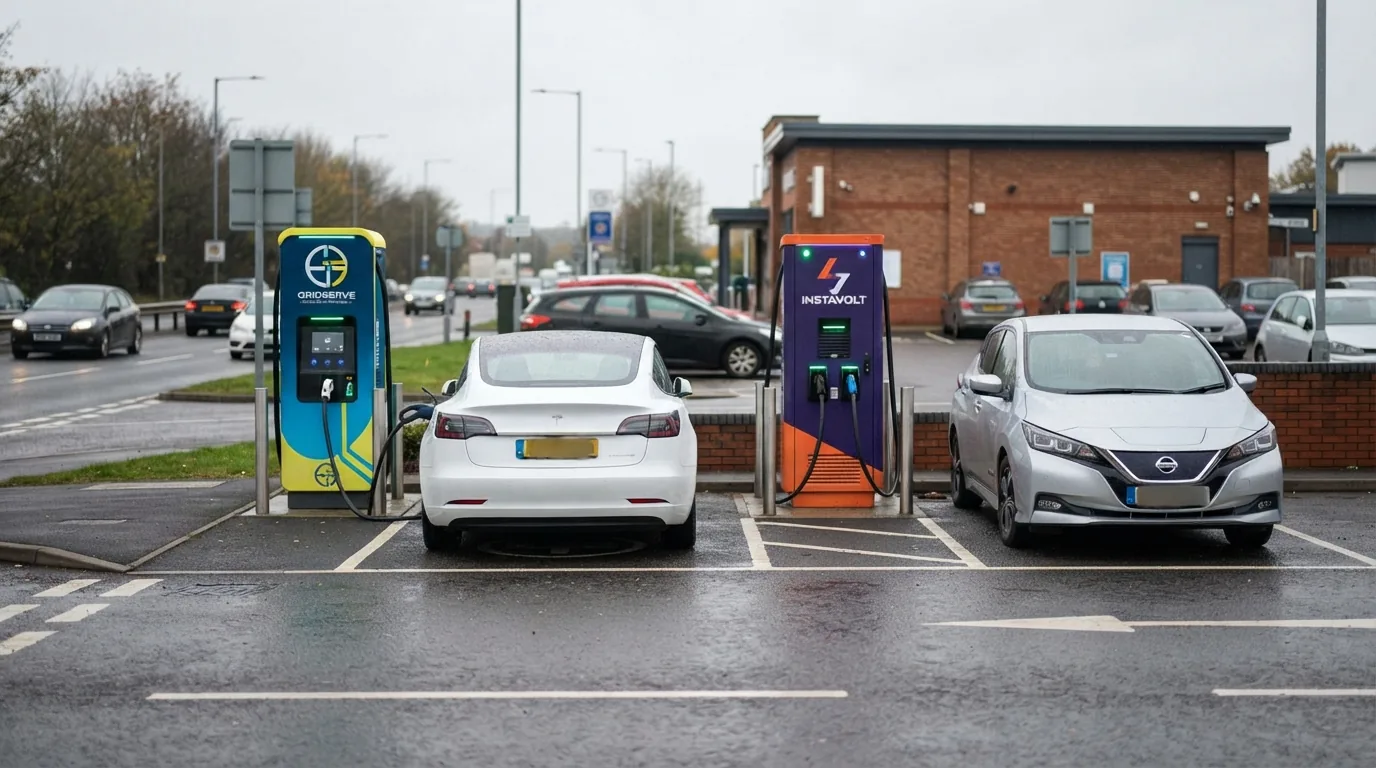
Quick answers
- GRIDSERVE and InstaVolt are two of the most credible rapid charging operators in the UK, consistently rated ahead of larger but less reliable competitors.
- Coverage: GRIDSERVE leads on motorways: GRIDSERVE covers approximately 85% of UK motorway service stations following its takeover of the Ecotricity Electric Highway.
- Price: InstaVolt off-peak is the standout: GRIDSERVE's PAYG rate is approximately 75p per kWh across its network.
- InstaVolt consistently leads independent reliability assessments.
- User experience: Both networks accept contactless payment with no membership required.
- The realistic verdict: Neither network needs to be chosen to the exclusion of the other.
GRIDSERVE and InstaVolt are two of the most credible rapid charging operators in the UK, consistently rated ahead of larger but less reliable competitors. They approach the market differently: GRIDSERVE concentrates on motorway and destination hubs with the highest power hardware; InstaVolt focuses on reliability and simple access across a wider spread of retail and forecourt locations. Both deserve a place in your charging strategy, but for most drivers, one will be the better primary choice.
Bottom line: InstaVolt wins for day-to-day reliability and off-peak pricing. GRIDSERVE wins for motorway coverage and the best hub amenities. Neither is the cheapest rapid option on the market in absolute terms, but both are considerably more dependable than BP Pulse or the older Shell Recharge estate.
Head to head: the key numbers
| Factor | GRIDSERVE | InstaVolt |
|---|---|---|
| Total UK chargepoints | ~2,100 | ~2,100 |
| Rapid/ultra-rapid power | 90 kW to 400 kW | 50 kW to 300 kW |
| PAYG contactless rate | ~75p/kWh | 92p/kWh (peak) |
| Off-peak rate | No off-peak pricing | 55p/kWh (8pm–7am, free app) |
| Membership/subscription | No (free app only) | No (free app) |
| Connection fee | No | No |
| Connector types | CCS (tethered) | CCS (tethered) |
| Typical locations | Motorway services, Electric Forecourts | Supermarkets, retail parks, forecourts |
| Reliability (Zap-Map user rating) | Good (higher on new sites) | Very good (consistently top-rated) |
| Published uptime target | ~99% | >99% (stated 99.8%) |
Coverage: GRIDSERVE leads on motorways
GRIDSERVE covers approximately 85% of UK motorway service stations following its takeover of the Ecotricity Electric Highway. For a driver whose long journeys are primarily motorway, this is decisive: you will encounter GRIDSERVE chargers at nearly every major service stop on the national motorway network.
The Electric Forecourt flagship sites (Braintree, Norwich, Stevenage, London Gatwick) are the most sophisticated EV charging destinations in the UK: 24 or more bays at up to 350 kW, Costa Coffee, Wi-Fi, toilets and retail. No other network offers this combination. New Super Hub sites at Beaconsfield, Baldock, Cambridge, Cobham, Cullompton, Leeds Skelton Lake and Peterborough open through 2026, each with 400 kW-capable hardware.
InstaVolt’s 2,100 chargepoints are spread across supermarkets, retail parks and forecourts rather than concentrated at motorway services. This makes InstaVolt excellent for urban and suburban top-ups, less useful for motorway charging specifically.
Winner on coverage: GRIDSERVE for motorway; broadly equal for retail and A-road locations.
Price: InstaVolt off-peak is the standout
GRIDSERVE’s PAYG rate is approximately 75p per kWh across its network. There is no off-peak pricing and no subscription that reduces this significantly.
InstaVolt’s pricing is more complex but potentially much cheaper:
- Peak PAYG contactless: 92p per kWh (highest among the top networks)
- Off-peak app rate (8pm to 7am, free InstaVolt app): 55p per kWh
The off-peak differential of 37p per kWh is one of the largest on the UK rapid network. A 40 kWh charge session at InstaVolt off-peak costs £22 versus £30 at GRIDSERVE PAYG. Over a month of weekly evening stops, that is a saving of £32.
For drivers who cannot always charge in the evening, the peak PAYG rate at InstaVolt (92p per kWh) is higher than GRIDSERVE’s flat rate. The value proposition depends entirely on your typical charging time.
Winner on price: InstaVolt if you can charge off-peak (8pm to 7am). GRIDSERVE if you mainly charge during the day.
Reliability: InstaVolt’s track record is stronger
InstaVolt consistently leads independent reliability assessments. It has publicly stated a 99.8% network uptime figure and regularly appears in the top two or three networks in Zap-Map user surveys. The combination of relatively modern hardware, 24/7 monitoring and active fault response gives it an edge over most competitors.
GRIDSERVE’s reliability picture is less uniform. New-build Super Hub sites and Electric Forecourts perform well and are comparable to InstaVolt. Older GRIDSERVE sites that retain refurbished Ecotricity hardware have more variable reliability. A broadly accurate way to think about it: if you can confirm the site has had recent investment, GRIDSERVE is reliable; if you are unsure, check Zap-Map user comments from the past 48 hours.
Winner on reliability: InstaVolt, consistently across the full network.
Speed: GRIDSERVE has the higher ceiling
GRIDSERVE’s Super Hub sites offer up to 400 kW hardware. The Electric Forecourts and newer motorway hubs deploy 350 kW units. For cars with peak acceptance rates of 150 kW or more (Hyundai Ioniq 6 at 233 kW, Tesla Model 3 at 250 kW, Kia EV6 at 235 kW), GRIDSERVE’s hardware delivers maximum speed without being the limiting factor.
InstaVolt’s maximum is 300 kW at its fastest chargers. For the vast majority of EVs on UK roads in 2026, this is still more than enough: most EVs peak between 50 kW and 200 kW, meaning neither network creates a practical difference for cars accepting below 200 kW.
Winner on speed ceiling: GRIDSERVE (400 kW vs InstaVolt’s 300 kW, though irrelevant for most EVs).
User experience
Both networks accept contactless payment with no membership required. Both have free apps that improve session management and provide receipts suited to expense claims.
GRIDSERVE’s Electric Forecourt sites set the standard for EV charging venue quality in the UK: clean facilities, covered bays, coffee, Wi-Fi and sufficient bays to minimise queuing. The motorway service sites are broadly equivalent to the standard service station experience.
InstaVolt’s locations are more varied: some are well-maintained retail park installations; others are basic forecourt bays. The consistency of the user experience at InstaVolt is lower than at GRIDSERVE’s curated Electric Forecourt sites, but InstaVolt’s charging hardware itself is the more reliable.
Who should choose which?
Choose GRIDSERVE if you:
- Drive long distances on the motorway network regularly
- Value the best possible amenities at charging stops
- Charge mainly during daylight hours
- Drive a high-acceptance-rate EV that benefits from 350 kW+ hardware
Choose InstaVolt if you:
- Charge primarily in the evening (8pm to 7am) and want 55p per kWh
- Prioritise reliability above all else
- Charge mainly at retail parks and supermarkets rather than motorway services
- Want the simplest possible experience with no accounts needed at all (contactless works on every unit)
The realistic verdict
Neither network needs to be chosen to the exclusion of the other. The most practical approach for most EV drivers is: use InstaVolt for evening or off-peak top-ups and rely on GRIDSERVE for motorway stops. Having both operators’ free apps on your phone costs nothing and takes five minutes to set up.
If forced to name a single primary network, InstaVolt’s reliability record and off-peak pricing make it the more consistently excellent choice for everyday charging. GRIDSERVE is the more important network for long-distance travel.
Where to find more
For a full comparison of all major UK networks, see Best Public EV Charging Networks in the UK.
For a complete overview of how UK public charging works, visit our Public Charging guide.
How we test and where our numbers come from
Range figures are official WLTP combined values taken from manufacturer UK specification pages, with real-world estimates drawn from independent comparative testing. Prices are UK list prices at the time of the latest update. Tax, grant and charging-scheme figures come from GOV.UK and HMRC publications. We re-check every guide when pricing, specification or policy changes. Last checked 11 August 2026.
Sources and further reading
- zapmap.comZap-MapPrimary source referenced in this article.

EV Compared
The EV Compared editorial team tracks the UK electric vehicle market full time: new model launches, list prices, WLTP and real-world range, public charging tariffs and the tax rules that decide what an EV actually costs to run. Every guide is checked against manufacturer specifications and official GOV.UK figures, and updated whenever the numbers move.
Related reading
View all
BP Pulse vs Shell Recharge: Which UK Network Wins?
Two of the UK's biggest charging networks compared on price, reliability and which type of driver each suits
Can You Charge Any EV at Any Public Charger in the UK?
Why almost any new EV works at almost any UK public charger, and the two exceptions you need to know
Can You Charge an EV From a Three-Pin Plug in the UK?
Yes, most cars ship with the cable, but speed and safety limits mean it works best for occasional or emergency use