Which EV Brands Are Winning and Losing in the UK in 2026
BYD outsells Tesla in cumulative UK registrations, Chinese brands take 12% of EV sales, and Volkswagen's ID range faces headwinds
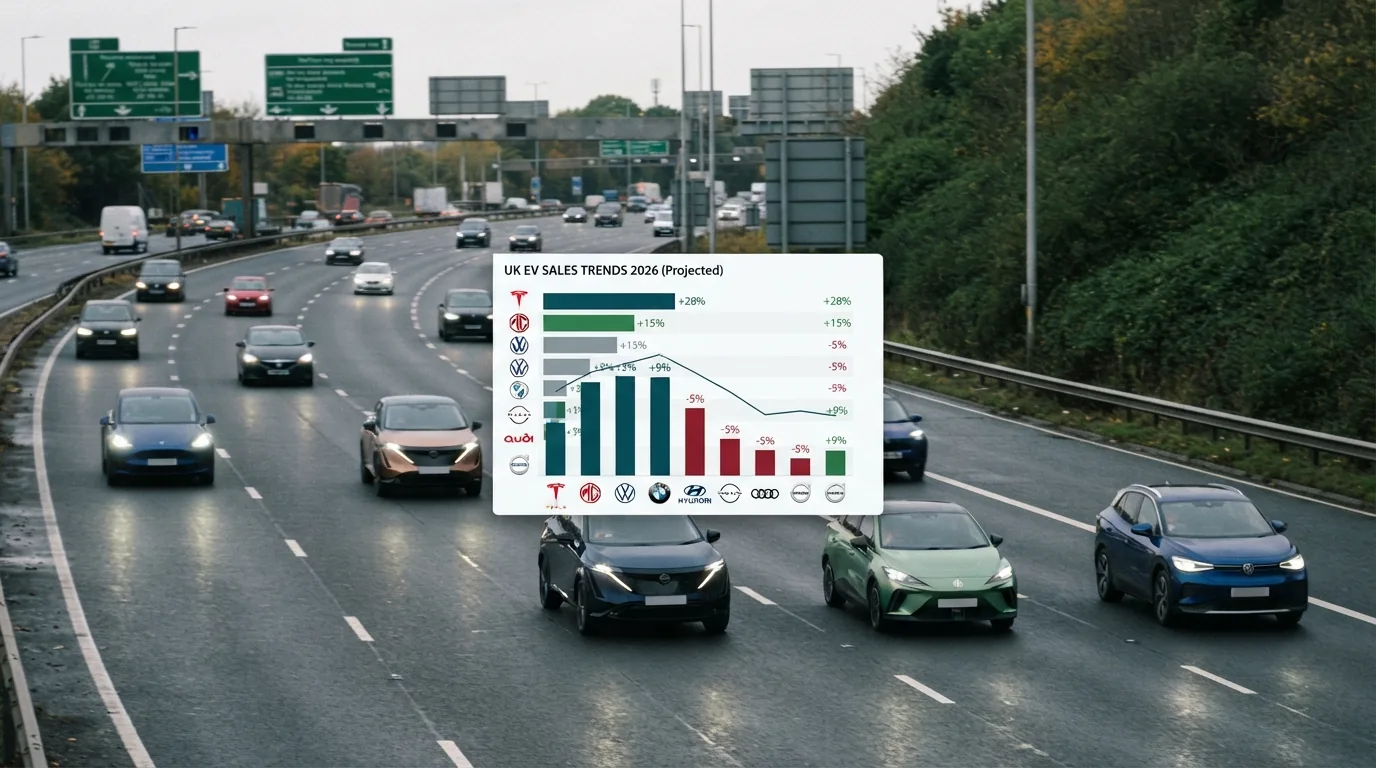
Quick answers
- The UK electric car market in 2026 looks very different from the one that existed three years ago. Tesla no longer dominates the headlines on registrations.
- Figures based on SMMT registration data and Zap-Map market analysis for early 2026.
- The winners: BYD registered 51,422 vehicles in the UK during 2025, against Tesla's 45,513 -- the first time a Chinese manufacturer has outsold Elon Musk's company in a major Western market.
- The losers: Tesla's position is more complicated than a simple "winner/loser" verdict allows.
- What does brand position mean for buyers: From a buyer's perspective, the competitive intensity in the UK EV market in 2026 is unambiguously good news.
- The most persistent myth is that Chinese-built EVs are lower quality or less safe than European or Korean alternatives.
The UK electric car market in 2026 looks very different from the one that existed three years ago. Tesla no longer dominates the headlines on registrations. Chinese brands have moved from novelty to meaningful market presence. European volume brands are fighting on two fronts — against cheaper Asian competitors below and stronger German rivals above. And a handful of newcomers are posting the sort of percentage growth figures that suggest they will be major players within a few years.
Here is a clear-eyed look at who is winning, who is losing and why it matters for buyers right now.
The overall picture: BEV sales by brand (UK, early 2026)
| Brand | Position | Key model | Year-on-year trend | Notes |
|---|---|---|---|---|
| Tesla | 1 (YTD) | Model Y | Declining | Still top YTD, but falling |
| MG | 2 | MG4 | Stable/growing | Most established Chinese brand |
| BYD | 3 | Dolphin / Seal | Growing | Outsold Tesla in cumulative 2025 |
| Volkswagen | 4 | ID.3 / ID.4 | Declining | ID.3 -11%, ID.4 -15%, ID.7 -24% |
| Kia | 5 | EV6 / EV3 | Growing | Strong EV6 and new EV3 |
| Hyundai | 6 | IONIQ 5/6 | Stable | Premium positioning |
| Leapmotor | Rapid riser | T03 | +677% YoY | Small base, but trajectory is clear |
| Jaecoo | Rapid riser | Jaecoo 7 | New entrant | Outsold Mini and Renault in Jan 2026 |
Figures based on SMMT registration data and Zap-Map market analysis for early 2026.
The winners
BYD: the headline story
BYD registered 51,422 vehicles in the UK during 2025, against Tesla’s 45,513 — the first time a Chinese manufacturer has outsold Elon Musk’s company in a major Western market. In 2026 that trajectory has continued. BYD’s UK model range now spans from the £18,650 Dolphin Surf at the affordable end to the £47,025 Sealion 7. The Seal executive saloon, priced from £45,730, competes directly with the Tesla Model 3 Long Range and is winning buyers on specification per pound.
BYD’s competitive edge is vertical integration. The company makes its own Blade batteries, its own semiconductors, its own motors and its own software. That gives it a cost base and a speed-to-market advantage that European brands have struggled to match. In 2026 BYD is also expanding into hybrid territory in the UK with the Dolphin G DM-i, which will be the UK’s cheapest plug-in hybrid if it arrives as priced.
Kia: the established winner
Kia is probably the strongest-performing mainstream brand in the UK EV market in 2026. The EV6 continues to win comparison tests, and the smaller EV3 — arriving in the UK this year — takes the fight into the volume small-SUV segment. Kia’s residual values are strong, its dealer network is well-prepared and its five-year warranty gives buyers reassurance. It does not make the loudest headlines but it consistently sells well and satisfies customers.
Leapmotor: the wildcard
A 677% year-on-year growth rate is the kind of number that looks like a misprint. It is not. Leapmotor entered the UK recently with the budget T03 and has rapidly built a following among buyers looking for the lowest possible entry point to a new EV with a proper safety specification. The numbers are still small in absolute terms, but the brand has established credibility quickly. Its C10 SUV, launching in 2026, will test whether that momentum extends beyond the entry-level segment.
The losers
Volkswagen Group (volume EVs)
Volkswagen is facing a difficult year in the UK EV market. The ID.3, ID.4 and ID.7 are all down year on year in registrations — 11%, 15% and 24% respectively. The ID.3 in particular is being squeezed hard by the Renault 5 below it and by the prospect of the VW ID.Polo arriving above it in specification for around the same price.
VW’s challenge is partly pricing and partly perception. Chinese rivals now match or beat VW’s EV range on specification for significantly less money. Volkswagen is responding with the next-generation MEB+ platform (which will underpin the ID.Polo and eventually filter through to updated ID models), but the transition period is visible in the sales numbers.
Tesla: pressure from all sides
Tesla’s position is more complicated than a simple “winner/loser” verdict allows. The Model Y remains the UK’s best-selling individual electric car year to date in 2026. Cumulative volumes are still strong. But the direction of travel on year-on-year registrations is negative. Tesla faces three distinct pressures:
First, brand perception. In some segments of the market, Elon Musk’s political activities have caused buyers to look elsewhere. This is anecdotal and hard to quantify precisely, but dealers and analyst surveys have noted it.
Second, product freshness. The Model 3 and Model Y have received updates (the refreshed “Juniper” Model Y launched in the UK in 2024), but rivals including the Kia EV6, BMW i4 and Polestar 2 have closed the gap on technology, refinement and charging speed.
Third, pricing pressure from below. The Xpeng G6 starts at under £40,000 and undercuts the comparable Model Y by around £5,000 while matching it on range and adding 800V charging. That is a direct competitive threat.
Tesla’s Supercharger network remains a genuine advantage — it is still the most reliable rapid-charge network in the UK — but since Tesla opened Supercharging to non-Tesla vehicles, that advantage is narrowing.
What does brand position mean for buyers?
From a buyer’s perspective, the competitive intensity in the UK EV market in 2026 is unambiguously good news. It means manufacturers are competing harder on price, specification and deal quality. The fact that Volkswagen is under pressure has contributed to better finance offers on ID.3 and ID.4. The fact that Tesla is being squeezed by Chinese rivals has contributed to more competitive Model 3 and Model Y pricing.
The one area where brand position matters most for buyers is residual values. Cars from brands with strong UK dealer networks and consistent sales volumes tend to depreciate more slowly. Tesla, despite its challenges, still holds residual values well. BYD’s residuals are improving but still lower than equivalent European brands because the brand is newer in UK consumer consciousness. Leapmotor residuals are an unknown at this stage.
If you are buying on finance (PCP in particular), residual values directly affect your monthly payment. For an equivalent monthly outlay, a car with stronger residuals will give you a better specification or lower payments.
What is the common mistake buyers make when thinking about brands?
The most persistent myth is that Chinese-built EVs are lower quality or less safe than European or Korean alternatives. The evidence does not support this. The BYD Seal, Xpeng G6 and MG4 EV all carry five-star Euro NCAP ratings. BYD’s Blade battery technology has a strong real-world safety record. The build quality of current-generation Chinese EVs is substantially better than the first wave of Chinese cars in any segment.
A more legitimate concern is after-sales support. Some newer Chinese brands have smaller dealer networks and less established parts supply chains than established brands. This is a genuine consideration and worth researching brand by brand rather than dismissing all Chinese EVs on the grounds of unfamiliarity.
What should you do next?
For a full breakdown of the best models across every brand and budget, see our best electric cars to buy guide. Our Buying and Owning guide covers what to consider beyond the headline price, including warranty, dealer network and whole-life cost.
The brand landscape in UK EVs is genuinely more competitive than it has ever been. That makes 2026 a good time to shop widely rather than defaulting to familiar names.
How we test and where our numbers come from
Range figures are official WLTP combined values taken from manufacturer UK specification pages, with real-world estimates drawn from independent comparative testing. Prices are UK list prices at the time of the latest update. Tax, grant and charging-scheme figures come from GOV.UK and HMRC publications. We re-check every guide when pricing, specification or policy changes. Last checked 11 August 2026.
Frequently asked questions
What does brand position mean for buyers?
From a buyer's perspective, the competitive intensity in the UK EV market in 2026 is unambiguously good news. It means manufacturers are competing harder on price, specification and deal quality.
What is the common mistake buyers make when thinking about brands?
The most persistent myth is that Chinese-built EVs are lower quality or less safe than European or Korean alternatives. The evidence does not support this.
Sources and further reading
- smmt.co.ukSMMT / Zap-Map / electrive.comPrimary source referenced in this article.

EV Compared
The EV Compared editorial team tracks the UK electric vehicle market full time: new model launches, list prices, WLTP and real-world range, public charging tariffs and the tax rules that decide what an EV actually costs to run. Every guide is checked against manufacturer specifications and official GOV.UK figures, and updated whenever the numbers move.
Related reading
View all
BYD in the UK: Full Model Range and Prices for 2026
From the £18,650 Dolphin Surf to the £47,025 Sealion 7 -- a complete guide to every BYD you can buy in Britain right now
Cheapest New EVs You Can Buy in the UK Right Now
From £14,495 to £30,000: the new electric cars that offer the most genuine value in the current market
Chinese EV Brands in the UK: Who Is Here and Are They Any Good?
BYD, MG, Xpeng, NIO, Leapmotor and Jaecoo are all selling in Britain -- here is an honest assessment of what each offers