EV Battery Technology in 2026: What Is Actually New
LFP dominates with 81% market share, CATL's sodium-ion EV arrives, solid-state inches toward production -- here is the real state of EV batteries
Quick answers
- EV battery technology is genuinely advancing in 2026, but the headlines often outrun the reality for UK buyers. Solid-state batteries are not in your showroom yet.
- The basics: what chemistry do most EVs use: The broad trend in 2026 is a shift toward LFP at the mainstream end of the market.
- What is actually new in 2026: Lithium Manganese Iron Phosphate (LMFP) is an evolution of LFP that adds manganese to the cathode.
- What about sodium-ion batteries: Sodium-ion batteries use sodium ions rather than lithium ions to store energy.
- What about solid-state batteries: Solid-state batteries replace the liquid electrolyte in conventional lithium-ion batteries with a solid material.
- The useful question is not "will batteries be better in three years?" (they will) but "does the current technology meet my actual needs?" If the answer is yes, the case for waiting is weak.
EV battery technology is genuinely advancing in 2026, but the headlines often outrun the reality for UK buyers. Solid-state batteries are not in your showroom yet. Sodium-ion vehicles are arriving in China, but not in significant numbers here. What is actually new and significant in 2026 is less dramatic than some predictions but more meaningful: better LFP chemistry, silicon-carbon anodes, 800V charging architecture becoming mainstream, and the first production sodium-ion EVs. Let us work through what matters and what does not.
The basics: what chemistry do most EVs use?
Most EVs on UK roads use lithium-ion batteries, but within that broad category there are two main chemistries:
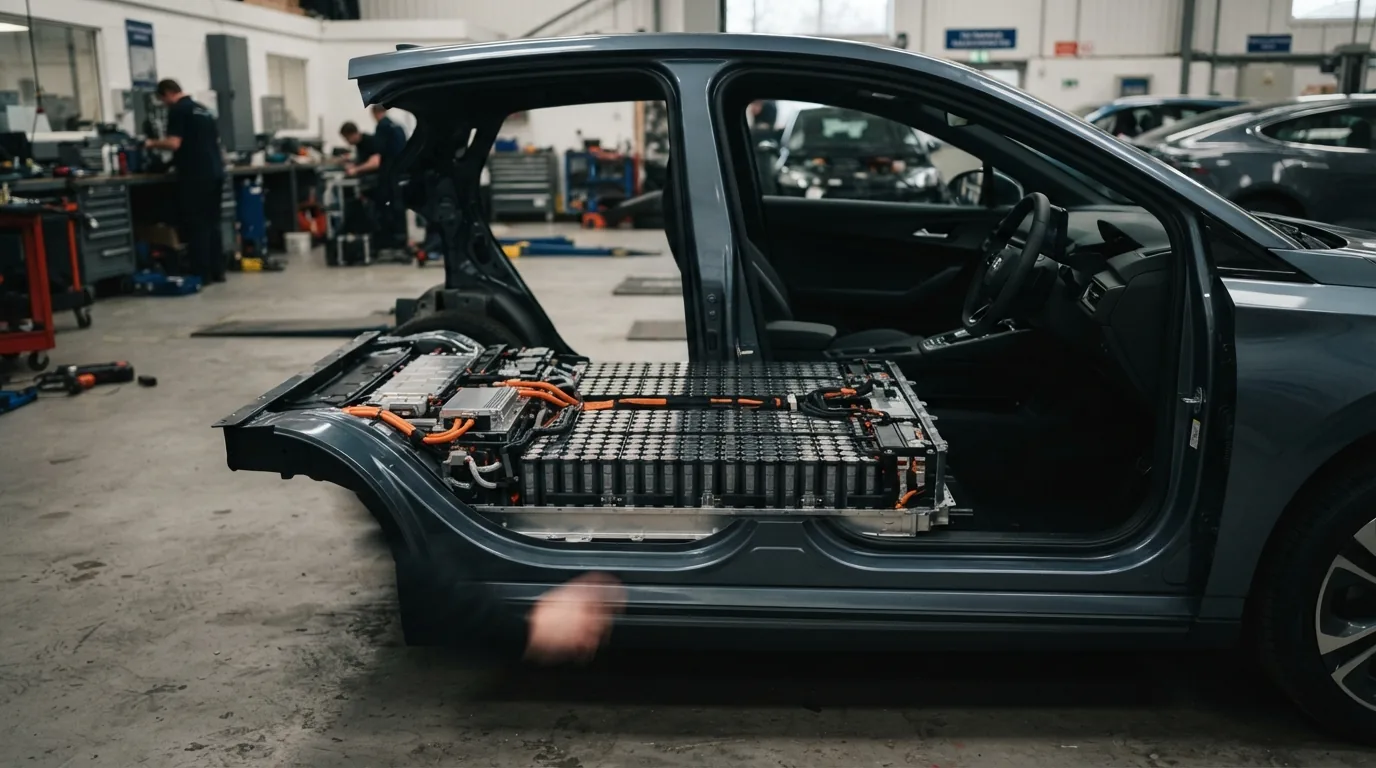
Lithium Iron Phosphate (LFP): Used by BYD (including in all Blade battery models), MG, and increasingly by other manufacturers including Tesla for standard-range models. Characteristics: inherently safer (lower risk of thermal runaway), longer cycle life (more charge-discharge cycles before degradation), slightly lower energy density than NMC, slightly more range loss in cold weather.
Nickel Manganese Cobalt (NMC): Used by most other manufacturers including Volkswagen Group, Hyundai, Kia, BMW, Mercedes. Higher energy density (meaning more range for a given pack size), slightly more complex thermal management requirements.
The broad trend in 2026 is a shift toward LFP at the mainstream end of the market. LFP is now estimated to account for 81% of global battery cell production. For UK buyers, this matters primarily because LFP batteries in cars like the BYD Seal, MG4 and Tesla Model 3 Standard Range tend to be safe, long-lived and increasingly competitive on range with NMC alternatives.
What is actually new in 2026?
1. LMFP: better LFP chemistry
Lithium Manganese Iron Phosphate (LMFP) is an evolution of LFP that adds manganese to the cathode. The result is higher energy density than standard LFP while retaining the safety and longevity benefits. BYD’s second-generation Blade Battery uses an LMFP composite cathode combined with a silicon-carbon anode, pushing energy density to 190-210 Wh/kg. That is a meaningful improvement on first-generation LFP Blade cells.
In practical terms: LMFP technology in the 2026 BYD Seal and updated Dolphin models means slightly more range from a similar-sized pack compared to 2024 models. The improvement is incremental — perhaps 10-15% more range from the same physical battery size — but it is real and it accumulates.
2. Silicon-carbon anodes
Standard lithium-ion batteries use graphite anodes. Silicon can store significantly more lithium ions than graphite (roughly ten times as much per unit weight), which enables higher energy density. The problem is that silicon expands dramatically during charging and contracts on discharge, which was historically causing cracking and rapid degradation.
Silicon-carbon composite anodes — mixing silicon with carbon to moderate the expansion problem — are now appearing in production vehicles. BYD’s Gen-2 Blade battery uses silicon-carbon anodes alongside the LMFP cathode. CATL has included silicon-composite anodes in its 2026 production cells. The result is incremental range improvements without increasing pack size.
This is not a revolution, but it is genuine engineering progress. Cars with silicon-carbon anode batteries are starting to appear in UK showrooms in 2026.
3. 800V architecture becomes mainstream
The shift from 400V to 800V electrical architecture is one of the most significant practical improvements for UK EV owners in 2026. 800V systems allow dramatically faster DC charging:
- 400V architecture: typically charges at 100-250 kW maximum
- 800V architecture: typically charges at 200-400 kW maximum
The Hyundai IONIQ 5 and EV6, Porsche Taycan and new BMW i3 use 800V architecture. In 2026, the Xpeng G6, the new BMW i3 and several other models bring 800V to more accessible price points. At a 400 kW charger (now appearing at GRIDSERVE Super Hubs and other motorway sites), an 800V vehicle can add over 100 miles of range in under 10 minutes.
The practical implication: on a long motorway journey, the charging stop that took 25-30 minutes in a 400V car takes closer to 10-15 minutes in an 800V car, at sites with sufficient charger power. The network is not universally 400 kW yet, but the fastest chargers at motorway service areas increasingly support these rates.
What about sodium-ion batteries?
Sodium-ion batteries use sodium ions rather than lithium ions to store energy. Sodium is abundant (roughly 1,000 times more common in the Earth’s crust than lithium) and the chemistry does not require cobalt, nickel or manganese. If sodium-ion batteries can be made to work competitively, they could significantly reduce battery cost and supply-chain complexity.
CATL launched its first commercial sodium-ion powered EV in China in April 2026, targeting a range of over 370 miles (600 km) from a sodium-ion pack. Battery costs are approaching $100/kWh for sodium-ion — lower than NMC but currently still above the ~$52/kWh that LFP has reached.
What this means for UK buyers: Sodium-ion EVs are not yet available in the UK market. CATL has indicated that European models using sodium-ion technology may follow within a few years. If cost targets are met, sodium-ion could enable sub-£15,000 new EVs with 150-200 miles of range in the late 2020s — a transformative prospect for making EVs truly mass-market.
The honest caveat: sodium-ion batteries have slightly lower energy density than LFP at current technology generations, which means larger packs are required for equivalent range. The cost-of-pack advantage needs to outweigh the size disadvantage. The engineering is viable; the manufacturing cost trajectory needs to continue improving.
What about solid-state batteries?
Solid-state batteries replace the liquid electrolyte in conventional lithium-ion batteries with a solid material. The theoretical benefits are significant: higher energy density, no flammable liquid, potentially longer cycle life, and faster charging.
The reality in 2026 is more cautious than some headlines suggest. Toyota, BYD, CATL, Volkswagen and Samsung have all announced solid-state development programmes. Multiple vehicle models carrying “100 kWh semi-solid” packs are reportedly entering mass production in late 2026 in China. These semi-solid designs are closer to solid-state than conventional lithium-ion but are not full all-solid-state batteries.
Full solid-state batteries at scale are more likely to arrive in UK consumer cars between 2027 and 2030. CATL’s prototype condensed-state cells have reached 500 Wh/kg, but the jump from prototype to affordable mass-produced vehicle battery involves manufacturing challenges and cost-reduction that take years to solve.
The buyer-relevant takeaway: Do not wait to buy an EV in 2026 because you expect solid-state batteries to arrive soon. Semi-solid and solid-state tech will be relevant in the next generation of vehicles, not the current one.
How does battery technology affect real-world UK driving?
The improvements in battery technology over the last three years have produced tangible changes in what EV ownership looks like:
Range anxiety is much reduced. The average range of a new EV sold in the UK has increased from around 200 miles (WLTP) in 2020 to over 280 miles in 2026. Many mainstream models exceed 300 miles WLTP. In real-world terms, 250+ miles is enough to cover most multi-stop UK journeys, and with 15 minutes of DC charging mid-way, even London to Edinburgh is manageable.
Cold weather performance has improved. Thermal management systems have become more sophisticated. The range loss in winter on a modern EV (typically 15-25% in very cold conditions) is smaller than on early models, and LFP chemistry — now the dominant chemistry — has had its cold-weather losses reduced through improved thermal management.
Charging curves are flatter. Early EVs accepted high charging rates only briefly, often dropping to much lower rates before reaching 80%. Newer batteries with LMFP and silicon anode chemistry accept higher rates for longer, meaning more energy added per minute across the bulk of the charging session. This makes real-world charging faster than raw peak kW figures suggest.
Should you wait for better battery technology before buying?
For most UK buyers, no. The argument for waiting is that batteries will be better and cheaper in a few years. This is true, and has been true every year since the first mass-market EVs arrived. Buyers who waited in 2019 got better cars in 2021; buyers who waited in 2021 got better cars in 2023. But the buyers who purchased at each of those stages also benefited from years of ownership at dramatically lower running costs than petrol alternatives.
The useful question is not “will batteries be better in three years?” (they will) but “does the current technology meet my actual needs?” If the answer is yes, the case for waiting is weak.
The exception: if you have a specific use case that current technology does not serve well — for example, you regularly drive 300 miles in a single day with no opportunity to charge — it may be worth waiting for 400-mile real-world range to become common in your price bracket. That is a reasonable, technology-specific reason to wait.
What should you do next?
For guidance on how battery technology affects the specific models we recommend, see our best electric cars to buy guide, where range and charging specifications are current as of 2026. For help understanding how battery degradation affects used EV buying decisions, see our EV tech and apps guide.
Battery technology in 2026 is not the revolution that solid-state headlines sometimes imply, but it is meaningful, continuous and commercially relevant progress. The EVs available today are substantially better than those of three years ago — and that will remain true in another three years.
How we test and where our numbers come from
Range figures are official WLTP combined values taken from manufacturer UK specification pages, with real-world estimates drawn from independent comparative testing. Prices are UK list prices at the time of the latest update. Tax, grant and charging-scheme figures come from GOV.UK and HMRC publications. We re-check every guide when pricing, specification or policy changes. Last checked 11 August 2026.
Frequently asked questions
The basics: what chemistry do most EVs use?
The broad trend in 2026 is a shift toward LFP at the mainstream end of the market. LFP is now estimated to account for 81% of global battery cell production.
What is actually new in 2026?
Lithium Manganese Iron Phosphate (LMFP) is an evolution of LFP that adds manganese to the cathode. The result is higher energy density than standard LFP while retaining the safety and longevity benefits.
What about sodium-ion batteries?
Sodium-ion batteries use sodium ions rather than lithium ions to store energy. Sodium is abundant (roughly 1,000 times more common in the Earth's crust than lithium) and the chemistry does not require cobalt, nickel or manganese.
What about solid-state batteries?
Solid-state batteries replace the liquid electrolyte in conventional lithium-ion batteries with a solid material. The theoretical benefits are significant: higher energy density, no flammable liquid, potentially longer cycle life, and faster charging.
Should you wait for better battery technology before buying?
For most UK buyers, no. The argument for waiting is that batteries will be better and cheaper in a few years.
Sources and further reading
- technologyreview.comMIT Technology Review / CATL / BYD / evlithium.comPrimary source referenced in this article.

EV Compared
The EV Compared editorial team tracks the UK electric vehicle market full time: new model launches, list prices, WLTP and real-world range, public charging tariffs and the tax rules that decide what an EV actually costs to run. Every guide is checked against manufacturer specifications and official GOV.UK figures, and updated whenever the numbers move.
Related reading
View all
BYD in the UK: Full Model Range and Prices for 2026
From the £18,650 Dolphin Surf to the £47,025 Sealion 7 -- a complete guide to every BYD you can buy in Britain right now
Cheapest New EVs You Can Buy in the UK Right Now
From £14,495 to £30,000: the new electric cars that offer the most genuine value in the current market
Chinese EV Brands in the UK: Who Is Here and Are They Any Good?
BYD, MG, Xpeng, NIO, Leapmotor and Jaecoo are all selling in Britain -- here is an honest assessment of what each offers