Can an Electric Car Replace a Diesel for Long Commutes?
The honest numbers for high-mileage UK commuters considering the switch
Quick answers
- For most UK long-distance commuters with home charging, yes, an electric car can replace a diesel. For high-mileage drivers who rely heavily on public rapid charging, the saving narrows but often remains positive.
- What "long commute" means in this context: UK government data shows the average one-way commute by car is around 9 miles.
- Cars with 300-plus miles of WLTP range now include: - Mercedes EQS: up to 452 miles WLTP - BMW iX3: up to 430 miles (largest battery variant) - Volkswagen ID.7: up to 435 miles WLTP - Hyundai Ioniq 6 (long range): up to 379 miles WLTP - Kia EV6 (long range): up to 328 miles WLTP - Tesla Model 3 (long range): up to 390 miles WLTP
- Most long commuters with home charging do not need to charge at work or en route during the week.
- What about servicing and maintenance: An EV doing the same mileage needs: - Annual check (brake fluid, tyres, wipers, cabin filter): around £100 to £150 - No oil changes - No DPF or AdBlue - Brake pad wear is reduced by regenerative braking
- What about diesel's strong motorway MPG: The diesel's advantage in long-haul efficiency is real but narrowing in relative terms.
For most UK long-distance commuters with home charging, yes, an electric car can replace a diesel. For high-mileage drivers who rely heavily on public rapid charging, the saving narrows but often remains positive. The detail matters: your specific route, charging access, and annual mileage all affect how compelling the switch is.
Here is the honest breakdown.
What “long commute” means in this context
UK government data shows the average one-way commute by car is around 9 miles. A “long commute” in this article means 40 miles or more each way, totalling at least 80 miles per day or roughly 20,000 miles per year for a five-day working week. This is the scenario where the diesel’s legendary motorway efficiency used to make it difficult to beat.
That is less true in 2026.
The cost comparison at 20,000 miles per year
| Factor | Diesel (50mpg, 184.9p/litre) | EV (home, off-peak tariff 7p/kWh) | EV (home, standard rate 24.67p/kWh) | EV (80% public rapid at 79p/kWh) |
|---|---|---|---|---|
| Cost per mile | ~16p | ~2p | ~7p | ~14 to 23p blended |
| Annual fuel/energy cost | ~£3,200 | ~£400 | ~£1,400 | ~£2,800 to £4,600 |
| Annual saving vs diesel | , | ~£2,800 | ~£1,800 | -£400 to £1,600 |
The table makes the key point clearly. Home charging on an off-peak EV tariff saves around £2,800 per year compared to diesel for a 20,000-mile driver. On the standard Ofgem tariff, it is still £1,800 per year. Relying on public rapid charging breaks the advantage and can cost more than diesel.
Motorway range: does the EV work for a long commute?
This was the core concern with early EVs. A 100-mile motorway commute required a car with genuine real-world motorway range to match it.
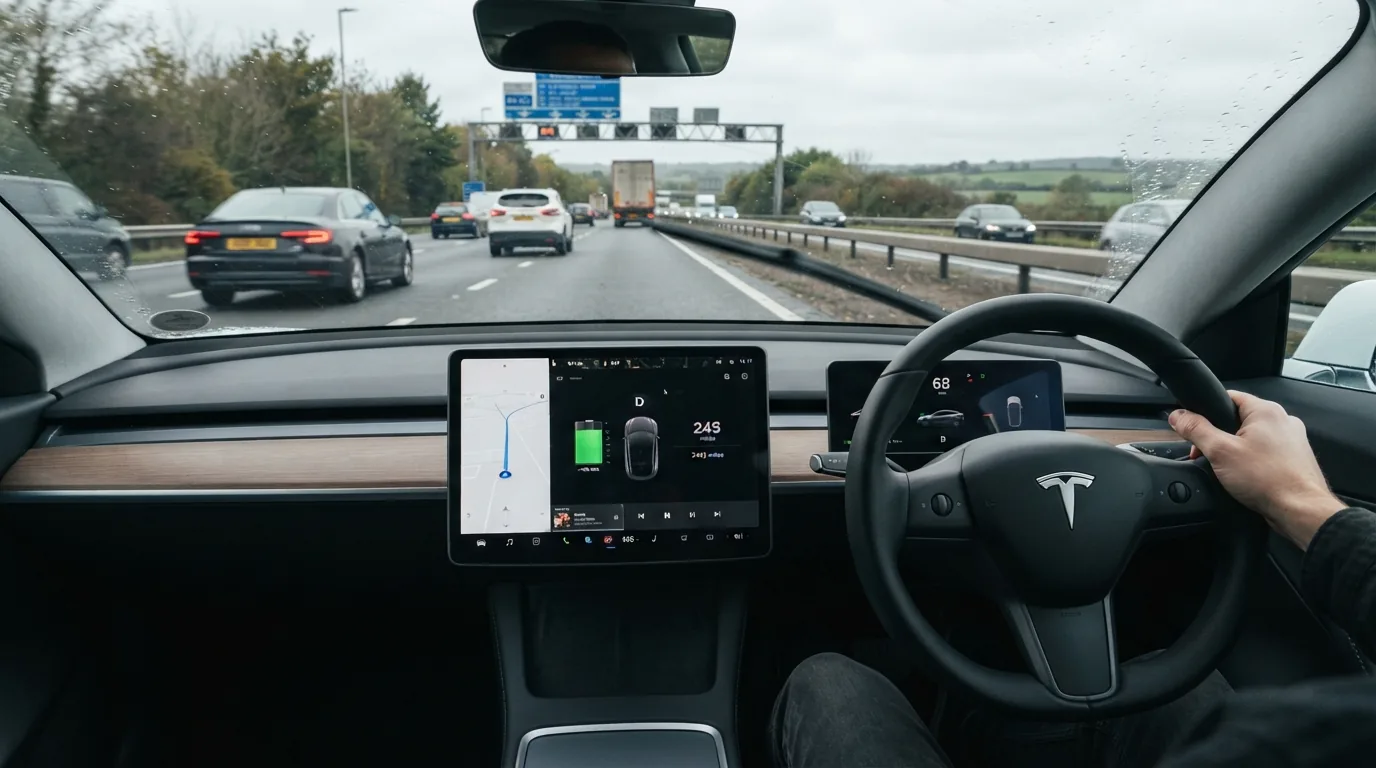
Modern EVs do this comfortably. At motorway speeds (70mph), EV range is reduced compared to WLTP figures by around 20 to 25% due to aerodynamic drag. A car rated at 300 miles WLTP might deliver 225 to 240 miles at a steady 70mph. That is sufficient for a 100-mile daily commute (50 miles each way) with range to spare, and the car can be charged overnight ready for the next day.
Cars with 300-plus miles of WLTP range now include:
- Mercedes EQS: up to 452 miles WLTP
- BMW iX3: up to 430 miles (largest battery variant)
- Volkswagen ID.7: up to 435 miles WLTP
- Hyundai Ioniq 6 (long range): up to 379 miles WLTP
- Kia EV6 (long range): up to 328 miles WLTP
- Tesla Model 3 (long range): up to 390 miles WLTP
Even at an 80-mile motorway day, any of these cars complete a week’s commuting with comfortable margin, charging once overnight each evening.
Does the commute involve rapid charging top-ups?
Most long commuters with home charging do not need to charge at work or en route during the week. The car charges overnight and is ready each morning.
The exception is if your commute exceeds roughly 150 to 200 miles each way (a very long-distance commute) or if you drive irregularly and cannot guarantee a consistent overnight charge. In those cases:
- Look for a car with 150kW or faster DC rapid charging capability
- Identify rapid chargers on your regular route using Zap-Map or your car’s built-in navigation
- Allow 15 to 25 minutes for a top-up at a 150kW charger (typically 100 to 120 miles added in that time)
The rapid charging cost is the caveat. At 79p per kWh for ultra-rapid charging, the per-mile cost approaches diesel levels. Where possible, charge at home (cheapest), at work (often free or subsidised), or at destination chargers (often 40 to 60p per kWh) rather than motorway ultra-rapids.
What about servicing and maintenance?
High-mileage drivers know that servicing costs add up fast. A diesel doing 20,000 miles per year typically needs:
- Annual service including oil and filter change: £200 to £350
- Timing belt replacement every 5 to 7 years: £400 to £800
- Diesel particulate filter (DPF) cleaning or replacement: £100 to £1,500
- AdBlue refills (if applicable): £25 to £50 per fill
An EV doing the same mileage needs:
- Annual check (brake fluid, tyres, wipers, cabin filter): around £100 to £150
- No oil changes
- No DPF or AdBlue
- Brake pad wear is reduced by regenerative braking
For a high-mileage driver, the servicing saving is estimated at around £400 to £800 per year. Combined with fuel savings, the total running cost advantage of an EV over a diesel for a 20,000 mile-per-year driver is often £3,000 to £4,000 annually with home charging.
What about diesel’s strong motorway MPG?
The diesel’s advantage in long-haul efficiency is real but narrowing in relative terms. A 50mpg diesel at 184.9p per litre costs 16p per mile. An EV on a home off-peak tariff costs 2p per mile. Even if the diesel achieves a sterling 60mpg, it costs 13p per mile, still six times more than a home-charged EV on a cheap tariff.
The diesel made sense when electricity was expensive and EVs had short range. In 2026, with off-peak EV electricity at 7p per kWh and EV range at 300-plus miles, the calculus has fundamentally shifted.
The case for keeping a diesel: when it still makes sense
There are circumstances where retaining a diesel is rational for a long-commuter:
- You cannot charge at home and your workplace has no charger. If all your charging is public rapid, costs are comparable to diesel.
- Your commute involves very long motorway runs between rural areas with poor charging infrastructure. Planning anxiety, though not the reality for most routes, remains a concern.
- You are planning to sell in 12 to 18 months. Upfront EV cost premiums need time to pay back.
For rural high-mileage drivers in particular, see our best electric cars for rural UK drivers guide, which covers the models and strategies suited to areas with thinner charging infrastructure.
The verdict
An electric car in 2026 absolutely can replace a diesel for most long-distance UK commutes. With home charging and a suitable model, the annual saving for a 20,000-mile driver is typically £2,000 to £3,000 in fuel alone, plus reduced servicing. The public charging caveat is real: if rapid public charging is your only option, the saving shrinks significantly.
For model recommendations for high-mileage commuters, start with best first electric cars for switching from petrol and see the full comparison at diesel vs electric for high-mileage UK drivers. For the complete switching guide, return to the switching from petrol or diesel hub.
Sources: RAC fuel watch data May 2026, Ofgem energy price cap Q2 2026, SMMT registration data 2026, GOV.UK EV chargepoint statistics March 2026.
How we test and where our numbers come from
Range figures are official WLTP combined values taken from manufacturer UK specification pages, with real-world estimates drawn from independent comparative testing. Prices are UK list prices at the time of the latest update. Tax, grant and charging-scheme figures come from GOV.UK and HMRC publications. We re-check every guide when pricing, specification or policy changes. Last checked 11 August 2026.
Frequently asked questions
Motorway range: does the EV work for a long commute?
This was the core concern with early EVs. A 100-mile motorway commute required a car with genuine real-world motorway range to match it.
Does the commute involve rapid charging top-ups?
Most long commuters with home charging do not need to charge at work or en route during the week. The car charges overnight and is ready each morning.
What about servicing and maintenance?
An EV doing the same mileage needs: - Annual check (brake fluid, tyres, wipers, cabin filter): around £100 to £150 - No oil changes - No DPF or AdBlue - Brake pad wear is reduced by regenerative braking
What about diesel's strong motorway MPG?
The diesel's advantage in long-haul efficiency is real but narrowing in relative terms. A 50mpg diesel at 184.9p per litre costs 16p per mile.

EV Compared
The EV Compared editorial team tracks the UK electric vehicle market full time: new model launches, list prices, WLTP and real-world range, public charging tariffs and the tax rules that decide what an EV actually costs to run. Every guide is checked against manufacturer specifications and official GOV.UK figures, and updated whenever the numbers move.
Related reading
View all
What Are the Biggest Myths About Switching to an EV?
The claims that put UK drivers off going electric, and what the evidence actually says

Should You Buy an EV in 2026 or Wait for Cheaper Models?
An honest look at where EV prices are heading and whether the wait is worth it for UK buyers
Buying and Owning an Electric Car in the UK: The Complete 2026 Guide
Everything you need to know about costs, charging, depreciation and day-to-day life with an EV