Best Electric Cars for Rural UK Drivers
The EVs that work best for drivers in areas with thinner public charging infrastructure
Quick answers
- Rural EV ownership in the UK is harder than urban EV ownership, but it is no longer the barrier it once was.
- What rural drivers actually worry about: Rural UK drivers have legitimate reasons for hesitation around EVs.
- The rural driving range reality: On A-roads at 50 to 60mph, EV efficiency typically falls between urban and motorway use.
- The most important specification for rural drivers is not just range: it is the combination of range and charging network reliability.
- Best outright range: BMW iX3: If maximising the gap between charges is the priority, the BMW iX3 (the larger BMW SUV with the larger battery) delivers up to 430 miles WLTP and around 310 to 350 miles in real-world rural driving.
- Best value for rural range: Kia EV3: The Kia EV3 at around £32,000 to £38,000 offers the best value-to-range ratio in the 2026 market.
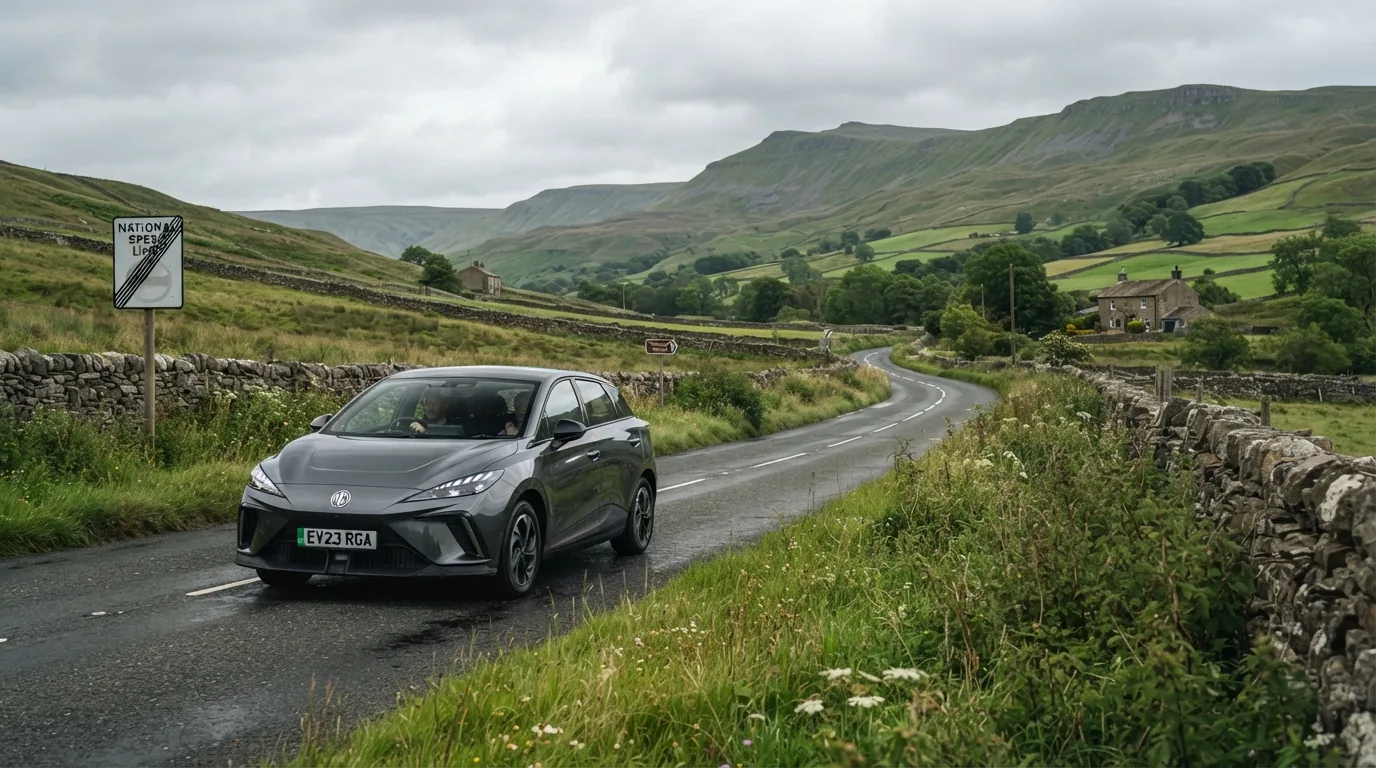
Rural EV ownership in the UK is harder than urban EV ownership, but it is no longer the barrier it once was. The key concerns for rural drivers are public charging gaps, the need for longer range between charges, and the prevalence of A-road and cross-country driving that consumes more energy than urban stop-start use. Here is what the data says and which cars handle rural use best.
What rural drivers actually worry about
Rural UK drivers have legitimate reasons for hesitation around EVs. Charging infrastructure is less dense in rural areas than in cities. LEVI (Local Electric Vehicle Infrastructure) fund investments are still flowing through to rural areas. Fast-food drive-throughs and supermarkets with chargers are less common in the countryside. And if your daily route involves A-roads at 50 to 60mph rather than urban stop-start, your energy consumption per mile is higher than the WLTP figure assumes.
These are real differences. But several factors mitigate them significantly in 2026:
Home charging is the solution for most rural drivers. Rural properties are much more likely to have driveways and off-street parking than urban ones. Around 80% of rural homeowners have access to off-street parking, versus around 60% of urban ones. If you have a driveway, home charging solves the daily charging problem entirely.
Modern EV ranges are large enough for rural use. A car with 300-plus miles of real-world range can cover a typical rural week’s driving, including longer A-road journeys, without a public charger.
Rapid charging infrastructure on A-roads is improving. The LEVI fund (£381 million allocated for 2025 to 2027) is specifically targeted at improving rural and suburban charging infrastructure. Many A-road petrol station sites now have rapid chargers.
The rural driving range reality
On A-roads at 50 to 60mph, EV efficiency typically falls between urban and motorway use. A car rated at 300 miles WLTP might achieve 220 to 260 miles on mixed rural A-road driving depending on terrain and temperature. Hill climbing reduces efficiency; downhill descent with regenerative braking recovers some of it.
The practical planning rule for rural drivers: assume 70 to 75% of WLTP range in mixed rural conditions with no severe cold weather. In winter, reduce to 65%.
The shortlist for rural UK drivers
| Model | Price from | WLTP range | Rural real-world range (est.) | Rapid charge | Home charging | Notes |
|---|---|---|---|---|---|---|
| BMW iX3 (large) | ~£52,000 | 430 miles | ~310–350 miles | 195kW | 22kW AC | Best outright range |
| Volkswagen ID.7 (Pro S) | £56,990 | 435 miles | ~330–360 miles | 200kW | 11kW AC | Best estate-like practicality |
| Hyundai Ioniq 6 (long range RWD) | ~£46,000 | 379 miles | ~290–320 miles | 220kW | 11kW AC | Exceptional efficiency |
| Kia EV3 (81.4kWh) | ~£37,000 | 375 miles | ~280–310 miles | 135kW | 11kW AC | Best value long-range |
| Tesla Model 3 (long range) | £47,990 | 390 miles | ~310–340 miles | 170kW | 11kW AC | Best charging network |
| Tesla Model Y (long range) | £51,990 | 348 miles | ~270–295 miles | 250kW | 11kW AC | Best for families with rural range |
| Skoda Enyaq 85kWh | ~£49,000 | 381 miles | ~290–320 miles | 175kW | 11kW AC | Good value premium range |
Our top pick for rural drivers: Tesla Model 3 or Model Y Long Range
The most important specification for rural drivers is not just range: it is the combination of range and charging network reliability. In rural and semi-rural areas, a charger that is not there or not working is a real problem. Tesla’s Supercharger network is the most reliable in the UK.
The Tesla Model 3 Long Range at £47,990 delivers around 310 to 340 miles of real-world range on mixed roads. The Model Y Long Range at £51,990 delivers around 270 to 295 miles with the additional space and higher driving position that many rural drivers prefer.
Both cars have access to Tesla’s Supercharger network at 170kW to 250kW speeds, which is reliably available at motorway service areas and at an increasing number of rural market towns and A-road fuel stations.
The Model Y’s optional tow bar and 1,600kg towing rating also make it practical for rural uses such as towing horse boxes, trailers, or small caravans at weights below 1,600kg.
Best outright range: BMW iX3
If maximising the gap between charges is the priority, the BMW iX3 (the larger BMW SUV with the larger battery) delivers up to 430 miles WLTP and around 310 to 350 miles in real-world rural driving. For a driver whose nearest rapid charger is 40 miles away, starting with 310 miles of range removes virtually all charging anxiety.
The iX3’s charging speed of 195kW is fast enough for a 20-minute motorway stop to add 150-plus miles. BMW’s iDrive interface is considered among the most refined in the EV market.
The caveat: at around £52,000 to £75,000+ depending on spec, the iX3 is expensive. It is the right choice for rural drivers who do high annual mileage and can justify the cost through running savings.
Best value for rural range: Kia EV3
The Kia EV3 at around £32,000 to £38,000 offers the best value-to-range ratio in the 2026 market. Its 375-mile WLTP range translates to around 280 to 310 miles in real rural conditions. For most rural drivers, this is sufficient for the entire week’s driving without a public charge.
The 135kW charging, while not as fast as the premium options, is adequate for the occasional top-up. The 7-year/100,000-mile warranty provides important peace of mind for rural buyers who are often further from dealers.
The EV3 also has bi-directional charging (V2H and V2G capability on some variants), which is relevant for rural drivers interested in home energy storage or vehicle-to-home power.
Rural charging strategy
For rural drivers, the charging approach differs from urban owners:
-
Home charging is the foundation. If you have off-street parking, install a 7kW wallbox. Plug in every evening regardless of charge level. Start each morning full.
-
Identify your nearest rapid charger. Use Zap-Map to find the closest 50kW or faster rapid charger to your home and to the towns you regularly visit. Many rural market towns now have at least one rapid charger at a car park or petrol station.
-
Top up during regular errands. When you visit a town with a charger, plug in while shopping even if you do not urgently need range. Destination charging (at supermarkets, car parks, leisure centres) is typically the cheapest public charging option.
-
Plan longer journeys through charging stops. A Better Route Planner (ABRP) or your car’s built-in navigation handles this automatically for most modern EVs.
-
Keep a buffer. Rural driving leaves less margin for error. Setting your charge schedule to maintain a minimum of 20 to 30% battery overnight (rather than running close to zero) is sensible practice.
The LEVI fund and rural infrastructure
The Local Electric Vehicle Infrastructure fund allocated £381 million to local authorities specifically for EV charging infrastructure in 2025 to 2027. Much of this is targeted at areas outside cities and major towns.
The Rural Services Network has identified charging gaps in specific rural regions, and the government has set targets for rural local authorities to publish EV infrastructure strategies. Progress is uneven: some rural councils have moved quickly, others slowly. Checking the status of LEVI funding in your local authority area is worthwhile before deciding.
The honest verdict for rural drivers
If you have home charging (most rural drivers do), a modern EV with 280-plus miles of real-world range works for rural UK use in 2026. The occasional top-up during a town visit substitutes effectively for public charging dependence.
If you do not have home charging and you live in an area with poor on-street infrastructure, EV ownership is genuinely harder than in an urban setting. A PHEV or hybrid may be a more practical interim step.
For the full comparison of petrol and electric options, see petrol vs electric: which is right for UK drivers in 2026?. For the complete switching guide, return to the switching from petrol or diesel hub. For model options across all types, see best first electric cars for switching from petrol.
Sources: GOV.UK LEVI fund documentation, EV Database UK range data 2026, Tesla UK Supercharger network, Rural Services Network EV infrastructure report, Ofgem energy price cap Q2 2026, GOV.UK EV chargepoint statistics March 2026, RAC fuel watch data May 2026.
How we test and where our numbers come from
Range figures are official WLTP combined values taken from manufacturer UK specification pages, with real-world estimates drawn from independent comparative testing. Prices are UK list prices at the time of the latest update. Tax, grant and charging-scheme figures come from GOV.UK and HMRC publications. We re-check every guide when pricing, specification or policy changes. Last checked 11 August 2026.

EV Compared
The EV Compared editorial team tracks the UK electric vehicle market full time: new model launches, list prices, WLTP and real-world range, public charging tariffs and the tax rules that decide what an EV actually costs to run. Every guide is checked against manufacturer specifications and official GOV.UK figures, and updated whenever the numbers move.
Related reading
View all
What Are the Biggest Myths About Switching to an EV?
The claims that put UK drivers off going electric, and what the evidence actually says
Should You Buy an EV in 2026 or Wait for Cheaper Models?
An honest look at where EV prices are heading and whether the wait is worth it for UK buyers
Buying and Owning an Electric Car in the UK: The Complete 2026 Guide
Everything you need to know about costs, charging, depreciation and day-to-day life with an EV