Petrol vs Electric: Which Is Right for UK Drivers in 2026?
A direct head-to-head comparison of petrol and electric cars on cost, convenience, and real-world use
Quick answers
- Electric wins on running cost for most UK drivers. Petrol wins on upfront purchase price and on public refuelling convenience.
- The conclusion is stark: home charging makes an EV significantly cheaper to run than petrol; public rapid charging makes it roughly equivalent or slightly more expensive.
- However: - The Electric Car Grant provides up to £3,750 off eligible new EVs priced under £37,000 - Like-for-like model comparisons show smaller gaps: a Renault 5 petrol versus Renault 5 E-Tech, or a VW Golf versus VW ID.3 - Manufacturer incentives and competition from Chinese brands have reduced EV prices significantly in 2024 to 2026 - New EVs start from £14,495 (Leapmotor T03) before the grant
- On performance: electric wins: This is one area where even modest EVs outperform comparable petrol cars.
- A petrol car with a 50-litre tank and 40mpg achieves around 440 miles of range.
- Who should buy electric in 2026: Electric makes the stronger case for: - Any driver with home charging doing typical annual mileage (8,000 to 15,000 miles) - Company car drivers at any mileage level (BiK tax saving is decisive) - High-mileage drivers with home charging (saving grows with mileage) - Urban drivers who rarely make long-distance trips - Drivers who want to front-run the 2035 policy direction and own a car well into the next decade
Electric wins on running cost for most UK drivers. Petrol wins on upfront purchase price and on public refuelling convenience. The verdict depends on your specific circumstances, not a universal preference. Here is the head-to-head comparison that gives you the honest answer for your situation.
The direct comparison at a glance
| Category | Petrol | Electric | Winner |
|---|---|---|---|
| Average new car price | ~£28,000 | ~£43,896 | Petrol |
| Cost per mile (home charging) | 16–18p | 2–7p | Electric |
| Cost per mile (public rapid charging) | 16–18p | 15–23p | Tie / Petrol edge |
| Annual fuel saving (10,000 miles) | , | £900–£1,600 | Electric |
| Annual servicing cost | £350–£500 | £150–£250 | Electric |
| Road tax (VED) | £190 | £190 | Tie |
| 0–60mph acceleration | Typical family car: 8–12 sec | Typical family car: 5–8 sec | Electric |
| Cabin noise on motorway | Moderate (engine drone) | Low (road/tyre only) | Electric |
| Refuelling convenience (home charging) | Must visit petrol station | Plug in at home overnight | Electric |
| Refuelling convenience (public only) | Fast (3–5 minutes) | Slower (20–45 minutes) | Petrol |
| Long-distance ease | Fill up in 3 minutes anywhere | Plan charging stops; 20–30 min | Petrol |
| Company car BiK rate | 25–37% | 4% | Electric |
| Vehicle choice in 2026 | Very wide | Growing fast (broad mainstream choice) | Petrol (more options) |
| New car purchase grant | None | Up to £3,750 on eligible models | Electric |
| 2035 new car sale deadline | Cannot buy new after 2035 | No restriction planned | Electric |
On running costs: electric wins clearly for home chargers
This is where the comparison is most decisive.
Petrol: At 159.6p per litre (May 2026 average) and 40mpg, a petrol car costs approximately 18p per mile. At 10,000 miles per year, that is £1,800 in fuel.
Electric (home, off-peak tariff): At 7p per kWh and 3.5 miles per kWh efficiency, an EV costs approximately 2p per mile. At 10,000 miles per year, that is £200 in electricity. Annual saving: £1,600.
Electric (home, standard Ofgem rate): At 24.67p per kWh, the cost is approximately 7p per mile. Annual cost: £700. Annual saving versus petrol: £1,100.
Electric (public rapid charging only): At 79p per kWh for ultra-rapid charging, the cost is approximately 22.5p per mile. This is higher than petrol per mile and represents the scenario where EV ownership is not financially advantageous on energy costs alone.
The conclusion is stark: home charging makes an EV significantly cheaper to run than petrol; public rapid charging makes it roughly equivalent or slightly more expensive.
Servicing savings add to the electric advantage: EVs have no oil changes, no timing belt, and experience less brake wear due to regenerative braking. Annual servicing cost savings of £200 to £300 per year accumulate meaningfully over typical ownership periods.
On purchase price: petrol wins, but the gap is narrowing
The average new EV costs around £43,896. The average new petrol car costs around £28,000. That is a headline gap of roughly £15,000.
However:
- The Electric Car Grant provides up to £3,750 off eligible new EVs priced under £37,000
- Like-for-like model comparisons show smaller gaps: a Renault 5 petrol versus Renault 5 E-Tech, or a VW Golf versus VW ID.3
- Manufacturer incentives and competition from Chinese brands have reduced EV prices significantly in 2024 to 2026
- New EVs start from £14,495 (Leapmotor T03) before the grant
The purchase price gap is the legitimate remaining barrier for most buyers. Running cost savings of £1,000 to £1,600 per year offset a £5,000 to £8,000 price premium within three to five years of typical ownership.
On convenience: it depends how you charge
This is the most nuanced part of the comparison.
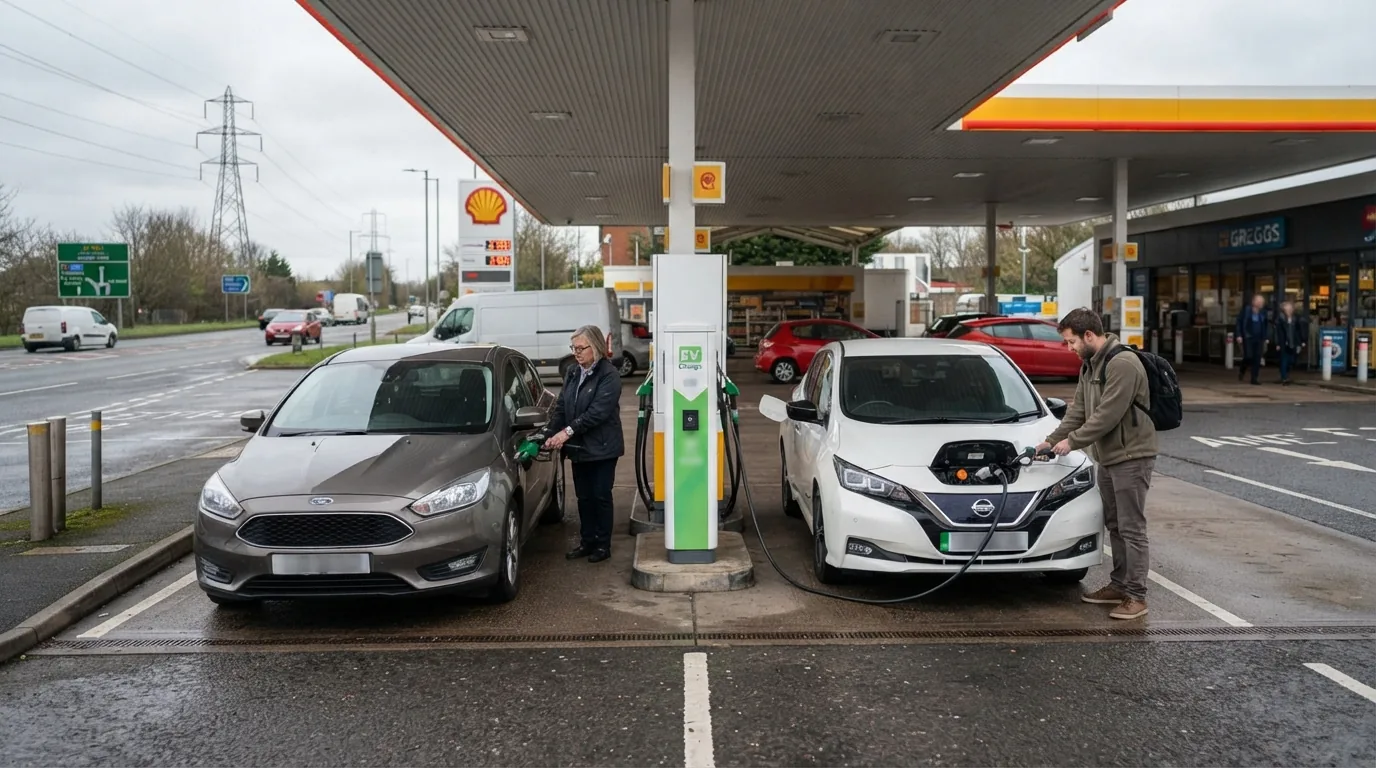
Home charging: for a driver with a driveway and a wallbox, an EV is more convenient than petrol. You never visit a fuel station. You plug in when you get home and wake up full. The refuelling interaction takes five seconds. The cost management is automated via an overnight schedule.
Public charging only: petrol wins clearly. Filling a petrol tank takes three to five minutes at any one of approximately 8,300 petrol stations in the UK. A rapid EV charging stop takes 20 to 45 minutes and requires more planning. For drivers relying entirely on public charging, this is a genuine daily friction.
Long-distance trips: petrol still has the advantage on ease. You can cross the UK in a petrol car with one five-minute fuel stop. In an EV, you typically plan one or two 20 to 30-minute stops. The stops are becoming faster and more reliable, but they still require more planning.
On performance: electric wins
This is one area where even modest EVs outperform comparable petrol cars.
Electric motors produce maximum torque from zero rpm, giving immediate, responsive acceleration. A typical mid-range EV family car (100 to 150kW motor) reaches 60mph in around 5 to 8 seconds. A petrol equivalent typically takes 8 to 12 seconds.
The torque response makes everyday driving, overtaking, and motorway merging feel easier and more confident in an EV. The cabin is quieter too: no engine drone, less vibration, significantly calmer long-distance experience.
On range: petrol still wins, but EVs have caught up significantly
A petrol car with a 50-litre tank and 40mpg achieves around 440 miles of range. An EV with 300 miles of WLTP range achieves around 230 to 280 miles in real-world conditions at motorway speeds.
However: the vast majority of UK driving does not use the full range of either car on a single day. RAC data shows 74% of UK drivers cover fewer than 150 miles per week. An EV with 250 miles of real-world range covers that entire week on a single charge.
Range only becomes a meaningful comparison point for:
- Long-distance commuters (150+ miles per day)
- Drivers who regularly make 300-mile-plus trips
- Drivers in areas with limited rapid charging infrastructure
For everyone else, the practical range of a modern EV is more than sufficient for everyday use.
Who should buy petrol in 2026?
There are specific circumstances where a petrol car still makes rational sense:
- You regularly make long-distance trips (300+ miles) and cannot rely on rapid charging being available
- You have no home charging and rely entirely on public rapid charging for everyday use
- Your annual mileage is very low (under 5,000 miles), making the running cost savings too small to offset a purchase premium
- You need to sell in under two years and want to minimise depreciation risk
- Your work requires towing above 2,500kg regularly (no EV matches diesel for heavy towing)
Who should buy electric in 2026?
Electric makes the stronger case for:
- Any driver with home charging doing typical annual mileage (8,000 to 15,000 miles)
- Company car drivers at any mileage level (BiK tax saving is decisive)
- High-mileage drivers with home charging (saving grows with mileage)
- Urban drivers who rarely make long-distance trips
- Drivers who want to front-run the 2035 policy direction and own a car well into the next decade
The verdict
For most UK drivers in 2026 with home charging, electric is the rational choice when viewed over a three to five-year ownership period. The running cost savings are substantial, the driving experience is better on most metrics, and the purchase price premium is declining.
Petrol remains rational for specific use cases: no home charging, very low mileage, or frequent long-distance journeys in areas with poor rapid charging infrastructure.
The “default choice” has shifted. In 2019, petrol was the default for UK drivers and EVs required justification. In 2026, for most UK drivers with home charging, the burden of justification has moved to petrol.
For model recommendations, see best first electric cars for switching from petrol. For the complete switching guide, return to the switching from petrol or diesel hub.
Sources: SMMT vehicle registration data 2026, Ofgem energy price cap Q2 2026, RAC fuel watch data May 2026, GOV.UK Vehicle Excise Duty rates, HMRC BiK rates 2026/27, GOV.UK Electric Car Grant guidance, GOV.UK EV chargepoint statistics March 2026, RAC motoring statistics 2025.
How we test and where our numbers come from
Range figures are official WLTP combined values taken from manufacturer UK specification pages, with real-world estimates drawn from independent comparative testing. Prices are UK list prices at the time of the latest update. Tax, grant and charging-scheme figures come from GOV.UK and HMRC publications. We re-check every guide when pricing, specification or policy changes. Last checked 11 August 2026.
Frequently asked questions
Who should buy electric in 2026?
Electric makes the stronger case for: - Any driver with home charging doing typical annual mileage (8,000 to 15,000 miles) - Company car drivers at any mileage level (BiK tax saving is decisive) - High-mileage drivers with home charging (saving grows with mileage) - Urban drivers who rarely make long-distance trips - Drivers who want to front-run the 2035 policy direction and own a car well into the next decade

EV Compared
The EV Compared editorial team tracks the UK electric vehicle market full time: new model launches, list prices, WLTP and real-world range, public charging tariffs and the tax rules that decide what an EV actually costs to run. Every guide is checked against manufacturer specifications and official GOV.UK figures, and updated whenever the numbers move.
Related reading
View all
What Are the Biggest Myths About Switching to an EV?
The claims that put UK drivers off going electric, and what the evidence actually says
Should You Buy an EV in 2026 or Wait for Cheaper Models?
An honest look at where EV prices are heading and whether the wait is worth it for UK buyers
Buying and Owning an Electric Car in the UK: The Complete 2026 Guide
Everything you need to know about costs, charging, depreciation and day-to-day life with an EV