Volkswagen ID.7 vs Tesla Model 3: UK Range Showdown
The ID.7 goes further on paper, costs more and offers more space. The Model 3 charges better and comes with a superior network. Which wins?
Quick answers
- The Volkswagen ID.7 Pro S claims 434 miles WLTP. The Tesla Model 3 Long Range RWD claims 466 miles WLTP.
- The ID.7 Pro S carries 86 kWh of usable battery capacity, 7 kWh more than the Model 3 Long Range's 79 kWh.
- The ID.7's MEB platform with its nearly three-metre wheelbase provides exceptional rear passenger legroom.
- Charging: Tesla has the decisive advantage: The Model 3's 250 kW Supercharger rate versus the ID.7's 175 kW CCS peak is not just a numbers game.
- Driving the two: character and comfort: For drivers who want engagement, the Model 3 is the better car to drive.
- The infotainment comparison: one surprise: Volkswagen's latest MIB4 infotainment system in the ID.7 is a significant improvement over the criticised touchscreen interfaces of early ID models.
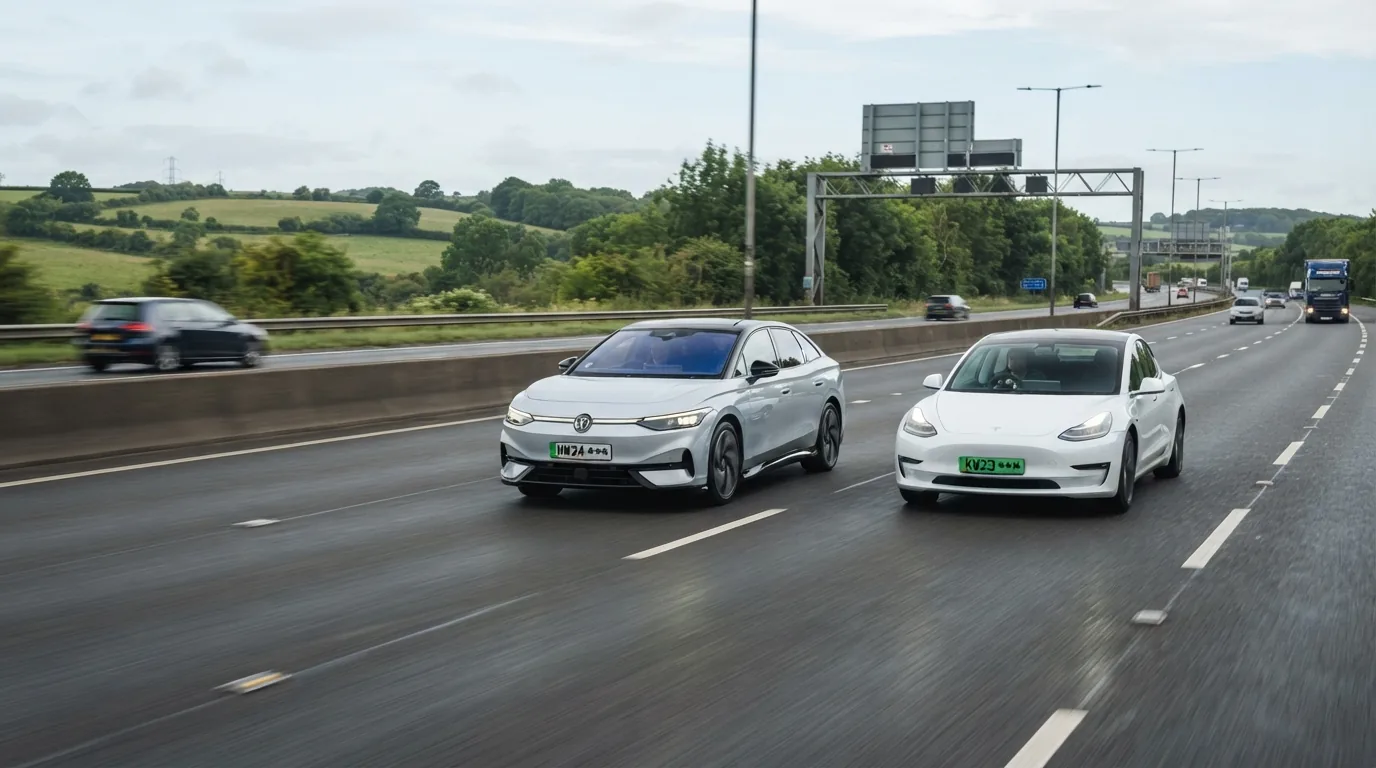
The Volkswagen ID.7 Pro S claims 434 miles WLTP. The Tesla Model 3 Long Range RWD claims 466 miles WLTP. The Tesla goes further on paper, but only by 32 miles. In real-world motorway driving, the gap is similarly modest. The ID.7 costs from around £55,000 in Pro S form compared with £45,990 for the Model 3 Long Range: approximately a £9,000 premium for the Volkswagen.
What justifies that premium? The ID.7 is a significantly larger car with a vast 532-litre boot, more rear passenger space and a more traditional, comfortable driving experience. The Tesla offers the Supercharger network, better real-world efficiency per kWh and a lower price of entry. This is a comparison between a large-format saloon and a mainstream mid-size, with range as the common thread.
Head-to-head specification
| Specification | VW ID.7 Pro S | Tesla Model 3 Long Range RWD |
|---|---|---|
| WLTP Range | 434 miles | 466 miles |
| Real World (mixed est.) | ~320-355 miles | ~350-380 miles |
| Motorway 70 mph (est.) | ~305-335 miles | ~325-360 miles |
| Battery (usable) | 86 kWh | 79 kWh |
| Power | 286 hp | 258 hp |
| 0-62 mph | 6.5 seconds | 5.8 seconds |
| Peak DC Charging | 175 kW | 250 kW (Supercharger) |
| 10-80% charge time | ~28-32 min | ~25-30 min |
| Boot space | 532 litres | 594 litres |
| Starting Price (UK) | ~£51,500 (Pro), ~£55,000 (Pro S) | £45,990 |
| Drag coefficient | 0.24 | 0.23 |
| BiK rate (2026/27) | 4% | 4% |
| Efficiency | ~3.6-3.9 miles/kWh | ~3.8-4.2 miles/kWh |
Model 3 has a larger boot than the ID.7 in absolute terms due to its saloon-style boot and additional front trunk.
Range: the paradox of a bigger battery that goes shorter distances
The ID.7 Pro S carries 86 kWh of usable battery capacity, 7 kWh more than the Model 3 Long Range’s 79 kWh. Yet the Tesla claims 32 more miles on WLTP and delivers around 30 to 35 more miles in mixed real-world conditions. How?
The Model 3 is more efficient per kWh. Its Cd of 0.23 versus the ID.7’s 0.24 is one small factor. The Tesla’s drivetrain efficiency, built over many platform generations, is the bigger one. The Model 3 achieves around 3.8 to 4.2 miles per kWh in mixed conditions; the ID.7 typically returns 3.6 to 3.9 miles per kWh. Over a full battery, 7 extra kWh in the ID.7 is outweighed by the Tesla’s efficiency advantage.
The practical implication: despite its larger battery, the ID.7 does not achieve more real-world range than the Model 3 Long Range. For buyers choosing primarily on maximum range, the Tesla wins even though it is cheaper and has a smaller battery.
Where the ID.7 clearly wins: interior space
The ID.7’s MEB platform with its nearly three-metre wheelbase provides exceptional rear passenger legroom. It is a genuinely large car in a saloon body, closer to E-segment dimensions despite being marketed and priced closer to D-segment. The flat floor (no transmission tunnel) makes all three rear seats genuinely comfortable.
The 532-litre boot is large for the class, comparable to a large traditional executive saloon. Combined with the front storage area and interior cubbies, the ID.7 is one of the most practically capacious electric saloons available.
Interestingly, the Tesla Model 3 has a marginally larger boot on paper (594 litres) due to its separate boot opening and 88-litre frunk. However, the ID.7’s interior passenger space is superior for rear occupants.
Charging: Tesla has the decisive advantage
The Model 3’s 250 kW Supercharger rate versus the ID.7’s 175 kW CCS peak is not just a numbers game. At 175 kW, the ID.7 completes a 10 to 80 per cent charge in approximately 28 to 32 minutes. The Tesla takes a similar 25 to 30 minutes at a V3 Supercharger. On paper, the difference is modest.
In practice, the Supercharger network delivers consistently faster and more reliable charging on UK motorways than the third-party CCS infrastructure the ID.7 relies on. Supercharger stalls are more plentiful at key motorway services, payment is automatic through the Tesla app, and pre-arrival battery conditioning is deeply integrated with navigation.
Volkswagen has partnered with the We Charge network and offers preferential rates on certain charging networks, but the convenience and reliability gap between Tesla’s network and the public CCS alternatives remains meaningful in 2026.
Driving the two: character and comfort
The ID.7 is a calm, composed long-distance car. Its air suspension (optional but widely specified) absorbs UK road imperfections extremely well, and the large body offers excellent isolation from wind and road noise at motorway speeds. Steering is light and precise but not particularly engaging. The ID.7 is designed to move passengers efficiently and comfortably, not to excite the driver.
The Model 3 is more driver-focused. Steering feel is better, body control is tighter, and the overall handling is more responsive despite the Model 3’s performance-oriented setup in Long Range RWD form. The Model 3 is also quicker: 5.8 seconds to 62 mph versus the ID.7’s 6.5 seconds.
For drivers who want engagement, the Model 3 is the better car to drive. For passengers and long-distance comfort, the ID.7 is harder to fault.
The infotainment comparison: one surprise
Volkswagen’s latest MIB4 infotainment system in the ID.7 is a significant improvement over the criticised touchscreen interfaces of early ID models. Physical climate controls have returned as proper haptic sliders, and the menu structure is more logical. It is still not as polished as Tesla’s Autopilot-integrated software, but the gap has narrowed considerably.
Tesla’s Autopilot and full self-driving capability (where legally permitted) remain the most advanced driver assistance systems in this class. The ID.7 has Volkswagen’s Travel Assist adaptive cruise control and lane keeping, which is competent but not in the same league as Tesla’s implementation.
Company car: the BiK and whole-life cost calculation
Both attract 4 per cent BiK in 2026/27. The ID.7 Pro’s higher list price (from £51,500 vs £45,990) means a higher annual BiK tax charge for the employee:
- Tesla Model 3 Long Range: approximately £736 annual BiK tax (40% taxpayer)
- VW ID.7 Pro: approximately £824 annual BiK tax (40% taxpayer)
Over a three-year cycle, the Model 3 saves approximately £262 in BiK tax. Add the lower list price advantage, and the whole-life cost case for the Tesla is significant for business drivers comparing the two directly.
Verdict: which should you buy?
Choose the Tesla Model 3 Long Range if: you want the best range-per-pound in this class, you value the Supercharger network on long journeys, you want faster charging and better real-world efficiency, or you are making a financially rational company car decision.
Choose the Volkswagen ID.7 Pro S if: you need the larger interior space for frequent rear passengers, you want the more comfortable long-distance ride, or you prefer Volkswagen’s approach to infotainment and physical controls over Tesla’s touchscreen-only philosophy. The ID.7 is the better car for those specific use cases; it just does not deliver more range per pound than the Model 3.
For a driver who primarily wants maximum range efficiency and charging network quality, the Model 3 wins clearly. For a driver who equally values passenger comfort, interior space and a traditional car experience alongside long range, the ID.7 justifies its premium.
For the full market ranking of every UK EV by range, see longest range electric cars. For more on motorway efficiency and how different cars perform at speed, see most efficient EVs for motorway driving and the range and performance hub.
Sources: Volkswagen UK ID.7 pricing and specification, Tesla UK pricing, Auto Express VW ID.7 vs Tesla comparison, DriveDuel UK comparative data, EV Database UK, Carbuyer VW ID.7 review, What Car? VW ID.7 vs Tesla comparison.
How we test and where our numbers come from
Range figures are official WLTP combined values taken from manufacturer UK specification pages, with real-world estimates drawn from independent comparative testing. Prices are UK list prices at the time of the latest update. Tax, grant and charging-scheme figures come from GOV.UK and HMRC publications. We re-check every guide when pricing, specification or policy changes. Last checked 11 August 2026.
Frequently asked questions
Verdict: which should you buy?
For a driver who primarily wants maximum range efficiency and charging network quality, the Model 3 wins clearly. For a driver who equally values passenger comfort, interior space and a traditional car experience alongside long range, the ID.7 justifies its premium.

EV Compared
The EV Compared editorial team tracks the UK electric vehicle market full time: new model launches, list prices, WLTP and real-world range, public charging tariffs and the tax rules that decide what an EV actually costs to run. Every guide is checked against manufacturer specifications and official GOV.UK figures, and updated whenever the numbers move.
Related reading
View all
Do Bigger Wheels Reduce Electric Car Range?
Yes, significantly. Here is the data on how much wheel size costs in miles and why it happens
BMW i4 vs Tesla Model 3: UK Range and Efficiency Test
The BMW costs more and goes less far, but is it worth it? A data-led head to head for UK buyers
How Far Can an Electric Car Really Go on One Charge?
Real-world range figures for UK drivers: what the numbers mean and which cars go furthest