Most Efficient EVs for UK Motorway Driving
Ranked by real-world motorway efficiency, with the aerodynamic and technical reasons each car excels at speed
Quick answers
- The most efficient electric cars at UK motorway speeds share one characteristic above all others: low aerodynamic drag. At 70 mph, aerodynamic resistance dominates energy consumption, making the drag coefficient (Cd) the single most important technical figure for motorway drivers.
- An EV achieving 4.0 miles per kWh in mixed conditions may achieve only 3.0 to 3.3 miles per kWh on a sustained 70 mph motorway run.
- The Ioniq 6's 0.21 drag coefficient is achieved through a "Electrified Streamliner" body that incorporates active air flaps, wheel gap reducers and a carefully optimised rear diffuser.
- The Model 3 Long Range combines its Cd of 0.23 with a 79 kWh usable battery to deliver the best combination of motorway range, charging infrastructure and everyday practicality in the mainstream segment.
- Mercedes EQS: best absolute motorway range: The EQS is in a different price bracket (from around £94,000), but it deserves mention for delivering the best motorway range in absolute terms.
- What about the BMW i4: The BMW i4 eDrive40's Cd of 0.24 and 80.7 kWh battery produce respectable motorway range, typically around 285 to 315 miles at 70 mph.
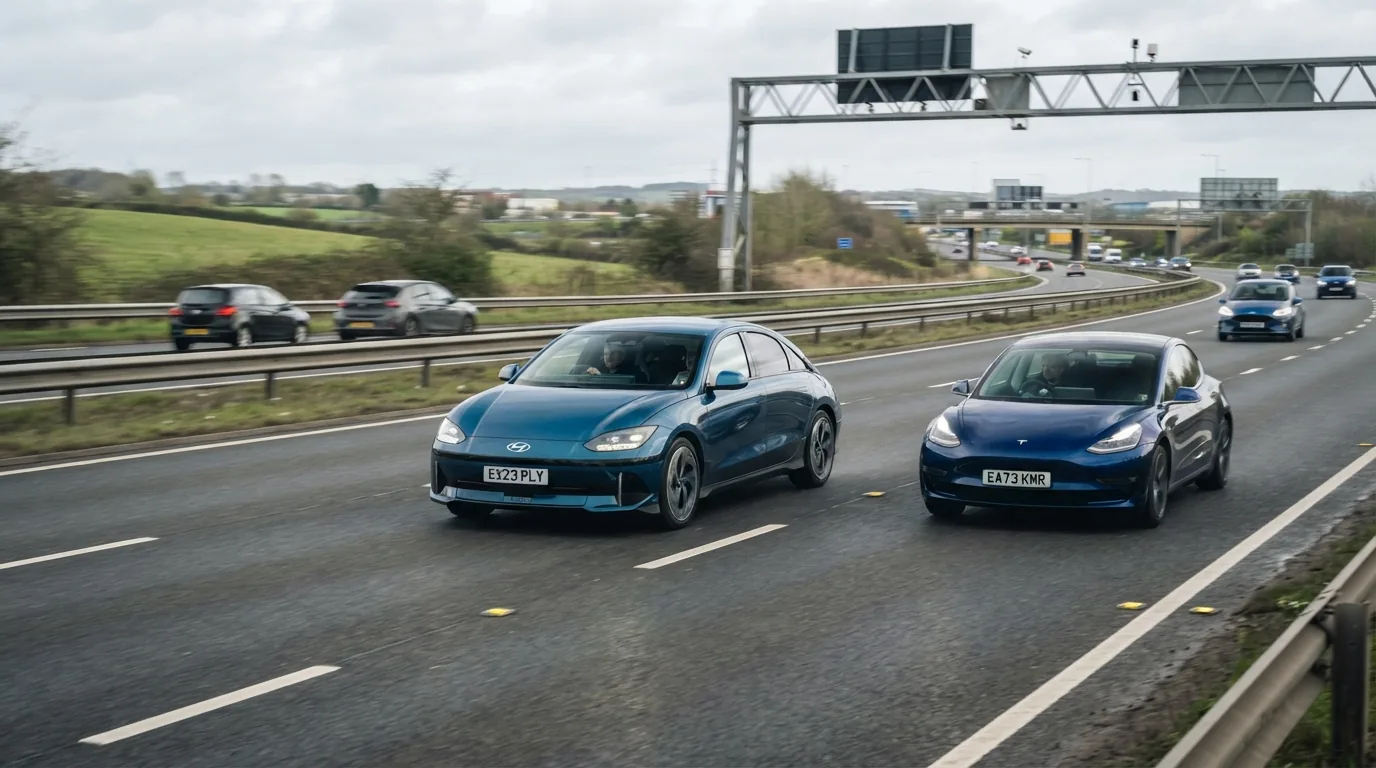
The most efficient electric cars at UK motorway speeds share one characteristic above all others: low aerodynamic drag. At 70 mph, aerodynamic resistance dominates energy consumption, making the drag coefficient (Cd) the single most important technical figure for motorway drivers. Cars with Cd below 0.25 hold their range far better at speed than the general EV average.
The Hyundai Ioniq 6 leads this group outright, with a Cd of 0.21 that the EPA recognised as making it the most energy-efficient EV in North America for two consecutive years. The Tesla Model 3 (Cd 0.23) is close behind. At the premium end, the Mercedes EQS (Cd 0.20) holds the aerodynamic record for a production car.
Why motorway driving is so different from WLTP
The WLTP test averages just 29 mph (46.5 km/h). Its energy consumption figures reflect that moderate speed. At 70 mph, aerodynamic drag is roughly 30 per cent higher per mile than at 50 mph, and 45 per cent higher at 80 mph. Cars that are efficient at low speeds may not be efficient at motorway speeds. The key metric for motorway drivers is not WLTP range but real-world miles per kWh at 70 mph.
An EV achieving 4.0 miles per kWh in mixed conditions may achieve only 3.0 to 3.3 miles per kWh on a sustained 70 mph motorway run. A car with excellent aerodynamics might maintain 3.5 to 3.8 miles per kWh at the same speed.
Top efficient EVs for UK motorway driving
| Car | Cd | Battery (usable) | 70 mph Motorway Range (est.) | Price From |
|---|---|---|---|---|
| Hyundai Ioniq 6 RWD (77.4 kWh) | 0.21 | 74 kWh | ~255-275 miles | £46,260 |
| Tesla Model 3 Long Range RWD | 0.23 | 79 kWh | ~345-370 miles | £45,990 |
| Mercedes EQS 450+ | 0.20 | 107.8 kWh | ~385-415 miles | ~£94,000 |
| Polestar 2 Long Range | 0.25 | 78 kWh | ~275-300 miles | ~£47,000 |
| BMW i4 eDrive40 | 0.24 | 80.7 kWh | ~285-315 miles | £52,005 |
| Volkswagen ID.7 Pro S | 0.24 | 86 kWh | ~315-350 miles | ~£56,000 |
| Audi A6 e-tron Performance | 0.22 | 94.9 kWh | ~355-385 miles | ~£63,000 |
| Tesla Model S Long Range | 0.23 | ~100 kWh | ~385-415 miles | ~£90,000 |
| Mercedes CLA Electric | 0.21 | ~80 kWh | ~300-330 miles | ~£47,000 |
| Kia EV6 Long Range RWD | 0.28 | 77.4 kWh | ~255-280 miles | £45,585 |
Motorway range estimates are at 70 mph in mild conditions (approximately 15-20°C, no climate control).
Hyundai Ioniq 6: the motorway efficiency leader
The Ioniq 6’s 0.21 drag coefficient is achieved through a “Electrified Streamliner” body that incorporates active air flaps, wheel gap reducers and a carefully optimised rear diffuser. At motorway speeds, this translates to approximately 3.4 to 3.8 miles per kWh, depending on trim and conditions.
With the 77.4 kWh battery (74 kWh usable), the Ioniq 6 RWD delivers approximately 255 to 275 miles at 70 mph in mild conditions. That is not the longest motorway range in absolute terms (the battery is smaller than the EQS), but the efficiency per kWh is exceptional. If you are comparing cost-per-mile on a motorway run, the Ioniq 6 is among the cheapest cars to run in this class.
The 800-volt architecture also means that when you stop to charge, the 10 to 80 per cent top-up takes around 18 minutes on a 350 kW charger, making the Ioniq 6 one of the fastest-charging mainstream EVs available in the UK.
Tesla Model 3 Long Range: the practical motorway choice
The Model 3 Long Range combines its Cd of 0.23 with a 79 kWh usable battery to deliver the best combination of motorway range, charging infrastructure and everyday practicality in the mainstream segment. At 70 mph, expect around 345 to 370 miles in mild conditions. That is enough to cover most UK long-distance trips on a single charge with a safety margin.
Tesla’s Supercharger network is the key differentiator for motorway use. Superchargers at UK motorway services are consistently faster, more reliable and simpler to use than third-party public chargers, and the car’s navigation automatically plans charge stops and preconditions the battery before each stop.
Mercedes EQS: best absolute motorway range
The EQS is in a different price bracket (from around £94,000), but it deserves mention for delivering the best motorway range in absolute terms. Its 107.8 kWh usable battery and Cd of 0.20 combine to make it capable of around 385 to 415 miles at 70 mph in mild conditions. For drivers whose business requires very long motorway distances with minimal stops, the EQS is a genuine solution.
What about the BMW i4?
The BMW i4 eDrive40’s Cd of 0.24 and 80.7 kWh battery produce respectable motorway range, typically around 285 to 315 miles at 70 mph. It is not the outright efficiency leader, but it is competitive and the CCS rapid charging system supports up to 205 kW, meaning charge stops are quick. The i4 is also available with BMW’s ID Charging partner network, which includes high-power chargers at key locations.
Kia EV6: capable but less efficient at speed
The EV6’s 0.28 drag coefficient puts it behind the aerodynamic leaders at motorway speeds. Despite sharing the same 77.4 kWh battery as the Ioniq 6, its motorway range at 70 mph is noticeably shorter: around 255 to 280 miles versus the Ioniq 6’s 255 to 275 miles. The EV6 compensates with better driving dynamics, a sportier character and (in some trims) an optional 84 kWh battery that extends motorway range to around 295 to 315 miles.
The efficiency rule buyers often miss
Buying the highest WLTP range car does not guarantee the best motorway efficiency. A car with 430 miles WLTP but a Cd of 0.28 may deliver worse motorway range than a car with 360 miles WLTP but a Cd of 0.22, because the drag-disadvantaged car loses far more range at speed than the aerodynamic one.
If motorways are your primary use case, prioritise:
- Drag coefficient (Cd below 0.25 ideally)
- Battery size (larger gives more absolute motorway range)
- Charging speed (800-volt systems charge fastest at motorway service points)
Common question: does air conditioning hurt motorway range?
Yes, but less than the heater in winter. Air conditioning typically draws 1.5 to 3 kW. At 70 mph, the car may be drawing 25 to 30 kW total for propulsion; the air con adds 5 to 12 per cent to energy consumption. In summer, motorway range with air conditioning running is roughly 5 to 10 per cent lower than without it. That is manageable. The winter heater is a larger issue (3 to 5 kW for a resistive heater), particularly compounded by reduced battery efficiency in cold temperatures.
For full rankings including non-motorway scenarios, visit the longest range electric cars guide. The range and performance hub covers all the factors that affect EV efficiency on UK roads.
Sources: EV Database drag coefficient data, EPA efficiency rankings, independent motorway efficiency testing from Carwow and Autocar, manufacturer specifications, Tesla Supercharger network data.
How we test and where our numbers come from
Range figures are official WLTP combined values taken from manufacturer UK specification pages, with real-world estimates drawn from independent comparative testing. Prices are UK list prices at the time of the latest update. Tax, grant and charging-scheme figures come from GOV.UK and HMRC publications. We re-check every guide when pricing, specification or policy changes. Last checked 11 August 2026.
Frequently asked questions
What about the BMW i4?
The BMW i4 eDrive40's Cd of 0.24 and 80.7 kWh battery produce respectable motorway range, typically around 285 to 315 miles at 70 mph. It is not the outright efficiency leader, but it is competitive and the CCS rapid charging system supports up to 205 kW, meaning charge stops are quick.
Common question: does air conditioning hurt motorway range?
Yes, but less than the heater in winter. Air conditioning typically draws 1.5 to 3 kW.

EV Compared
The EV Compared editorial team tracks the UK electric vehicle market full time: new model launches, list prices, WLTP and real-world range, public charging tariffs and the tax rules that decide what an EV actually costs to run. Every guide is checked against manufacturer specifications and official GOV.UK figures, and updated whenever the numbers move.
Related reading
View all
Do Bigger Wheels Reduce Electric Car Range?
Yes, significantly. Here is the data on how much wheel size costs in miles and why it happens
BMW i4 vs Tesla Model 3: UK Range and Efficiency Test
The BMW costs more and goes less far, but is it worth it? A data-led head to head for UK buyers
How Far Can an Electric Car Really Go on One Charge?
Real-world range figures for UK drivers: what the numbers mean and which cars go furthest