BMW i4 vs Tesla Model 3: UK Range and Efficiency Test
The BMW costs more and goes less far, but is it worth it? A data-led head to head for UK buyers
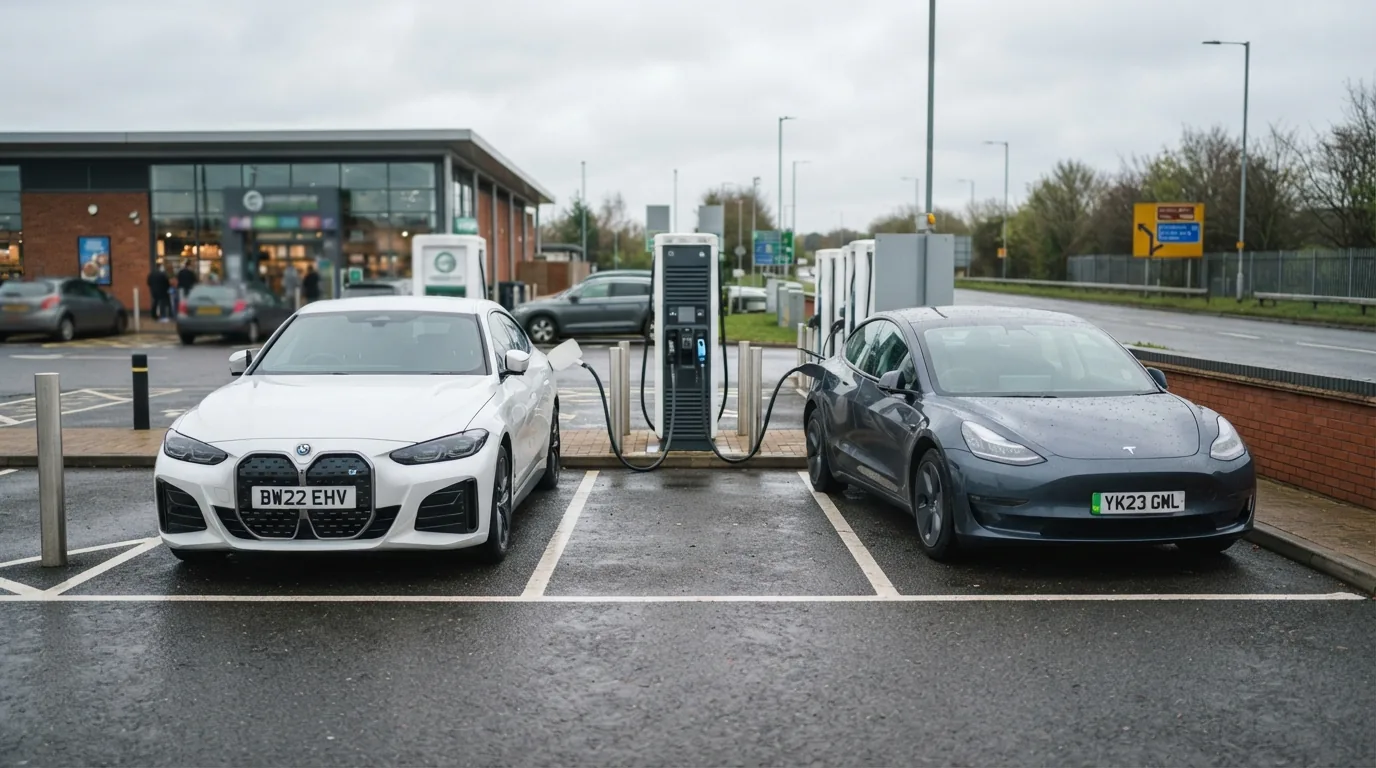
Quick answers
- The BMW i4 starts at around £52,000 and the Tesla Model 3 Long Range at £45,990. The i4 eDrive40 produces 380 miles WLTP; the Model 3 Long Range delivers 466 miles WLTP.
- The Model 3 Long Range (79 kWh usable) and the i4 eDrive40 (80.7 kWh usable) have almost identical battery capacities.
- Charging: Supercharger vs CCS: The i4 uses the CCS standard and supports up to 205 kW DC peak charging, meaning a 10 to 80 per cent top-up in approximately 28 to 30 minutes.
- The i4 M60 dual-motor AWD version produces 544 hp, does 0 to 62 mph in 3.9 seconds and costs around £71,500.
- Verdict: which should you buy: At the current pricing and specification, we consider the Tesla Model 3 Long Range the rational choice for most buyers in this segment.
The BMW i4 starts at around £52,000 and the Tesla Model 3 Long Range at £45,990. The i4 eDrive40 produces 380 miles WLTP; the Model 3 Long Range delivers 466 miles WLTP. At 70 mph on a UK motorway, the Tesla goes further, costs less and accesses a better charging network. The BMW offers a more conventional interior experience, sharper dynamics from its upgraded M Sport chassis, and the reassurance of a physical dealer network.
The Tesla wins on the range and charging metrics decisively. Whether the BMW justifies its premium depends on what you are buying the car for.
Head-to-head specification
| Specification | BMW i4 eDrive40 | Tesla Model 3 Long Range RWD |
|---|---|---|
| WLTP Range | 367 miles | 466 miles |
| Real World (mixed est.) | ~280-310 miles | ~350-380 miles |
| Motorway 70 mph (est.) | ~260-295 miles | ~325-360 miles |
| Battery (usable) | 80.7 kWh | 79 kWh |
| Power | 340 hp | 258 hp |
| 0-62 mph | 5.7 seconds | 5.8 seconds |
| Peak DC Charging | 205 kW | 250 kW (Supercharger) |
| 10-80% charge time | ~28-30 min | ~25-30 min |
| Boot space | 470 litres | 594 litres |
| Starting Price (UK) | ~£52,005 | £45,990 |
| Drag coefficient | 0.24 | 0.23 |
| BiK rate (2026/27) | 4% | 4% |
Why does the Tesla go significantly further from nearly the same battery?
The Model 3 Long Range (79 kWh usable) and the i4 eDrive40 (80.7 kWh usable) have almost identical battery capacities. Yet the Tesla claims 99 miles more range on WLTP and delivers noticeably more in real-world testing. The difference is efficiency.
The Tesla’s Cd of 0.23 gives it a marginal aerodynamic edge over the i4’s 0.24, but the bigger factor is drivetrain efficiency. Independent testing has consistently found the Model 3 returning around 3.8 to 4.2 miles per kWh in mixed conditions, while the i4 eDrive40 achieves approximately 3.4 to 3.8 miles per kWh. Tesla’s years of proprietary motor and inverter development, combined with highly optimised power electronics, translate into more miles per unit of energy.
In real-world motorway testing from Carwow and similar outlets, the BMW i4 typically returns around 3.8 miles per kWh at 70 mph, while the Tesla Model 3 Long Range achieves around 4.0 miles per kWh at the same speed. The gap is not dramatic, but across a 300-mile motorway journey it represents a meaningful difference in charge stop frequency.
Charging: Supercharger vs CCS
The i4 uses the CCS standard and supports up to 205 kW DC peak charging, meaning a 10 to 80 per cent top-up in approximately 28 to 30 minutes. This is competitive by mainstream standards, though behind the 800-volt competition (Ioniq 6, EV6) in terms of peak rate.
The Model 3 uses Supercharger (in Tesla’s proprietary North American format, but CCS2 in the UK) and peaks at 250 kW at V3 Superchargers. The practical advantage is the Supercharger network itself: Tesla’s UK motorway service chargers are consistently among the fastest, most reliable and simplest to use of any public rapid charging network. BMW’s i Charging partner network gives i4 owners priority rates at partner sites, but the experience is not as seamless.
Dynamics: BMW’s genuine advantage
The i4 is the better car to drive. BMW’s Gran Coupé body, rear-wheel drive layout and sport-tuned suspension deliver a more engaging driving experience than the Model 3’s competent but less characterful setup. The i4 M60 (the dual-motor variant, from around £71,500) is genuinely fast and genuinely rewarding on a good road.
The i4’s interior is another area where BMW is ahead. The curved digital display integrating the information cluster and infotainment, the quality of materials throughout the cabin, and the physical controls for key functions all make the i4 a more familiar and immediate experience for drivers coming from a traditional premium German car. The Model 3’s single-screen approach, with almost all controls located on the touchscreen, divides opinion.
The M Sport i4: more expensive, less efficient
The i4 M60 dual-motor AWD version produces 544 hp, does 0 to 62 mph in 3.9 seconds and costs around £71,500. Its WLTP range drops to around 305 miles, and real-world mixed range to approximately 230 to 250 miles. For buyers who want performance at any price, it is impressive. As a long-range EV, it is not the right choice.
Company car: the cost comparison matters
Both cars attract a 4 per cent BiK rate in 2026/27. The i4 eDrive40’s higher list price (£52,005 vs £45,990) means the annual BiK tax bill is around £130 to £160 more per year for a higher-rate taxpayer. Over a three-year company car cycle, that is £390 to £480 extra in personal tax, plus a higher NIC charge for the employer. The Tesla’s P11D advantage compounds across the fleet for multiple drivers.
Verdict: which should you buy?
Buy the Tesla Model 3 Long Range if: range is your primary consideration, you use motorway rapid charging regularly, you want the best value long-range EV in the premium mid-size segment, or total cost of ownership is a priority. The Model 3 is the better EV on the metrics that most buyers cite as important.
Buy the BMW i4 if: you genuinely value the driving experience and interior quality of a traditional premium car, you want a physical dealer network and conventional service relationship, or you are moving from a BMW and want continuity of the brand experience. The i4’s shortfall in range versus the Model 3 is real, but for a buyer who is not primarily motivated by maximum range, it is an excellent car.
At the current pricing and specification, we consider the Tesla Model 3 Long Range the rational choice for most buyers in this segment. The BMW i4 is the choice for buyers for whom the intangibles of the BMW brand and driving experience outweigh the £6,000 price gap and 100-mile range deficit.
For the full context on long-range EVs in the UK market, see the longest range electric cars guide. More on the factors that determine real-world range in different conditions is in the range and performance hub.
Sources: BMW UK i4 pricing and specification, Tesla UK pricing, EV Database UK, Carwow comparative testing, Parkers BMW i4 review, HMRC BiK rate tables 2026/27.
How we test and where our numbers come from
Range figures are official WLTP combined values taken from manufacturer UK specification pages, with real-world estimates drawn from independent comparative testing. Prices are UK list prices at the time of the latest update. Tax, grant and charging-scheme figures come from GOV.UK and HMRC publications. We re-check every guide when pricing, specification or policy changes. Last checked 11 August 2026.
Frequently asked questions
Why does the Tesla go significantly further from nearly the same battery?
The Model 3 Long Range (79 kWh usable) and the i4 eDrive40 (80.7 kWh usable) have almost identical battery capacities. Yet the Tesla claims 99 miles more range on WLTP and delivers noticeably more in real-world testing.
Verdict: which should you buy?
At the current pricing and specification, we consider the Tesla Model 3 Long Range the rational choice for most buyers in this segment. The BMW i4 is the choice for buyers for whom the intangibles of the BMW brand and driving experience outweigh the £6,000 price gap and 100-mile range deficit.

EV Compared
The EV Compared editorial team tracks the UK electric vehicle market full time: new model launches, list prices, WLTP and real-world range, public charging tariffs and the tax rules that decide what an EV actually costs to run. Every guide is checked against manufacturer specifications and official GOV.UK figures, and updated whenever the numbers move.
Related reading
View all
Do Bigger Wheels Reduce Electric Car Range?
Yes, significantly. Here is the data on how much wheel size costs in miles and why it happens
How Far Can an Electric Car Really Go on One Charge?
Real-world range figures for UK drivers: what the numbers mean and which cars go furthest

Best Electric Cars for Range in Cold Weather
Which UK EVs retain the most range when temperatures drop, ranked with heat pump data and winter test results