Used Tesla Model 3 vs Used Polestar 2: Which to Buy in the UK?
Two of the best-regarded used electric saloons compared on price, range, charging, build quality and real-world ownership in 2026
Quick answers
- The used Tesla Model 3 and the used Polestar 2 occupy the same market space: premium electric saloons with genuine long-range capability, strong technology and an ownership experience that has defined what buyers expect from a modern EV.
- Range and charging: Tesla wins clearly: The Tesla Model 3 Long Range AWD delivers more real-world range and charges significantly faster.
- This is where the Polestar 2 makes its strongest case, particularly against pre-2024 Model 3s.
- Software and technology: Tesla leads: The Polestar 2 uses a Google-developed infotainment system with native Google Maps, Google Assistant and the Play Store.
- Depreciation and value: For a used buyer this means the Polestar 2 is available at a slightly lower price point for a comparable-year car.
- Running costs: One practical difference: Polestar recommended service intervals require more dealer visits than Tesla, which recommends annual safety checks but has fewer mandatory items.
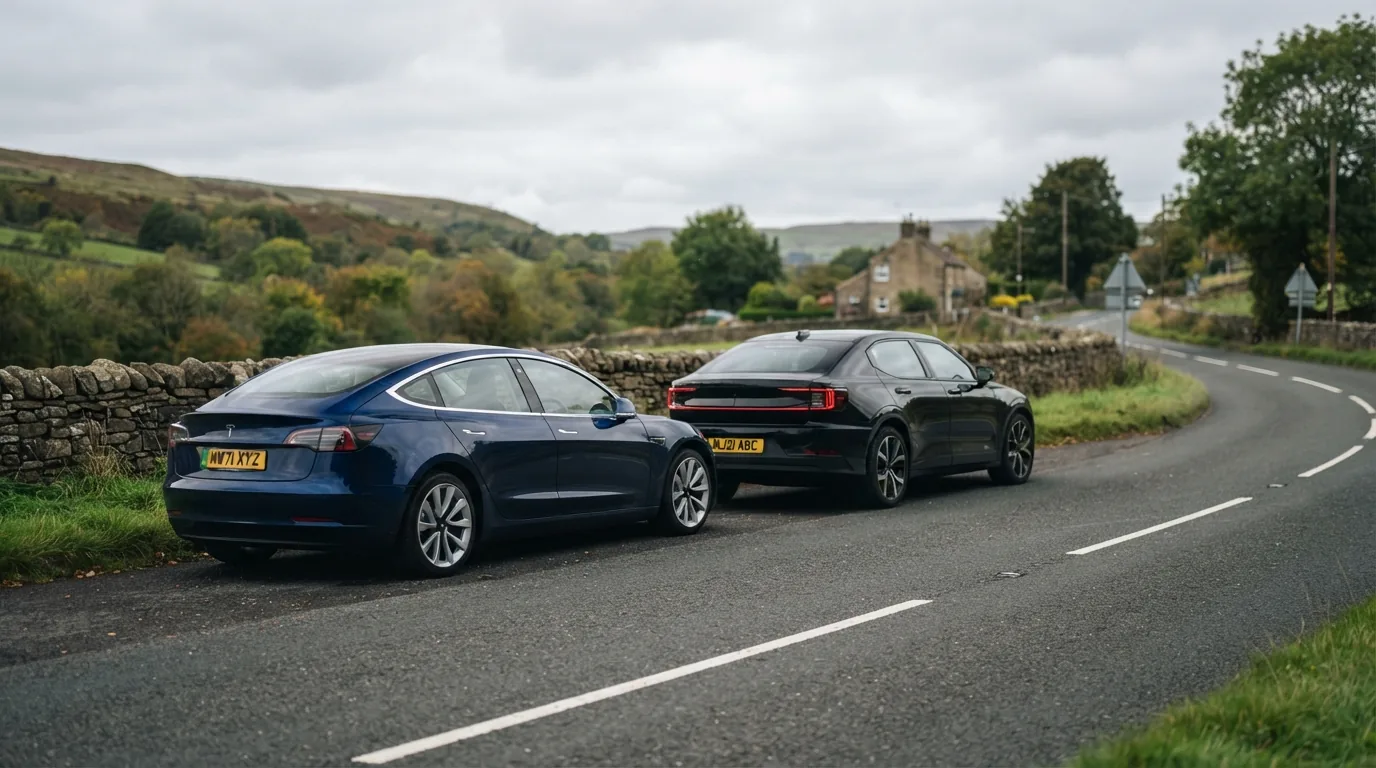
The used Tesla Model 3 and the used Polestar 2 occupy the same market space: premium electric saloons with genuine long-range capability, strong technology and an ownership experience that has defined what buyers expect from a modern EV. They have competed directly since the Polestar 2’s launch in 2020, and in the used market of 2026 they overlap significantly in price.
The verdict is not obvious. Here is a detailed comparison.
Specs and pricing
| Spec | Tesla Model 3 Long Range AWD (2021-2022) | Polestar 2 Long Range Single Motor (2021-2022) |
|---|---|---|
| Battery | 82kWh | 78kWh |
| WLTP range | 358 miles | 335 miles |
| Real-world range (mixed) | 280 to 330 miles | 260 to 300 miles |
| Max DC charging | 250 kW | 155 kW |
| Max AC charging | 11 kW | 11 kW |
| 0-62 mph | 4.4 seconds (AWD) | 6.2 seconds (single motor) |
| Boot space | 682 litres total | 405 litres (+ 41 litre frunk) |
| Typical used price (2026) | £22,000 to £30,000 | £20,000 to £28,000 |
| 3-year residual value | ~71% | ~60% |
| Battery warranty | 8yr/150,000mi | 5yr/160,000km (expired on 2021 cars) |
Range and charging: Tesla wins clearly
The Tesla Model 3 Long Range AWD delivers more real-world range and charges significantly faster. The 250 kW maximum DC charging rate (achieved at V3 Superchargers, which are the majority of Tesla’s UK network) means a 10% to 80% charge in approximately 25 minutes. The Polestar 2’s 155 kW maximum DC is capable but noticeably slower: a similar charge takes around 35 to 40 minutes on a comparable public charger.
The more important factor is the charging network. Tesla’s UK Supercharger network consists of over 1,800 stalls at more than 170 locations. Reliability is consistently higher than the public multi-network offering. Polestar 2 owners charge on the public CCS network, which has improved significantly but still has higher fault rates and less consistent availability than the Supercharger network.
For drivers who regularly make journeys over 200 miles, this difference in charging experience is meaningful. For predominantly urban or commuter drivers who home-charge daily, it is much less significant.
Build quality: Polestar leads on pre-2024 cars
This is where the Polestar 2 makes its strongest case, particularly against pre-2024 Model 3s. Polestar, as a brand emerging from Volvo’s engineering culture, has focused intensely on panel fit, material quality and interior refinement.
The Polestar 2’s dashboard and door panels use recycled materials executed to a high standard. Panel gaps are tighter and more consistent than on equivalent-year Tesla Model 3s, which had documented build quality variability in the 2020 to 2022 production period. The physical buttons and controls in the Polestar are preferred by drivers who find fully touchscreen-dependent interfaces like Tesla’s less intuitive in use.
From the 2024 Tesla Model 3 Highland update, the gap narrows substantially. But for 2021 to 2023 cars, the Polestar 2 has a clear interior quality advantage.
Software and technology: Tesla leads
Tesla’s software is the best in the consumer EV industry. Maps, navigation, charging network integration, voice control, and over-the-air updates work at a level other manufacturers have not matched. The Model 3’s energy consumption screen, charging schedule, and driving data displays are genuinely useful tools, not just features.
The Polestar 2 uses a Google-developed infotainment system with native Google Maps, Google Assistant and the Play Store. This is one of the best non-Tesla infotainment experiences available on any used EV, and significantly better than VW, BMW or Hyundai interfaces in terms of daily usability. But it still does not match the level of integration Tesla achieves with its own network and software.
Over-the-air updates: both cars receive them. Tesla’s update pace is faster and has meaningfully changed the driving experience of older cars. Polestar’s updates are less frequent and less transformative.
Depreciation and value
Tesla retains value better. The Model 3 holds approximately 71% of its original value after three years; the Polestar 2 retains approximately 60%. In absolute terms, on a car that cost £48,000 new, the Model 3 is worth roughly £34,000 after three years versus the Polestar 2 at approximately £29,000 with a similar new price.
For a used buyer this means the Polestar 2 is available at a slightly lower price point for a comparable-year car. The premium you pay for Tesla’s Supercharger access and software is real and reflected in the residual value differential.
Running costs
Both cars cost broadly similar amounts to run. Energy consumption at motorway speeds is similar. Servicing on both is minimal: no oil changes, no clutch. Tyre costs will be comparable given comparable performance and weight.
One practical difference: Polestar recommended service intervals require more dealer visits than Tesla, which recommends annual safety checks but has fewer mandatory items. Tesla’s lower servicing frequency translates to slightly lower annual running costs for owners who follow manufacturer recommendations.
Warranty: important difference
Tesla offers an 8-year/150,000-mile battery and drive unit warranty on the Model 3. For a 2021 car bought in 2026, this means three years of remaining battery warranty.
Polestar offers a 5-year/unlimited-mileage warranty on the complete vehicle, with the battery covered for 8 years but limited to 160,000 km (approximately 100,000 miles). A 2021 Polestar 2 has no remaining Polestar factory warranty in 2026. Budget for aftermarket extended warranty cover if buying a 2021 or earlier example.
The verdict
| Category | Winner |
|---|---|
| Real-world range | Tesla Model 3 |
| Charging speed | Tesla Model 3 |
| Charging infrastructure | Tesla Model 3 (significantly) |
| Build quality (2021-2022 cars) | Polestar 2 |
| Interior refinement | Polestar 2 |
| Software experience | Tesla Model 3 |
| Remaining factory warranty | Tesla Model 3 |
| Boot space | Tesla Model 3 |
| Remaining purchase price | Polestar 2 (slightly lower) |
Buy the used Tesla Model 3 Long Range if: You regularly make journeys over 150 miles, value fast and reliable charging, and want the best software experience. The Supercharger network advantage is durable and makes long-distance EV ownership significantly less stressful.
Buy the used Polestar 2 if: You primarily drive locally and home-charge, value superior interior quality and conventional build standards over Tesla’s software ecosystem, and can access a slightly lower purchase price for an equivalent-year car.
For the majority of UK buyers who make occasional longer journeys and want the most complete used EV experience, the Tesla Model 3 Long Range is the better choice. But the Polestar 2 is not a compromise: it is an excellent car for a specific buyer who knows what they want.
Where to next?
Return to the used EVs guide for the full buying framework, or browse our best used electric cars for more model comparisons and rankings.
How we test and where our numbers come from
Range figures are official WLTP combined values taken from manufacturer UK specification pages, with real-world estimates drawn from independent comparative testing. Prices are UK list prices at the time of the latest update. Tax, grant and charging-scheme figures come from GOV.UK and HMRC publications. We re-check every guide when pricing, specification or policy changes. Last checked 11 August 2026.

EV Compared
The EV Compared editorial team tracks the UK electric vehicle market full time: new model launches, list prices, WLTP and real-world range, public charging tariffs and the tax rules that decide what an EV actually costs to run. Every guide is checked against manufacturer specifications and official GOV.UK figures, and updated whenever the numbers move.
Related reading
View all
Do Bigger Wheels Reduce Electric Car Range?
Yes, significantly. Here is the data on how much wheel size costs in miles and why it happens
BMW i4 vs Tesla Model 3: UK Range and Efficiency Test
The BMW costs more and goes less far, but is it worth it? A data-led head to head for UK buyers
How Far Can an Electric Car Really Go on One Charge?
Real-world range figures for UK drivers: what the numbers mean and which cars go furthest