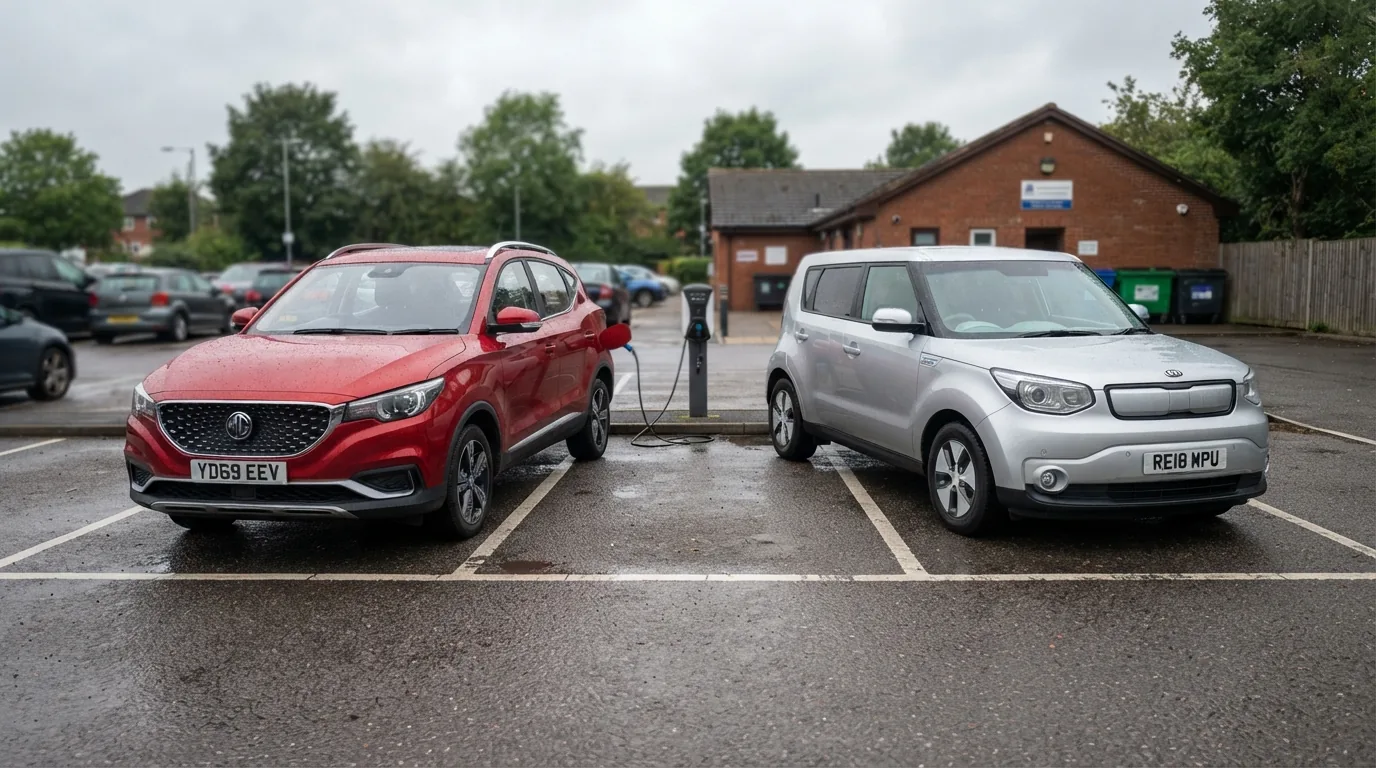
Used MG ZS EV vs Used Kia Soul EV: Budget Used SUV Showdown
Two compact electric SUVs at similar used prices compete on range, refinement, reliability and long-term cost. We pick the winner
Quick answers
- The MG ZS EV and Kia Soul EV are two of the most affordable compact electric SUVs in the UK used market. Both offer a compact SUV body, practical interior space for a small family, and real-world range that covers typical UK commuting comfortably.
- This is counterintuitive but consistent with real-world data.
- Ride quality: the Soul EV absorbs road imperfections more smoothly.
- Boot space: MG ZS EV wins significantly: The one area where the MG ZS EV comprehensively outperforms the Soul EV is boot space.
- Reliability and warranty: Both cars carry Kia's seven-year, 150,000 km warranty on the vehicle and battery.
- Running costs: Servicing: both require similar intervals and costs given comparable drivetrain architecture.
The MG ZS EV and Kia Soul EV are two of the most affordable compact electric SUVs in the UK used market. Both offer a compact SUV body, practical interior space for a small family, and real-world range that covers typical UK commuting comfortably. But they achieve this very differently, and the gap in refinement, reliability track record and long-term confidence is wider than the price difference suggests.
This comparison focuses on the most relevant variants: the MG ZS EV Long Range (72kWh, 2021 to 2023) and the Kia Soul EV 64kWh (2019 to 2022).
Head to head: specs and pricing
| Spec | MG ZS EV Long Range (2021-2023) | Kia Soul EV 64kWh (2019-2022) |
|---|---|---|
| Battery (usable) | 70kWh | 64kWh |
| WLTP range | 273 miles | 280 miles |
| Real-world range (mixed) | 195 to 230 miles | 230 to 265 miles |
| Max DC charging | 76 kW | 77 kW |
| Max AC charging | 11 kW | 7.2 kW |
| Boot space | 470 litres | 315 litres |
| Body length | 4.31 m | 4.20 m |
| Battery cooling | Liquid | Liquid |
| Typical used price (2026) | £13,000 to £18,000 | £14,000 to £19,000 |
| Warranty (original) | 7yr vehicle, 7yr battery | 7yr vehicle, 7yr battery |
Range: Kia Soul EV ahead despite smaller battery
This is counterintuitive but consistent with real-world data. Despite having a smaller 64kWh battery, the Soul EV typically covers more miles per charge than the MG ZS EV Long Range in UK driving conditions. The reason is efficiency: the Soul EV’s smaller, lower body extracts more range per kWh.
WLTP ratings suggest they are essentially equal (280 versus 273 miles), but in practice, real-world variation puts the Soul EV around 230 to 265 miles versus the MG’s 195 to 230 miles in mixed driving. At motorway speeds particularly, the MG’s larger body and higher aerodynamic drag are more apparent.
DC charging speed is nearly identical at 76 to 77 kW peak. Neither car is particularly fast to charge by modern standards, but both are adequate for a driver who primarily home-charges.
Refinement and ride quality: Soul EV wins clearly
This is where the comparison becomes unambiguous. The Kia Soul EV is significantly more refined than the MG ZS EV in the areas that matter most for daily driving comfort.
Ride quality: the Soul EV absorbs road imperfections more smoothly. On UK roads with their variable surface quality, the difference is noticeable, particularly on A-roads and B-roads. The MG ZS EV’s suspension tuning is firmer and less well-damped at low speeds.
Wind and road noise: the Soul EV is quieter on A-roads and motorways. The MG ZS EV generates noticeably more wind noise at speeds above 60 mph.
Interior quality: both cars have adequate interiors for their price points, but the Soul EV uses higher-quality materials with more consistency. The dashboard and door panels feel more considered. The MG ZS EV’s interior materials, while functional, feel more cost-engineered.
Driving feel: the Soul EV’s steering is more accurate and communicative. The MG’s power steering is light but somewhat vague in feel. Neither car is sporty, but the Soul EV rewards a driver who wants to be confident in their inputs.
Boot space: MG ZS EV wins significantly
The one area where the MG ZS EV comprehensively outperforms the Soul EV is boot space. At 470 litres with the rear seats up (versus 315 litres in the Soul EV), the MG can carry meaningfully more. This is a 49% difference in boot volume, and it is significant for families who carry pushchairs, sports equipment or regular supermarket loads.
The Soul EV’s compact rear boot is one of its genuine weaknesses relative to its body size. The external dimensions are similar between the two cars (4.31 m versus 4.20 m), but the Soul EV’s body design sacrifices boot space for its distinctive squared-off styling.
Reliability and warranty
Both cars carry Kia’s seven-year, 150,000 km warranty on the vehicle and battery. Wait: the MG ZS EV also carries a seven-year warranty? Yes, MG matched Kia’s warranty to compete directly. On paper, both cars offer equivalent warranty protection.
In practice, the Soul EV has a longer established reliability record in the UK. Kia’s service network is broader and better established across Britain, with more specialists trained on the platform. MG’s UK dealer network has grown rapidly and competently, but independent data on long-term MG ZS EV reliability is less comprehensive than for the Korean alternative.
Battery longevity data is limited for MG ZS EV Long Range models given their relative newness to the used market. The Soul EV’s 64kWh liquid-cooled battery has shown strong SoH retention in real-world UK use: most 2019 to 2021 examples show 88% to 94% SoH in 2026.
Running costs
Both cars cost broadly similarly to run. Energy consumption per mile is slightly lower in the Soul EV due to better efficiency. Insurance may be marginally lower on the Soul EV given its Kia brand positioning versus MG.
Servicing: both require similar intervals and costs given comparable drivetrain architecture. MG’s parts supply has historically been less immediately available than Kia’s in the UK, which can extend turnaround times for non-urgent work.
The verdict
| Category | Winner |
|---|---|
| Real-world range | Soul EV |
| Ride comfort | Soul EV (clearly) |
| Interior refinement | Soul EV |
| Noise levels | Soul EV |
| Boot space | MG ZS EV (significantly) |
| Purchase price | MG ZS EV (slightly cheaper) |
| Established reliability data | Soul EV |
| Dealer network depth | Soul EV |
| Efficiency | Soul EV |
Buy the used Kia Soul EV if: Ride quality, refinement and confidence in long-term reliability are your priorities. The Soul EV is the better car to live with daily, more capable on longer journeys, and backed by a deeper UK support network.
Buy the used MG ZS EV Long Range if: Boot space is genuinely important to you (470 litres is a meaningful practical advantage) and the lower entry price makes the difference between owning an EV and not. For a buyer who needs to carry a lot but cannot stretch to the Soul EV price, the MG is a viable choice.
Overall winner: Kia Soul EV 64kWh. Better range in real-world conditions, superior ride and refinement, stronger UK dealer support and a more established reliability track record. The MG ZS EV is not a bad car, but the Soul EV is the more complete package for most UK buyers at this price point.
Where to next?
Return to the used EVs guide for the full used EV buying framework, or visit our best used electric cars for our full shortlist across every budget and body type.
How we test and where our numbers come from
Range figures are official WLTP combined values taken from manufacturer UK specification pages, with real-world estimates drawn from independent comparative testing. Prices are UK list prices at the time of the latest update. Tax, grant and charging-scheme figures come from GOV.UK and HMRC publications. We re-check every guide when pricing, specification or policy changes. Last checked 11 August 2026.

EV Compared
The EV Compared editorial team tracks the UK electric vehicle market full time: new model launches, list prices, WLTP and real-world range, public charging tariffs and the tax rules that decide what an EV actually costs to run. Every guide is checked against manufacturer specifications and official GOV.UK figures, and updated whenever the numbers move.
Related reading
View all
Do Bigger Wheels Reduce Electric Car Range?
Yes, significantly. Here is the data on how much wheel size costs in miles and why it happens
BMW i4 vs Tesla Model 3: UK Range and Efficiency Test
The BMW costs more and goes less far, but is it worth it? A data-led head to head for UK buyers
How Far Can an Electric Car Really Go on One Charge?
Real-world range figures for UK drivers: what the numbers mean and which cars go furthest