Used Kia e-Niro vs Used Hyundai Kona Electric: UK Comparison
Two closely related Korean EVs compete on space, range, warranty and value in the UK used market. We pick the winner for different buyer types
Quick answers
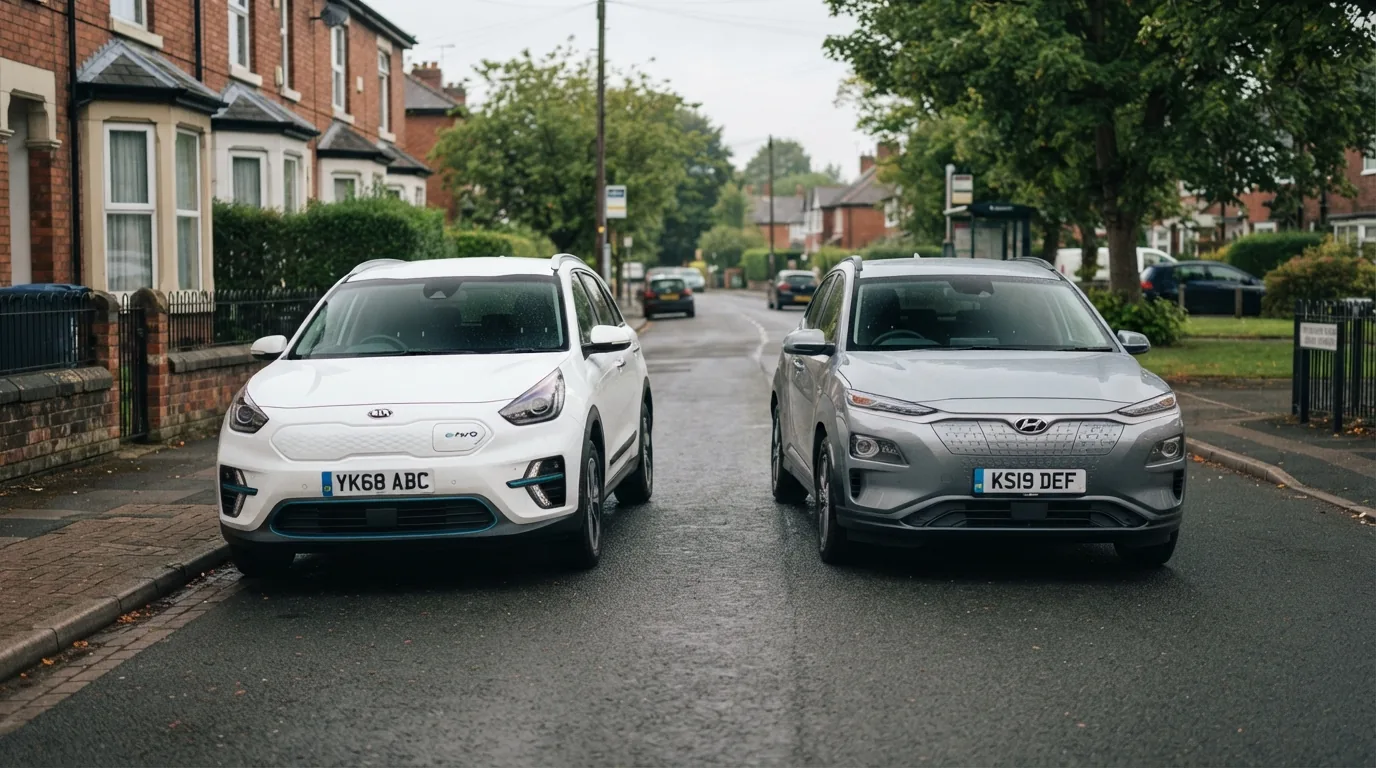
- The Kia e-Niro and Hyundai Kona Electric are siblings. They share the same corporate parent (Hyundai Motor Group), the same basic electric powertrain architecture, the same battery options and broadly the same technology.
- Both cars use identical 64kWh battery packs with the same 77 kW DC charging capability.
- The e-Niro is 150mm longer than the Kona Electric and noticeably more spacious inside.
- Kia's seven-year warranty on the e-Niro (covering both the vehicle and the battery) transfers to subsequent owners and remains one of the strongest used car value propositions in the market.
- Build quality and interior: Neither car is as sophisticated as a Tesla in terms of software.
- Reliability: Warranty claim rates for both are low, consistent with Hyundai-Kia group's strong reliability reputation in the UK market.
The Kia e-Niro and Hyundai Kona Electric are siblings. They share the same corporate parent (Hyundai Motor Group), the same basic electric powertrain architecture, the same battery options and broadly the same technology. Yet they serve different buyers well, and the used market treats them differently in terms of price and positioning.
This comparison focuses on the 64kWh variants, which are the ones most relevant to UK buyers looking for genuine long-range capability on a reasonable used EV budget.
Head to head: specs and pricing
| Spec | Kia e-Niro 64kWh (2019-2022) | Hyundai Kona Electric 64kWh (2019-2022) |
|---|---|---|
| Battery | 64kWh | 64kWh |
| WLTP range | 282 miles | 279 miles |
| Real-world range (mixed) | 240 to 270 miles | 220 to 255 miles |
| Max DC charging | 77 kW | 77 kW |
| Max AC charging | 7.2 kW | 7.2 kW |
| Boot space | 451 litres | 332 litres |
| Body length | 4.36 m | 4.18 m |
| Rear legroom | More spacious | More compact |
| Battery cooling | Liquid | Liquid |
| Typical used price (2026) | £17,000 to £23,000 | £16,000 to £21,000 |
| Kia warranty | 7yr/150,000km | N/A (Hyundai: 5yr + 8yr battery) |
| Battery warranty (Kia) | 7yr/150,000km | 8yr/200,000km (Hyundai) |
Range and efficiency: e-Niro has a slight edge
Both cars use identical 64kWh battery packs with the same 77 kW DC charging capability. On paper they are virtually identical. In real-world UK testing, the e-Niro typically covers slightly more miles per charge, partly because its larger and heavier body benefits less than you might expect from the extra weight, and partly because its aerodynamic profile is marginally better than the boxy Kona.
Real-world difference: roughly 10 to 20 miles per charge in favour of the e-Niro under similar conditions. Both cars are significantly more capable at motorway speeds than their Nissan Leaf and Renault Zoe competitors, and both handle occasional longer journeys without significant range anxiety.
Charging speed is identical. At a 77 kW DC charger, both cars can charge from 20% to 80% in approximately 47 to 54 minutes. This is adequate for most use cases but noticeably slower than the E-GMP platform (EV6, Ioniq 5) and Tesla, which matters most on longer journeys with multiple charging stops.
Space and practicality: e-Niro wins by a distance
The e-Niro is 150mm longer than the Kona Electric and noticeably more spacious inside. The boot at 451 litres is 119 litres larger than the Kona’s 332 litres. This is a substantial practical difference: a family with pushchairs, sports equipment or regular luggage will notice it immediately.
Rear legroom is meaningfully better in the e-Niro. Adults sitting behind tall adults have adequate space. In the Kona Electric, the rear seat is better suited to shorter adults or children.
The Kona Electric’s more compact dimensions (4.18 m versus 4.36 m) make it easier to park in city centres and tight residential streets. If urban manoeuvrability and parking ease matter more than cargo space, the Kona has an advantage.
Warranty: both excellent, different structures
Kia’s seven-year warranty on the e-Niro (covering both the vehicle and the battery) transfers to subsequent owners and remains one of the strongest used car value propositions in the market. A 2020 or 2021 e-Niro bought today has up to two to three years of comprehensive warranty remaining.
Hyundai’s warranty structure is different: five years on the vehicle, eight years (to 200,000 km) on the battery. The battery warranty is longer and in kilometrage terms is very generous. The vehicle warranty on a 2020 Kona expired in 2025, but the battery warranty continues. Read the terms carefully: what is covered under the battery warranty is specifically capacity retention (to 70%), not electrical faults or software issues.
Both warranty structures are substantially better than those offered by Tesla (eight years on battery/drive unit only, no whole-vehicle warranty) or many European competitors.
Build quality and interior
Both cars are well built for their price segments. The e-Niro’s interior feels slightly more premium, with better material choices in the 2020 to 2022 models. Both cars have competent infotainment systems with Apple CarPlay and Android Auto as standard. Kia’s UVO Connect and Hyundai’s Bluelink systems offer remote monitoring and charging management via smartphone.
Neither car is as sophisticated as a Tesla in terms of software. Both are solid, no-nonsense interiors that function well without asking the driver to adapt to unusual interfaces.
Reliability
Both models have very good reliability records. The e-Niro’s liquid-cooled battery has demonstrated strong SoH retention in the UK: most 2019 to 2021 examples on the used market in 2026 show 88% to 94% SoH according to fleet data and dealer health check reports. The Kona Electric’s battery is identical and shows comparable longevity.
Warranty claim rates for both are low, consistent with Hyundai-Kia group’s strong reliability reputation in the UK market.
Price comparison
The Kona Electric is typically £1,000 to £2,000 cheaper than an equivalent-year and equivalent-mileage e-Niro. This reflects the smaller body and perceived practicality difference. It is not a reflection of battery quality or reliability.
For buyers on a tight budget, the Kona Electric offers access to 64kWh Korean EV capability at a lower entry price. For buyers who prioritise practicality and plan to own the car for many years, the e-Niro’s extra boot space and legroom justify the modest price premium.
The verdict
| Category | Winner |
|---|---|
| Real-world range | e-Niro (slightly) |
| Boot space | e-Niro (significantly) |
| Rear passenger space | e-Niro |
| Urban manoeuvrability | Kona Electric |
| Purchase price | Kona Electric |
| Kia factory warranty period | e-Niro |
| Hyundai battery warranty duration | Kona Electric |
| Build quality | Tie |
Buy the used Kia e-Niro 64kWh if: You regularly carry luggage, have children, or need comfortable seating for adults in the rear. The larger boot and better space make it the more practical family car. The seven-year warranty is a meaningful bonus.
Buy the used Hyundai Kona Electric 64kWh if: You are buying on a tighter budget, primarily drive in urban conditions where the compact dimensions help, or the additional legroom of the e-Niro is not relevant to your use case.
Both are excellent used EVs and neither is a wrong choice. The e-Niro is the better all-rounder for most UK family buyers; the Kona Electric is the right choice for a more urban-focused buyer or someone prioritising the lowest possible entry price into the 64kWh Korean EV bracket.
Where to next?
Return to the used EVs guide for the full buying overview, or visit our best used electric cars for rankings across all models and price points.
How we test and where our numbers come from
Range figures are official WLTP combined values taken from manufacturer UK specification pages, with real-world estimates drawn from independent comparative testing. Prices are UK list prices at the time of the latest update. Tax, grant and charging-scheme figures come from GOV.UK and HMRC publications. We re-check every guide when pricing, specification or policy changes. Last checked 11 August 2026.

EV Compared
The EV Compared editorial team tracks the UK electric vehicle market full time: new model launches, list prices, WLTP and real-world range, public charging tariffs and the tax rules that decide what an EV actually costs to run. Every guide is checked against manufacturer specifications and official GOV.UK figures, and updated whenever the numbers move.
Related reading
View all
Do Bigger Wheels Reduce Electric Car Range?
Yes, significantly. Here is the data on how much wheel size costs in miles and why it happens
BMW i4 vs Tesla Model 3: UK Range and Efficiency Test
The BMW costs more and goes less far, but is it worth it? A data-led head to head for UK buyers
How Far Can an Electric Car Really Go on One Charge?
Real-world range figures for UK drivers: what the numbers mean and which cars go furthest