Used BMW i3 vs Used Volkswagen e-Golf: Which Is Better Now?
Two pioneering European EVs compared in the 2026 used market. They cost similar money but offer very different experiences
Quick answers
- The BMW i3 and the Volkswagen e-Golf arrived in the UK within a year of each other. Both were earnest attempts by major European manufacturers to bring electric cars to a mainstream audience.
- Range: i3 has a clear advantage: The i3 120Ah delivers around 140 to 165 miles in mixed real-world UK driving.
- This is the most important qualitative difference between the two cars.
- Battery longevity: both good, i3 has edge: Both cars use liquid-cooled batteries, which is a significant advantage over the Nissan Leaf and Renault Zoe at comparable prices.
- Reliability: e-Golf edges it: The i3 has slightly more idiosyncratic components: the carbon fibre body is unusual, the rear-hinged doors have documented issues with hinge wear on higher-mileage examples, and specialist knowledge is helpful (though not essential) for some repairs.
- The Range Extender (REX) version: Some i3s were sold with a small 650cc two-cylinder petrol engine as a range extender, intended to generate electricity and extend range by 60 to 80 miles.
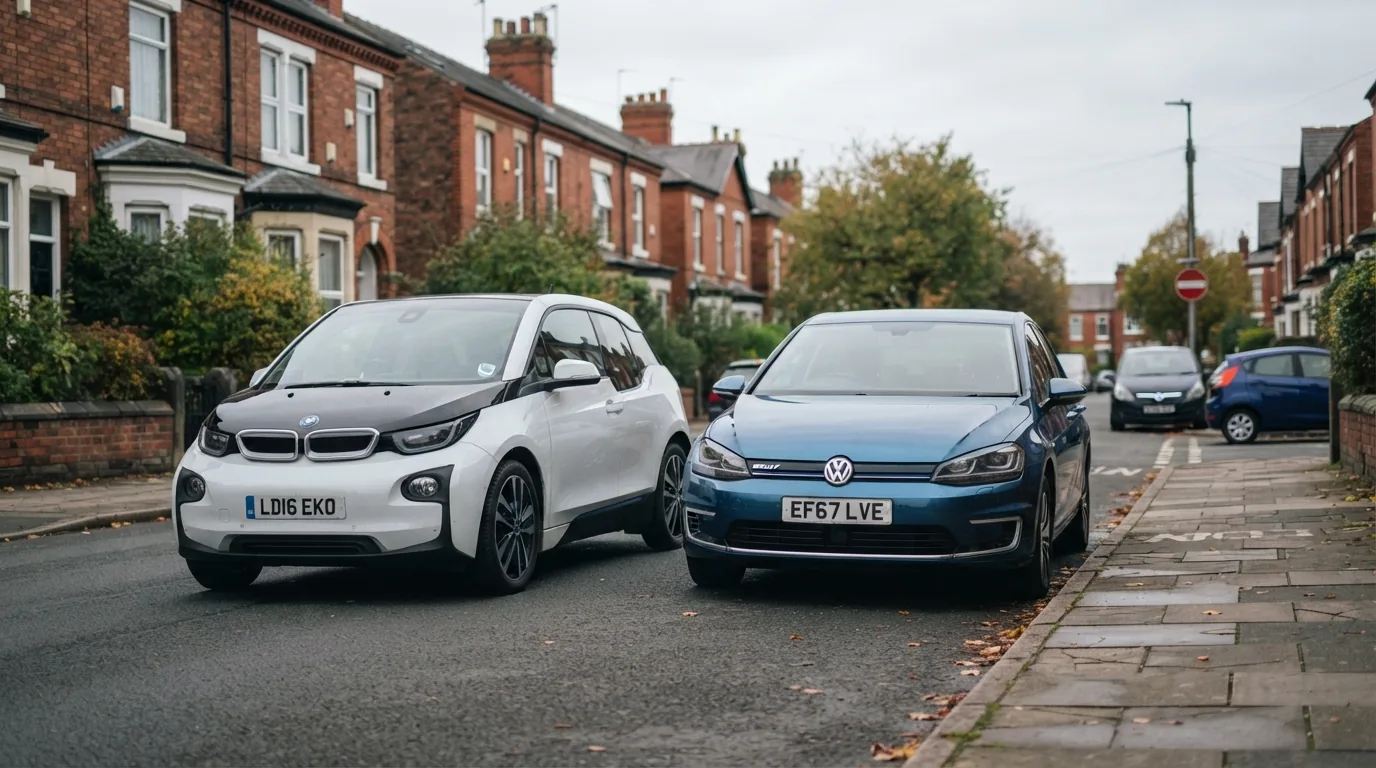
The BMW i3 and the Volkswagen e-Golf arrived in the UK within a year of each other. Both were earnest attempts by major European manufacturers to bring electric cars to a mainstream audience. Both are now available in the used market at prices that make them genuinely accessible. And they could hardly be more different in philosophy and character.
This comparison focuses on the later, more capable variants: the BMW i3 120Ah (42.2kWh) and the Volkswagen e-Golf 35.8kWh, which represent the versions most buyers will find in the UK used market.
Head to head: specs and pricing
| Spec | BMW i3 120Ah (2019-2022) | Volkswagen e-Golf 35.8kWh (2017-2020) |
|---|---|---|
| Battery (usable) | 37.9kWh | 32.8kWh |
| WLTP range | 189 miles | 144 miles |
| Real-world range (mixed) | 140 to 165 miles | 110 to 140 miles |
| Max DC charging | 50 kW | 40 kW |
| Max AC charging | 11 kW | 7.2 kW |
| Boot space | 260 litres (1,100 with seats folded) | 341 litres (1,231 with seats folded) |
| Body weight | ~1,195 kg | ~1,510 kg |
| Body length | 3.99 m | 4.26 m |
| Battery cooling | Liquid | Liquid |
| Typical used price (2026) | £9,000 to £14,000 | £8,500 to £12,500 |
Range: i3 has a clear advantage
The i3 120Ah delivers around 140 to 165 miles in mixed real-world UK driving. The e-Golf covers 110 to 140 miles from its smaller 35.8kWh battery. That is a meaningful gap in a price bracket where every mile matters.
The i3’s advantage is amplified by its lower weight. At approximately 1,195 kg, it weighs 315 kg less than the e-Golf. This translates into better efficiency at all speeds: the i3 extracts more miles per kWh from its larger battery, compounding the advantage.
At motorway speeds the difference is particularly noticeable. The e-Golf’s range drops more sharply above 65 mph due to its higher aerodynamic drag. The i3’s narrow, tall profile is not ideal aerodynamically either, but its low weight compensates.
The e-Golf’s 40 kW maximum DC charging (versus the i3’s 50 kW) means slower rapid-charging stops as well. For buyers who occasionally need to charge en route, this matters.
Driving character: very different approaches
This is the most important qualitative difference between the two cars.
The BMW i3 is a driver’s car in a way that its modest specification suggests it should not be. Its light weight, rear-wheel drive layout, near-perfect weight distribution and taut (firm) suspension create a genuinely engaging urban drive. It is agile and responsive, with direct steering and strong regenerative braking. The i3’s one-pedal driving via the B mode is one of the best regen implementations of any used EV.
The rear-hinged back doors and high seating position are genuinely practical features rather than quirks. The interior uses interesting sustainable materials, bamboo and recycled plastics that are executed to a quality level unusual in this price bracket.
The Volkswagen e-Golf is a very different experience: calm, refined and conventional. It feels like what it is: a well-executed electric version of one of Europe’s most popular hatchbacks. The ride is comfortable, the steering is light and accurate, and there is very little to distinguish the driving experience from a competent petrol Golf except for the silence and the torque response. For a driver coming from a petrol car who wants maximum familiarity, this is a strength.
The e-Golf’s interior is large-scale Golf: good ergonomics, logical layout, quality materials. The boot at 341 litres is larger than the i3’s 260 litres, making it more practically useful as a family car.
Battery longevity: both good, i3 has edge
Both cars use liquid-cooled batteries, which is a significant advantage over the Nissan Leaf and Renault Zoe at comparable prices. Liquid cooling slows degradation meaningfully, particularly under rapid charging and in varying temperature conditions.
The i3’s battery longevity record is genuinely impressive. Used examples from 2017 to 2019 regularly show 87% or higher SoH in 2026, nine or more years after manufacture. The battery management system is sophisticated and has protected the cells well over time.
The e-Golf’s liquid cooling is similarly effective. The 35.8kWh battery ages gracefully under typical UK driving conditions. Both cars should be checked with an OBD2 tool before purchase, but neither carries the battery anxiety associated with air-cooled models.
Reliability: e-Golf edges it
Both cars are generally reliable. The e-Golf benefits from Volkswagen’s well-understood conventional hatchback architecture: apart from the electrical drivetrain, the car is mechanically conventional and widely supported by the VW dealer network across the UK. The e-Golf’s most common issues are minor electrical components and occasional software updates rather than fundamental drivetrain failures.
The i3 has slightly more idiosyncratic components: the carbon fibre body is unusual, the rear-hinged doors have documented issues with hinge wear on higher-mileage examples, and specialist knowledge is helpful (though not essential) for some repairs. BMW’s dealer network handles the i3 competently, but independent specialist knowledge is less common than for the Golf.
The Range Extender (REX) version
Some i3s were sold with a small 650cc two-cylinder petrol engine as a range extender, intended to generate electricity and extend range by 60 to 80 miles. REX cars are interesting but add complexity: the petrol engine requires its own servicing, insurance in some cases, and occasional petrol (a tiny tank). For a used buyer, a pure electric i3 is simpler unless you specifically need the REX for a particular journey pattern.
Which should you buy?
| Category | Winner |
|---|---|
| Real-world range | i3 (significantly) |
| Charging speed | i3 |
| Driving engagement | i3 |
| Ride comfort | e-Golf |
| Boot space | e-Golf |
| Interior practicality | e-Golf |
| Conventional usability | e-Golf |
| Purchase price | e-Golf (slightly cheaper) |
| Battery longevity | i3 (slight edge) |
| Dealer network support | e-Golf |
Buy the used BMW i3 120Ah if: You want a distinctive, engaging urban EV with better range and charging than the e-Golf, are drawn to the unusual and sustainably produced interior, and do not need a big boot. The i3 is the more rewarding car to own and drive.
Buy the used Volkswagen e-Golf if: You want the most seamless transition from a petrol hatchback to an EV, prioritise conventional comfort and ergonomics, and value the broader VW dealer support network. The e-Golf is the more conventional and practical choice.
Overall winner: The i3 120Ah. Its superior range, better charging speed, engaging driving character and exceptional battery longevity give it a clearer long-term proposition in the used EV market. The e-Golf is a fine car but its smaller battery and slower charging speed make it feel more dated than the i3 despite their similar ages.
Where to next?
Return to the used EVs guide for the full used EV buying framework, or browse our best used electric cars for rankings across all price points.
How we test and where our numbers come from
Range figures are official WLTP combined values taken from manufacturer UK specification pages, with real-world estimates drawn from independent comparative testing. Prices are UK list prices at the time of the latest update. Tax, grant and charging-scheme figures come from GOV.UK and HMRC publications. We re-check every guide when pricing, specification or policy changes. Last checked 11 August 2026.

EV Compared
The EV Compared editorial team tracks the UK electric vehicle market full time: new model launches, list prices, WLTP and real-world range, public charging tariffs and the tax rules that decide what an EV actually costs to run. Every guide is checked against manufacturer specifications and official GOV.UK figures, and updated whenever the numbers move.
Related reading
View all
Do Bigger Wheels Reduce Electric Car Range?
Yes, significantly. Here is the data on how much wheel size costs in miles and why it happens
BMW i4 vs Tesla Model 3: UK Range and Efficiency Test
The BMW costs more and goes less far, but is it worth it? A data-led head to head for UK buyers
How Far Can an Electric Car Really Go on One Charge?
Real-world range figures for UK drivers: what the numbers mean and which cars go furthest